Adverse media findings are the conclusions an analyst records at the end of a review: which stories were about the customer, what each alleges, at what stage, from which source, and what the bank should do about it. A finding is only as good as the reasoning a second person can follow, because relevance is a judgement, not a lookup: two careful analysts can read the same article and disagree on whether it is about the customer, whether it matters, or how much. The useful test is therefore agreement. Have two analysts read the same reviews blind, count where they diverge, and fix the cause. Botminds' Adverse Media Screening builds a second person into every finding: an analyst confirms a story with a reason code, a different person accepts it into the customer file, and every sentence the file relies on is cited in its original language.
The examples come from a fictional sample bank as it runs through the solution, Corvane National Bank, and one EDD refresh for a director of a high-risk client. The agreement figures in the worked example are illustrative, not measured. The enforcement and research are real and linked where they appear.
What an adverse media finding should say, every time
- What was searched
Name forms, languages, sources and years, so a nil result means something.
- Why the story is about the customer
The identifiers that agree and any that conflict, each dated to the article.
- What it alleges, in the source’s own words
The sentence that carries the allegation, quoted in the original language, with the translation the analyst relied on.
- How far it has gone
Allegation, investigation, charge, conviction or acquittal, and whether anyone has denied it.
- Why the source is credible
The outlet, whether others carry the story, and anything that weakens it.
- What follows, and who decided
Into the file or not, the rating effect, any referral, and the names of the maker and the checker.
What should an adverse media finding say?
It should say what the story alleges, why it is about this customer, how far it has gone, why the source can be believed and what the bank will do, and point to the sentence each claim rests on. The Wolfsberg Group, a standards body formed by global banks, asks for procedures that make analysts record the outcome and rationale of every alert they decide, matches and false positives alike, and for an escalation process for positive matches (Wolfsberg Group, Negative News Screening FAQs, 2022).
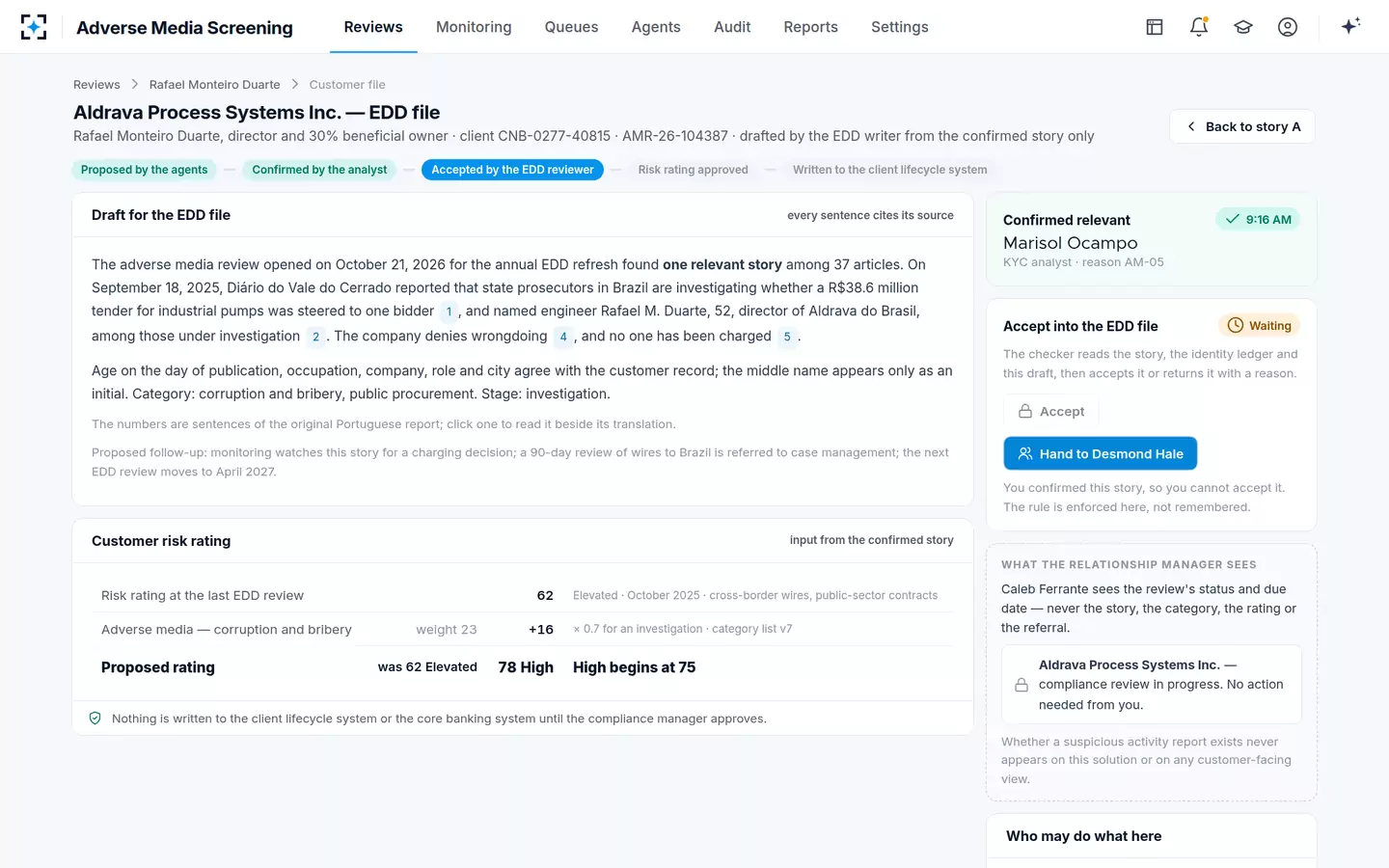
The sample bank's EDD paragraph shows the standard in practice. It reads, in part: "On September 18, 2025, Diário do Vale do Cerrado reported that state prosecutors in Brazil are investigating whether a R$38.6 million tender for industrial pumps was steered to one bidder, and named engineer Rafael M. Duarte, 52, director of Aldrava do Brasil, among those under investigation. The company denies wrongdoing, and no one has been charged." Each clause carries the number of the sentence in the Portuguese original it comes from, and a second paragraph states which identifiers agree, that the middle name appears only as an initial, the category and the stage.
Two things in that paragraph are easy to leave out and expensive to miss. The denial and the absence of charges are part of the finding, not a softening of it: they are what the stage means. And the identity reasoning is in the file, not in the analyst's head, so a reviewer a year later can see why this Rafael Duarte, and not the footballer or the realtor with the same name, is the customer.
Would two analysts reach the same conclusion?
Often, but not reliably, and a bank does not know how often until it measures. Adverse media decisions rest on judgement at three points: identity, where the evidence is whatever the journalist chose to print; relevance, where the policy's categories and exclusions are never complete; and severity, where the same allegation can be weighed differently. Wolfsberg acknowledges the problem directly, describing a tiered model in which hard alerts go to specialists because of the subjective nature of negative news.
Enforcement shows where unexamined judgement leads. FinCEN's 2026 consent order with UBS Financial Services found that "For the negative news that UBSFS considered, UBSFS did not appropriately explain or justify how it dispositioned this news" (FinCEN, Consent Order 2026-02). Among its failures FinCEN listed "not reasonably analyzing the negative news that UBSFS identified". The firm's analysts reached conclusions; the trouble was that nobody could see how, and a second reader would not have reached the same ones.
What makes an adverse media finding defensible?
A finding is defensible when a second reader, given the same cited sentences and identity tests, reaches it without the first reader's help. That excludes most of the dismissals regulators quote back at banks, because they assert a conclusion instead of showing one.
How negative news was dismissed at UBS, and what a defensible finding says instead
What FinCEN found: The adverse news about how the customers’ owner began amassing his wealth "are only speculations and there have been no legal proceeding filed against [him]."
A finding a second analyst could sign: States the allegation, its sources and how persistently it is reported, and treats the lack of proceedings as a stage, not a verdict.
What FinCEN found: The adviser concluded the allegations were not credible and recommended the firm "disregard these [negative news] articles altogether."
A finding a second analyst could sign: Names who assessed credibility and on what evidence; an adviser with the relationship is not an independent reviewer.
What FinCEN found: A 2012 weapons-shipment story and a 2015 Iran-linked investment story; "UBSFS personnel failed to further investigate or escalate either piece of negative news".
A finding a second analyst could sign: Records each story, its stage and its link to the customer, and routes anything touching sanctions to the sanctions team.
The common thread on the left is a missing reason. "Only speculations" says nothing about the sources; "disregard these articles" says nothing about who checked them. European supervisors have written the counter-rule into guidance: a lack of convictions alone may not justify dismissing an allegation. A defensible finding can still conclude that a story does not change the relationship, but it says why, in terms a second reader can test.
How do you measure agreement between two analysts?
Take a sample of closed reviews, give them to a second analyst without the first analyst's conclusions, and compare the two sets of decisions, separately for identity, relevance and stage. Count the share on which they agree, and correct it for agreement that would happen by chance, because most reviews are easy and both readers will mark them "nothing relevant".
The correction matters. As McHugh's review of the kappa statistic explains, "In 1960, Jacob Cohen critiqued use of percent agreement due to its inability to account for chance agreement", and introduced kappa, which runs from below zero to 1, with 0 the agreement chance alone would produce (McHugh, Biochemia Medica, 2012). The same review notes that "many texts recommend 80% agreement as the minimum acceptable interrater agreement", and warns that the usual kappa labels may be too lenient.
Agreement between two analysts on 50 reviews, corrected for chance
Observed agreement
Reviews both marked the same ÷ all reviews
Both relevant on 8, both not relevant on 36: 44 ÷ 50 = 0.88.
Chance agreement
Sum of each analyst’s rates, multiplied, per outcome
Analyst 1 marks 12 relevant (0.24), analyst 2 marks 10 (0.20): 0.24 × 0.20 + 0.76 × 0.80 = 0.656.
Cohen’s kappa
(observed − chance) ÷ (1 − chance)
(0.88 − 0.656) ÷ (1 − 0.656) = 0.65.
Read the example as a warning about raw percentages. Six disagreements in fifty reviews sounds like a well-run team. But on the reviews that matter, the ones where at least one analyst found something relevant, the two agreed on 8 of 14. A quality program that reports only percent agreement will look healthy while the hard decisions drift.
Where readers diverge: identity, relevance, severity
Measure the three decisions separately, because each kind of disagreement has a different cause and a different fix. Disagreement on identity is usually a method problem: ages compared with today's age instead of the age on the day, partial names treated as conflicts, a namesake set aside without a test. Disagreement on relevance is usually a policy problem: a category or exclusion the procedure never settled, such as whether a regulatory penalty or a civil suit counts. Disagreement on severity is usually a calibration problem: the same investigation weighed heavily by one analyst and lightly by another.
What a kappa level means: the share of decisions that are reliable
By that scale, the illustrative team's 0.65 on relevance is moderate: good enough to show the procedure works, not good enough to stop measuring. The fix is rarely more training in general. It is a sharper rule for the specific decisions that split the readers, written into the procedure and then measured again.
How do you QA adverse media reviews?
Use two controls: a check before each decision is final, and a sample of closed decisions tested afterwards. Wolfsberg puts it precisely: "QC is performed as a preventative control (pre-alert outcome determination), while QA is deemed a detective control (post-alert outcome determination). A strong control framework will contain elements of both." On sampling it adds that, where resources allow, "a statistical based sampling should be viewed as the target approach."
Its list of QA tests is a useful starting point, and two items are the ones most often skipped. One is reconciliation: "Monitoring of the screening population to certify that the total number of alerts generated matches the total of alerts worked on", which catches reviews that silently fell out of a queue. The other is the test of what was set aside: "Monitoring and testing of the false positive alert population to ensure there are no missed true matches." A QA program that samples only confirmed findings never sees the namesake that was the customer after all.
Wolfsberg's management information list ends with a number that keeps the whole exercise honest: "The relationships reviewed and exited by the FI due to NNS." A program that reviews thousands of customers and never changes a rating or exits a relationship is either screening a very clean book or not reading what it finds.
The finding as the reviewer sees it: cited sentences, then the rating input
When does a finding go to EDD or investigations?
A finding goes to the EDD file when it is about the customer and relevant; it goes to investigations when it suggests the money passing through the account may itself be suspect; and it goes to the sanctions team the same day if it touches a designation. Those are different owners, and the procedure should name each. At UBS, part of what FinCEN faulted was the missing second step: news found, and then neither investigated further nor escalated.
On the sample review, the finding went three ways at once. The story went into the EDD file; the customer's rating moved from Elevated 62 to High 78, approved by the compliance manager with a decision to retain the relationship with conditions; and a 90-day review of the customer's wires to Brazil was referred to case management, visible to the BSA unit only. The relationship manager saw only that a compliance review was in progress. Monitoring now watches the story for a charging decision, and the next EDD review moved to April 2027.
How do I write the rationale?
Write it for a reader who has not seen the articles: what the source says, quoted; why it is the customer, with the identifiers; what stage it is at, in the source's words; and what you concluded and why. Five habits make the difference.
Quote, then interpret, and keep the two apart. Cite the original-language sentence, not a paraphrase of a machine translation. Name the stage the source names: "investigating", "charged", "acquitted". Say what is not known as plainly as what is: no one has been charged, the company denies it. And never close with a conclusion that has no reason attached, such as "no formal negative news", "speculation" or "not credible", unless the next sentence says why.
How Adverse Media Screening keeps two people on every finding
The solution makes the second reader structural. The analyst confirms a story with a reason code, and Confirm stays disabled until one is chosen; rejecting a proposal asks for a note. The analyst then becomes the maker, and Accept is locked for her: a different person, the EDD reviewer, reads the identity tests and the cited draft and accepts it or returns it with a reason. Any rating change needs the compliance manager.
Every decision on the trail: who, what, when, why and the evidence
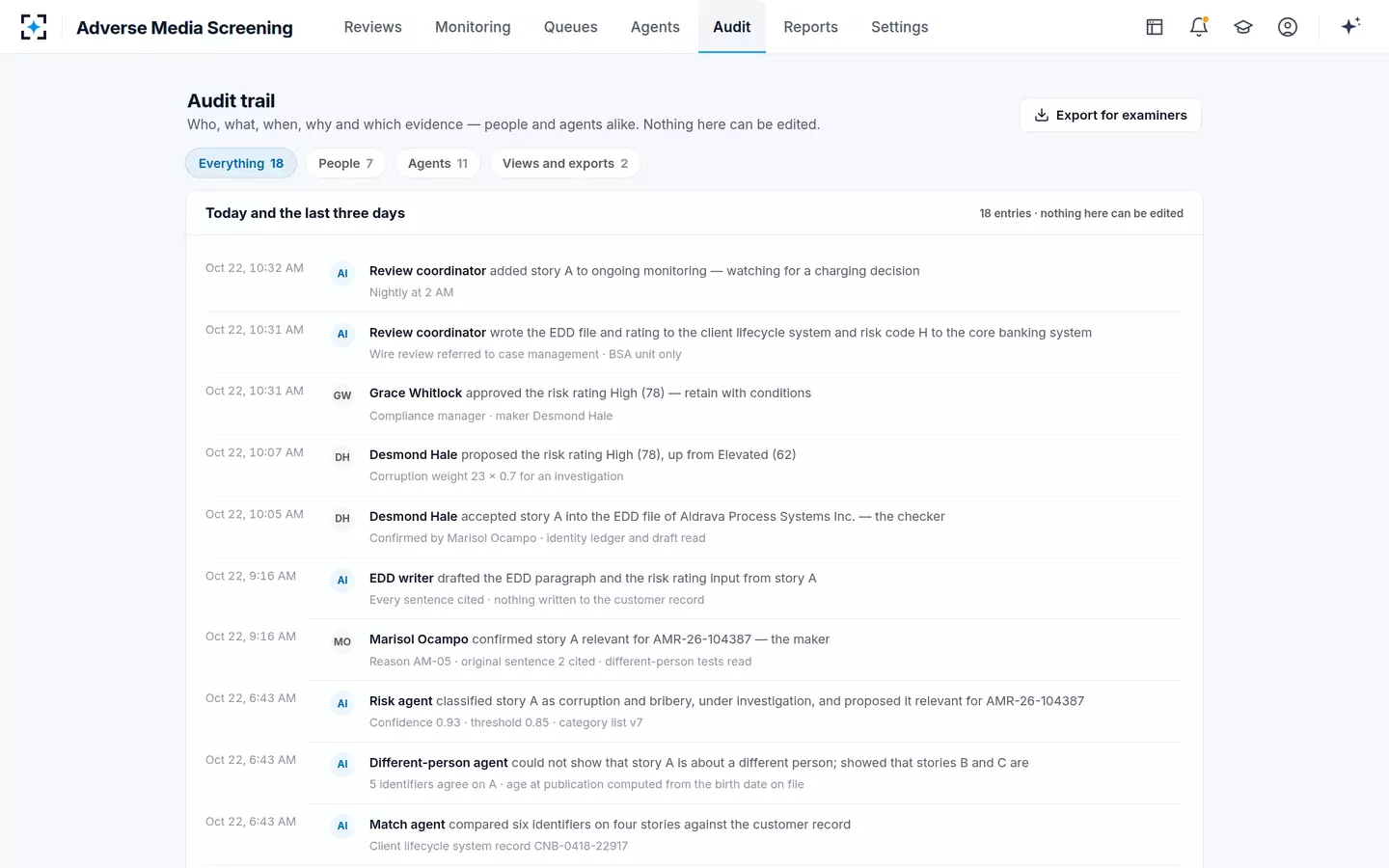
The same design gives a quality team its sample. Reviews where every story was another person or not adverse can be confirmed in bulk, but a random 5% go to a second analyst first, which is exactly the population Wolfsberg asks banks to test for missed matches. Every override carries a reason code, and the examiner pack reports where people disagreed. To see the finding, the trail and the rating together, start from Adverse Media Screening; how the analyst gets to a finding at all is in what an adverse media hit means.
Questions people ask
What does "adverse media findings" mean?
It means the conclusions recorded at the end of an adverse media review: which stories were about the customer, what they allege, at what stage, and what the bank decided to do. A finding of "nothing relevant" is a finding too, and needs the same record of what was searched and why each story was set aside.
Should an adverse media finding include the article itself?
It should cite the sentence it relies on, in the original language, and keep a copy, because online articles can be changed or removed. Listing every copy of the story under the original also shows that nothing was dropped. A screenshot of a search results page is not a substitute.
What is a reason code in adverse media screening?
A short, standard label for why a decision was made, such as relevant and under investigation with no charge. Reason codes make decisions countable, so a quality team can compare analysts and spot drift. In the sample bank, the analyst's confirmation carried AM-05, "relevant, under investigation, no charge", and a rejected proposal records AM-07 with a note.
How big should an adverse media QA sample be?
Big enough to measure the decisions that matter, not only the easy ones. Wolfsberg prefers statistical sampling where resources allow. Oversampling reviews with a relevant or unsure story, and including a random share of "nothing relevant" reviews, tests both kinds of error.
Can an adverse media finding change later?
Yes, and it should. A story moves from investigation to charges or to acquittal, and the finding's stage and weight should move with it. Ongoing monitoring that adds new articles to the story already on file, rather than opening a new alert, keeps one finding up to date instead of several in conflict.