Adverse media screening, also called negative news screening, is the search of public information (news reports, court records, regulatory notices) for signs that a customer or its owners are involved in financial crime: money laundering, corruption, fraud, terrorism, sanctions evasion or tax crime. Banks run it before onboarding a higher-risk customer, when they refresh an enhanced due diligence (EDD) file, and when an event calls for a fresh look. In the United States no rule requires adverse media screening by name. The FFIEC examination manual asks each bank to decide "on the basis of risk" whether and when "negative media search programs" are appropriate, and a bank that decides they are must then do them well. The search is the easy part; the reading is hard, because a name returns copies of one report, namesakes and stories in other languages. Botminds' Adverse Media Screening uses agents to search every language tied to a customer, group the copies into stories and challenge every match, and leaves each decision to two named people.
The examples on this page come from a fictional sample bank as it runs through the solution, Corvane National Bank; its customers, the articles and the people are invented. The rules and enforcement cases are real and linked where they appear.
Adverse media screening on one card: what is searched, for which crimes, at which stage
Definition
“information available in the public domain which FIs would consider relevant to the management of Financial Crime risk”
Also called negative news, negative media or adverse news.
Risk categories (examples)
- Money laundering
- Terrorism and terrorist financing
- Bribery and corruption
- Organised crime
- Drug trafficking
- Human trafficking
- Wildlife trafficking
- Proliferation and its financing
- Tax evasion
Stage of the event
- Allegation
- Investigation
- Charges
- Conviction
An alert at the allegation stage comes early and often; at conviction, late and rarely.
Public sources
Online news outlets, court records, regulatory disclosures, penalty notices.
Often excluded
Matters with no tie to financial crime, such as speeding fines and public disorder offences.
What is adverse media screening in AML?
In anti-money laundering (AML) work, adverse media screening is one input to customer due diligence: it tells the bank what the public record says about who it is dealing with, which a customer's own forms never will. The Wolfsberg Group, a standards body formed by global banks, defines negative news as "information available in the public domain which FIs would consider relevant to the management of Financial Crime risk", and lists the public domain as "media sources from online news outlets, court records, regulatory disclosures, penalty notices" (Wolfsberg Group, Negative News Screening FAQs, 2022).
The definition is deliberately about relevance, not tone. A customer quoted in an article about a contract award is in the news, and the story is not adverse. A director named in a procurement investigation is in adverse news even though nothing has been proven. The job is to find the second kind of story, decide whether it is about this customer, and decide how much it matters, which is where most of the effort goes.
Wolfsberg names five ways the result is used: revealing involvement in crime that may justify more due diligence or "targeted reviews of past transactional activity"; informing the customer's risk rating; acting as a trigger for fresh due diligence; supporting investigations of suspicious activity; and testing a customer's source of wealth story. The first two are the everyday ones.
Is adverse media the same as negative news?
Yes. Adverse media, negative news, negative media and adverse news name the same check. Wolfsberg says so directly: negative news "is also referred to as Adverse Media, Negative Media or Adverse News." The FFIEC manual says "negative media search programs", FinCEN's consent orders say negative news, and the European Banking Authority says adverse media. A procedure can use any of them, as long as it uses one consistently.
The term to keep separate is reputational risk. Wolfsberg describes it as "the risk of negative public perception with respect to the FI's association with a customer", which may or may not have anything to do with financial crime. A bank can satisfy itself, after enhanced due diligence, that an allegation of money laundering is false and still face the reputational question; Wolfsberg says that element "should therefore be assessed and considered in its own right".
Is adverse media screening required in the US?
No US statute or regulation requires adverse media screening by name. What the rules require is risk-based customer due diligence, and the examination manual leaves it to each bank to decide when a negative media search is part of that. Banks should say this plainly in their procedures, because the decision itself is what examiners test.
The rule is FinCEN's customer due diligence requirement. A bank's AML program must include "Appropriate risk-based procedures for conducting ongoing customer due diligence", including understanding each relationship "for the purpose of developing a customer risk profile" and, "on a risk basis", maintaining and updating customer information (31 CFR 1020.210). It does not mention the news.
The FFIEC examination manual fills in the expectation. "Consistent with the risk-based approach, the bank should do more in circumstances of heightened risk", and "The bank should establish policies and procedures for determining whether and/or when, on the basis of risk, obtaining and reviewing additional customer information, for example through negative media search programs, would be appropriate." It also lists "Results of negative media search programs" among the reasons to review a relationship, and says ongoing monitoring "does not impose a categorical requirement that the bank must update customer information on a continuous or periodic basis" (FFIEC BSA/AML Examination Manual, Customer Due Diligence).
So the US obligation is a decision, documented: which customers get a negative media search, when, and how deep. For a bank with private banking clients, foreign correspondents or cash-intensive businesses, that decision will rarely be "none". For a small bank with a local retail book, a narrow program may be defensible, and what a free, manual approach really costs is worked through separately.
Who says what about adverse media screening, and how binding it is
| Source | What it says | Status |
|---|---|---|
| FinCEN CDD rule, 31 CFR 1020.210 | Risk-based ongoing due diligence to build a customer risk profile and keep customer information current. No mention of media. | US regulation |
| FFIEC BSA/AML Examination Manual | Decide “on the basis of risk” when negative media searches are appropriate; their results are a reason to review a relationship. | US examiner guidance |
| FATF Recommendations, note to R.10 | An example of enhanced due diligence: more information on the customer, including “information available through public databases, internet, etc.” | International standard; examples “for guidance only” |
| EBA ML/TF Risk Factors Guidelines | Adverse media reports are a customer risk factor; “adverse media searches” are an example of enhanced due diligence. | Guidelines to EU banks |
| Wolfsberg Negative News Screening FAQs | Definition, risk categories, stages, sources, frequency, quality assurance. | Industry standards guidance, not a rule |
What FATF and the EU say about adverse media
The international standard mentions public information only as an example. The interpretive note to FATF Recommendation 10 lists, among enhanced due diligence measures for higher-risk relationships, "Obtaining additional information on the customer (e.g. occupation, volume of assets, information available through public databases, internet, etc.)", and the same note says its examples "are not mandatory elements of the FATF Standards, and are included for guidance only" (FATF Recommendations, February 2025). Wolfsberg reads it the same way: FATF does "not explicitly refer to NNS".
European supervisors are more explicit. The European Banking Authority's risk factor guidelines tell firms to consider "information from credible and reliable open sources, such as reports in reputable newspapers", and list as a customer risk factor: "Are there adverse media reports or other relevant sources of information about the customer, for example are there any allegations of criminality or terrorism against the customer or the beneficial owner? If so, are these reliable and credible?" For banks, enhanced due diligence may include "carrying out open source or adverse media searches or commissioning a third party intelligence report" (EBA/GL/2021/02).
The EBA adds the sentence most worth pinning above an analyst's desk: "the absence of criminal convictions alone may not be sufficient to dismiss allegations of wrongdoing." A bank with operations in the EU works to that standard there, whatever its US procedures say.
What counts as adverse media?
Adverse media is a story that links a customer, an owner or a controller to a financial crime the bank has chosen to screen for, from a source the bank considers credible, at a stage the bank has chosen to be alerted on. All three choices belong to the bank, and each changes what counts.
The crime. Wolfsberg's examples are "Money Laundering, Terrorism/Terrorist Financing, Bribery and Corruption, Organised Crime, Drug Trafficking, Human Trafficking, Wildlife Trafficking, Proliferation and Proliferation Financing, and Tax Evasion". A bank may add others, such as fraud, sanctions evasion or regulatory action; the sample bank in this guide screens eleven categories. Matters with no financial-crime link can be left out: Wolfsberg's examples are "speeding fines and public disorder offences".
The source. The EBA asks banks to judge credibility by the quality and independence of the source and how persistently a story is reported. Wolfsberg treats editorial oversight, political independence and corroboration as marks of a good source, and content "corroborated from social media" or "opinion-based" as warning signs.
The stage. An allegation, an investigation, charges and a conviction are different points in the life of the same event, and an acquittal is a fifth. Alerting at the allegation stage produces more alerts than alerting at conviction, Wolfsberg notes, and a bank that alerts only on convictions will learn about its customers years late.
When is adverse media screening done?
Adverse media screening is done at four moments: before a higher-risk customer is onboarded, at each periodic refresh of an EDD file, when a trigger event calls for a fresh look, and continuously for the customers a bank chooses to monitor. Wolfsberg's list of possible frequencies runs from "daily, weekly, monthly, quarterly, annually" to "whenever CDD/EDD is conducted, including onboarding, triggered event, periodic, on-going basis".
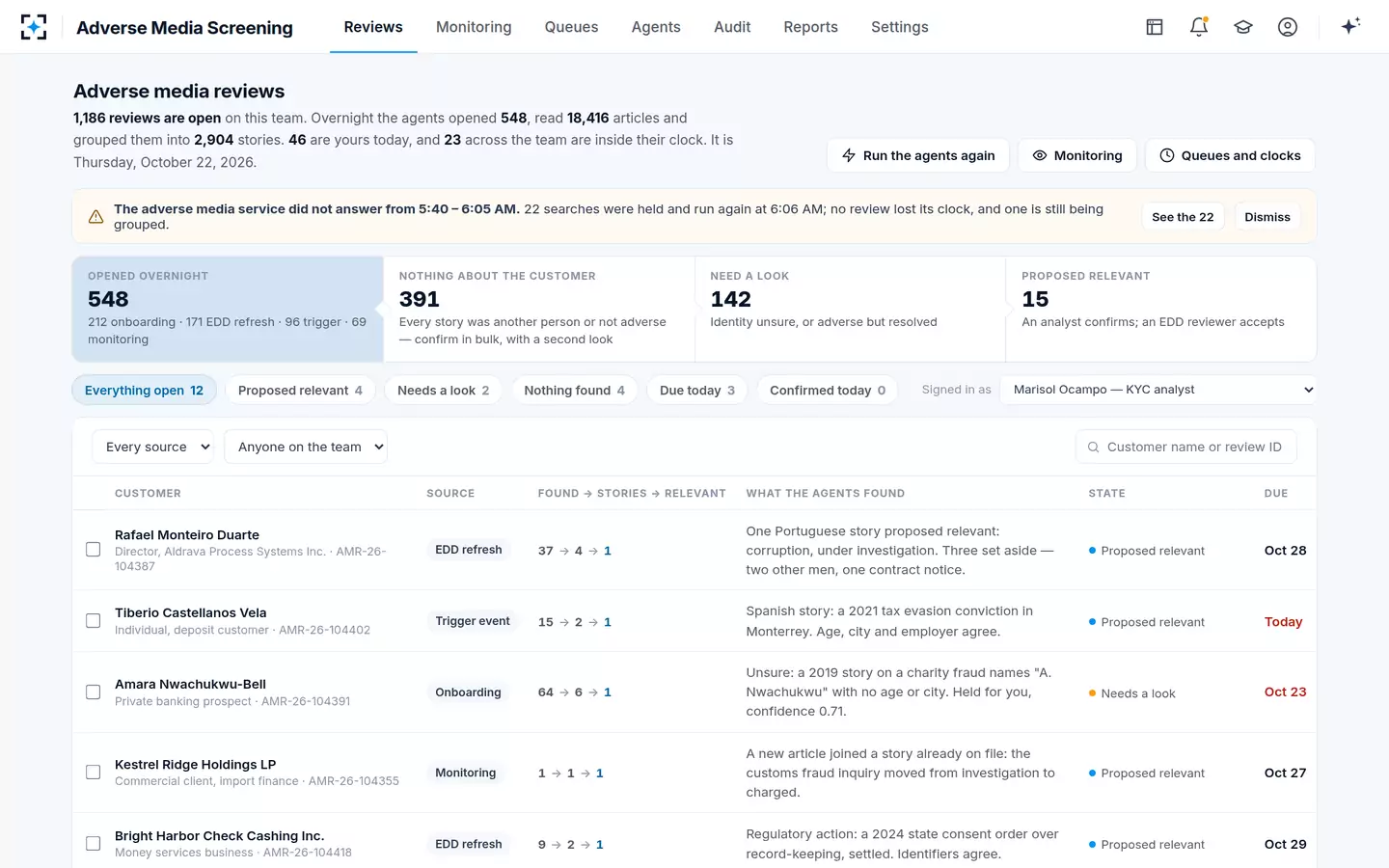
One night's adverse media reviews at a sample bank, by what opened them
Monitoring is the moment that has changed most. Re-running a full search every night re-alerts on the same old story; the useful signal is a new story, or an old one that has moved, from investigation to charges, say. In the sample bank, 6,240 high-risk customers are searched every night, and only a new story or a story whose stage moved reaches a person. Ongoing monitoring is also where the FFIEC trigger list bites: once a search finds something material, the bank "should reassess the customer risk profile/rating" under its own procedures.
The overnight funnel: reviews opened, sorted and waiting for a decision
Adverse media screening vs sanctions and PEP screening
Sanctions and PEP screening compare a name with a list; adverse media screening reads whatever has been published. Wolfsberg draws the line in its first page: negative news "should not be confused with other forms of searches such as Sanctions or Politically Exposed Persons (PEP) screening, which are traditionally list-based." The difference changes the evidence, the outcome and who carries the risk.
List screening and adverse media screening answer different questions
Sanctions and PEP screening: A list: a government sanctions list or a database of politically exposed persons.
Adverse media screening: Open text: news, court and regulatory notices, in any language, of any quality.
Sanctions and PEP screening: A name close to a listed name, with identifiers to compare.
Adverse media screening: A name in an article, with whatever identifiers the writer chose to print.
Sanctions and PEP screening: For sanctions, a legal answer: block, reject or process.
Adverse media screening: A risk judgement: relevant or not, at which stage, and what it does to the rating.
Sanctions and PEP screening: Spelling variants and weak aliases in the list.
Adverse media screening: Copies, namesakes, translation and stories that develop over years.
Sanctions and PEP screening: The bank; OFAC does not confirm matches.
Adverse media screening: The bank, with no authority to ask.
The two meet more often than procedures admit. In a UK case penalised in 2025, a manual adverse media check during a PEP review identified a Bank of Scotland customer as a designated person, and the finding was misread and never reached the sanctions team (OFSI, Bank of Scotland; the analyst's side of that case). An adverse media search that turns up a sanctions story has found a sanctions question, and it belongs with the sanctions team the same day.
What enforcement shows: news that was public and unread
Recent US enforcement does not punish banks for failing to run a search. It punishes them for owning information, in public or in their own systems, that nobody read or acted on. Three FinCEN consent orders since October 2024 make the point; in each, negative news is one failure among many and the penalty covers the whole AML program.
Three FinCEN orders in which negative news went unread or unanalysed
$1.3B
TD Bank, October 2024: public negative news at onboarding in 2019; the only documented screen came in May 2024
$125M
UBS Financial Services, 2026: negative news found but not analysed; 25 of 150+ articles read
$1.2B
Bank of America, 2026: a risk model built to use negative news missed a public disclosure of a DOJ investigation
At TD Bank, a customer onboarded in July 2019 had a leader with public ties to terrorist organizations; "Despite this publicly available negative news, TD Bank failed to perform adequate due diligence at account opening", and "The only negative news screening documented for this customer relationship was completed on May 29, 2024." At UBS Financial Services, FinCEN faulted negative news the firm had found and then failed to analyse. At Bank of America, "although the Dynamic Risk Rating model was designed to incorporate negative news, it failed to incorporate one customer's public disclosure in a securities filing that it was under investigation by the Department of Justice for potential violations of money laundering laws."
The lesson for the US's risk-based rule is uncomfortable: a bank that decides negative media searches are appropriate for a customer, and then runs them carelessly, is worse placed than one that documented why it did not. How to conduct adverse media screening so that the search, the reading and the decision all leave evidence is the subject of its own guide.
How Adverse Media Screening runs the check
The solution runs the search and the sorting; people make the three decisions. On the sample review, an EDD refresh for Rafael Monteiro Duarte, a director of a high-risk commercial client, the agents searched six forms of his name in English, Portuguese and Spanish (the languages his citizenship, a Brazilian subsidiary and wire payments tie him to) and found 37 articles. They grouped them into 4 stories, showed that 2 were about other men and 1 was harmless company news, and proposed one Portuguese report of a procurement investigation as relevant.
Three signatures before a rating changes: analyst, reviewer, manager
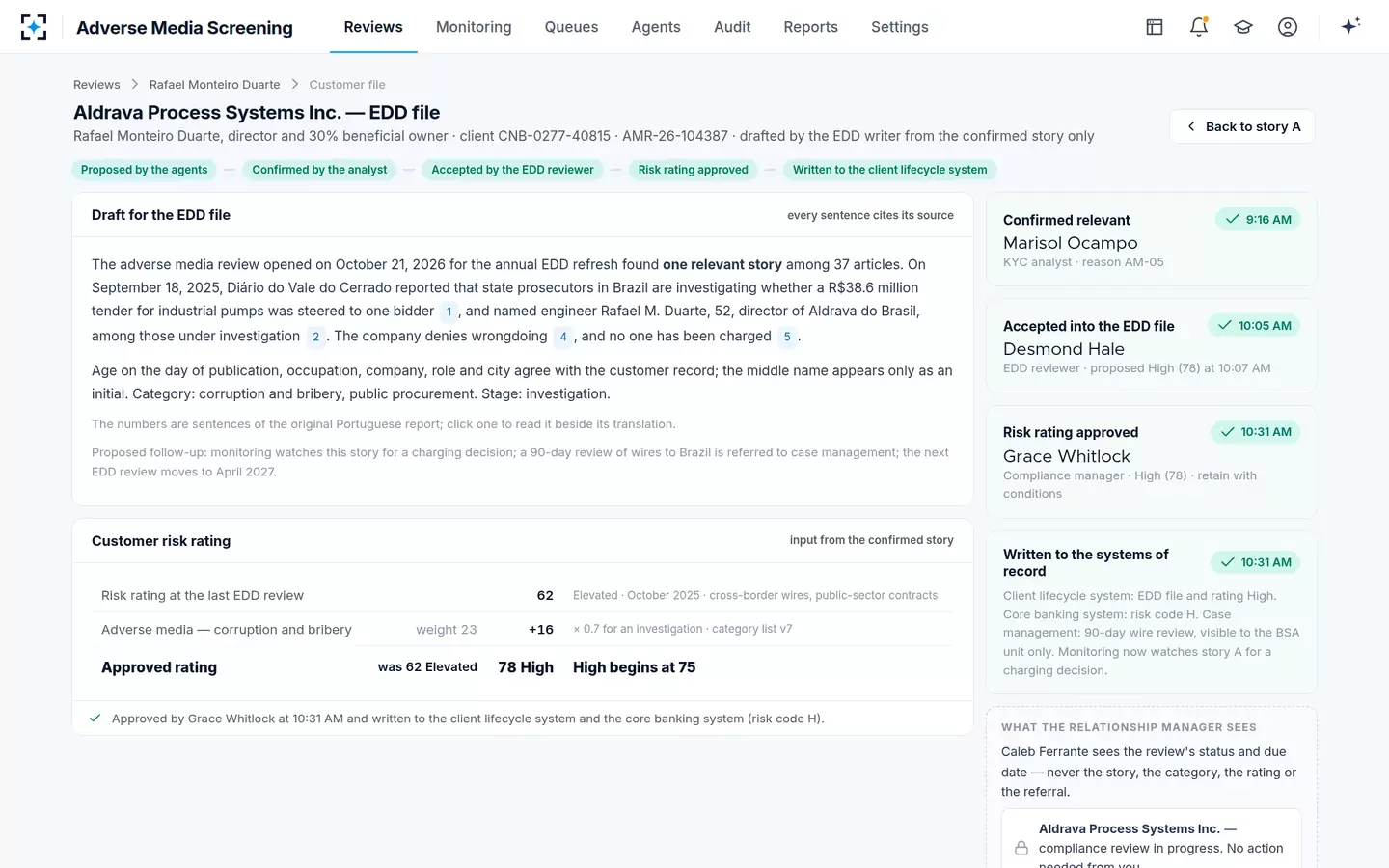
The analyst confirmed the story with a reason code; a different person accepted it into the customer file; the compliance manager approved the higher rating, and only then was anything written to the bank's systems. That is the shape the FFIEC manual asks for when it expects procedures to name who may change a customer's risk profile. To see the review from the first search, start from Adverse Media Screening; to see why most hits are not the customer at all, read what an adverse media hit means.
Questions people ask
What is an adverse media check?
The same thing as adverse media screening: a search of news and other public sources for a customer's links to financial crime. "Check" is more often used for a one-off search at onboarding, "screening" or "monitoring" for a repeated one. Either way the result has to say what was searched and why each story was kept or set aside.
Does adverse media screening apply to existing customers?
It can, on a risk basis. The US CDD rule requires ongoing due diligence "on a risk basis", and the FFIEC lists the results of negative media searches as a reason to review an existing relationship. Many banks re-screen higher-risk customers at each EDD refresh and monitor the highest-risk ones continuously.
Is social media adverse media?
It can be searched, but it rarely stands on its own. Wolfsberg treats social media as "unstructured" data that returns broad results, and names content "corroborated from social media" as a sign a source may not be reliable. A social media post is usually a lead to a credible source, not a finding.
How far back should adverse media screening go?
No rule sets a period. Wolfsberg suggests a multi-year look-back, longer or shorter by type of offence, and screening only new media after the first review. The sample bank in this guide looks back 10 years, with 5 and 7 as its other settings.
Do small banks have to do adverse media screening?
Not by rule; they have to decide, on a risk basis, whether and when to do it. Wolfsberg accepts that a bank need not spend resources on it where the added value is negligible. A small bank with a few higher-risk customers will usually still screen those.