Adverse media review is the reading of news about a customer for financial crime risk, and at a bank it falls to the adverse media analyst: the person on the KYC or financial crimes team who searches the news about a customer under review, works out which articles are actually about that customer, and decides whether anything found matters for money laundering, corruption, fraud or other financial crime risk. The seat goes by several names (KYC analyst, EDD analyst, negative news analyst) and the job is mostly not finding bad news. It is proving that a story is about someone else, reading ten copies of the same report, and getting a foreign-language article into a language the analyst can judge. Botminds' Adverse Media Screening puts agents in front of that reading: they search every name form in every language tied to the customer, group the copies, translate sentence by sentence and try to prove each match wrong. The analyst still decides, and a second person still signs.
The examples on this page come from a fictional sample bank as it runs through the solution: Corvane National Bank, whose team of 24 KYC analysts and 6 EDD reviewers carries 1,186 open adverse media reviews. Every bank, person, company and article named in them is invented. The research figures come from regulators, official statistics and a banking standards body, linked where they appear.
What an adverse media reviewer's seat costs, by the nearest official count
19,850
compliance officers employed in credit intermediation, which includes banks
$94,090
their mean annual wage, May 2025: the base cost of one seat before overhead
417,070
compliance officers across all industries, at a mean of $88,400
What does an adverse media analyst do?
An adverse media analyst does four things on every review: searches, sorts, judges and writes. The search runs the customer's name, and every form of it, against risk words such as fraud, bribery or money laundering. The sort separates copies of one report, stories about namesakes and harmless news from anything that might matter. The judgement asks three questions of what is left: is this the customer, is it relevant to financial crime, and how far has it gone, from allegation to conviction. The note says what was searched, what was set aside and why, and what the bank should do.
The Wolfsberg Group, a standards body formed by global banks, describes the same work from the other end, in the procedures a bank should write for it. Its 2022 guidance on negative news screening lists the grounds on which an alert may be closed: a "significant difference" in name, "Differences in key secondary identifier information (e.g., date of birth, date of incorporation, gender)", or immateriality, as when "The FI's customer is not the subject (e.g., customer is a plaintiff)" or the source "is deemed not to be credible (e.g., blogs, tabloids)" (Wolfsberg Group, Negative News Screening FAQs, 2022). It is guidance from an industry body, not a rule, but it is the closest thing the trade has to a job description, and it asks for "a clear demonstration of the logic applied" on every alert, the false ones included.
The work is not sanctions screening, and the difference shapes the seat. Sanctions and PEP screening compare names with lists, a distinction Wolfsberg draws on its first page and what adverse media screening is sets out in full. A sanctions alert is a comparison with a government list and ends in a legal answer; OFAC's own FAQ 5 walks a bank through deciding whether to block, reject or process. An adverse media alert is a comparison with whatever the press has printed, in any language and of any quality, and ends in a risk judgement the bank owns entirely.
Is adverse media a KYC or an investigations job?
It starts in KYC and feeds investigations. The analyst usually works inside customer due diligence: onboarding, the periodic refresh of an enhanced due diligence (EDD) file, or a review prompted by an event. What the analyst concludes then travels two ways: into the customer's risk rating, and, when a story suggests the money itself may be suspect, to the team that decides on a suspicious activity report.
The rules put the seat in the same place. The FFIEC examination manual counts the results of negative media searches among the reasons a bank may re-review a customer relationship, alongside red flags from monitoring and law enforcement requests (FFIEC BSA/AML Examination Manual, Customer Due Diligence). Wolfsberg lists five uses, from informing "the risk assessment and classification of the customer" to "Providing additional context to support an investigation into potentially suspicious activity". One reading, several owners: which is why the analyst's note has to be written for people who were not in the room.
The adverse media analyst's seat, and the people on either side of it
Today
Searches each name form by hand, reads every copy, rules out namesakes and pastes foreign reports into a translator.
With agents
Opens a review already sorted into stories, with namesakes set aside and their tests kept, and confirms the story that matters with a reason code.
Still theirs: The decision that a story is about the customer and relevant
Today
Checks the analyst’s note against screenshots and search results that may have changed since.
With agents
Reads an EDD paragraph citing the original sentences and accepts it into the customer file, or returns it with a reason.
Still theirs: Acceptance into the file; never the person who confirmed
Today
Asked to approve a rating change from a summary of what an article alleges.
With agents
Sees the category, the stage and the rating arithmetic before approving or rejecting.
Still theirs: Every change to the customer’s risk rating
Today
Rebuilds what was searched and who decided when an examiner asks.
With agents
Signs one examiner export with every search, decision and override on it.
Still theirs: Accountability for the program, and any decision to exit
Where the minutes go on one review with a relevant story
On a review that does turn up a relevant story, Botminds estimates an analyst working by hand spends about 75 minutes, and only 6 of them deciding the category and stage, the judgement the job exists for. Searching each name form in each language takes about 12, reading copies of the same report about 20, ruling out namesakes 15, translating 12, deciding the category and stage 6 and writing the note 10. The solution's design target for the same review is 6 minutes of analyst time.
By hand, most of an adverse media review is reading that leads nowhere
By hand · 75 min
- Searching · 16%
- Reading copies · 27%
- Namesakes · 20%
- Translating · 16%
- Judging · 8%
- Writing · 13%
With agents · 6 min target
- Searching · 8%
- Reading copies · 8%
- Namesakes · 17%
- Translating · 25%
- Judging · 17%
- Writing · 25%
The shape matters more than the totals. By hand, copies and namesakes take nearly half the review; with agents, the analyst's remaining minutes go mostly to reading the original passage beside its translation, judging it and checking the note. The decision on category and stage falls from 6 minutes to 1 because the agents propose it; the analyst still confirms or rejects it, with a reason.
Copies are the hidden cost. A single report is picked up by wire services, rewritten by regional outlets and translated, and a search returns every version as a separate result. Reading the eleventh copy of a story the analyst has already understood adds nothing to the decision and something to the risk of skimming the one copy that differs. Telling a namesake from the customer is the other sink, and the arithmetic behind it is more exacting than it looks.
How many articles does an analyst read per review?
There is no published benchmark, and the range is enormous: from nothing for a retail customer with no public profile to hundreds for a public figure. Wolfsberg makes the point directly: high net worth individuals, PEPs and large corporates "are more likely to have a high public profile" and "would be expected to be subjected to a higher degree of media scrutiny of both a positive and negative nature", while a typical retail customer "will likely have a lower public profile".
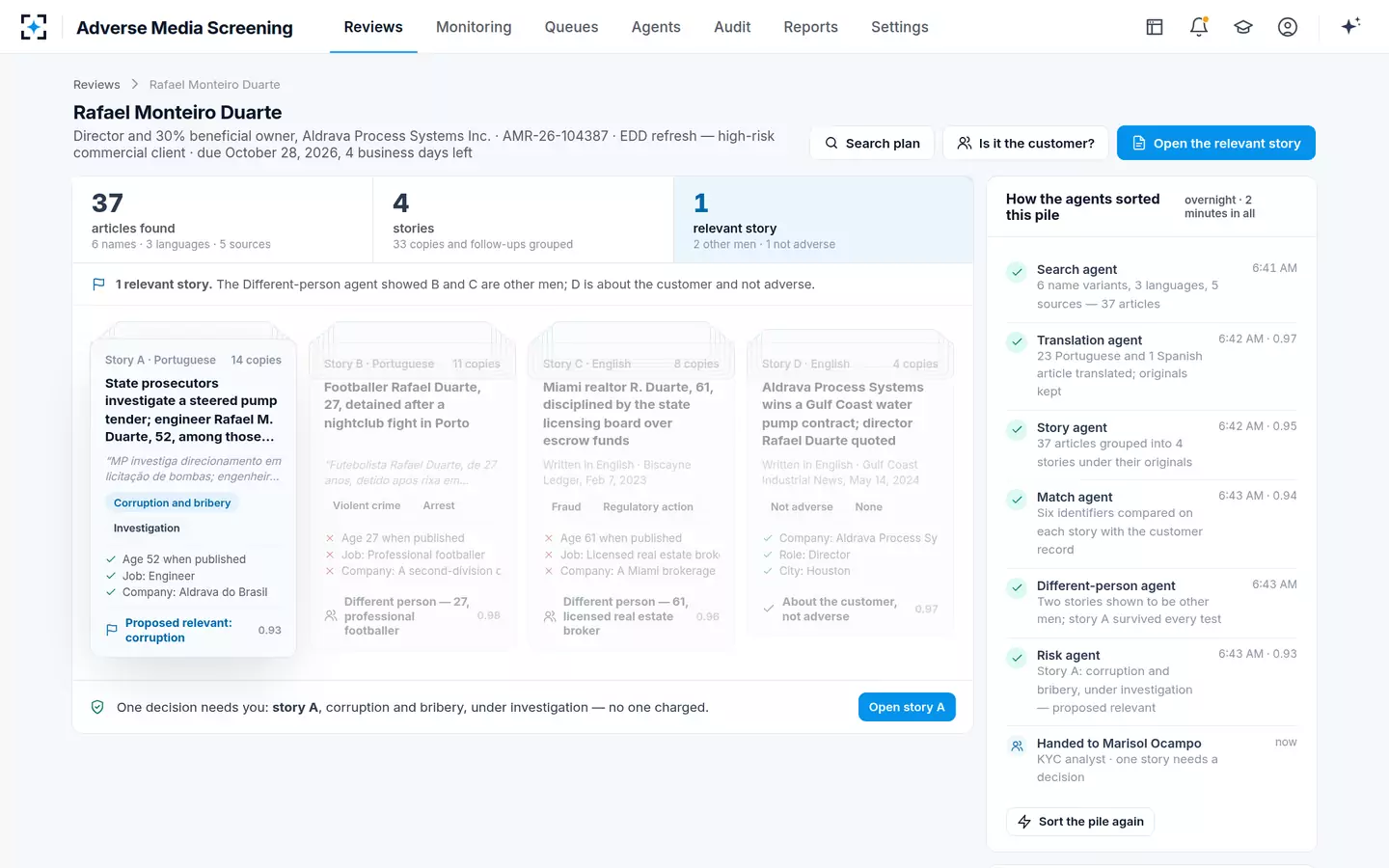
Enforcement records give the upper end. FinCEN's 2026 consent order with UBS Financial Services describes one customer whose negative news screening at onboarding "resulted in thousands of hits across more than 300 articles", and a periodic review that "returned more than 150 articles, of which UBSFS reviewed only the first twenty-five" (FinCEN, Consent Order 2026-02). At the sample bank the agents read 18,416 articles across 548 reviews in one night, about 34 per review on average, and the sample review on this page had 37, which grouped into 4 stories.
One review, sorted before the analyst opens it: 37 articles, 4 stories, 1 relevant
Who decides if news is relevant?
The analyst decides whether a story is about the customer and whether it is relevant; other named people decide what follows. That split is not a regulatory formula, but the FFIEC manual expects a bank's procedures to "indicate who in the organization is authorized to change a customer's risk profile", and Wolfsberg describes a tiered model in which a first level works "high volumes" of alerts against agreed rules, and later levels take the ones that cannot be closed because of "the subjective nature of NNS outputs".
Who decides what on an adverse media review
| Decision | Who makes it | What it rests on |
|---|---|---|
| Is the story about this customer? | KYC analyst | The identifiers in the article against the customer file, read as of the article’s date |
| Is it relevant, and where does it stand? | KYC analyst, with a reason code | The bank’s crime categories and stages, from allegation to conviction |
| Does it go into the customer file? | EDD reviewer, never the analyst who confirmed it | The cited sentences, the identity tests and the draft paragraph |
| Does the risk rating change? | Financial crimes compliance manager | The category, the stage and the rating arithmetic |
| Do we keep or exit the relationship? | Compliance manager and BSA officer | The rating, the story and the bank’s risk appetite |
| Is a suspicious activity report filed? | The BSA unit, outside the review | Transactions as well as news; never shown to the relationship manager |
The last row is the one analysts are trained hardest on. Under 31 CFR 1020.320(e), a suspicious activity report is confidential, and so is anything that would let someone infer that one was filed. An adverse media finding is not itself a SAR, but a note that tells a relationship manager why a review is open can come close, which is why the sample bank's relationship managers see only "Compliance review in progress. No action needed."
What skills should a bank train its negative news analysts in?
Five skills carry the job: reading for identity, reading for stage, judging sources, handling languages and writing a rationale a stranger can follow. None is exotic; all are easy to do fast and badly.
Reading for identity means comparing what an article says about a person (age, occupation, employer, role, city) with the customer file, and doing the date arithmetic: an article from 2023 gives the age the person was in 2023. Reading for stage means telling an allegation from an investigation, a charge, a conviction or an acquittal, because an allegation alerts early and often while a conviction alerts late and rarely, and the bank's policy says which one it wants. Judging sources means asking whether an outlet has editorial oversight, whether other reputable sources carry the same story, and whether the report names its own sources.
Languages are less about fluency than about knowing what a name can turn into. Wolfsberg separates transliteration, transcription and translation, three ways one name becomes several, and the search string an analyst writes decides which of those forms are ever found. Writing is the skill reviewers judge most. Wolfsberg's training list ends with "Empowering relevant staff to exercise critical thinking in the assessment of Negative News alerts" and, before it, "Consequences of 'getting it wrong'".
The occupation the US counts these analysts under is Compliance Officers, which O*NET places in Job Zone Four, where "Most of these occupations require a four-year bachelor's degree, but some do not" (O*NET OnLine, 13-1041.00). For a manager sizing the team, that is the profile to hire and train for, and the BLS wage above is the starting cost of each seat.
What goes wrong when the reading is rushed
The failures regulators describe are rarely failures to search. They are failures to read what the search found, to explain why it was set aside, or to pass it on. Three recent cases show each one.
Not reading it all. At UBS Financial Services, the firm read only the first 25 of more than 150 articles a periodic review returned, and FinCEN also faulted how it explained the news it did read. Reported connections between a customer's beneficial owner's brother, a Russian oligarch, and an alleged laundering network were summed up in an internal memorandum as "no formal negative news". FinCEN imposed a $125 million civil money penalty, for failures that went well beyond negative news.
Reading it, then misreading it. In a UK case, Bank of Scotland began a PEP review of a customer on 20 February 2023, and "A manual adverse media check was conducted which identified that the customer was a designated person. However, due to human error, the customer was assessed as being removed from both the UK and the EU sanctions list, as opposed to only the EU list." There was "not an explicit instruction to escalate all potential sanctions connections to a relevant sanctions team", and £75,000 was credited to the account before it was restricted. OFSI imposed £160,000 on 10 November 2025 (OFSI penalty notice, Bank of Scotland).
Never reading it. At TD Bank, four months after one customer group was onboarded, a financial regulator ordered an affiliate of the group to cease operations and its assets to be liquidated. FinCEN found that TD "only identified this adverse media related to Customer Group C after inquiries from law enforcement" (FinCEN, TD Bank consent order, October 2024). The Bank of Scotland case is the analyst's lesson: the reading was right and the routing was not. A finding two analysts would both sign is the defence against all three.
What changes for the analyst with Adverse Media Screening
The analyst stops doing the sorting and starts checking it. On the sample review, an EDD refresh for a director of a high-risk commercial client, the agents ran six name forms in English, Portuguese and Spanish, found 37 articles and grouped them into 4 stories. The Different-person agent showed that two of them were about other men, a footballer of 27 in Porto and a realtor of 61 in Miami, and wrote down every test; a fourth story was about the customer and harmless. The analyst, Marisol Ocampo, read one Portuguese passage beside its English translation and confirmed it at 9:16 AM with reason code AM-05: relevant, under investigation, no charge.
Confirming makes her the maker, and the solution locks her out of the next step. A different person, the EDD reviewer, accepts the story into the customer file; the compliance manager approves the rating change. Nothing reaches the client lifecycle system or the core banking system until all three have signed.
Queues and clocks: the analyst's day as a list, not a pile
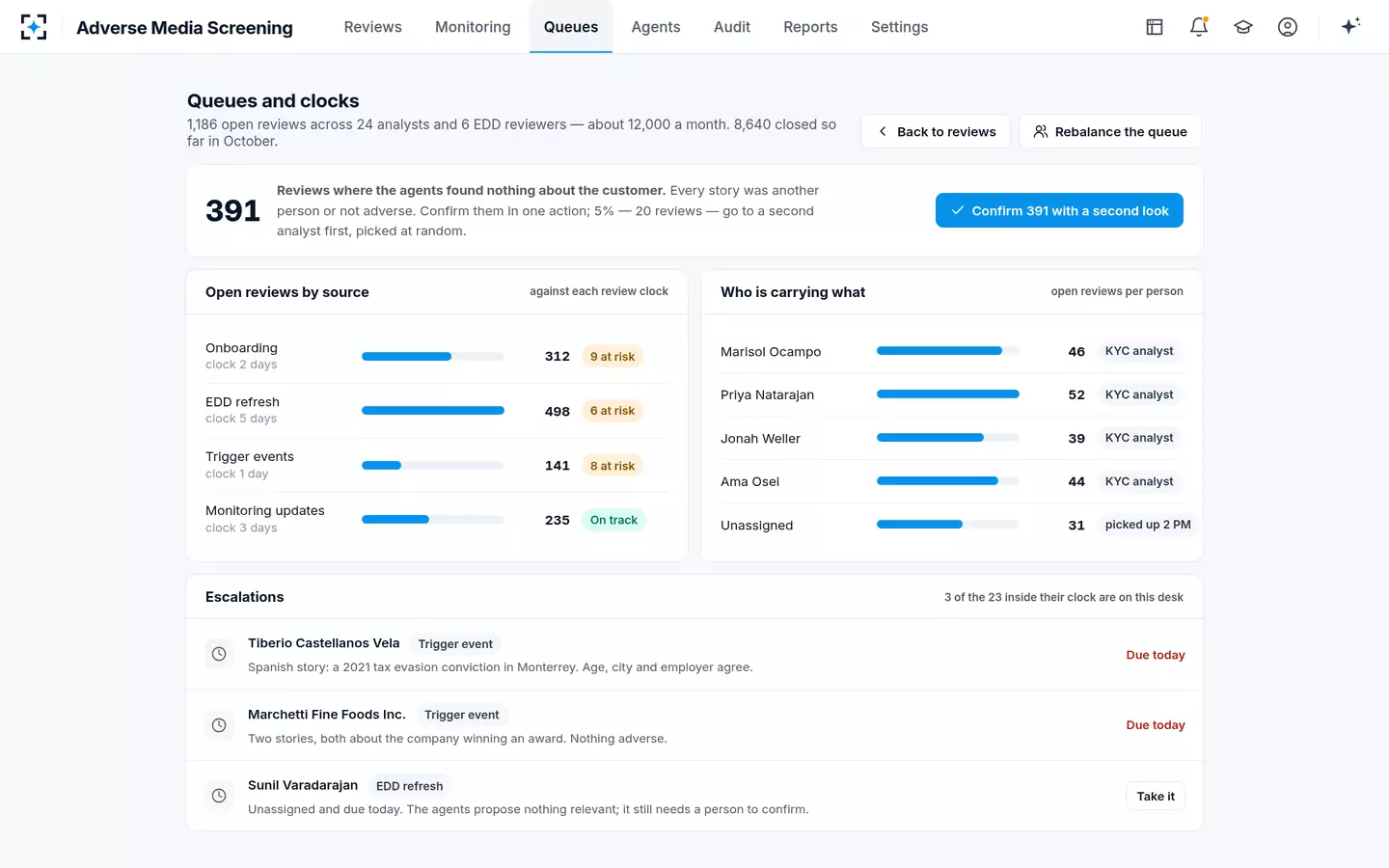
The empty reviews change most. Of the 548 reviews the agents opened overnight at the sample bank, 391 found nothing about the customer: every story was another person or not adverse. An analyst confirms those in one action, and the solution sends a random 5% to a second analyst first; the agents cannot confirm them, even when asked. The minutes saved go where Wolfsberg says the specialist belongs, on the alerts "where alerts cannot be discounted, or positive matches are identified". To see the full review, start from Adverse Media Screening.
Questions people ask
Is an adverse media analyst the same as a sanctions analyst?
No, though one person may do both. Sanctions screening compares names with government lists and ends in a legal decision to block, reject or process; adverse media screening reads whatever the press has published and ends in a risk judgement. The skills overlap, reading identifiers above all, but the sources, the outcome and the rules are different.
Does an adverse media analyst need a second language?
It helps, but no team covers every language its customers' news appears in. What the analyst needs is to know which languages a customer's footprint points to (citizenship, addresses, subsidiaries, payment countries) and to read a translation against its original. Wolfsberg notes that words "searched in their translated version" can return a different volume and quality of results than the local-language original.
How experienced should the people doing adverse media analysis be?
First-level review is often staffed with newer KYC analysts, but the judgement it needs comes with experience. O*NET puts compliance officers in Job Zone Four, where "Employees in these occupations usually need several years of work-related experience, on-the-job training, and/or vocational training." Wolfsberg's tiered model sends the alerts that cannot be closed on the bank's rules to a second level with specialist knowledge.
Can an adverse media analyst tell the relationship manager what was found?
The finding itself is not a suspicious activity report, but anything that would reveal a SAR is confidential under 31 CFR 1020.320(e), and a review note can drift close to that line. Many banks therefore show relationship managers only the status of a review; in the sample bank, "Compliance review in progress. No action needed."