Yes, adverse media screening can be done for free: a general search engine, the free enforcement databases that US regulators and prosecutors publish, and the customer's local press will find most published stories about most customers. What is not free is the analyst time to run each search properly and read what comes back, and the risk that a search engine, which was never built for financial crime work, buries or reorders the story that matters. For a community bank that screens a few dozen higher-risk customers a year, a disciplined manual method can be the right answer. For a bank whose customers have foreign owners, foreign subsidiaries or foreign payments, free stops being cheap quickly. Botminds' Adverse Media Screening is built for that second case: agents search every language tied to a customer, group the copies and challenge each match, and an analyst confirms.
The hours and costs on this page are our estimates, built from stated assumptions you can change; the wage and bank counts are official statistics; the examples from the solution are fictional sample data.
Most US banks are small, and their compliance hours are expensive
3,246
of the 4,313 FDIC-insured institutions had under $1 billion in assets on June 30, 2026
584
had under $100 million
$45/ hour
mean wage of a compliance officer in credit intermediation, before benefits
Is there free adverse media screening?
There are free tools, not free screening. A search engine, a news site's own search and the public enforcement pages of US agencies cost nothing to use, and together they cover a great deal. What they do not do is decide anything: each result still has to be opened, matched to the customer or ruled out, read for stage and credibility, and written up. That reading is the cost, and it scales with the number of reviews, the number of name forms and the number of languages.
Free is also a reasonable choice under the rules. US rules ask each bank to decide on the basis of risk whether and when negative media searches are appropriate, and the Wolfsberg Group, a standards body formed by global banks, says "It may also be appropriate not to conduct NNS; an FI would not be expected to devote resources to NNS where the added value is negligible or disproportionate to its Financial Crime Risks" (Wolfsberg Group, Negative News Screening FAQs, 2022). For a retail customer with no public profile, it suggests "more targeted searches of structured news and media sources", and asks whether "alternative measures such as anti-fraud databases provide more effective means of risk identification."
Can I just use Google for adverse media?
You can use a search engine for part of the job, if you understand its limits and record what you did. Wolfsberg's caution is the right starting point: search engines "have not been designed to assess Financial Crime Risk and may inadvertently de-prioritise information most relevant for this purpose." They rank what is popular and recent, not what is about a customer's role in a procurement case six years ago, and they return each copy of a story as a separate result.
FATF made the same point about politically exposed persons more than a decade ago: "general searches on the larger search engines can prove difficult because of the number of 'hits' that would require reviewing", while "searching focused sources that could be linked to the customer may assist in locating relevant information (for example, (social) media websites in the customer's country of origin)" (FATF, PEP guidance, 2013). Both halves apply to adverse media: the volume of hits is the cost, and the customer's own countries are where the stories are. How to write the search string so a free engine finds them is covered separately.
What does an adverse media review cost by hand?
On our estimate, about 35 minutes of analyst time on an average review, or roughly $26 in wages, before benefits, supervision or a second reviewer. The average hides two very different reviews: one that finds nothing about the customer, and one that turns up a story that must be understood, translated and written up.
The cost of one manual adverse media review, term by term
A review that finds nothing
30 minutes
Our assumption: each name form searched with the risk terms, and enough read to set every result aside with a note.
Our assumption
A review with a story to decide
75 minutes
Searching 12, reading copies 20, ruling out namesakes 15, translating 12, deciding 6, writing 10.
Botminds estimate
The mix
9 in 10 × 30 + 1 in 10 × 75 = 34.5 minutes
At the fictional sample bank, 15 of 548 reviews in one night were proposed relevant and 142 more needed a person’s look; we assume 1 in 10 needs the full treatment.
Our assumption
Wage cost
34.5 ÷ 60 × $45.24 ≈ $26
BLS mean wage for compliance officers in credit intermediation, before benefits and overhead.
BLS, May 2025
The term that moves most is language. A review that has to cover Portuguese or Spanish news for a customer with ties to Brazil or Mexico adds a search per name form per language and a translation step for every result that might matter. That is where a manual method either grows in hours or quietly narrows to English, and the second is the version an examiner will find.
What does adverse media screening cost a small bank in a year?
At 34.5 minutes a review, a bank running 150 reviews a year spends about 86 analyst hours, and one running 1,000 spends about 575. The volume depends on how many customers the bank's risk assessment puts in scope and how often it reviews them, so the profiles below are illustrations, not benchmarks.
Analyst hours a year on manual adverse media screening, by review volume
Two things about those numbers matter more than their size. First, the cost is not the wage; it is what the hours displace. In a one- or two-person compliance department, 288 hours is seven weeks of the BSA officer's year, taken from monitoring, training and exam preparation. Second, the hours are least elastic exactly where the risk is highest. A customer with a foreign subsidiary and foreign payments takes the longest to search properly, and is the one a hurried analyst is most tempted to search only in English.
How do small banks do adverse media screening?
A small bank can run a defensible program by hand: a documented decision about which customers get a negative media search, a standard set of searches for those customers at onboarding and at each enhanced due diligence refresh, and a note of what was found. Three of every four FDIC-insured institutions have less than $1 billion in assets, and a bank that size may have only a few dozen higher-risk relationships: money services businesses, cash-intensive businesses, customers with foreign owners.
The pressure points are predictable. Onboarding comes with a deadline, so the search is narrowed to fit the day. Periodic refreshes bunch up around the anniversary of a big onboarding year. And monitoring between refreshes is usually absent, because no free tool watches a customer's name overnight. A small bank can live with the first two through procedure; the third is where a free method has nothing to offer except a calendar reminder.
Free sources for adverse media screening, and what each one leaves to you
| Free source | What it is good for | What it leaves to you |
|---|---|---|
| A general search engine | Broad coverage of the open web, in any language you search in | Ranking not built for financial crime, copies listed separately, results that vary by day and user, no record of what you saw |
| FinCEN, OCC and Federal Reserve enforcement pages | Official actions against banks, money services businesses and bank insiders | Only the cases those agencies brought, mostly against institutions |
| SEC litigation releases and Justice Department news | Charges, pleas and settlements against people and companies | US matters only; earlier stages such as allegations rarely appear |
| The customer’s local press | Stories national outlets never carry | A reader of the language, and a judgement about the outlet’s credibility |
| Court records | What was filed and decided, not what was reported | Searching by jurisdiction, and in many places a fee |
When is a paid adverse media tool worth it?
A paid tool is worth it when the hours it saves cost more than the tool, or when it does something the free method cannot do at any price in hours: search languages nobody on the team reads, watch customers between reviews, or produce a record an examiner can follow. Prices depend on coverage, languages, volume and monitoring, so the honest comparison is the bank's own: its review volume times the minutes saved times its loaded hourly cost, against the quote.
Four signals usually decide it before the arithmetic does. Customers with foreign owners, subsidiaries or payments, because their news is in other languages. A higher-risk population large enough that refreshes bunch up and onboarding searches get narrowed. A need for ongoing monitoring, because a free method cannot run overnight. And exam findings about documentation: a file that says "Google search, nothing found" without the forms, languages and results is the weakest point of a manual program, and the easiest to fix with software.
The opposite is also true. A bank with a local retail book, a handful of higher-risk business customers and no foreign exposure may find that 100 hours a year of careful manual searching is cheaper and good enough. That is a defensible decision if it is written down, and what US law actually requires is a risk-based decision, not a product.
Doing adverse media screening free, and defensibly
A free method survives an exam when it is consistent and recorded. Most of what makes it defensible costs nothing but discipline.
A free adverse media check an examiner can follow
- Write down who gets screened, and why
The customer types and risk ratings in scope, approved by the BSA officer.
- Use one written list of risk terms
The same terms on every search, reviewed when the policy is reviewed.
- Search every form of the name
Full name, initials, without a second family name, and any transliteration.
- Search the languages the customer’s file points to
Citizenship, addresses, subsidiaries and payment countries; use a translation tool and keep the original text.
- Check the official sources too
FinCEN, OCC, Federal Reserve, SEC and Justice Department pages, for actions a search engine may rank low.
- Save what you searched and what came back
Date, engine, settings, result counts, and the link and text of anything relevant.
- Note why each story was set aside
A different person (with the identifier), not adverse, or not credible.
- Have a second person read the ones that matter
Any story kept in the file, and a sample of the reviews that found nothing.
Where Adverse Media Screening fits, and where it does not
Adverse Media Screening fits banks whose reviews are numerous, multilingual or monitored, and whose examiners ask to see every search and decision. It is not the answer for every small bank: for a few dozen domestic customers a year, the checklist above, done consistently, may be enough.
Where it fits, the saving comes mostly from the reviews that find nothing. At the fictional sample bank, the agents opened 548 reviews in one night and 391 found nothing about the customer: every story was another person or not adverse, with the tests kept. An analyst confirms those in one action, and a random 5% go to a second analyst first. The analyst's minutes go to the 142 that need a look and the 15 proposed relevant, where the solution's design target is 6 minutes of analyst time for a review with a relevant story.
The empty reviews, confirmed in one action with a random second look
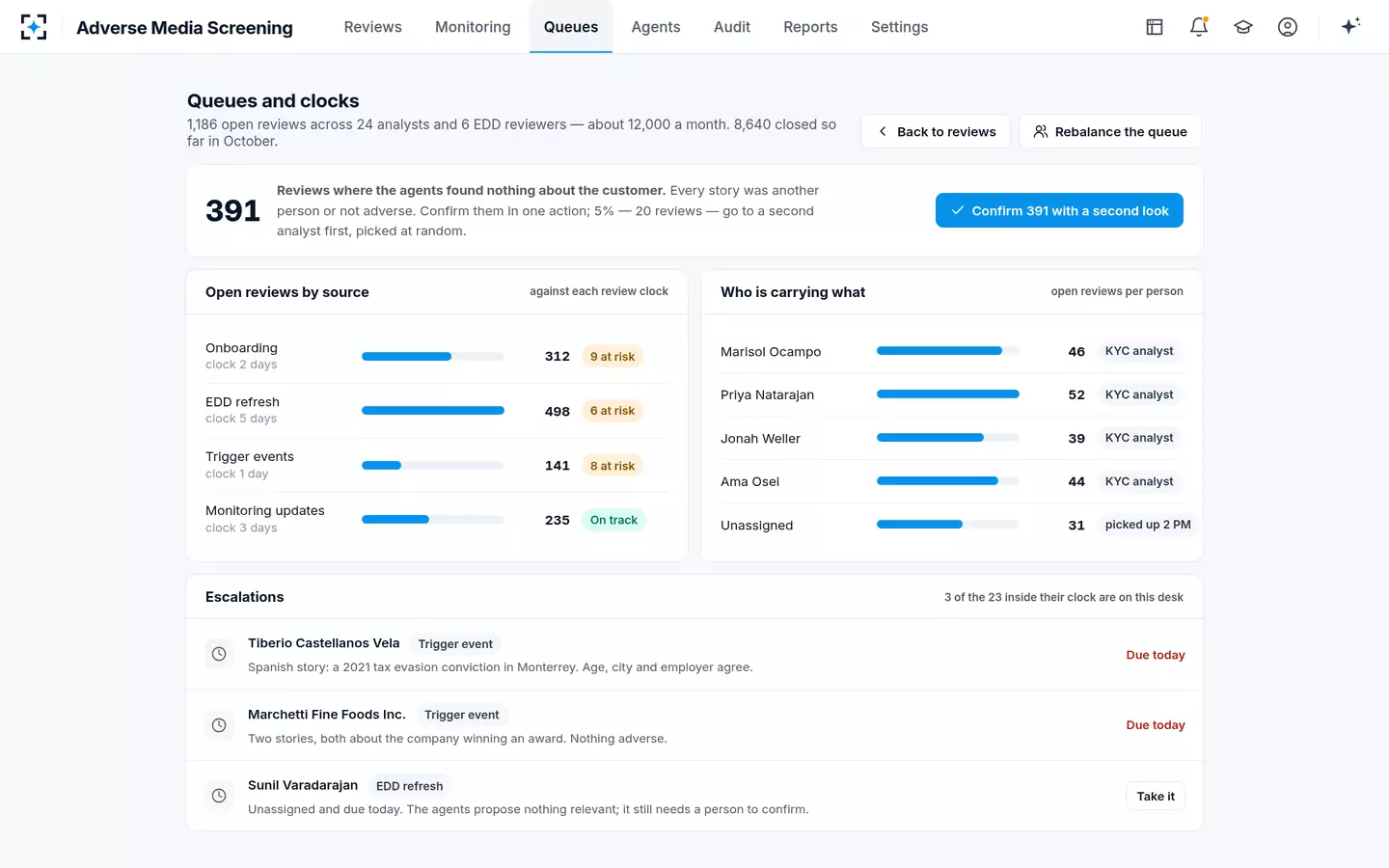
That is also the honest limit. The solution does not remove the judgement, and it does not make a bank's risk assessment for it: which customers to screen, which crimes, how far back and in which sources are still the bank's decisions, set as configuration. What a bank brings to adverse media screening software covers those inputs; to see the reviews themselves, start from Adverse Media Screening.
Questions people ask
Is there a free adverse media check online?
Yes, in the sense that search engines and government enforcement databases are free to use. None of them checks anything for you: they return pages and records that someone still has to match to the customer, read and record. Free tools work when the method around them is written down and followed.
Is OFAC's search tool an adverse media check?
No. OFAC's Sanctions List Search compares a name with OFAC's sanctions lists; it says nothing about news, investigations or allegations. A customer can be absent from every sanctions list and still be the subject of a corruption investigation reported in the press.
How long does a manual adverse media check take?
No public benchmark exists. On our estimate, a review that finds nothing takes about 30 minutes and one that turns up a story to decide about 75, by Botminds' estimate, with translation and copies the largest variables. Customers with a high public profile or a foreign footprint take longest.
Will a free search satisfy examiners?
It can, if the bank decided on a risk basis that it is proportionate and can show what was searched, what came back and why each result was set aside. What examiners are unlikely to accept is a note that says only that a search found nothing.
What does adverse media screening software cost?
It depends on the coverage, languages, volume and monitoring a bank needs, and vendors price it in different ways. The useful comparison is internal: annual reviews times minutes saved times the loaded hourly cost of the people doing them, against the quote, plus what the free method cannot do at all.