An adverse media hit means that a search found an article in which a name matching, or resembling, your customer's appears near a risk term such as fraud, bribery or money laundering. That is all it means. A hit is a name in an article, not a finding: it becomes one only when the article is shown to be about this customer, and then only if what it reports is relevant and credible. Most of the work of adverse media screening is the first test, and its trap is time. An article gives the age, job and city a person had when it was written, so the customer's identifiers have to be worked out for that day before they are compared. Botminds' Adverse Media Screening does that comparison on every story, and then a second agent tries to prove each match is someone else before anything reaches the analyst.
The worked example below is a fictional review from a sample bank in the solution: an enhanced due diligence refresh for Rafael Monteiro Duarte, born June 11, 1973, a mechanical engineer and director of a Brazilian subsidiary in Goiânia. The search found 37 articles that grouped into four stories. The customer, the companies and the articles are invented.
Four stories, six identifiers: the customer's age worked out on each publication date
Story ASept 18, 2025
- Name as printed… Rafael M. Duarte
- Age on the day✓ 52 · customer 52
- Occupation✓ Engineer
- Company✓ Aldrava do Brasil
- Role✓ Director
- City✓ Goiânia
About him: relevant
Story BJune 20, 2026
- Name as printed… Rafael Duarte
- Age on the day✗ 27 · customer 53
- Occupation✗ Footballer
- Company✗ A second-division club
- Role✗ Player
- City✗ Porto
Different person
Story CFeb 7, 2023
- Name as printed… R. Duarte
- Age on the day✗ 61 · customer 49
- Occupation✗ Real estate broker
- Company✗ A Miami brokerage
- Role✗ Broker
- City✗ Miami
Different person
Story DMay 14, 2024
- Name as printed… Rafael Duarte
- Age on the day– Not given · customer 50
- Occupation– Not given
- Company✓ Aldrava Process Systems
- Role✓ Director
- City✓ Houston
About him: not adverse
What does an adverse media hit mean?
A hit is a search result that met the bank's matching rules: a name close enough to the customer's, in an article containing a risk term from the bank's list. It says nothing yet about who the article is about, whether it is true, or whether it matters. The Wolfsberg Group, a standards body formed by global banks, separates the two questions an analyst must answer: whether the hit is a false positive, the article being about someone else, and whether a true match is material, meaning the news "may indicate a heightened Financial Crime or Reputational Risk" (Wolfsberg Group, Negative News Screening FAQs, 2022).
A search does not return hits one story at a time. On the sample review, 37 articles came back under six forms of the name, but they reported four events: 33 were copies and follow-ups. Grouping the copies first means the identity test is done once per story, on the fullest version of it, rather than 37 times on fragments.
How do I know the article is about my customer?
Compare every identifier the article prints with the customer file, as of the article's date, and count both agreements and conflicts. OFAC's guidance on judging a sanctions hit sets the same discipline for list screening: set every detail of the list entry against what you know about your party, and ask whether only the name matches or the date of birth, identification number or nationality differs (OFAC FAQ 5; the full method is in OFAC hit: what to do). A news article is a poorer source than a sanctions list, because a journalist decides which details to print, but the logic carries over.
Which identifiers can confirm a match?
Several identifiers agreeing, with none in conflict, can confirm a match; a single strong conflict can rule one out; and no single identifier confirms anything. Not all identifiers weigh the same. Wolfsberg lists a date of birth or incorporation as a strong ground for discounting, and treats others as "weaker" discounting criteria: "profession, residence and other situational factors which make a positive match unlikely". People change jobs and cities, so a different city in a 2015 article is weaker evidence than an age that is off by thirty years. The six identifiers the solution compares are the name as printed, age on the day, occupation, company, role and city.
Which identifiers can confirm a match, and which can only rule one out
| Identifier | Confirms when | Rules out when | Watch for |
|---|---|---|---|
| Name as printed | Never on its own | The name differs in more than form | Initials, a dropped second family name, transliteration |
| Age on the day | It equals the customer’s age that day | It differs by more than a year | Ages written days before publication |
| Occupation | It matches, with company or role | It is clearly incompatible | Career changes over the look-back |
| Company | It names the customer’s company or a subsidiary | It names an unrelated employer | Trading names and group companies |
| Role | It matches, with the company | It conflicts with the role on file | Former roles described in the present tense |
| City | It matches an address or operation on file | Only with other conflicts | Moves, second homes, subsidiaries abroad |
How do I handle articles that give an age?
Work out how old the customer was on the day the article was published, then compare. An article that says "52" is telling you the person's age in that week, not today. Comparing it with the customer's current age turns every old article into a false conflict, and every namesake who was the customer's age a few years ago into a false agreement.
The customer's age on the day an article ran
Years between
Publication year − birth year
Story A: 2025 − 1973 = 52.
Birthday adjustment
− 1 if the article ran before that year’s birthday
Story C ran on Feb 7, 2023, before June 11: 2023 − 1973 − 1 = 49.
Tolerance
Agree if within the bank’s tolerance
An age may be written days before it is printed; a one-year tolerance absorbs that.
The tolerance is a policy choice, and Wolfsberg gives the common one as an example of a rules-based closure: alerts "are closed when the date of birth in the FI's customer record differs to the one published in the media by +/- 1 year." The same rule needs care in the other direction. An age within a year of the customer's is agreement on one identifier, not a match; story A was proposed as relevant only because age, occupation, company, role and city all agreed, with the name partial.
When the article gives no age, as story D did, the identifier is simply absent. It neither confirms nor rules out, and the decision rests on the others: in story D, the company, role and city all matched the customer, and the story, a contract award, was not adverse.
Is it the customer? Six identifiers, story by story
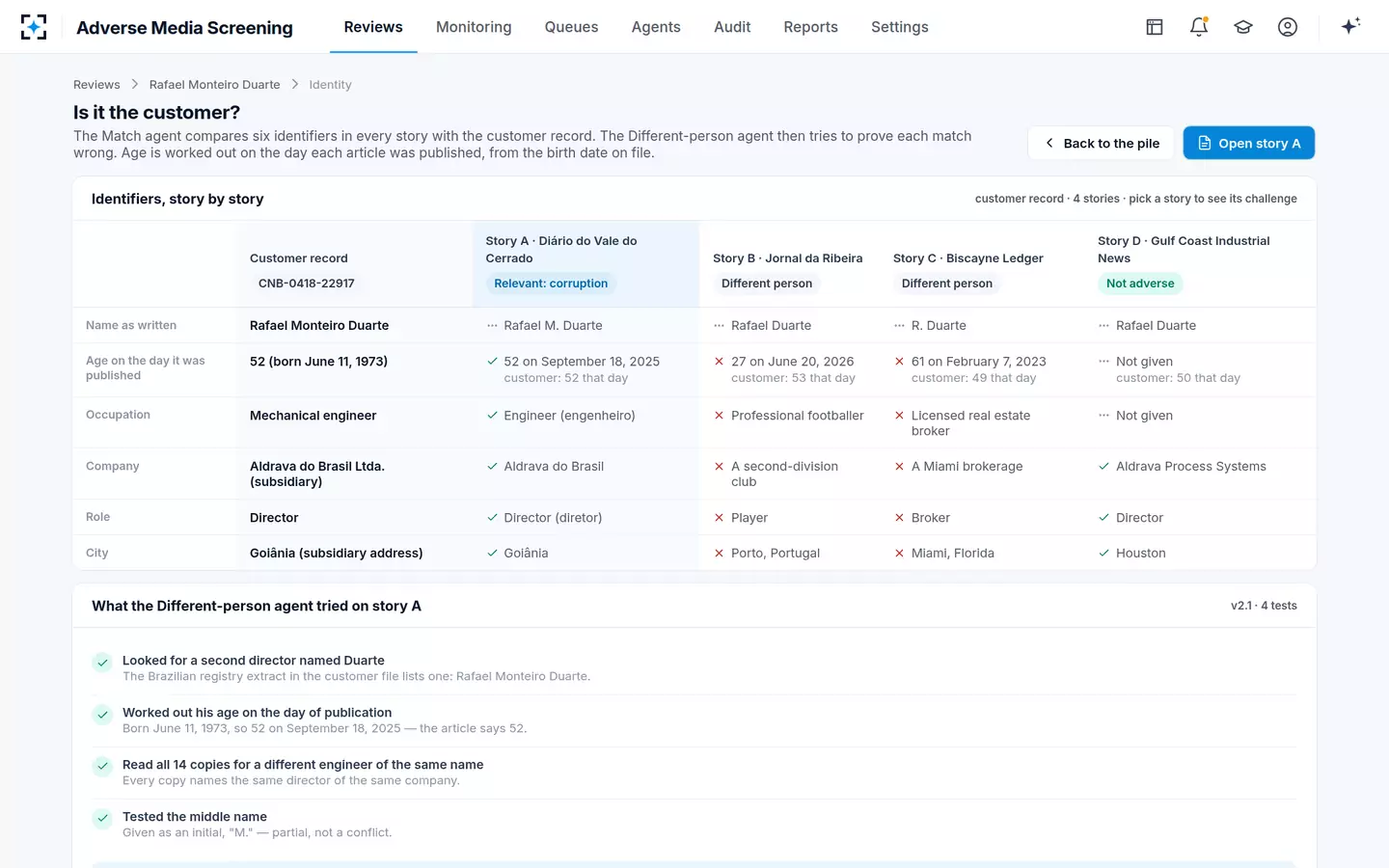
Story A: the one match that survived every test
Story A is what a real match looks like when the name is not quite right. The original, in Portuguese, was published on September 18, 2025 and copied 13 times, 11 more times in Portuguese, once in Spanish and once in English. It reports that state prosecutors are investigating whether a R$38.6 million tender for industrial pumps was steered to one bidder, and the sentence that ties it to a person reads: "Entre os investigados está o engenheiro Rafael M. Duarte, 52 anos, diretor da Aldrava do Brasil, empresa com sede em Goiânia." Among those under investigation is the engineer Rafael M. Duarte, 52, director of Aldrava do Brasil, a company based in Goiânia.
Five identifiers in that one sentence agree with the customer file: the age on the day, the occupation, the company, the role and the city. The sixth, the name, is partial: the article gives the middle name as an initial. A partial name is a gap, not a conflict, and the Different-person agent tested it as one, alongside a search of the Brazilian registry extract for a second director named Duarte and a read of all 14 copies for a different engineer of the same name. None of the four tests showed a different person. Only then did the story go to the analyst, as a proposal: whether it is relevant, at which stage, and what it does to the customer's risk is still hers to decide.
What is a namesake false positive?
A namesake false positive is a hit on an article about a different person who shares the customer's name, or a form of it. It is the most common reason a hit is set aside, and the most dangerous to set aside badly, because the same reasoning that dismisses a namesake can dismiss the customer.
On the sample review, stories B and C were namesakes. Story B, 11 copies, reported a footballer of 27 detained after a nightclub fight in Porto; the customer was 53 that day, an engineer, with no address, travel or payment tie to Portugal on file. Story C, 8 copies, reported a Miami real estate broker of 61 disciplined over escrow funds; the customer was 49 that day. In each, five identifiers conflicted and only a form of the name agreed.
The different-person check: every test, kept for the reviewer
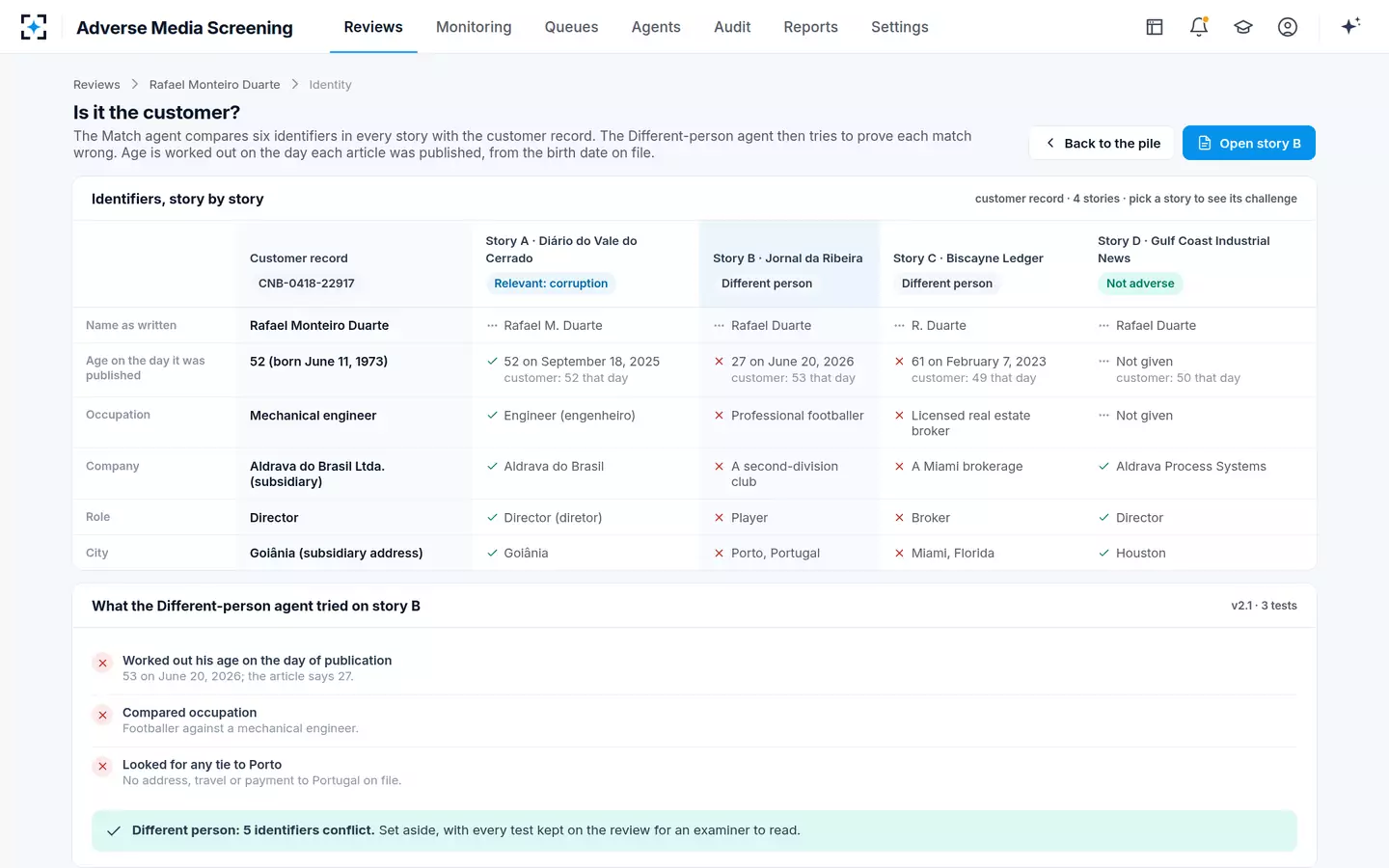
In the solution, the Match agent compares the six identifiers, and the Different-person agent then argues the other side: it tries to prove each matched story is about somebody else, using age on the day, occupation, company, city and the registry extracts in the customer file, and writes down every test. On story A it ran four tests, including a check that the Brazilian registry lists only one director named Duarte, and could not show a different person. Neither agent decides relevance; a named analyst does. Why the skeptical agent matters most is the subject of its own guide.
What if the article is old?
An old article is still evidence, but read it for what has happened since. The identity test is unaffected if the dates are handled properly: story C ran in 2023 and was ruled out using the customer's age in 2023. The relevance test is where age matters. An investigation reported eight years ago may have ended in charges, an acquittal or nothing, and the bank needs the latest stage, not the first headline.
Two settings govern old news. The look-back sets how far back a first review searches, ten years at the sample bank. Ongoing monitoring then watches the stories already on file, so a follow-up that reports charges or an acquittal joins its story and moves its stage. In the sample bank's monitoring, a regional court's acquittal of three defendants in a VAT fraud case led the agents to propose lowering that story's weight; a person decides.
When a hit should stay open
A hit should stay open, with a person deciding, when the identifiers neither confirm nor rule out. Closing it because a confirmation is missing is the classic error. The sample bank's queue shows one: an onboarding review in which a 2019 charity fraud story names "A. Nwachukwu" with no age or city, against a prospect with that surname; the agents' confidence was 0.71, below the 0.85 the bank requires before proposing a match, so the review was held for an analyst rather than set aside.
Sanctions enforcement shows what over-confident discounting costs. In a case OFAC settled with TD Bank in 2021, a reviewer dismissed an alert on a designated individual "Despite first and last name and date-of-birth matches", because the full name, date of birth and location did not all line up. Four more alerts followed over four years, three dismissed for similar reasons, before the fifth was found to be a true hit (OFAC, TD Bank enforcement release, 2021). The analyst demanded every identifier agree when two strong ones already did. News is messier than a list, which makes the same error easier.
Before closing an adverse media hit
- Group the copies first
Test identity on the story, using the fullest copy, not on each article.
- Work out the customer’s age on the publication date
Never compare an article’s age with the customer’s age today.
- Separate conflicts from gaps
An identifier the article does not print is missing, not a conflict.
- Weigh strong identifiers above weak ones
Age or date of birth outweighs city or job, which change over time.
- Try to prove it is someone else, and write the tests down
Registry extracts, addresses, travel and payment ties in the customer file.
- Keep it open when the evidence is thin
A partial name with no other identifier is a question for a person, not a closure.
- Route anything that mentions sanctions
A news report of a designation goes to the sanctions team, whoever it seems to be about.
A hit that passes the identity test is still only half decided: it then needs a relevance judgement, a stage and a reason a second reader would accept. That is the subject of adverse media findings two analysts would both sign. To see identity worked on every story of a review, start from Adverse Media Screening.
Questions people ask
What does "adverse media no match found" mean?
It means no article in the sources searched matched the customer's name forms and the bank's risk terms. It is a valid result only if the file says what was searched: which name forms, languages, sources and years. Without that, "no match found" cannot be told apart from a search that was never broad enough to find anything.
Is an adverse media hit a red flag?
Not by itself. A hit is a candidate; most are copies, namesakes or harmless news. It becomes a red flag when it is shown to be about the customer and reports conduct in a crime category the bank screens for, from a credible source, at a stage the bank's policy treats as relevant.
How do you match an adverse media hit on a company?
Use the company's identifiers: exact and trading names, registration number, date of incorporation, addresses and the names of its directors and owners. Wolfsberg lists date of incorporation alongside date of birth as a key secondary identifier. Group companies and subsidiaries need care, because a story about a parent or a sister company is not automatically about the customer.
How many identifiers must agree to confirm a match?
No rule sets a number. A sound practice is that no single identifier confirms a match, a clear conflict on a strong identifier such as age rules one out, and a match is proposed only when several strong and weak identifiers agree with no conflict. On the sample review, story A was proposed with five agreeing and the name partial.
Who decides that a hit is the customer?
A named analyst, recording the identifiers and the reason. In Adverse Media Screening the agents propose and challenge, but only an analyst confirms, with a reason code, and a different person accepts the story into the customer file.