The bank guarantee process runs from a client's request, which arrives carrying the beneficiary's own wording, through five checks before anything is issued: the wording against the bank's model form, the amount and term against a credit approval, the parties against sanctions lists, any clause outside the model form against trade counsel, and a second person's release of the message. After issue the same instrument is amended, extended, reduced, drawn on or left to expire, and each of those events has its own rule and its own clock. The difficulty is rarely one step. It is that the clause deciding how much the bank owes, and for how long, is read in one seat and priced in another. Botminds' Bank Guarantee & Standby LC Issuance reads every clause against the model form and the rule behind it, so each seat starts from the same cited file.
The guide follows one request through each seat. The example is sample data on fictional companies: Corvane National Bank, issuing a USD 2,500,000 performance standby for a marine contractor building two berths for a port authority. The rules are quoted from the International Chamber of Commerce's own free texts and from US regulation, and they apply to an instrument only because its wording says it is subject to them.
Six seats carry one guarantee in Bank Guarantee & Standby LC Issuance, and each keeps one decision
Today
Forwards the beneficiary's wording by email and promises the client a same-day answer before anyone has read it.
With agents
Logs the request with the contract and the wording; the deviations are listed before the first call back.
Still theirs: the client conversation, and asking the beneficiary to accept a redraft
Today
Compares the beneficiary's free text with a model form in a shared folder, clause by clause.
With agents
Opens a file already compared and cited, and decides the three clauses that change the bank's liability.
Still theirs: accepting, editing or rejecting every clause, with a reason
Today
Learns that a standby outlived its facility when the annual review finds it.
With agents
Receives an exception only when amount, tenor or beneficiary falls outside the approval.
Still theirs: every limit and every excess
Today
Answers wording questions in email threads with no file at the end.
With agents
Signs only the clauses with no model equivalent, with the opinion attached to the instrument.
Still theirs: governing law, forum, transfer and non-model clauses
Today
Re-reads the whole instrument to find what changed, then releases on trust.
With agents
Sees each deviation, the wording that goes out and who decided it.
Still theirs: the release of every message, and never of anything they drafted
Today
Screens the names someone remembered to send.
With agents
Receives the parties, vessels and ports named in the contract, with any possible match held.
Still theirs: clearing or confirming every possible match
What is the bank guarantee process, step by step?
Step by step, the bank guarantee process has ten moves, seven before issue and three after. A request comes in with the underlying contract and the wording the beneficiary will accept; the wording is compared with the bank's model form; the amount, tenor, currency and beneficiary are checked against the credit approval; collateral and the client's counter-indemnity are confirmed; the parties are screened; counsel signs any clause the model form does not cover; and a checker releases the issuing message. After issue the bank books the contingent liability, watches every date that changes it, and examines any demand inside the period its rules allow.
One request through Bank Guarantee & Standby LC Issuance, from the beneficiary's wording to an issued standby
A person decides
Relationship manager logs the requestContract, requested wording, amount and beneficiary attached to one file.
Agent
Wording agentMatches each clause to the model form and redrafts any deviation, citing the rule.
Never: accepts its own redraft
A person decides
Specialist decides each clauseAccept, edit or reject, under a reason code.
Agent
Facility and sanctions agentsAmount, tenor and collateral against the approval; parties against the lists.
Never: raises a limit or clears a match
A person decides
Counsel signs non-model clausesLaw, forum, transfer, anything with no model equivalent.
A person decides
Checker releases the messageThe instrument is issued when it leaves the bank's control.
The order matters more than it looks. Wording comes first because every later check depends on it: credit cannot confirm a tenor until the expiry clause is settled, and the checker cannot release an instrument whose reduction clause might never operate. On the sample request the wording review found three deviations among sixteen clauses, and one of them, an expiry clause with no date, was also the only credit exception.
Who approves a bank guarantee?
Credit approves the exposure, and operations releases the instrument; neither approval replaces the other. A guarantee or standby is credit to the client: the bank pays the beneficiary when its client has failed to perform or to pay, and then looks to the client to reimburse it. US examiners treat it that way. The OCC's examination procedures ask whether "the credit of the account party under any standby letter of credit is analyzed as thoroughly as that of an applicant for an ordinary loan", and tell examiners to combine standbys with the bank's other loans to the same account party when applying the lending limit (OCC Comptroller's Handbook, Trade Finance and Services).
The lending-limit rule says so directly. Its definition of a "contractual commitment to advance funds" includes an obligation to "guarantee or act as surety for the benefit of a person" and to "advance funds under a standby letter of credit" (12 CFR 32.2(g)). A standby therefore draws on the same limit as a loan, and is approved against a facility, as the sample request was: USD 2,500,000 against a USD 40,000,000 trade facility approved on September 14, 2026, leaving USD 15,750,000 available after issue.
What credit usually cannot see is the wording. An approval states an amount, a tenor and a purpose. Whether the instrument actually ends on that tenor, or reduces as the works progress, is decided by clauses credit never reads, which is why the specialist's seat and the credit seat have to share one file.
Where does the wording come from? The relationship manager's seat
The wording comes from the beneficiary, not the bank. The industry's own description of the product says as much: "Contract terms will be agreed between applicant and beneficiary. Details of the required SBLC or Guarantee are then communicated by the applicant to his bank so that the SBLC or Guarantee can be issued" (Wolfsberg Group, ICC and BAFT, Trade Finance Principles, 2019, Appendix III). A ministry, a port authority, a landlord or a utility sends its standard text; the client forwards it; the relationship manager promises an answer.
ICC's demand-guarantee rules recommend what every guarantee should name: the applicant, the beneficiary, the guarantor, a reference to the underlying relationship, the guarantee's own reference, the amount and currency, the expiry, the terms for demanding payment, whether a demand may be presented on paper or electronically, the language of documents, and who pays charges (URDG 758, art. 8). A request that arrives without one of them is incomplete, and the relationship manager is the person best placed to go back to the client before the specialist's clock starts.
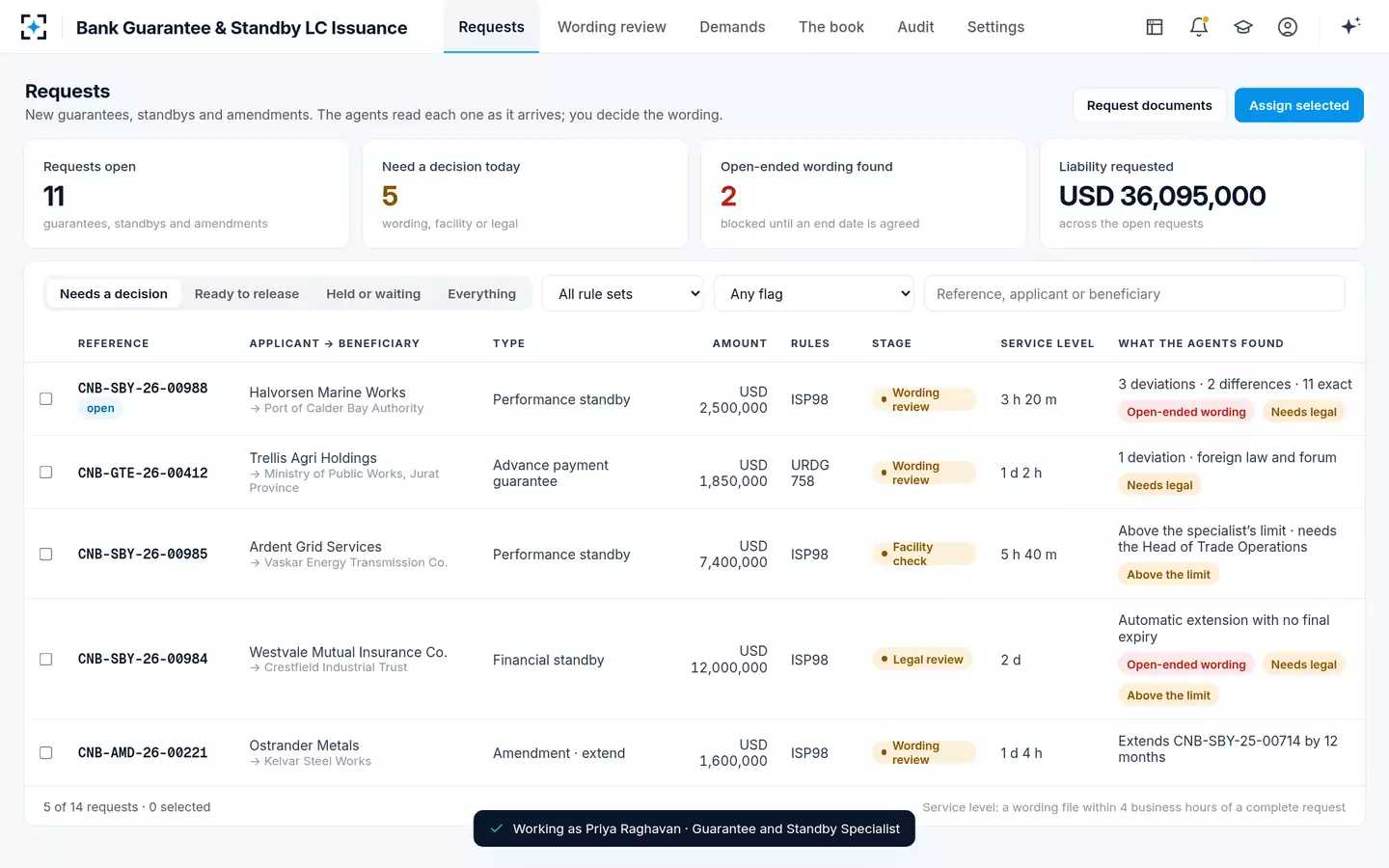
The request queue, with what the agents already found
The specialist's seat: the clause against the model form
The specialist decides whether the requested wording changes the bank's obligation, clause by clause. Most clauses do not. On the sample request eleven of sixteen matched the model form exactly and two differed only in wording; three changed the obligation. Those three are the kind that recur, because each one quietly contradicts a rule the instrument is about to be made subject to.
Three clauses that change the obligation, and the rule each one meets
| Requested wording | What it does | The rule it meets |
|---|---|---|
| "Valid until all obligations under the contract are fulfilled" | No expiry date and no right to terminate: the liability has no end the bank can see. | ISP98 rule 9.01 requires an expiry date or a right to terminate on notice; URDG 758 art. 25(c) ends a guarantee with neither after three years. |
| "The amount shall reduce as the works progress" | Names no document, so the bank cannot tell when the amount falls. | URDG 758 art. 7 and art. 13, and ISP98 rule 4.11: a condition with no document is disregarded, so the full amount stays on risk. |
| "Governed by the law and courts of the beneficiary's place" | Moves the dispute to a foreign court and law. | Under URDG 758 arts. 34 and 35 the default is the law and courts of the issuing branch; changing that is counsel's decision. |
Some requested words change nothing and the specialist should leave them alone. ISP98 says a standby "should not or need not state" that it is unconditional, absolute, primary or payable on demand, and that if it does, each word means only what the rules already provide, such as that payment "is conditioned solely on presentation of specified documents" (ISP98 rule 1.10). Separating those harmless words from the three that matter is most of the specialist's judgment, and it is the part a model form alone cannot do. The difference between the two rule sets that sit behind the forms is set out in the difference between a bank guarantee and a standby letter of credit.
Credit's seat: does the instrument fit inside the approval?
Credit's question is whether the instrument, as worded, stays inside what was approved. The national-bank rule on independent undertakings sets the minimum: the undertaking "should be limited in amount", should be limited in duration or let the bank terminate it periodically or on notice, or should entitle the bank to cash collateral on demand, and the bank should be fully collateralized or hold a right of reimbursement after it pays (12 CFR 7.1016(b)(1)).
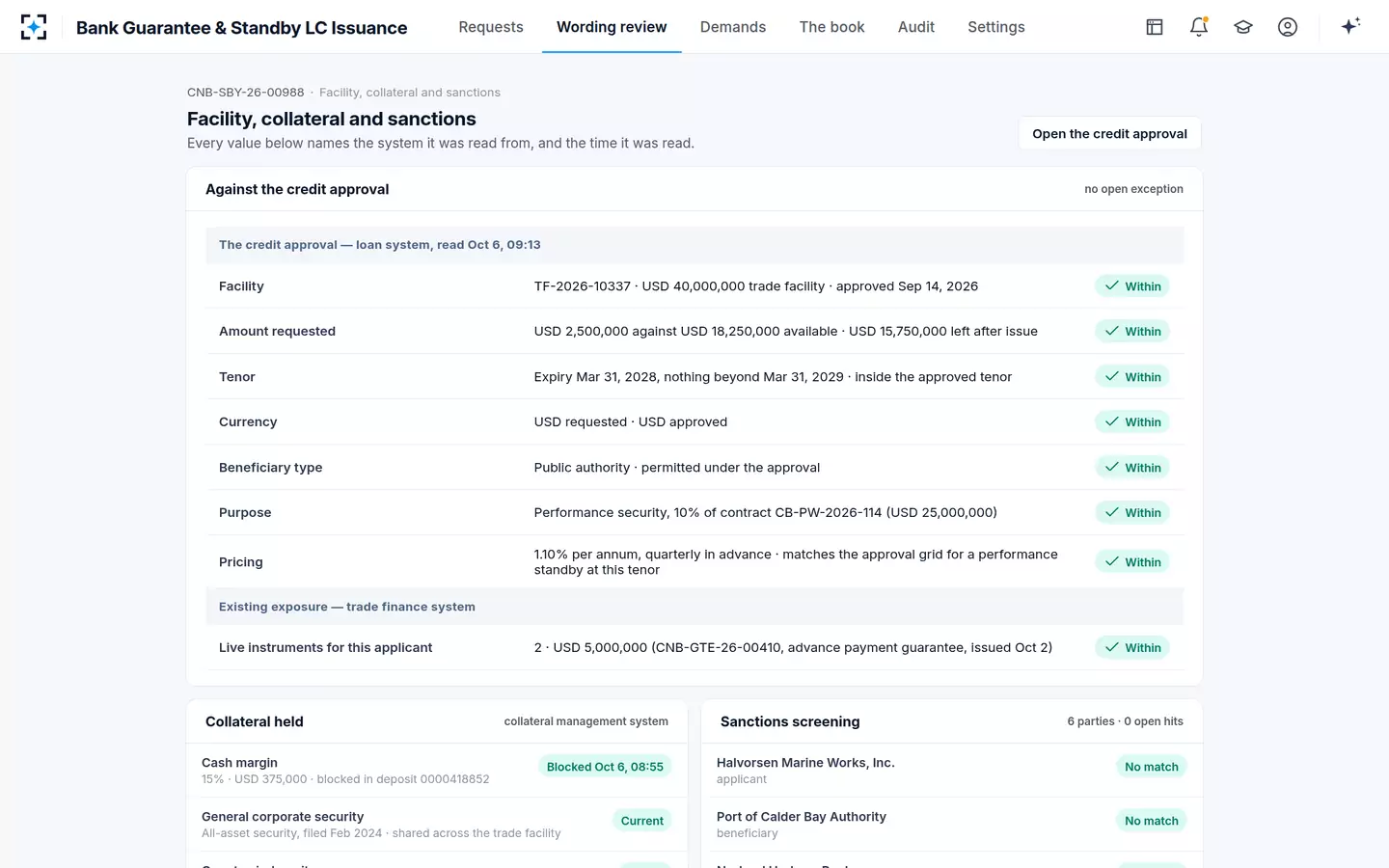
That list reads like a credit checklist because it is one, and each item can fail on wording alone. An expiry clause with no date defeats "limited in duration" even when the approval has a firm tenor. On the sample request the facility check passed on amount, currency, beneficiary type, purpose and pricing. Its one exception was the tenor: the requested wording ran past March 31, 2029, when the facility matures.
Amount, tenor and collateral, each against the credit approval
Sanctions and due diligence: why the check before issue matters most
Screening matters most before issue, because after issue the bank has little room to stop. The 2019 industry principles put it plainly: "once a SBLC or guarantee has been issued, Bank A has an obligation to complete the transaction. Only if subsequent reviewing activity showed a “positive match” of applicable names in the transactions with the names on Sanctions and Terrorist lists, would Bank A be in a position to stop the transaction" (Trade Finance Principles, Appendix III, 5.4(b)).
The same appendix lists what should be screened at the issuing request: the client, the beneficiary and other principal parties, names and countries, the type of goods if any, ports, and the structure of the instrument. On the sample request that meant six parties and a vessel named in the contract schedule. One possible match, the consulting engineer named in the contract, was held and cleared by the sanctions team on date of birth and address; the screening agent does not clear its own matches.
Counsel's seat: the clauses no model form covers
Counsel's seat exists for the clauses where the bank is choosing a legal position rather than matching a form: governing law, forum, transfer and assignment, and anything the model form does not contain. URDG 758 supplies defaults if a guarantee is silent, the law of the place of the issuing branch and the exclusive jurisdiction of its courts (arts. 34 and 35), so a beneficiary asking for its own law and courts is asking the bank to give up both.
Those defaults travel down a chain of counter-guarantees, which is why counsel reads them closely. In a February 2026 English case, a London bank faced a demand of £2,475,441.02 under a performance bond and had already been paid under a counter-guarantee from a Hong Kong bank; because that counter-guarantee was subject to URDG 758, the court accepted that its governing law and courts defaulted to Hong Kong (CR Construction v Barclays [2026] EWHC 202 (TCC)). On the sample request, counsel accepted New York law and courts in place of the beneficiary's, and signed the deviation with an opinion on file.
The checker's seat: the release is the moment the bank is bound
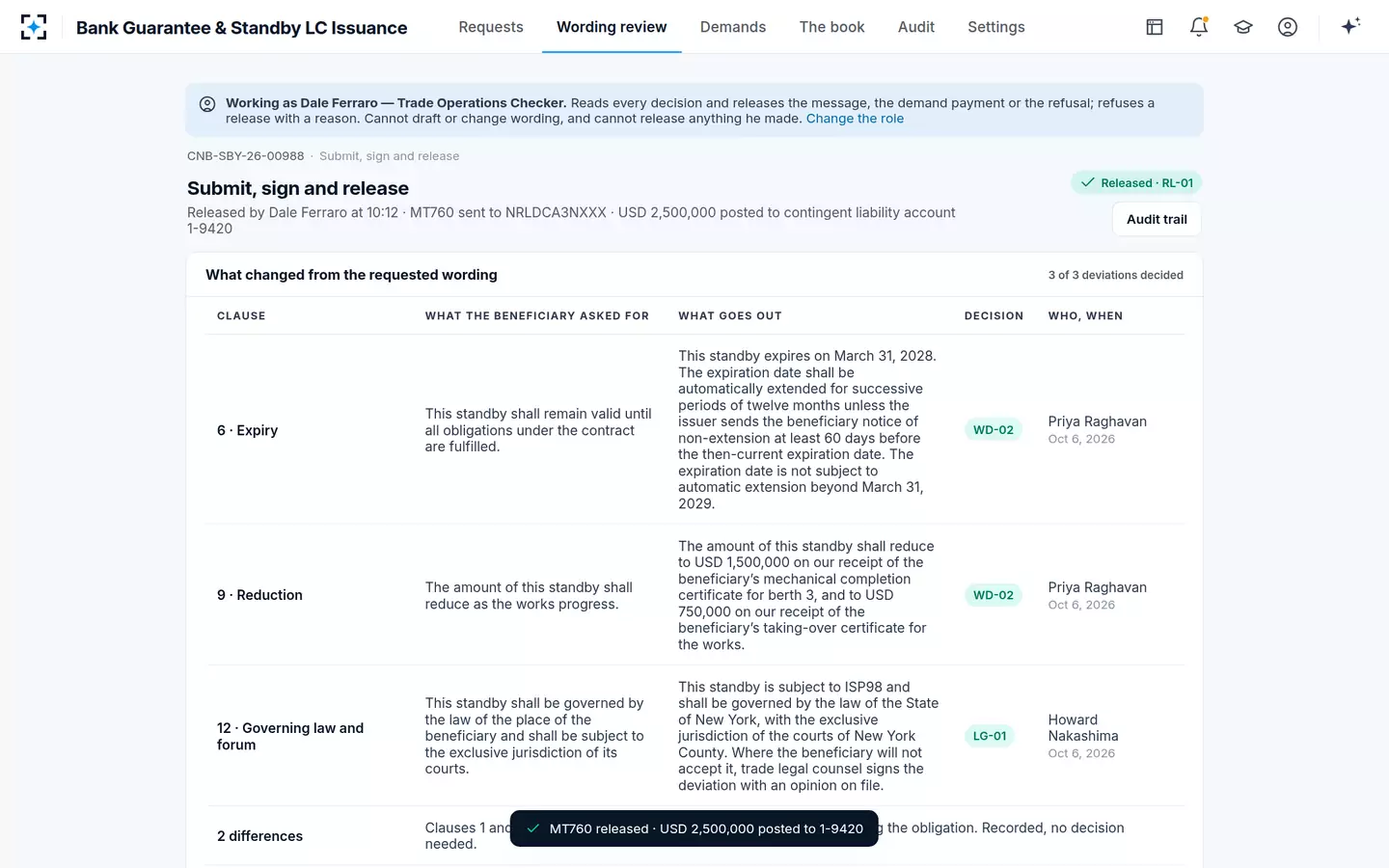
The checker's release is the legal moment of issue, not a clerical last step. "A guarantee is issued when it leaves the control of the guarantor", and it "is irrevocable on issue even if it does not state this" (URDG 758, art. 4); ISP98 rule 2.03 says the same of a standby. From the instant the issuing message leaves the bank, the beneficiary holds an undertaking the bank cannot amend or cancel without consent.
That is the argument for maker-checker at release, and for a checker who sees what changed rather than re-reading the whole instrument. The rule on independent undertakings adds a books-and-records duty: a bank "must accurately reflect the bank's or savings association's undertakings in its records" (12 CFR 7.1016(b)(4)), so the contingent liability should be booked at the same moment the message goes.
What changed, who decided it, and a checker's release
After issue: which seats wake up when something changes?
After issue, three events bring the seats back: an amendment, a demand and a date. An amendment binds the beneficiary only with its agreement, and a partial acceptance counts as a rejection (URDG 758, art. 11(b) and (e)), so the specialist and counsel see it again and the relationship manager carries it to the beneficiary. A demand must be passed on to the client without delay (art. 16), examined within five business days (art. 20(a)), and refused, if at all, in a single notice listing every discrepancy (art. 24); what a defensible demand file holds walks through it.
The dates are the quiet ones: reductions on a certificate, automatic extensions that happen unless the bank gives notice, and expiry. Nobody's inbox announces them, which is why they are watched as a calendar across the whole book rather than remembered by the specialist who issued each instrument.
The handoffs where a guarantee most often goes wrong
- Wording to credit
Credit approves a tenor; the expiry clause decides whether the instrument keeps to it.
- Credit to collateral
Cash margin and counter-indemnity confirmed before release, not after.
- Specialist to counsel
Law, forum and transfer clauses routed every time, not when someone thinks of it.
- Release to the books
The contingent liability booked with the message, at the same amount.
- Issue to the calendar
Every reduction, extension window and expiry dated on the day of issue.
- Demand to the client
The client told without delay, and the examination clock counted from the day after presentation.
How long does a bank guarantee take?
No regulator or standard-setter publishes how long banks take to issue a guarantee, and the rules set no clock for issue; their clocks start only when a demand arrives. The time a bank controls is the review of the wording and the approvals. The time it does not control is the negotiation with the beneficiary over any clause the bank will not accept, which can take longer than everything else together.
The useful measure is therefore internal: hours from a complete request to a cited wording file, and days from the bank's redraft to the beneficiary's acceptance. The sample bank sets itself a service level of a wording file within four business hours of a complete request; that is its own setting, not a market figure. There is no federal occupation code for the people doing this work either: O*NET's search for "standby letter of credit" returns only general credit, clerical and financial-specialist occupations (O*NET OnLine), so staffing benchmarks have to come from a bank's own desk.
Where a bank is US-chartered, the instrument it issues is more often a standby than a guarantee, for reasons of law rather than habit; what the OCC actually allows explains why. To see the seats working from one file, start from Bank Guarantee & Standby LC Issuance.
Questions people ask
What documents are needed for a bank guarantee?
The bank needs the client's application, the wording the beneficiary requires, an extract of the underlying contract, and the client's counter-indemnity, plus whatever collateral the approval calls for. The industry principles add due-diligence questions at the request stage: the countries the client trades with, the goods or services, and the kind of parties it does business with.
Who drafts the guarantee wording?
Usually the beneficiary, through its tender documents or contract, and the bank then compares that text with its own model form. The bank's specialist redrafts any clause that changes the obligation, and trade counsel signs the clauses that have no model equivalent, such as a foreign governing law.
What is a model form?
A model form is the bank's approved wording for one type of instrument under one rule set, such as a performance standby under ISP98 or an advance payment guarantee under URDG 758. The sample bank keeps four ISP98 forms, three URDG 758 forms and three local-law forms, each versioned, so every issued instrument names the form version it was checked against.
Can a bank guarantee be cancelled before it expires?
Not by the bank alone. Under ISP98 rule 7.01 a beneficiary's rights "may not be cancelled without its consent", and under URDG 758 art. 25(b) a guarantee terminates early only when nothing remains payable or the beneficiary presents a signed release.
Is a bank guarantee counted as a loan?
For lending limits, yes: US rules count an obligation to guarantee or to pay under a standby as a contractual commitment to advance funds, so it is combined with the client's other borrowings. On the balance sheet it is an off-balance-sheet contingent liability until the bank pays.
What is a counter-guarantee?
It is an undertaking by one bank, usually the client's own, to reimburse another bank that issues the guarantee locally to the beneficiary. URDG 758 defines it in art. 2, and a demand under it needs a statement that the local bank has received a complying demand (art. 15(b)).