LC document checking is the examination a bank makes of the documents presented under a letter of credit, to decide on the documents alone whether they comply with the credit, with UCP 600 and with international standard banking practice. Step by step it means: split the presentation into its documents and count the originals, read the credit as amended, pull every relevant value out of every page, cross-check each value against the credit and against the other documents, decide which differences are discrepancies, and send either payment or one notice of refusal. Botminds' Letter of Credit Document Checking gives the first four steps and the drafting to agents, examines each presentation twice, and leaves the decision and the release to named people. This guide follows one presentation through every step.
The presentation is from a fictional sample bank, Corvane National Bank: import credit CNB-ILC-26-04417 for USD 1,284,600.00, 1,200 metric tons of hot-rolled steel coil, CIF Baltimore, shipped from Gdańsk. The rules quoted are UCP 600 as the ICC itself publishes it free online.
Seven steps from a scanned presentation to a released payment or one notice
Agent
Split and countSplits 24 scanned pages into six named documents and counts originals against what field 46A calls for.
Never: decides whether anything complies, or discards a page
Agent
Read the creditTurns the MT700 and both amendments into seven lanes, one per term, and marks a condition with no document as disregarded.
Never: infers a term the credit does not state
Agent
Extract every valuePlaces 38 values on the lanes, each with its document, page and line, the original wording beside the reading.
Never: normalizes a value silently or writes a finding
Agent
Examine twiceTwo examiner agents on different models and prompts test every lane independently and write findings with the clause, the line and the article.
Never: resolves its own disagreement
A person decides
Decide each findingThe examiner accepts, strikes or edits every finding with a reason code from the bank's own list.
Agent
Draft the notice and waiver requestWrites the single notice of refusal and the waiver request from accepted findings only.
Never: adds a discrepancy no examiner accepted, or sends anything
A person decides
ReleaseA senior checker reads the evidence and releases the payment, the notice or the waiver request. The examiner cannot release their own work.
How does LC document checking work step by step?
LC document checking works from the credit outward: first establish what the credit demands, then what each document says, then whether they fit. The order matters because the credit, not the documents, defines the test. A checker who starts with the invoice and works back to the credit reads the documents for what they contain; a checker who starts with the credit reads them for what is missing.
Each step below names the article it rests on. The rules are private: UCP 600 applies because the credit says it is subject to UCP 600, as the sample credit does. Without that incorporation a US credit would be governed by UCC Article 5 alone, whose standard is similar but whose clock is longer.
Step 1: split the scan and count the originals
The first step is clerical and unforgiving: name each document in the scan and count its originals against what the credit calls for. UCP 600 art. 17(a) is short: "At least one original of each document stipulated in the credit must be presented" (ICC, UCP 600). A bill of lading issued in several originals must be presented as "the full set as indicated on the bill of lading" under art. 20(a)(iv), and an insurance document issued in more than one original must come with all of them under art. 28(b).
The sample presentation arrived as one 24-page scan. The intake agent split it into six documents: a commercial invoice in three originals, a bill of lading showing 3/3 originals, a packing list, an insurance certificate in two originals, a certificate of origin and an inspection certificate. It counted each against field 46A and raised nothing, because nothing was short. Had a page been unreadable it would have raised an exception rather than guess, and it never discards a page.
Step 2: read the credit as amended, and what fields 46A and 47A do
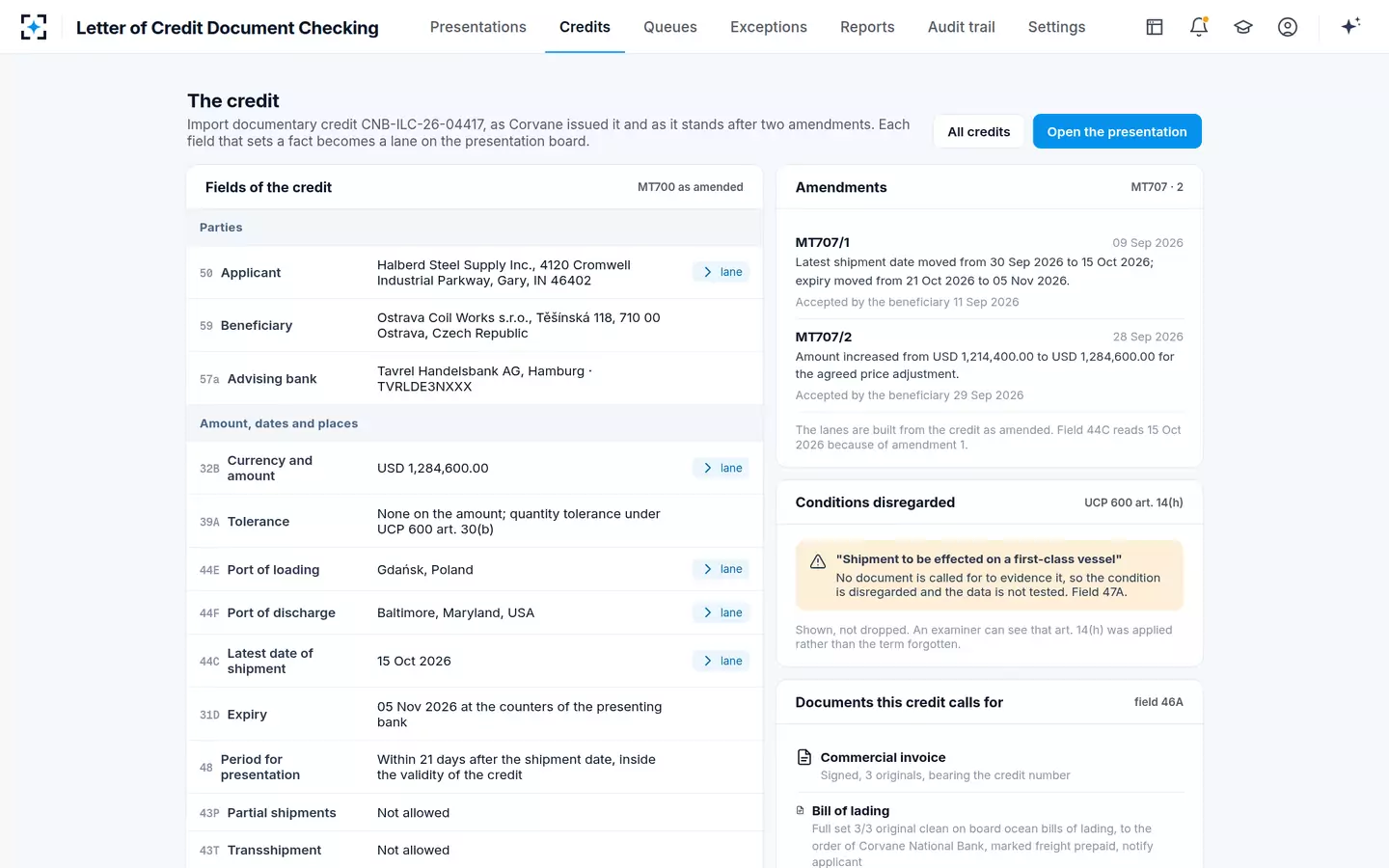
The credit is read in its current form, including every amendment the beneficiary has accepted, because that is the credit the documents must meet. UCP 600 art. 10(c) keeps the original terms in force for the beneficiary "until the beneficiary communicates its acceptance of the amendment to the bank that advised such amendment". The sample credit was amended twice: the first amendment moved the latest shipment date from 30 September to 15 October 2026 and the expiry from 21 October to 5 November; the second raised the amount from USD 1,214,400.00 to USD 1,284,600.00. The beneficiary accepted both.
Which credit fields become the lanes every document is tested against
| MT700 field | What it sets | Lane on the sample credit | Documents that speak to it |
|---|---|---|---|
| 45A | Description of goods and quantity | Hot-rolled steel coil; 1,200 metric tons | Invoice, bill of lading, packing list, insurance, origin, inspection |
| 32B and 46A | Amount; insurance cover required | USD 1,284,600.00; insurance for 110% of CIF value | Invoice, insurance certificate |
| 44E and 44F | Port of loading and port of discharge | Gdańsk, Poland to Baltimore, Maryland | Bill of lading, invoice, insurance, origin |
| 44C | Latest date of shipment | 15 October 2026, as amended | Bill of lading, inspection certificate |
| 50 | Applicant | Halberd Steel Supply Inc., Gary, Indiana | Invoice, bill of lading notify party, packing list, origin |
| 46A | Documents required, with originals and wording | Six documents, originals as stated | All six |
| 47A | Additional conditions | Shipment on a first-class vessel | None called for: disregarded under art. 14(h) |
Field 46A lists the documents and what each must show; 47A carries additional conditions. The difference matters because of art. 14(h): a condition for which the credit names no document to show compliance is treated as not stated and disregarded (article 14 explained quotes the paragraph). The sample credit's 47A requires shipment on a first-class vessel but calls for no document to show it, so the credit terms agent marks the condition as disregarded and shows it on screen, struck through, rather than dropping it. An examiner can see that art. 14(h) was applied instead of wondering whether the term was forgotten.
The credit as amended twice, field by field, with the disregarded condition shown
Step 3: extract every value, with the page and line it came from
Extraction is where most hand checking goes wrong, because it is where attention runs out. The extraction agent read all 24 pages and placed 38 values on the seven lanes, each carrying its document, page and line. It does not tidy a value it is unsure of: the original text stays beside the reading, so "1,198.420 MT" on the bill of lading is never quietly rounded to "1,200".
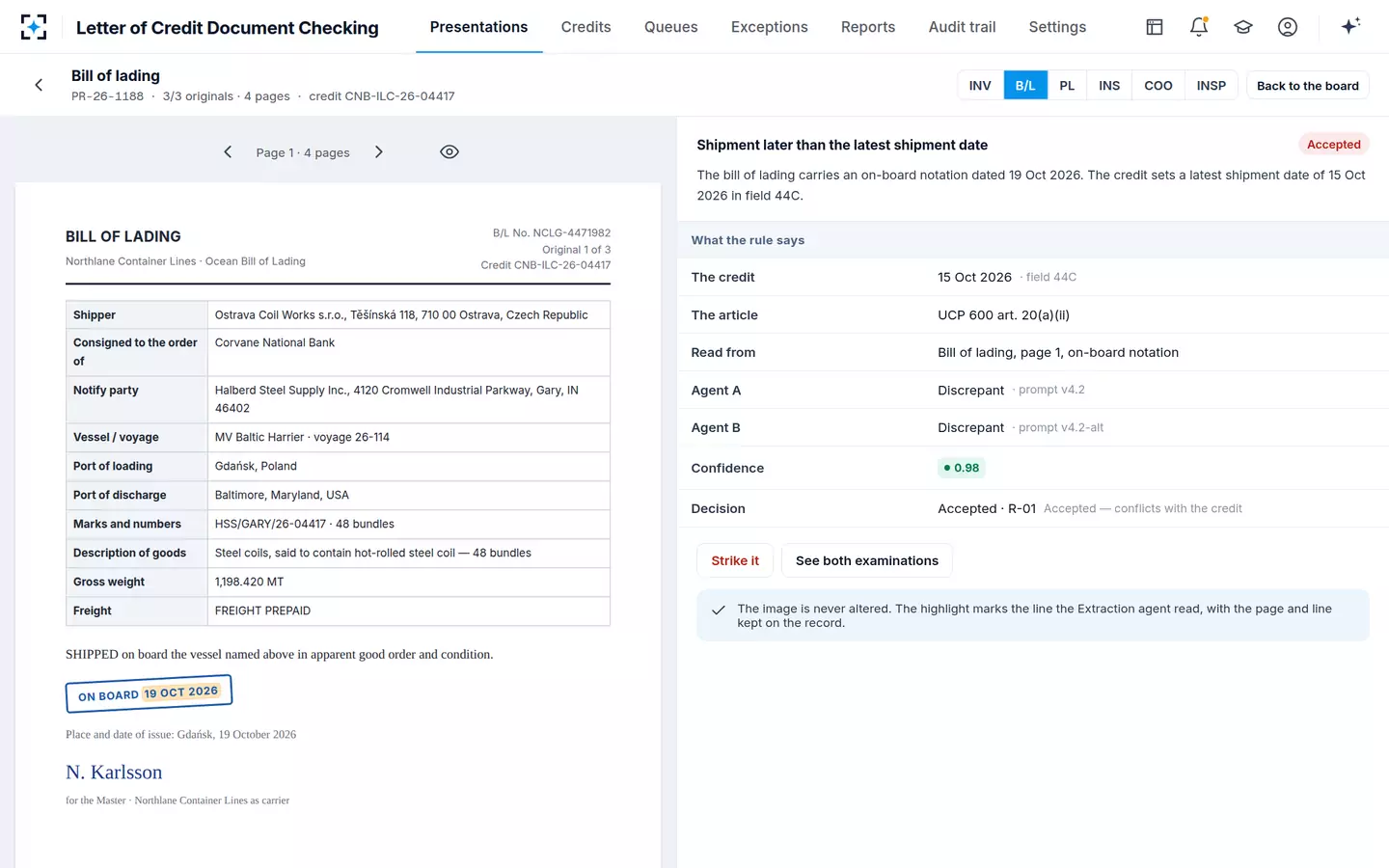
The value that mattered was a stamp. The bill of lading's pre-printed wording says the goods were shipped on board, and an on-board notation stamped beside it reads 19 October 2026. Under art. 20(a)(ii), "the date stated in the on board notation will be deemed to be the date of shipment" when the bill of lading contains one, not the date of issue. The extraction agent read the stamp, not the issue date, and placed 19 October on the latest-shipment lane.
The page itself: the on-board stamp, the clause and the article side by side
Step 4: cross-check every value against the credit and every other document
Cross-checking is two tests, not one: each value against the credit, and each value against the same value in every other document. The second is the one hand checking skips under time pressure, and UCP 600 art. 14(d) makes it part of the standard: data need not be identical but must not conflict with the credit or with any other stipulated document. How to check letter of credit documents against each other takes that rule through the cases.
On the sample, the cross-check produced three conflicts that are plainly discrepancies and two differences that are not. The insurance certificate covers USD 1,350,000.00. The credit asks for 110% of the CIF value, and the invoice shows a CIF value of USD 1,282,909.40, so the cover needed is USD 1,411,200.34; the certificate is USD 61,200.34 short. The inspection certificate is dated 21 October, two days after shipment, and the examiner accepted that as a discrepancy against the inspection certificate field 46A calls for. And the bill of lading's on-board date is four days after the latest shipment date.
The differences that are not discrepancies are as instructive. The bill of lading shows 1,198.420 metric tons against 1,200 in the credit, 0.13% short; art. 30(b) allows a tolerance of 5% more or less on quantity where the credit does not count packing units or items, and this one does not. The bill of lading also describes the goods as "Steel coils, said to contain hot-rolled steel coil" while the invoice repeats the credit's full description; art. 14(e) lets documents other than the invoice describe the goods in general terms, provided they do not conflict with the credit. A check that flagged either would waste an examiner's time, or worse, refuse a good presentation.
One sample presentation, as the agents laid it out
24
scanned pages split into six documents
38
values read, each with its page and line
7
lanes, one per term the credit sets
1
lane the two examinations read differently
Step 5: two examinations, and the one lane they read differently
The solution examines each presentation twice, with two examiner agents on different models and different prompts that cannot see each other's work until both finish. The reason is simple: a single engine has nothing to disagree with, so its wrong calls look exactly like its right ones. Agreement between two independent readings means something; disagreement is a signal that a person should look.
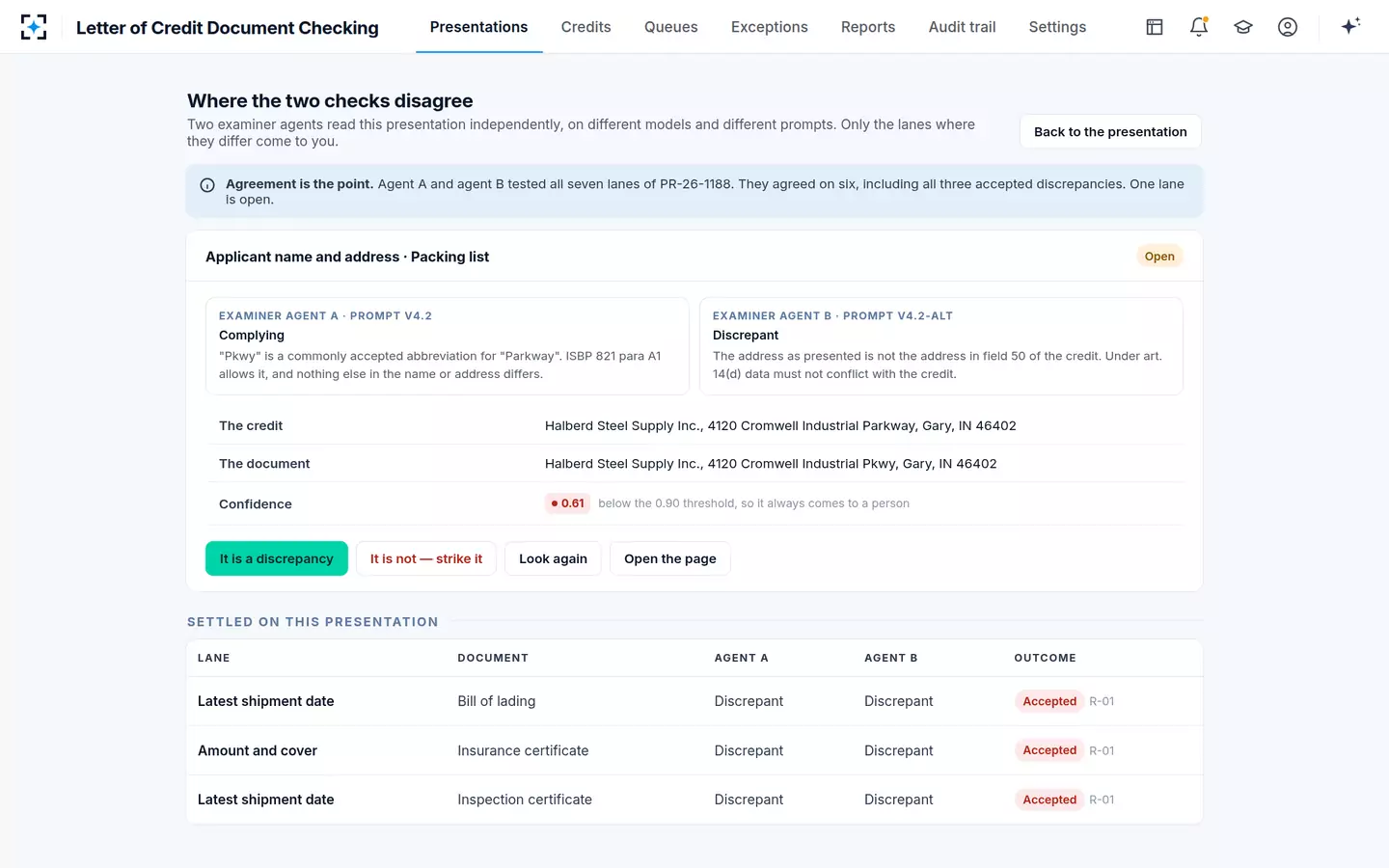
On the sample the two agents agreed on six of seven lanes, including all three discrepancies. They differed on the applicant's address. The packing list reads "4120 Cromwell Industrial Pkwy" where the credit reads "Parkway". Agent A called it an accepted abbreviation; agent B called it a conflict with field 50. Their confidence was 0.61, below the bank's 0.90 threshold, so the lane went to the examiner with both reasonings in full. Below the threshold a finding always reaches a person, even where both agents agree.
Where the two examinations differ, both reasonings reach the examiner
Who decides if a presentation complies?
A person at the bank decides, and the rules leave no room for anything else: art. 14(a) puts the duty to examine on the nominated, confirming and issuing banks, and art. 16 makes the refusal the bank's own act. In the solution the examiner accepts, strikes or edits every finding, and each decision takes a reason code from the bank's own list and a note kept with the presentation.
On the address lane the examiner struck the finding with reason R-07, an accepted abbreviation. She could have relied on a plainer rule too: under art. 14(j) an applicant's address on a document need not match the credit at all, provided it is in the same country, unless it appears as consignee or notify party on a transport document. A packing list is not a transport document. That is the kind of call the agents are built to bring forward, not to make.
The agents' job is to make sure the examiner never has to find the page. The examiner's job is to decide what the page means.
Step 7: one notice of refusal and one waiver request, drafted together
Once findings are decided, the drafting agent writes two documents at once: the single notice of refusal UCP 600 art. 16(c) allows, sent as an MT734, and the waiver request the issuing bank may send the applicant under art. 16(b). Both come from the accepted findings only, so the struck address finding cannot reach either. Each discrepancy is numbered and cited to the credit field and the article, and the notice says how the documents are held.
The bank then chooses the path. In the sample it asked the applicant first; the applicant waived all three discrepancies 48 minutes after the request went out, and a senior checker released payment on banking day 2 of 5. What happens if there is a discrepancy in a letter of credit follows each fork of that decision, including the one where nobody waives.
What does an LC checking system show the examiner?
A good LC checking screen shows the credit's terms, every document's value against each term, and the source line of every value, on one screen. The sample board puts the credit, the amount, the parties and a banking-day clock in a header, and below it the seven lanes. Each document drops a chip onto every lane it speaks to. Chips that agree line up; chips that conflict sit off the line and are marked discrepant, or "checks disagree" where the two examinations differ.
What the screen deliberately does not show is a score for the whole presentation. A presentation is not 90% compliant; it is complying or it is not, and the useful output is the list of lanes that are off, each with the page behind it. Confidence appears per finding, where it decides whether a person must look, not as a grade for the file.
Can LC document checking be fully automated?
No, and the industry's own standard says so. The Wolfsberg Group, the ICC and BAFT wrote in their 2019 Trade Finance Principles that parts of the work, such as screening against sanctions lists, may be automated, but that reviewing trade documents as a whole cannot by its nature be automated successfully, so that financial crime controls need a combination of automated and manual checks (Wolfsberg Group, ICC and BAFT, Trade Finance Principles, 2019 amendment; how technology can assist in combating TBML quotes them). Peer-reviewed research on AI in LC examination reaches the same place, judging full automation impractical for regulatory and trust reasons (Khalil et al., Digital Business, 2025; see what the research says about AI in LC work).
The trace above is built to that conclusion rather than against it. Agents do the reading, counting, extracting, cross-checking and drafting, which are the steps where a tired person makes mistakes. They do not decide compliance, clear a screening hit, extend the clock or send anything. A presentation leaves the bank on two human names, and every agent step and human decision sits on one trail that an auditor downloads as a single evidence pack. Trade finance automation software compared sets this design beside a rules engine and a fully manual desk. To see the full set of screens, start from Letter of Credit Document Checking.
Questions people ask
What are fields 46A and 47A in an MT700?
In the SWIFT MT700 that issues a documentary credit, field 46A lists the documents required and what each must show, and field 47A carries additional conditions. A 47A condition that names no document to evidence it is disregarded under UCP 600 art. 14(h), which is why the two fields have to be read together.
How are original documents counted under UCP 600?
At least one original of each stipulated document must be presented (art. 17(a)), and a document bearing an apparently original signature, mark, stamp or label of its issuer is treated as an original unless it says it is not (art. 17(b)). A bill of lading issued in several originals must be presented as the full set, and so must an insurance document issued in more than one original.
What are non-documentary conditions in a letter of credit?
They are conditions in the credit that no required document is said to evidence, such as "shipment on a first-class vessel" with nothing called for to prove it. UCP 600 art. 14(h) tells banks to deem them not stated and disregard them. A careful checking process shows them as disregarded rather than silently dropping them, so the examiner can see the article was applied.
Does the bank check the goods themselves?
No. UCP 600 art. 5 says banks deal in documents, not in the goods, services or performance the documents relate to. The examination asks whether the documents appear on their face to comply; whether the coil is really hot-rolled is between the buyer, the seller and any inspection the credit requires.
What happens to a document that was presented but not required?
Under art. 14(g) a document presented but not required by the credit is disregarded and may be returned to the presenter. It is not examined, so a conflict inside it is not a discrepancy, which is one more reason the first step of checking is to establish what the credit actually requires.