Agentic AI for trade finance means software agents that each carry out a defined task in a trade workflow, such as reading a scanned presentation, extracting every value, testing it against the credit, drafting the notice or counting the clock, and hand the result to the next agent or to a person, each within written limits on what it may do. In letter of credit checking the useful line is simple: agents prepare, the examiner decides. Under UCP 600 the duty to examine and the decision to refuse belong to the bank, and the industry's own standard-setters have said that the review of trade documents, taken as a whole, is not something automation can do well. Botminds' Letter of Credit Document Checking is built on that line. Eight agents read the presentation, test every term twice and draft the notice; an examiner accepts or strikes every finding, and a senior checker releases every payment, refusal and waiver request.
Regulatory, standard-setter and research sources are linked where they appear. Product examples come from a fictional sample bank, Corvane National Bank, as it runs through the solution.
Who may decide what on one presentation: four people, and the agents that serve them
Today
Reads every page, extracts every value and types the notice before deciding anything.
With agents
Opens findings each cited to the credit field, the page and the article, and decides each one.
Still theirs: Accepting, striking or editing every finding, with a reason code. May not release.
Today
Re-reads the presentation to trust the examiner's work.
With agents
Reads the evidence for each accepted finding and the checks behind the release.
Still theirs: Releasing every payment, notice and waiver request. May not prepare the same presentation.
Today
Tracks the five banking days in a spreadsheet.
With agents
Sees every presentation by banking day, escalated at day 3 and blocked at day 5.
Still theirs: Assigning, escalating and setting thresholds. May not release a payment.
Today
Hears about a vessel or party match when someone remembers to ask.
With agents
Receives every party, vessel, port and goods line before anything is released, with the presentation held on a hit.
Still theirs: Clearing or confirming every screening hit. No agent and no examiner may.
What is agentic AI in trade finance?
Agentic AI in trade finance is a set of AI agents, each with a defined job and defined limits, working through a trade operations process the way a team would: one reads, one extracts, two examine, one drafts, one watches the clock, and people decide. The difference from a single AI model answering questions is structure. Each agent's output is a record the next step can check, and each agent has things it is never allowed to do, written down and enforced by the system rather than by the agent's own judgment.
In the solution there are eight. An intake agent splits the scan and counts originals; a credit terms agent turns the credit and its amendments into terms to test; an extraction agent places every value with its page and line; two examiner agents, on different models and prompts, test every term independently; a drafting agent writes the notice and the waiver request; a screening agent sends parties, vessel, ports and goods to the screening system; and a clock agent counts the five banking days. None of them decides whether a presentation complies.
Which parts of LC examination can agents take?
The parts that can be checked against a document, not the review as a whole, and the honest answer starts from the industry's own position. In their Trade Finance Principles, the Wolfsberg Group, the ICC and BAFT accept that certain elements of reviewing a trade transaction can be automated, giving screening against published sanctions lists as the example, but hold that the review of trade documents taken as a whole is beyond what automation can do, and that anti-money-laundering work needs automated and manual controls together (Wolfsberg Group, ICC and BAFT, Trade Finance Principles, 2019 amendment; their words are quoted in how technology can assist in combating TBML).
That statement was written in 2019, about financial crime controls on trade transactions, before the current generation of language models. It still describes the right design. What has changed is which "certain elements" can be automated: reading a scanned bill of lading, extracting its on-board date, comparing it with field 44C and drafting the sentence for the notice are now within reach. What has not changed is the overall review: deciding whether a difference is a conflict, whether to ask for a waiver, whether to release money and whether a screening hit is real. The solution automates the first list and leaves the second to people, which is the combination the Principles describe.
What the 2019 statement says, and how the agents are built to it
Wolfsberg, ICC and BAFT, 2019: Certain elements of the process may be automated, screening against published lists given as the example.
Letter of Credit Document Checking: Reading, splitting, counting, extracting, cross-checking and drafting are automated; screening is sent to the bank's own system.
Wolfsberg, ICC and BAFT, 2019: Not automatable as a whole, in the standard-setters’ view.
Letter of Credit Document Checking: Every finding is accepted or struck by an examiner; every release is a senior checker's.
Wolfsberg, ICC and BAFT, 2019: A combination of automated and manual controls.
Letter of Credit Document Checking: Two independent examinations, a confidence threshold, reason codes, separation of duties and a clock that blocks day 5.
Wolfsberg, ICC and BAFT, 2019: Banks are generally not in a position to judge unit prices or to determine whether an export licence is required.
Letter of Credit Document Checking: The agents do not judge either; anything they notice goes to the financial crime team.
Can AI decide whether LC documents comply?
It should not, and the rules do not leave room for it. UCP 600 art. 14(a) puts the duty to examine a presentation, and to determine on the documents alone whether it complies, on the nominated, confirming and issuing banks (ICC, UCP 600). The determination is the bank's, and art. 16(f) makes the bank alone bear the consequence of getting the notice wrong. A bank can use any tool it likes to prepare that determination; it cannot hand the determination to the tool and still say its people examined the documents.
The research points the same way. A 2025 peer-reviewed study of AI-assisted LC examination, built with input from international banks, starts from the premise that human checkers must verify what the AI decides, and models how to assign those checks rather than how to remove them (Khalil et al., Decision Analytics Journal, 2025; what the research says about AI in LC work quotes it). The open question in the literature is how best to divide the work, not whether a person stays in it.
Who signs the refusal notice?
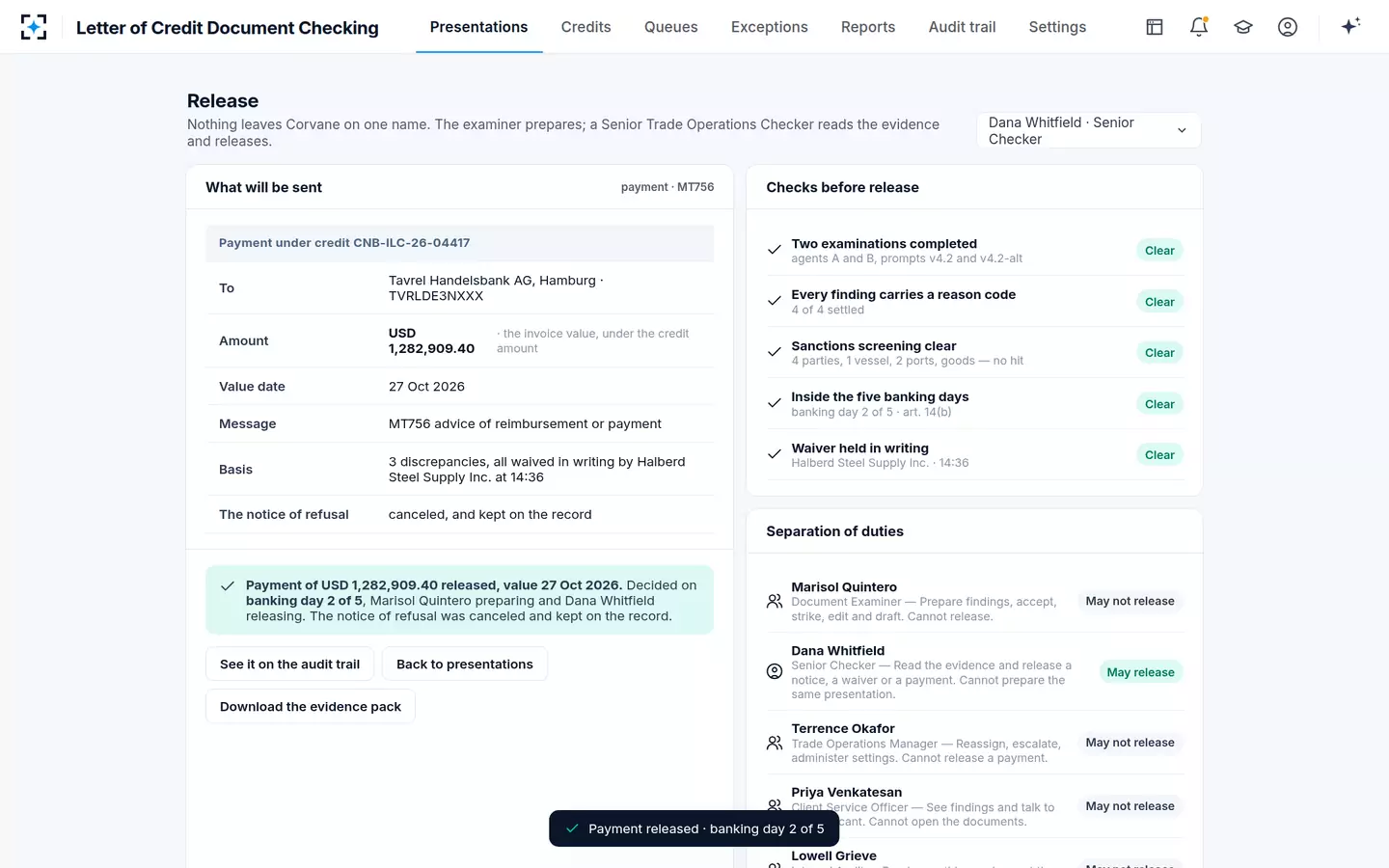
The bank sends it, through people it authorizes, and in a well-controlled desk two of them are involved. In the solution the drafting agent writes the single notice of refusal from the findings the examiner accepted, numbering each discrepancy and citing the credit field and article, and stating how the documents are held. It never sends anything and never adds a discrepancy no examiner accepted. The examiner reviews and may edit the wording, which is kept beside the original. A senior checker who did not prepare the presentation releases the notice, and the release is on the trail with both names.
The OCC's trade finance procedures tell examiners to test for segregation of duties and dual controls in transaction processing (OCC, Trade Finance and Services). Agents make that easier to enforce, not harder: the system can refuse to show a release button to the person who prepared the presentation, and the screen can say why.
The release screen: what will be sent, the checks behind it, and who may press the button
What should an AI agent never do in trade operations?
An AI agent in trade operations should never decide compliance, send a message to another bank, release money, clear a screening hit, extend or close the clock, or change its own instructions. Those are the acts that carry the bank's liability under the credit and its obligations under sanctions and AML law. The table lists each agent in the solution with what it does and what it may not do.
Eight agents, what each does, and what each may never do
| Agent | Does | Never |
|---|---|---|
| Intake | Splits the scan into named documents and counts originals against field 46A. | Decides compliance; discards a page; guesses at an unreadable page. |
| Credit terms | Reads the credit and every amendment into one term per lane; marks a condition with no document as disregarded under art. 14(h). | Infers a term the credit does not state; drops a disregarded condition from view. |
| Extraction | Places every value on its lane with its document, page and line. | Normalizes a value silently; writes a finding. |
| Examiner A | Tests every lane against the credit, UCP 600 and ISBP 821 and writes findings with clause, line and article. | Sends a notice; clears a screening hold. It proposes; a person decides. |
| Examiner B | Examines the same presentation independently on a different model and prompt. | Sees agent A's work while it runs; resolves a disagreement. |
| Drafting | Writes the single notice of refusal and the waiver request from accepted findings. | Adds a discrepancy no examiner accepted; sends anything. |
| Screening | Sends parties, vessel, ports and goods to the screening system before release; holds on a hit. | Clears a hit; releases a hold. |
| Clock | Counts banking days on the bank's calendar; escalates on day 3, pages on day 4, blocks day 5. | Decides; extends the clock; closes a presentation. |
Where the agents stop: the screening hold
The screening hold is the clearest place agents must stop, because the questions behind it are ones banks themselves are often not placed to answer. The Trade Finance Principles say banks are generally not placed to determine whether an export licence is required, and generally cannot make meaningful judgments about whether unit prices are legitimate. A document checking agent that tried to clear a hit on those grounds would be doing something the bank's own standard says it cannot do reliably.
So the screening agent does one thing: it sends the parties, the vessel, both ports and the goods to the bank's screening system before anything is released, and if there is a hit, it holds the presentation. No agent, no examiner and no senior checker can release a held presentation; the financial crime team decides. In the sample queue on Monday 26 October, one presentation was held before payment because the screening system matched a vessel name.
How do regulators view AI in trade finance?
We found no US regulatory guidance specific to AI in letter of credit examination. The OCC's trade finance booklet already describes systems that handle "discrepancy detection" alongside sanctions list screening and payment processing, and asks banks to mitigate the operational risks those systems bring. The standard-setters add accountability: the Wolfsberg Group's principles for AI and machine learning in financial crime compliance say institutions are responsible for decisions that rely on AI, whether the system is built in-house or bought, and that the harm a missed financial crime could do should be weighed against how often the AI can be wrong (Wolfsberg Group, AI/ML Principles, 2022; the passage is quoted in questions for an AML case management system).
To properly incorporate these technology platforms into the bank's daily operations, these systems should meet the bank's operational requirements and be designed with adequate controls to mitigate any potential risks.
OCC, Comptroller's Handbook, Trade Finance and Services
Is AI document checking a model under model risk guidance?
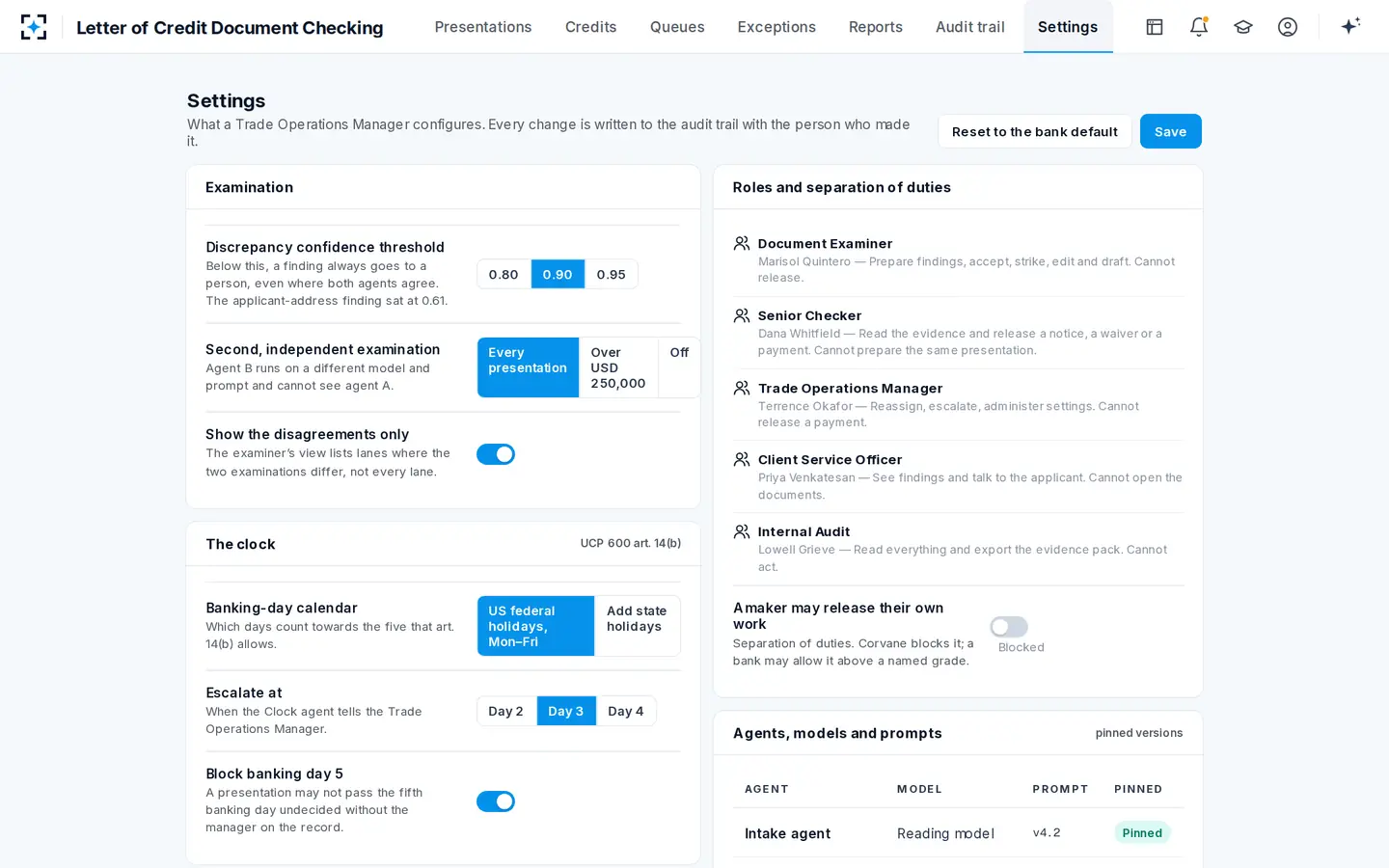
Not under the current federal guidance, but that does not mean it is ungoverned. The revised interagency guidance on model risk management, issued by the Federal Reserve, the OCC and the FDIC on April 17, 2026, supersedes SR 11-7 and leaves simple arithmetic and deterministic, rule-based software out of its definition of a model; it also places generative and agentic AI outside its scope, while telling banks that their own risk management and governance practices should still decide the controls for anything the guidance does not cover (interagency guidance). Whether a customer risk rating model is a model after SR 26-2 quotes the guidance and its scope note.
The agencies have said they plan a request for information on model risk management, with particular attention to banks' use of AI, generative and agentic AI included (OCC Bulletin 2026-13). Until that work produces something, a bank using agents in trade operations governs them under its own risk management framework, and should be able to show what that means in practice.
The governance built into the sample bank's configuration
2
independent examinations of every presentation, on different models and prompts
0.90
confidence threshold below which a finding always goes to a person
9
reason codes, the bank's own, on every accept, strike and edit
5 yrs
retention of documents, findings and the trail, exportable as one evidence pack
In practice that means four things the solution records for every presentation: which model and prompt versions examined it, where the two examinations disagreed and who settled it, what reason each decision carried, and who released what. Testing trade finance document automation on last quarter's files sets out how to measure the agents before they touch a live presentation, and again after every change.
The settings a model risk reviewer would ask about, on one screen
Where agentic AI earns its place in trade finance
Agents earn their place where the work is reading under a deadline. The five banking days do not stretch at quarter end; a presentation can run to dozens of pages; the cross-check between documents is where tired people miss things; and a refusal notice must be complete the first time. Those are the steps the agents take, and the result in the sample was a decision on banking day 2 of 5, which is the solution's design target, with three days to spare for a refusal if the applicant had said no.
What agents do not earn is the decision. The bank's liability, the applicant's trust and the beneficiary's goods all ride on it, and the rules, the standard-setters and the research agree it stays with a person. Agents prepare; the examiner decides. To see that division on your own presentations, start from Letter of Credit Document Checking, or read the step-by-step trace of one presentation.
Questions people ask
What is the difference between agentic AI and a rules engine in trade finance?
A rules engine applies fixed tests, such as whether a date is after field 44C, and is excluded from the 2026 interagency definition of a model as a deterministic rule-based process. Agents read and reason about documents, which lets them handle variation a rule cannot, but they need independent checking and human decisions behind them. Many designs use both.
Does using AI agents change the bank's liability under UCP 600?
No. The rules place the duty to examine and the consequences of a late or incomplete notice on the bank, whatever tools it uses. The Wolfsberg AI/ML Principles make the same point about financial crime decisions: the institution is responsible, whether the system is built in-house or bought.
Can an AI agent send a SWIFT message?
Technically, software can send anything it is connected to. In the solution no agent sends a message: the drafting agent writes the MT734 notice and the waiver request, and a senior checker releases them. Keeping the send with a person is the control that makes every outgoing message the bank's decision.
How do you stop two AI examinations from making the same mistake?
By making them as independent as possible: different models, different prompts, no sight of each other's work until both finish. Independence does not guarantee different errors, which is why a confidence threshold sends low-confidence findings to a person even when both agree, and why the bank should test the pair on its own closed presentations.
Is agentic AI allowed in bank trade operations?
We know of no US banking rule that prohibits it, and the OCC already expects trade systems to perform functions such as discrepancy detection. What examiners will look for is the bank's own governance: separation of duties, controls over changes, testing and an audit trail, because the 2026 model risk guidance leaves agentic AI to the bank's own risk management for now.