Discrepancies on a letter of credit can be waived by the applicant, the buyer who asked for the credit, when the issuing bank approaches it after finding that a presentation does not comply. UCP 600 art. 16(b) gives the issuing bank that option, in its sole judgement, but asking does not extend the five banking days the bank has to decide, and the applicant's waiver does not oblige the bank to pay. In practice applicants say yes almost every time: in the only measured study of US letter of credit files, they waived the discrepancies and allowed full payment in all but one of 365 discrepant files. The work is therefore not winning the waiver; it is getting it, in writing, while there is still time to send a complete refusal if it does not come. Botminds' Letter of Credit Document Checking drafts the waiver request and the notice of refusal together, from the same findings, so the bank can take the faster path without losing the safe one.
The waiver data come from Ronald Mann's study of 500 files at five US banks, collected in 1999 under the previous rules, UCP 500, and published in the Michigan Law Review. We found no later study that measures waiver rates. Product examples come from a fictional sample bank, Corvane National Bank.
How fast importers waived: 196 discrepant import files, from the day the bank called
Time from the issuer's contact to the applicant's waiver
- Within one business day · 103 files · 52.6%
- Within a week · 62 more · 31.6%
- Later than a week, or not at all · 31 · 15.8%
Can discrepancies in a letter of credit be waived?
Yes. When an issuing bank finds a presentation discrepant it can ask the applicant whether it will accept the documents anyway, and most do. UCP 600 art. 16(b) reads: "When an issuing bank determines that a presentation does not comply, it may in its sole judgement approach the applicant for a waiver of the discrepancies. This does not, however, extend the period mentioned in sub-article 14 (b)" (ICC, UCP 600). The rule applies because the credit incorporates UCP 600; it gives the bank an option, not a duty.
The waiver is commercial, not documentary. The applicant is deciding whether it still wants the goods on these documents, usually because it trusts the seller or needs the cargo, and the bank is deciding whether it still expects to be reimbursed. Neither decision changes the documents. A late on-board date stays late; the applicant simply agrees to pay for it.
Who waives discrepancies, the applicant or the bank?
The applicant waives; the issuing bank decides whether to accept the waiver. The rules make the bank's freedom explicit in the notice options: art. 16(c)(iii)(b) lets the issuing bank state that it "is holding the documents until it receives a waiver from the applicant and agrees to accept it, or receives further instructions from the presenter prior to agreeing to accept a waiver." Receiving a waiver and agreeing to accept it are two separate steps.
The ICC's Banking Commission has long taken the same view. Mann cites two of its opinions under UCP 500 to the effect that an applicant's waiver does not bind the issuing bank to take up the documents and that the decision is the bank's alone. Mann's own reading of why a bank would ever decline a waiver is practical: the "only substantial reason" appeared to be "doubts about its ability to obtain reimbursement from the applicant" (Mann, 2000). A waiver from a customer in financial trouble is worth less than one from a customer who can pay.
How often are LC discrepancies waived?
Almost always, on the only measured evidence. Mann expected applicants to use discrepancies as a reason to delay or refuse payment, and found the opposite: "In the 365 files with discrepancies, the applicants waived the discrepancies and permitted full payment in every file but one." In the exception, the applicant still permitted payment of 94% of the agreed amount. "Thus, in the 500 letter-of-credit transactions examined, the applicant never refused payment on the letter of credit."
Discrepancies were the rule; refusals were almost unheard of
364 of 365
discrepant files waived with full payment
53%
of discrepant import files waived within one business day
84%
waived within one week of the issuer's contact
0.03%
refusal rate one bank estimated: three a year in 10,000 presentations
The bankers Mann interviewed told the same story from the other side. One estimated that refused presentations were "a small fraction of one percent"; another, handling about 100,000 transactions a year, guessed refused documents numbered fewer than a hundred and perhaps fewer than ten. Interviews at three Japanese banks gave similar pictures. The rarity is the point: a desk that refuses often is either seeing unusual customers or calling discrepancies that its applicants would have waived.
We're very uncomfortable whenever we do refuse a set of documents. So even though I guess we're pretty willing to find discrepancies and call a customer up and say, "These are all the discrepancies," ... we want them to waive all those discrepancies.
A banker interviewed for Mann (2000)
Does asking for a waiver extend the five banking days?
No. Art. 16(b) says so in the same breath as it grants the option, and art. 16(d) requires any notice of refusal by the close of the fifth banking day after the day of presentation. The clock that started the day after the documents arrived keeps running while the client service officer is on the phone to the importer. A waiver that arrives on day six is still welcome, but the refusal notice it was meant to replace must already have gone, or the bank has lost its right to refuse.
That is why the order of work matters. A bank that examines on day 4 and asks for a waiver on day 5 has to send the refusal notice the same day regardless, and then deal with the waiver after it. A bank that has decided findings on day 1 or 2 can ask, wait a day, and still have time to send a complete notice if the applicant says no. What happens if there is a discrepancy walks the same clock from the beneficiary's side.
Inside five banking days: examine early, and the waiver fits; examine late, and it does not
- Findings decidedby day 2
- Waiverday 2
- Room for a notice if refuseddays 3–5
- Queue and examinationdays 1–4
- Notice anywayday 5
Hold pending waiver: the notice that keeps both doors open
The cleanest way to ask for a waiver without risking the clock is to refuse first, on time, and say in the notice that the documents are held pending the waiver. Art. 16(c) requires a single notice stating that the bank is refusing, each discrepancy, and what it is doing with the documents; option (iii)(b) is the holding-for-waiver statement quoted above. Sent by day five, it protects the bank's right to refuse. If the applicant then waives and the bank accepts, the bank pays.
The notice binds the bank to what it says. The English courts held in Fortis Bank v Indian Overseas Bank that a bank which states one disposal option must act on it with reasonable promptness, and that failing to do so can preclude it from relying on even a valid discrepancy. A hold-for-waiver notice therefore needs someone to follow up: if the presenter instructs the bank to return the documents before the waiver arrives, the bank must follow that instruction. What a missed or mishandled discrepancy costs takes that case in detail.
Three ways to handle a waiver inside UCP 600, and what each risks
| Path | What the bank does | Risk |
|---|---|---|
| Ask first, notice only if refused | Approaches the applicant early; pays on a written waiver, or sends the single notice before day 5 ends. | Low if findings are ready early; high if the request goes out on day 4 or 5. |
| Refuse and hold pending waiver | Sends the notice by day 5 with option (iii)(b); pays if the waiver comes and the bank accepts it. | Low on the clock; the bank must follow the presenter's instructions promptly meanwhile. |
| Pay on a verbal yes | Releases payment before a written waiver is on file. | High: reimbursement rests on a conversation the applicant may later dispute. |
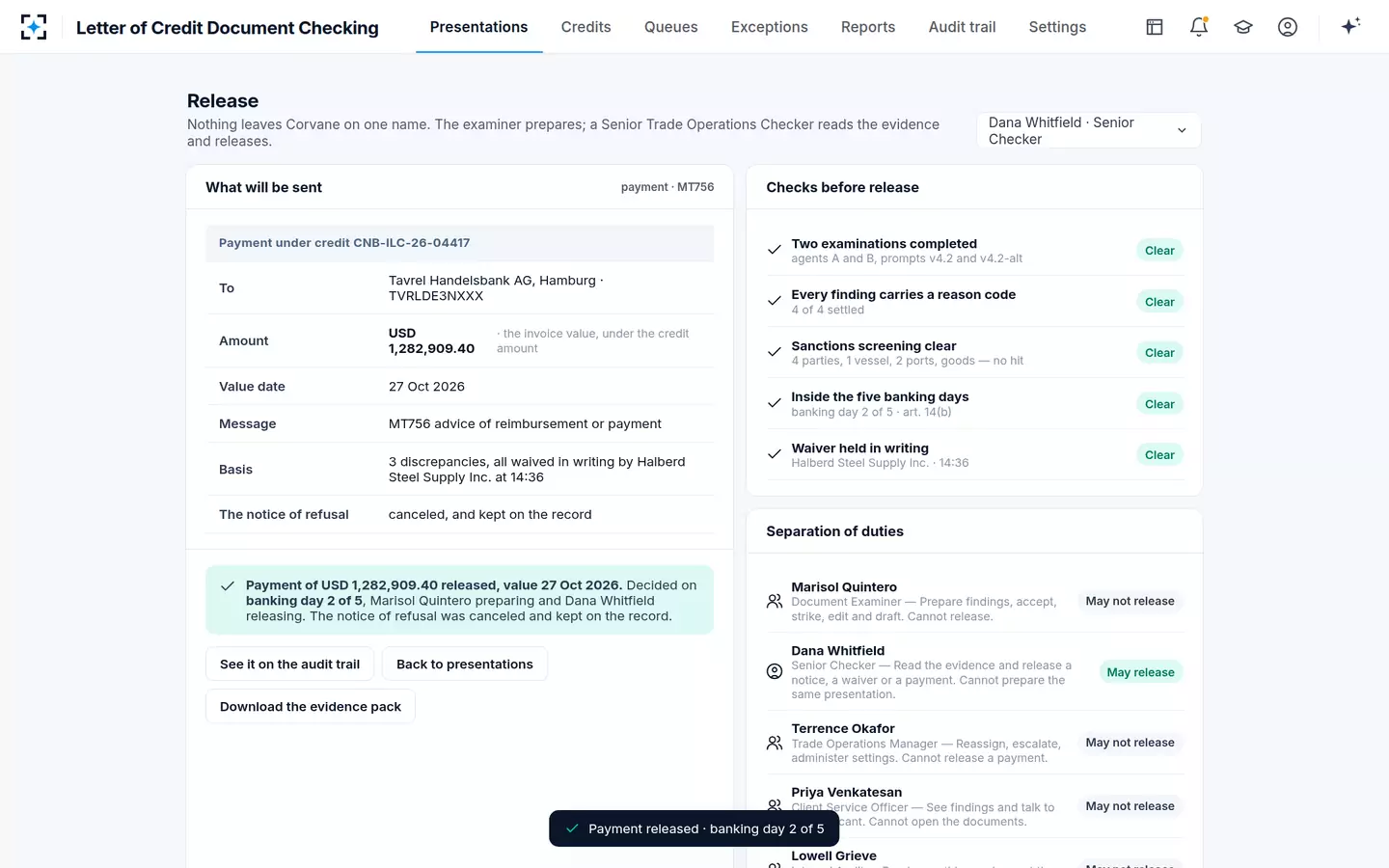
The release waits for the waiver in writing, checked by someone who did not prepare it
What happens if the applicant refuses the waiver?
If the applicant refuses, the issuing bank refuses the presentation, and what happens to the documents depends on the notice. Under art. 16(c)(iii) the notice must say whether the bank is holding them pending the presenter's instructions, holding them pending a waiver, returning them, or acting on instructions already received; under art. 16(e) a bank that has given a holding notice may return the documents to the presenter at any time. The beneficiary then has documents for goods that have shipped and a buyer who will not take them on these terms.
The beneficiary's options are narrow but real. If the credit has not expired and the period for presentation has not run out, it can correct the documents and present again; some discrepancies, such as a late on-board date, cannot be corrected at all. It can negotiate with the buyer: in the one file in Mann's sample without a full waiver, the applicant paid 94% of the agreed amount. Or it can deal with the goods through the documents it gets back, which is why a prompt return matters.
What fee is charged for LC discrepancies?
Banks charge fees for handling discrepant presentations, but no independent source we found publishes the amounts, and they vary by bank and by credit. The credit's charges clause decides who bears them, and UCP 600 art. 37(c) makes the issuing bank liable for charges it has put on the beneficiary but cannot collect. The ICC's introduction to UCP 600 records that banks' discrepancy fees made the whole problem of discrepancies more visible, especially where the discrepancies behind them proved dubious or unsound (ICC, UCP 600 Introduction).
The practical lesson is the same as for the waiver: a fee charged on a discrepancy the applicant waives within the hour is defensible only if the discrepancy was real. The OCC tells examiners to look at the volume and nature of document discrepancies and customer complaints and disputes, so a desk whose discrepancy fees cannot be traced to a page and an article is building its own complaint file (OCC, Trade Finance and Services).
Drafting the waiver request with the notice of refusal
The solution drafts the waiver request and the notice of refusal at the same moment, from the same accepted findings, so the bank can choose its path without rewriting anything. In the sample, the examiner accepted three discrepancies on Monday morning, banking day 2: a bill of lading on-board date four days after the latest shipment date, insurance cover of USD 1,350,000.00 against the USD 1,411,200.34 that 110% of the CIF value requires, and an inspection certificate dated after shipment. The client service officer sent the waiver request at 13:48 asking for an answer by Wednesday. The applicant waived all three at 14:36.
The waiver request, drafted from the same findings as the notice, with the clock stated on it
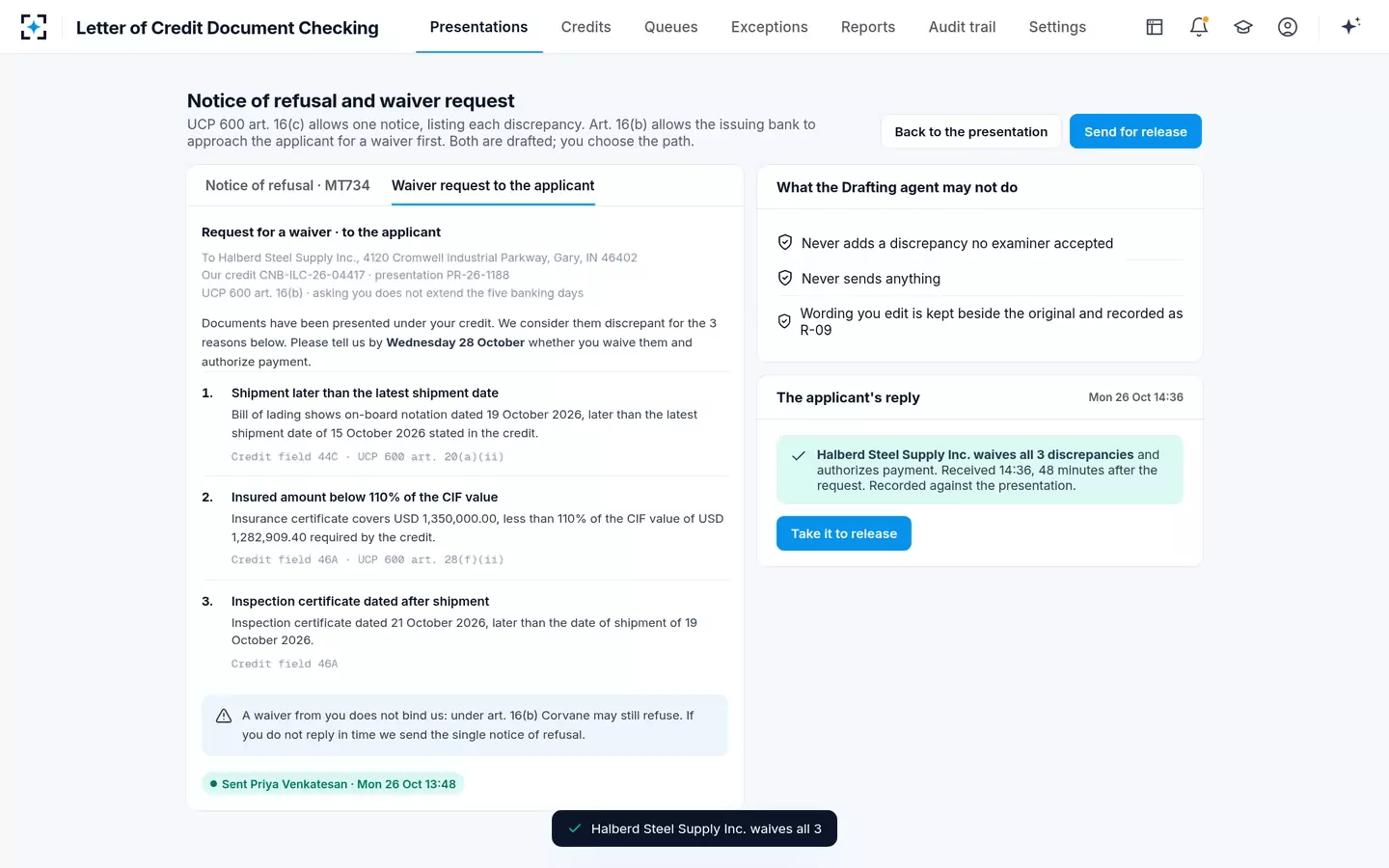
Two details on that screen carry the rules to the customer. The request says, in plain words, that the bank's asking does not extend the five banking days, and that a waiver "does not bind us": the bank may still refuse. And the release that followed required the waiver held in writing, checked by a senior checker who did not prepare the presentation. The discrepancies applicants are most often asked to waive are worth knowing for the same reason, and the full flow is on Letter of Credit Document Checking.
Questions people ask
Is the bank bound by the applicant's waiver?
No. The notice option in art. 16(c)(iii)(b) speaks of the issuing bank receiving a waiver "and agrees to accept it", two separate steps, and ICC Banking Commission opinions cited by Mann take the same view. A bank usually accepts; the main reason not to is doubt that the applicant will reimburse.
Can a confirming bank ask the applicant for a waiver?
Art. 16(b) gives that option to the issuing bank, and the hold-for-waiver notice in 16(c)(iii)(b) is also the issuing bank's. A confirming or nominated bank that finds discrepancies can refuse, or forward the documents to the issuing bank for it to decide, but it has no direct waiver route to the applicant under the rules.
How long do applicants take to waive discrepancies?
In Mann's 1999 sample of 196 discrepant import files, 53% waived within one business day of the bank's contact and 84% within a week; only six files remained unaccepted after four weeks. Those are dated figures under UCP 500, which allowed up to seven banking days, two more than UCP 600.
Should the waiver be in writing?
Yes. The bank's right to reimbursement after paying against discrepant documents rests on the applicant's waiver, and a waiver that exists only as a phone call is hard to prove later. The sample bank's release check requires the waiver held in writing, with its time, before payment can go.
Does a waiver cure the discrepancy?
No. The documents stay discrepant; the applicant agrees to pay against them anyway. That matters if the same discrepancy recurs on the same credit, because each presentation is examined on its own, and a waiver last month does not make this month's late shipment compliant.