ICC Banking Commission opinions are the official responses of the ICC's Banking Commission to questions practitioners raise about how UCP 600 and the other ICC rules apply in daily practice; ICC says they "fill in details that the rules, being more general in nature, cannot always provide". They are published in paid volumes, not free, and they are not law: a credit incorporates UCP 600, not the opinions. Yet they sit between the rules and standard practice in a way no examiner can ignore. Opinions approved over a decade were folded into ISBP 821, the drafters of UCP 600 reviewed some 500 of them, and courts cite them as evidence of practice. For a rules desk, the problem is keeping that layer visible and separate in every answer. Botminds' UCP 600 & ICC Rules Search searches the opinions in the bank's licensed set by passage and shows them labelled apart from the rule, the practice and the bank's own rulings.
ICC's own releases and the courts are linked where they appear; opinion texts are licensed and are described here, never quoted. Examples of the solution come from a fictional sample bank, Corvane National Bank, and its sample data.
How a question becomes practice: the layers between UCP 600 and a bank's answer
A person decides
ICC adopts the ruleThe Banking Commission adopts UCP 600; a credit that incorporates it makes it binding, the only layer that binds by itself.
A person decides
A practitioner asksRaised by a practitioner, often through an ICC national committee, when the rule does not settle a point.
A person decides
The Commission answersA draft opinion is debated and approved, or not; an approved opinion may later be cancelled by another.
A person decides
ICC updates practiceEvery decade or so, opinions that stood the test are folded in: nine into ISBP 821.
A person decides
The bank rulesWhere rule, practice and opinions still leave room, the bank decides its position and names an approver.
What are ICC Banking Commission opinions?
They are the Banking Commission's answers to real questions. ICC described its 2009–2011 volume as "official Banking Commission responses to three years of questions raised by practitioners concerning how the latest ICC rules on documentary credits, collections and demand guarantees are applied in daily practice", 69 opinions in all, most of them on UCP 600 (ICC, 28 June 2012).
ICC's own language for them is strong. Its 2002 release said "ICC Banking Commission opinions give the official analysis of how the ICC rules work in daily practice" and that "They are often cited in courts of law" (ICC, 5 July 2002). The opinions were also the raw material for UCP 600 itself: the Drafting Group "began the review process by analyzing the content of the official Opinions issued by the Banking Commission under UCP 500", reviewing "Some 500 Opinions" (ICC, UCP 600 Introduction).
The opinion layer in four ICC numbers
500
opinions under UCP 500 the drafters of UCP 600 reviewed
300+
queries and responses in ICC’s collected opinions for 1995–2001
69
opinions in ICC’s 2009–2011 volume, mostly on UCP 600
9
opinions approved 2013–2023 identified for incorporation into ISBP 821
Are ICC opinions binding?
Not by themselves. UCP 600 binds the parties because the credit says in terms that it is subject to the rules (UCP 600, art. 1); no credit incorporates the opinions, and no ICC text we cite gives them that force. Their weight is persuasive: they are the Banking Commission's view of the rules and of practice, and UCP 600 makes "international standard banking practice" part of what a complying presentation is (art. 2).
That second link is why examiners treat them as near-binding in practice. If an opinion states what standard practice is, and standard practice is part of the test, a bank that ignores the opinion needs a reason. In the United States the law builds the same bridge: UCC § 5-108(e) requires an issuer to follow the standard practice of institutions that regularly issue letters of credit, and leaves the court to decide whether it did (UCC § 5-108), the fifth myth in the doctrine of strict compliance.
Rule, practice, opinion, DOCDEX and the bank's ruling: how much weight each carries
| Layer | Binding? | Who writes it | Free or paid | How courts treat it |
|---|---|---|---|---|
| UCP 600 | Yes, once the credit incorporates it | ICC Banking Commission | Free on ICC’s Digital Library | As contract terms |
| ISBP 821 | Part of the test through art. 2 | ICC Banking Commission | Sold by ICC | Cited for practice |
| Opinions | No, persuasive | ICC Banking Commission, on queries | Sold in volumes | “Widely cited by judges”, per ICC |
| DOCDEX decisions | No, unless the parties agree | Three experts, reviewed by an ICC adviser | Fee per case; decisions in ICC’s library | As evidence of practice |
| The bank’s ruling | Within the bank only | The bank’s rules desk | Internal | Not at all, unless in evidence |
Do courts follow ICC opinions?
Courts use them as evidence of practice, and sometimes find they do not reach the case. ICC's technical adviser to the Banking Commission said in 2012: "The opinions are a necessary complement to the rules ... They are widely cited by judges when deciding disputes involving the ICC rules of practice" (ICC, 28 June 2012).
"The opinions are a necessary complement to the rules."
Gary Collyer, Technical Advisor to the ICC Banking Commission, in ICC's release of 28 June 2012
The English courts show the method. In Fortis Bank v Indian Overseas Bank, the High Court was referred to "a number of ICC Opinions under UCP 500" on what a bank must do after a refusal notice, and the Court of Appeal relied on DOCDEX Decision 242 as "A clear illustration of this practice" before holding that a bank electing to return documents must do so "with reasonable promptness" ([2011] EWCA Civ 58). The opinions and the DOCDEX decision did not decide the case; they told the court what bankers expect.
A US case shows the limit. In Mago v LHB, the beneficiary argued that under the UCP "and interpretive guidance issued by the International Chamber of Commerce Banking Commission", copies of bills of lading need not be signed. The Second Circuit assumed the argument about the rules was right and still held against it, because the credit itself required a copy "evidencing shipment", which an unsigned copy did not (2d Cir. 2016). An opinion about the rules never outranks the terms of the credit.
How does an ICC opinion get approved?
Through ICC's national committees, and not always. A query comes in, a draft opinion is prepared and numbered, it is debated at Banking Commission meetings, and national committees state their positions; an approved draft becomes an official opinion. ICC's July 2023 report shows how contested that can be.
Draft Opinion TA927, on "free of charge goods" and a paragraph of ISBP 745, was discussed in January 2023, redrafted, discussed again in April and still not finalised. Before the July meeting, national committees were given three choices. The result: 9 approved the wording, 2 approved with caveats, and 11 favoured inviting the person who raised the query to withdraw it. The query was withdrawn, so "TA927rev2 will not become a formal ICC opinion", and the issue was set aside "for a future ISBP update" (ICC Documentary Credit World, July 2023).
One draft opinion, three choices: how 22 national committees answered on TA927
Two lessons follow for a rules desk. A point can be genuinely unsettled even at the ICC, so a confident answer on it is a wrong answer. And the Banking Commission also publishes Technical Advisory Briefings, seven of them by July 2023, the seventh on the "Title of Invoice", so the interpretive layer is wider than the opinion volumes alone.
What is DOCDEX, and how much does it cost?
DOCDEX, Documentary Instruments Dispute Resolution Expertise, is ICC's expert procedure for disputes over credits, standbys, collections, guarantees and other trade finance instruments. "Cases are decided by a panel of three impartial experts", a technical adviser nominated by the Commission reviews each decision, and "The entire process usually takes between two and three months" (ICC, DOCDEX).
Costs are capped: "Depending on the amount in dispute, DOCDEX proceedings are capped at US$5,000 or US$10,000", and ICC says that "even in exceptional cases" any additional fee is US$3,000 or US$6,000. Decisions "are not binding unless the parties have otherwise agreed and are not arbitral awards", and anonymised decisions are widely distributed, with past decisions available in the trade finance channel of the ICC Digital Library. The UCP 600 drafters noted that DOCDEX outcomes "were invariably based on existing ICC Banking Commission Opinions" (ICC, UCP 600 Introduction), which is the layer cake again.
Where do I find ICC opinions?
In ICC's published volumes and its subscription Digital Library; there is no free official collection. The 1995–2001 volume was sold through ICC's bookstore, ICC Publishing and national committees; later volumes, such as 2009–2011, followed. What ICC serves free and what it sells is set out in its own guide.
Read every opinion with its date and status. ICC's 2002 release notes that "If an opinion has been cancelled out by a later one, this is indicated in the text" (ICC, 5 July 2002), and opinions issued under UCP 500 answer questions about different wording. Researchers cite them by number: Ronald Mann's study of 500 US credit files relied on Opinion R.267 on whether an applicant's waiver binds the issuing bank to take the documents (Mann, Michigan Law Review, 2000).
How an opinion changes a rules answer: a worked example
An opinion can turn a "not settled" rule into a settled answer, or show that a point really is open. Take a bill of lading marked "packaging reused". UCP 600 article 27 accepts only a clean transport document, one "bearing no clause or notation expressly declaring a defective condition of the goods or their packaging" (art. 27), and the phrase declares nothing in so many words.
Two licensed opinions pointing different ways, side by side in UCP 600 & ICC Rules Search
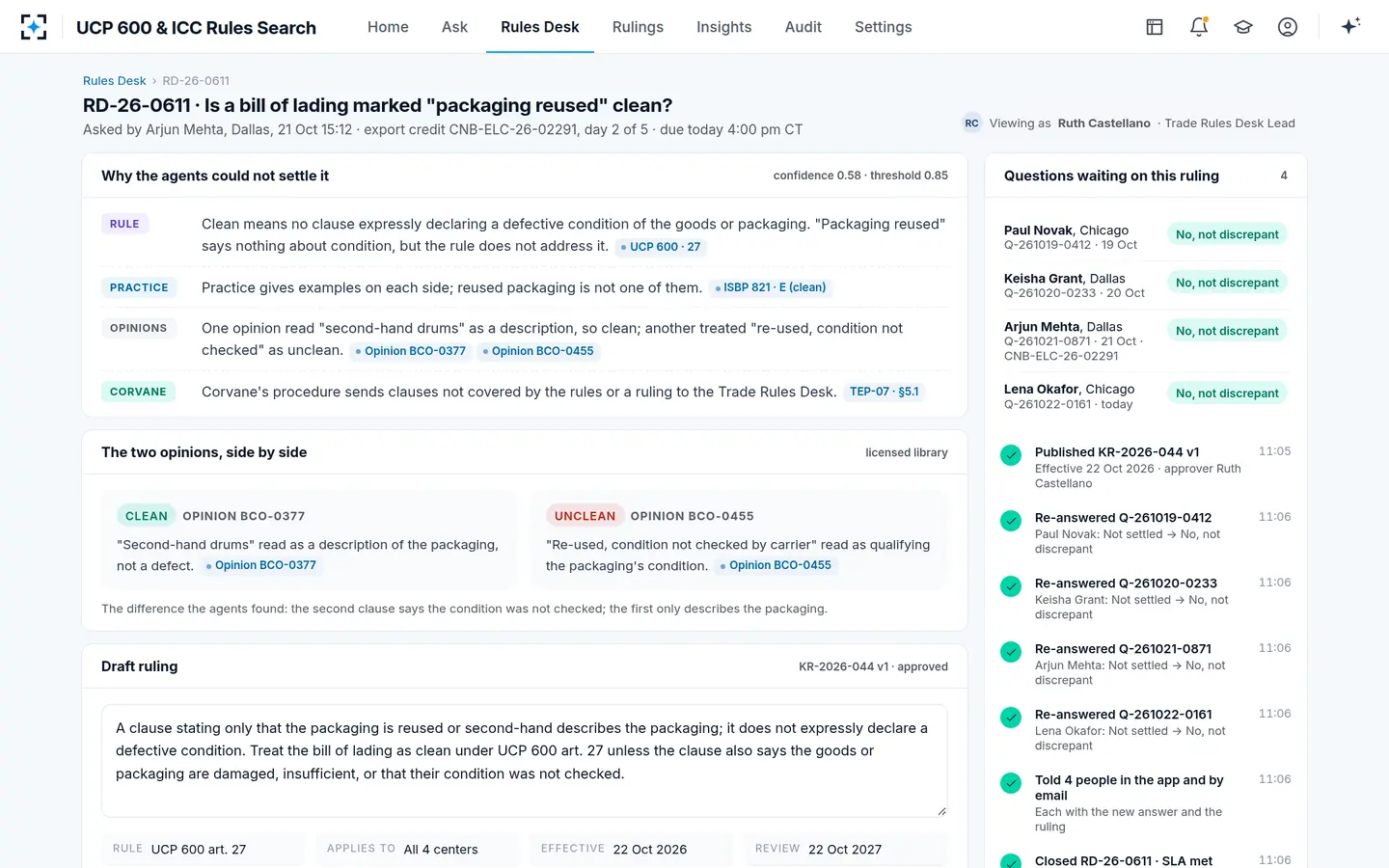
In the sample bank, the agents found two opinions in the licensed library: one treating "second-hand drums" as a description of the packaging, and so clean; another treating "re-used, condition not checked by carrier" as unclean. They also found the difference: the second clause says the condition was not checked. With rule, practice and opinions not agreeing on the phrase in front of them, the answer was "not settled", at a confidence of 0.58 against a threshold of 0.85. The Trade Rules Desk drafted a ruling that a clause stating only that packaging is reused does not make the bill unclean unless it also says the goods or packaging are damaged or their condition was not checked; a second person approved it, and four waiting answers were rewritten.
How UCP 600 & ICC Rules Search keeps opinions in their place
Opinions appear in every answer as their own labelled layer, never blended into the rule. The verdict writer is built never to blend rule, practice and procedure in one sentence, and the precedent trail below each verdict shows the licensed opinion, the bank's ruling with its version and approver, and the bank's own past decisions on the same point.
The precedent trail: a licensed opinion, the bank's ruling and its own past decisions
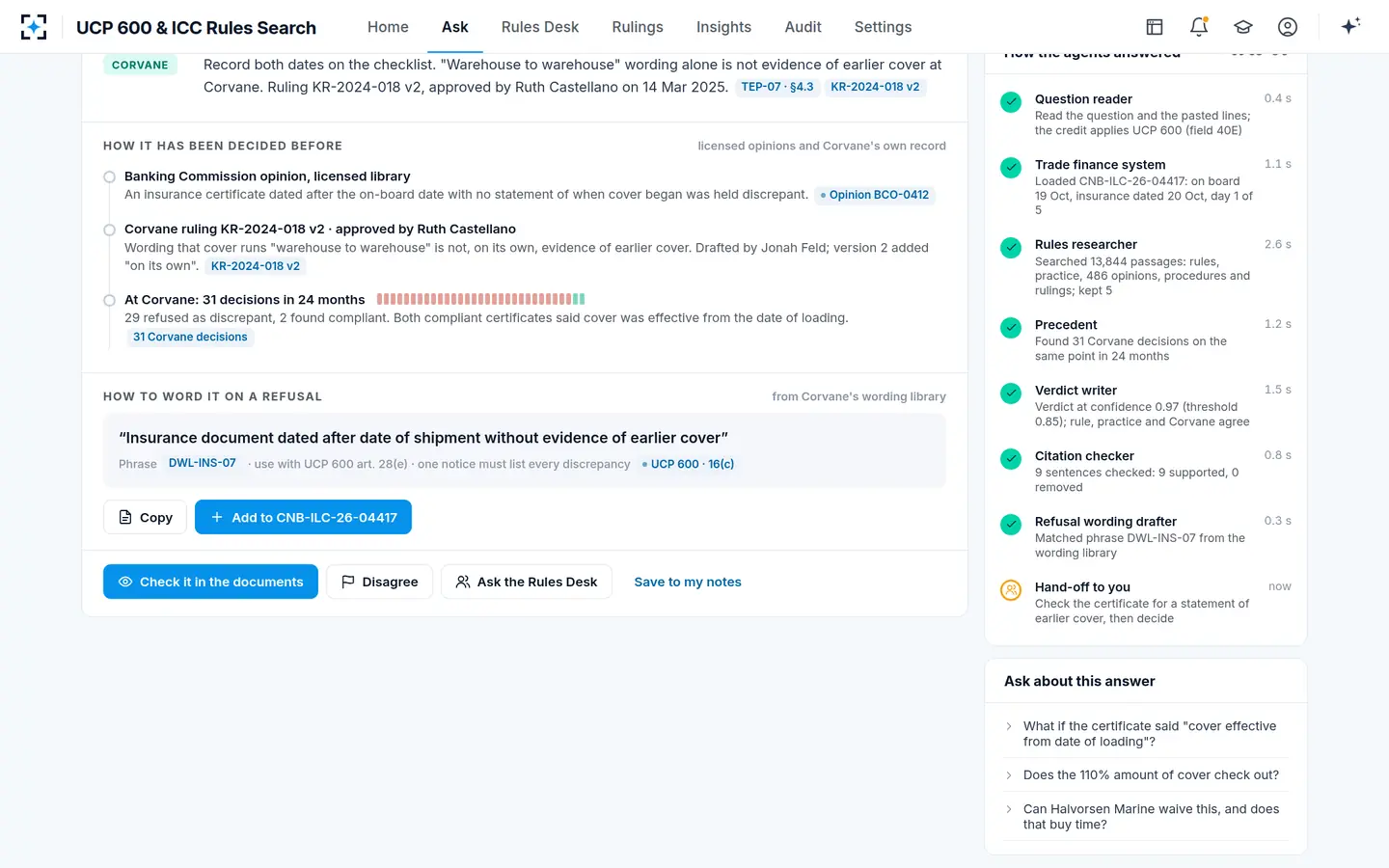
Opinions are licensed, so the solution works inside the bank's licence: ICC text is shown only to entitled staff, within an 80-word excerpt limit, and exports carry references, never text. The bank supplies the opinions it has licensed; the solution searches them by passage and version, and marks any that a later opinion has overtaken. It does not decide what an opinion means for a presentation. The examiner decides, and where the opinions disagree the Trade Rules Desk rules. The ICC Digital Library reports that the relationship between UCP 600, ISBP 821, ICC opinions and Technical Advisory Briefings will be "a central theme" of the Banking Commission's 2026–27 programme (ICC Digital Library, August 2026), a report its author marks as personal views. The myths that grow up where opinions are not read are the subject of the doctrine of strict compliance.
Questions people ask
What is the difference between an ICC opinion and a DOCDEX decision?
An opinion is the Banking Commission's answer to a general question about the rules, approved through ICC's national committees. A DOCDEX decision settles a specific dispute between parties, decided by three experts and reviewed by an ICC technical adviser, for a capped fee. Neither binds by itself; a DOCDEX decision binds only if the parties agree.
Are ICC opinions free?
No. ICC sells them in volumes, such as the 2009–2011 collection of 69 opinions, and makes them available in its subscription Digital Library. The UCP 600 rule text, by contrast, is served free on that library.
How long does DOCDEX take?
ICC says the entire process usually takes between two and three months. Fees are capped at US$5,000 or US$10,000 depending on the amount in dispute, with an additional US$3,000 or US$6,000 only in exceptional cases.
Can an ICC opinion override the terms of a letter of credit?
No. The credit's own terms come first, and article 1 of UCP 600 lets a credit modify the rules. In Mago v LHB, the Second Circuit held that whatever the general guidance on unsigned copies, the credit required a copy evidencing shipment, and the unsigned copy did not comply.
Do opinions under UCP 500 still apply to UCP 600 credits?
Only where the wording they interpreted survives. The UCP 600 drafters reviewed some 500 UCP 500 opinions to decide what to change, and ICC marks opinions cancelled by later ones. Read each opinion with the rule version it answered.