A global debt service coverage ratio is the combined cash flow of a business and its owners, after the owners' taxes and living costs, divided by all the debt payments the business and the owners make together. It answers the question a business-only ratio cannot: if the business pays its owners what they need to live, is there still enough to service every debt? For SBA 7(a) loans the rule is in SOP 50 10 8.1, which sets coverage of at least 1.15 on the business and "1:1 on a global basis" for Standard 7(a) loans. Botminds' Small Business Loan Decisioning computes both from the returns and the bank statements, and the worked example below shows why the statements matter as much as the returns.
The file is a sample on fictional parties: Halverson Mechanical, a Dayton heating and air conditioning contractor owned 60/40 by Erik Halverson and Luis Ortega, asking for $240,000 under SBA 7(a) Small. The business figures come from the sample file in the solution. The owners' personal figures, their split of wages, taxes, living expenses and personal debts, are illustrative, added for this example.
Global debt service coverage on one SBA file, line by line
1
Operating cash flow (EBITDA), 2025 Form 1120-S
Net income $65,400 + interest $21,700 + depreciation $64,200
$151,300
2
Business debt service
Existing debts $57,120 + new SBA loan $38,460 ($3,205 a month)
$95,580
3
Business coverage
Line 1 ÷ line 2; SBA floor for 7(a) Small 1.10x, bank policy 1.25x
1.58x
4
Owners' wages from the business
Officer compensation on the return: $112,000 + $70,000
+ $182,000
5
Owners' income taxes
On wages and on the S corporation income passed through to them
− $52,000
6
Owners' living expenses
Two households, from the personal financial statements
− $108,000
7
Global cash available for debt service
Lines 1 + 4 − 5 − 6. The K-1 income is not added: it is line 1 again
$173,300
8
Owners' personal debt service
Two mortgages and a car loan, from the credit reports
+ $52,800
9
Global debt service
Line 2 + line 8
$148,380
10
Global coverage
Line 7 ÷ line 9; SOP 50 10 8.1 floor for Standard 7(a) 1:1
1.17x
11
The undisclosed cash advance
$1,140 a business day × 252, found in the bank statements
+ $287,280
12
Global coverage with the advance counted
$173,300 ÷ ($148,380 + $287,280 = $435,660)
0.40x
What is a global debt service coverage ratio?
It is debt service coverage measured across everyone who stands behind the loan. A business ratio divides the business's operating cash flow by the business's debt service. A global ratio adds the owners and guarantors: their income from the business and elsewhere goes on top, their taxes and living expenses come off, and their personal debt payments join the business's below the line. Affiliates enter too, for the cash they send to or draw from the people and businesses in the calculation.
The reason is that small business owners and their businesses share one pool of cash. A contractor who pays himself $112,000 and carries a mortgage, a car loan and a household will pull money out of the business whenever the household needs it, whatever the business ratio says. SOP 50 10 8.1 asks Standard 7(a) lenders for a "global cash flow analysis that includes assessment of impact on cash flow to/from any affiliate business" (SOP 50 10 8.1, Section B Chapter 1). The global ratio is the number that analysis ends in.
The global coverage formula: two sources of cash, two costs, one divisor
Business cash flow
EBITDA from the spread
Net income plus interest, depreciation and amortisation; add-backs only with a reason
From the returns
Owners' income
Wages and other personal income
W-2 wages from the business, rents, a spouse's salary; not the K-1 income already in EBITDA
From personal returns
Taxes and living costs
− personal taxes − living expenses
Taxes on wages and on pass-through income; a realistic household budget
From the personal financial statements
All debt service
÷ (business + personal payments)
Every business debt including the new loan and any found in the statements; mortgages, car loans and other personal debt
From the schedule, the bureau and the statements
What is the SBA minimum global DSC?
For a Standard 7(a) loan it is 1:1. SOP 50 10 8.1 states that "the Applicant's debt service coverage ratio (DSC) must be equal to or greater than 1.15 on a historical and/or projected cash flow basis and 1:1 on a global basis" (SOP 50 10 8.1). Debt service is defined as "the future required principal and interest payments on all business debt inclusive of new SBA loan proceeds", and the SOP adds that a complete analysis needs "a current debt schedule prepared by the Applicant, including any shareholder debt".
Where SBA's rules set coverage, and where global coverage appears
| Loan type under SOP 50 10 8.1 | Business coverage minimum | Global coverage |
|---|---|---|
| Standard 7(a) | 1.15 on historical and/or projected cash flow | 1:1, stated in the SOP |
| 7(a) Small (up to $350,000), other than changes of ownership | 1.10 on historical or projected cash flow, with two months of bank activity reviewed | Not stated in the 7(a) Small text; follows the lender's policy for similar loans |
| Change of ownership (Appendix 15): initial acquisition, owner buyout, ESOP | 1.25 on historical cash flow; projections may not be relied on | Owner compensation adjustments must be backed by a global analysis meeting 1:1 |
| Change of ownership: business expansion | 1.15 on historical cash flow | As above |
Does SBA require 1:1 global coverage on every loan?
Not in so many words. The 1:1 global floor is written into the Standard 7(a) credit analysis and into the change-of-ownership rules. The 7(a) Small text sets 1.10 on the business and tells lenders to use the credit analysis they use for similarly sized conventional loans, so a bank whose conventional policy runs a global analysis on owner-guaranteed credit should run it on its 7(a) Small files too. The safer reading for a small loan is that SBA expects the owners to be able to live and pay their own debts without draining the business, whichever section applies.
The change-of-ownership rules make the link explicit. Where a lender adjusts the owners' pay to make the business ratio work, the adjustment "must also be substantiated by a global cash flow analysis that demonstrates that the principals have the financial wherewithal to meet their obligations based upon the adjusted compensation proposed and must meet the 1:1 DSC on a global basis". The same appendix adds that "the ownership compensation of the Applicant must be sufficient to support their current obligations and living expenses" (SOP 50 10 8.1, Appendix 15). Cutting the owner's salary on paper does not create cash.
How do you calculate global DSCR? The business side first
Start with the business, exactly as for a business ratio. The sample file's 2025 Form 1120-S shows net income of $65,400; interest of $21,700 and depreciation of $64,200 are added back to reach operating cash flow, EBITDA, of $151,300. Debt service is every business debt on the borrower's schedule, two van loans, an equipment loan and the interest on a line of credit, $57,120 a year, plus the new loan: $240,000 over ten years at 10.25%, $3,205 a month, $38,460 a year. Business coverage is $151,300 ÷ $95,580 = 1.58x.
The business side: three years spread, each line tied to the return
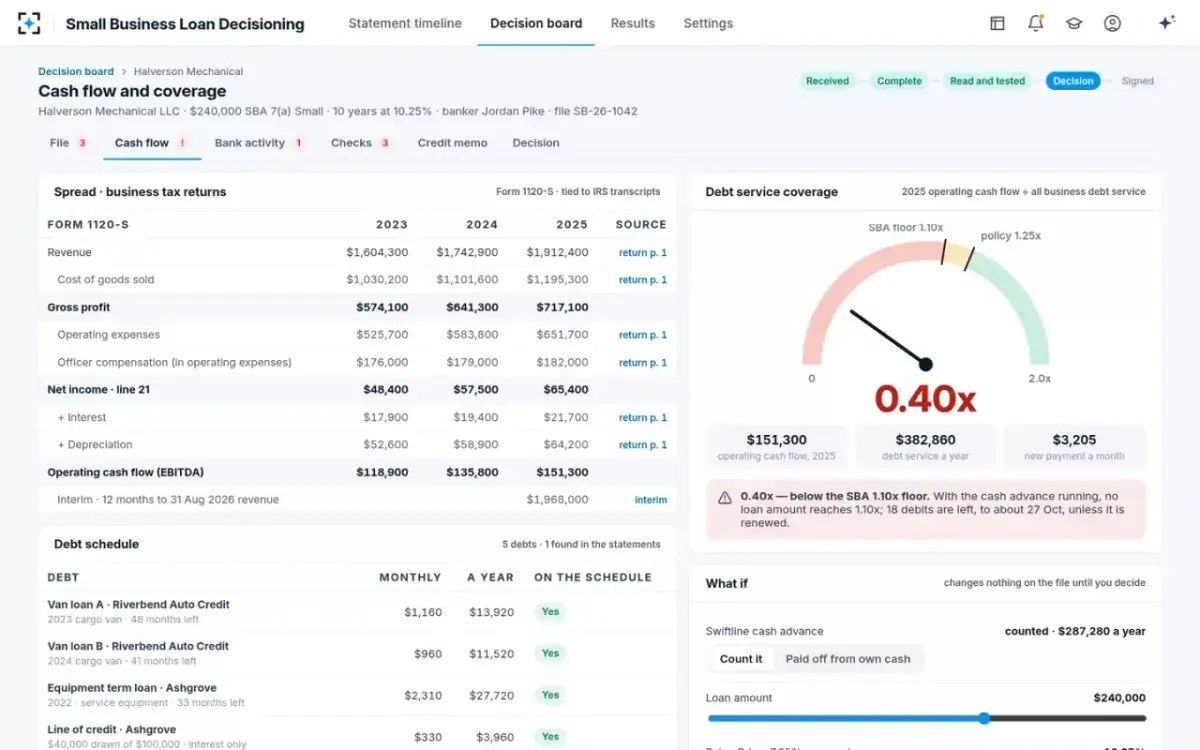
Two choices in that arithmetic deserve a sentence in the memo. Officer compensation of $182,000 is already deducted as an expense before net income, so the business ratio pays the owners first; if the owners took less, the business ratio would rise and the global one would not move. And the S corporation's income passes through to the owners' personal returns as K-1 income. That $65,400 is the same money as the net income inside EBITDA, and adding it again on the personal side is the most common double count in global cash flow. How to do a global cash flow analysis without double counting covers distributions, rents between entities and the other traps in detail.
Adding the owners, line by line
The owners' side adds income and subtracts what the income must pay for. In the illustrative figures, Erik takes $112,000 in wages and Luis $70,000, matching the $182,000 on the return. Their combined income taxes, on the wages and on the pass-through income, are $52,000. Two households need $108,000 a year to live. What is left, together with the business's own cash flow, is $173,300 of global cash available for debt service.
Below the line, the owners' personal debts join the business's: two mortgages and a car loan, $52,800 a year, taken from the credit reports and checked against the personal financial statements. Global debt service is $95,580 + $52,800 = $148,380. Global coverage is $173,300 ÷ $148,380 = 1.17x: above SBA's 1:1 floor for Standard loans, and well below the 1.58x the business shows on its own. That gap is normal. It is also the reason a business ratio alone flatters every owner-operated borrower.
How are guarantor debts included?
Every guarantor's required personal debt payments go into global debt service: mortgages, car loans, student loans, minimum card payments, and payments on other business debts they personally carry. The source is the credit report, checked against the personal financial statement SBA collects on Form 413; a debt on one and not the other is a question for the borrower. Contingent liabilities, such as a guaranty of an affiliate's loan that the affiliate is paying, are usually noted rather than added, unless the affiliate cannot pay its own way.
Income is the harder side. A guarantor's wages from the business are real cash; a guarantor's share of an affiliate's profits is cash only if the affiliate distributes it. Rent the owner's property company charges the business is income to the owner and an expense to the business, and the two cancel in a global view. The rule of thumb that keeps the arithmetic honest is to follow the cash, not the tax forms: count each dollar once, at the point where someone can actually spend it on a debt.
Affiliates: cash in, cash out
The SOP's instruction is short: the global analysis must assess the "impact on cash flow to/from any affiliate business". In practice that means three questions for each affiliate. Does it pay its own debts from its own cash flow? Does the applicant or an owner send it money, or take money from it? And does anyone in the calculation guarantee its debt? An affiliate that covers its own debts and sends nothing either way can stay outside the calculation; one that needs support adds its shortfall to global debt service.
The sample file has no affiliates, which the eligibility checker confirms from Form 1919 and the ownership documents. Another file on the same sample board does: an owner who holds 51% of a second business, which raises both an affiliation question for SBA size and a cash question for global coverage. The two analyses use the same ownership facts, which is why the solution reads them once.
The line where an undisclosed advance changes the answer
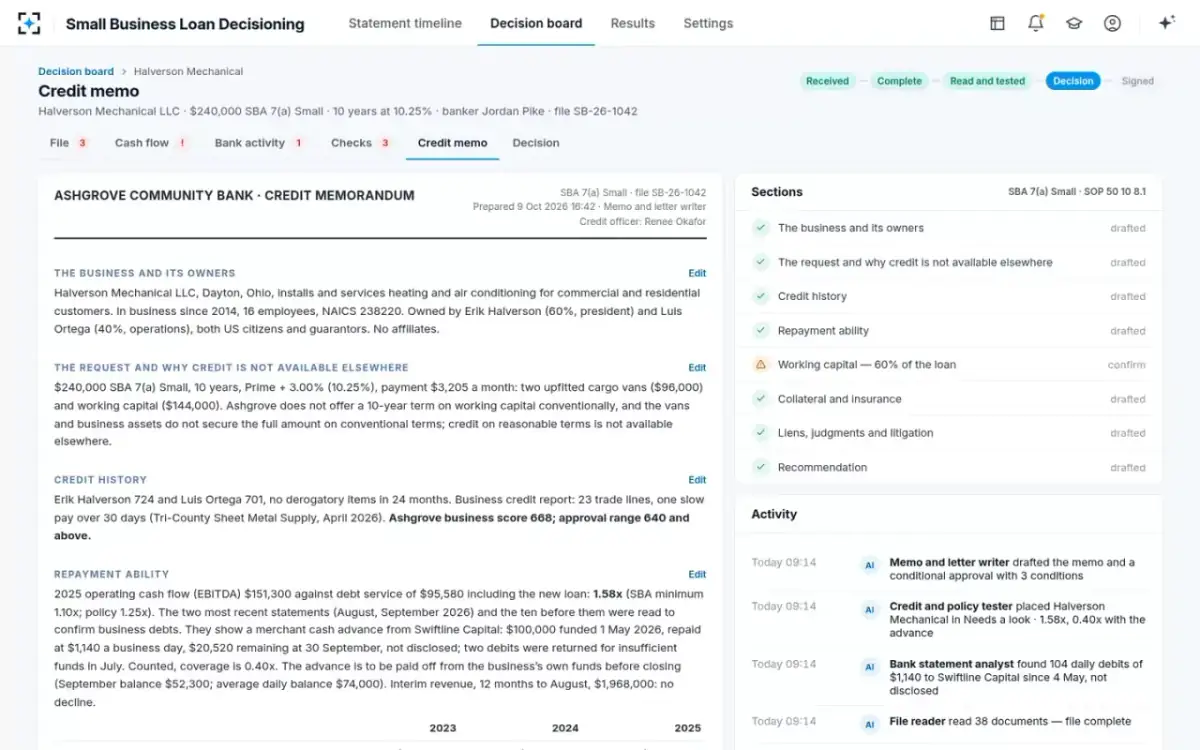
Line 11 is not on the borrower's debt schedule. The bank statements show a $100,000 credit from a merchant cash advance funder on May 1 and $1,140 debited every business day since. Counted as debt at $1,140 × 252 business days, the advance adds $287,280 a year. Global debt service becomes $435,660, and global coverage falls from 1.17x to 0.40x. The business ratio falls to the same place, from 1.58x to 0.40x, because the advance is a business debt.
One unlisted debt moves both ratios below every floor
This is the line an analyst working from the application and the tax returns cannot see. The advance began in May 2026, after the 2025 return was filed, and it appears on no credit report. Only the statements show it. That is why SBA requires the two most recent months of operating-account activity on 7(a) Small loans to confirm all debts are in the coverage calculation, and why testing a reviewer with planted advances is worth doing before trusting any coverage number.
The fix changes the structure, not the arithmetic. The sample bank's condition is that the advance be paid off from the business's own funds before closing, with a zero-balance letter; with the $20,520 balance paid, business coverage returns to 1.58x and global to 1.17x. A counter-offer for the vans alone does not help while the advance runs: coverage stays at 0.42x on the business.
The memo states coverage both ways, and the condition that restores it
What is a good global DSCR?
Above the floor that applies, with room for a bad year. SBA's floor for Standard 7(a) is 1:1, which means the business and owners exactly cover every payment and nothing more. A lender's policy is usually the binding number; the sample bank sets 1.25x on the business. On the global ratio, the useful test is sensitivity: how far can business cash flow fall before global coverage reaches 1:1?
How much room the sample file has once the advance is paid
1.17x
global coverage with the advance paid off
$24,920
of global cash flow above 1:1
16%
fall in business cash flow before global coverage reaches 1:1
A 16% cushion on a contractor whose revenue grew 9.7% last year is reasonable but not generous. It is also the kind of number a credit officer can discuss with the owners: two signed contracts worth $598,800 support next year's revenue, and the working capital in the loan exists to carry them. Why loans of this size need more checking per dollar, not less, is the subject of a companion guide. To see the spread, the statements and the memo together, start from Small Business Loan Decisioning.
Questions people ask
What is the difference between DSCR and global DSCR?
DSCR divides the business's operating cash flow by the business's debt service. Global DSCR adds the owners and guarantors: their income on top, their taxes and living costs off, and their personal debt payments below the line. On the sample file the business ratio was 1.58x and the global ratio 1.17x.
Is EBITDA or EBIDA used for SBA debt service coverage?
SOP 50 10 8.1 defines operating cash flow for coverage as EBITDA: earnings before interest, taxes, depreciation and amortisation. Lenders may make additions and subtractions, such as unfunded capital expenditures or distributions for S corporation taxes, but each needs a justification in the memo.
Do you count K-1 income in global cash flow?
Not if the business that issued the K-1 is already in the calculation. The K-1 income is the same money as the business's net income inside EBITDA. Count the owners' wages, which the business has already paid out, and subtract the taxes the owners owe on both.
How do merchant cash advances change DSCR?
They add a large fixed payment that usually appears nowhere but the bank statements. A daily debit is commonly annualised at 252 business days. On the sample file $1,140 a day added $287,280 a year and took both business and global coverage to 0.40x.
Can projections be used for global DSC on an SBA loan?
For Standard 7(a), historical cash flow comes first; if the most recent year and the interim statements do not show enough coverage, the lender must obtain two years of detailed projections and justify relying on them. For changes of ownership under Appendix 15, the lender must evaluate projections but may not rely on them to meet the coverage minimum.