A business loan adverse action notice is the notice Regulation B requires a lender to give a business that is declined, offered credit on terms it did not ask for and does not accept, or otherwise refused. For a business with gross revenue of $1 million or less in its last fiscal year, the lender must notify it within 30 days of a completed application and give the specific principal reasons, or tell it how to get them. For larger businesses the notice is due within a reasonable time, with written reasons if the business asks within 60 days. None of this changes when AI has read the file. Botminds' Small Business Loan Decisioning is built on that premise: its agents draft the reasons from findings in the file, and a credit officer decides and signs. The question for a compliance officer is whether a reason drafted by software can meet the standard, and the answer depends entirely on where the reason comes from.
What Regulation B requires of a business decline, and what the design does
What the rule requires: 30 days after a completed application for businesses with revenue of $1 million or less; a reasonable time above that.
What Small Business Loan Decisioning does: Tracks every file against 30 days from the complete-file date, with a warning at day 20, whatever the revenue.
What the rule requires: The creditor takes the action and owes the notice.
What Small Business Loan Decisioning does: The agents recommend a lane and never decline; a named credit officer decides and signs.
What the rule requires: Specific, naming the principal reasons. "Internal standards" or "failed to achieve a qualifying score" are insufficient.
What Small Business Loan Decisioning does: Each drafted reason is tied to a finding and the page it came from: the coverage figure, the statement line, the docket entry.
What the rule requires: A refusal on the terms requested is adverse action unless the applicant accepts the counter-offer.
What Small Business Loan Decisioning does: Drafts the counter-offer letter with its reasons beside the approval and decline options.
What the rule requires: ECOA bars discrimination on a prohibited basis.
What Small Business Loan Decisioning does: The credit and policy tester never uses or infers a protected characteristic.
What the rule requires: The duty to give accurate, specific reasons applies whatever technology made the decision.
What Small Business Loan Decisioning does: No reason comes from a model that cannot state it; reasons come from findings a person has seen.
Do business loans require an adverse action notice?
Yes. The Equal Credit Opportunity Act and Regulation B apply to business credit, and section 1002.9 sets out how lenders notify business applicants. The duty starts with the general rule: a creditor "shall notify an applicant of action taken within: (i) 30 days after receiving a completed application concerning the creditor's approval of, counteroffer to, or adverse action on the application" (12 CFR 1002.9(a)(1)). Paragraph (a)(3) then adjusts the form for business credit by the size of the business.
Adverse action is defined broadly enough to catch the outcomes small business lenders most often reach. It includes "a refusal to grant credit in substantially the amount or on substantially the terms requested in an application unless the creditor makes a counteroffer ... and the applicant uses or expressly accepts the credit offered" (12 CFR 1002.2(c)). An offer of $96,000 for vans to a business that asked for $240,000 is adverse action until the business accepts it.
Business adverse action notice rules by size of business
The rule splits business applicants at $1 million of gross revenue in the preceding fiscal year. Below the line, the lender follows the full timing and content rules with two concessions: the statement of action may be oral, and the right to a statement of reasons may be disclosed at application instead of at decline. Above the line, the lender notifies within a reasonable time and owes written reasons only on a written request made within 60 days. Trade credit and factoring sit with the larger tier whatever the business's size.
Business adverse action notices: what each tier requires
| Revenue of $1 million or less | Revenue over $1 million, trade credit, factoring | |
|---|---|---|
| When the notice is due | 30 days after a completed application; 30 days after adverse action on an incomplete one; 90 days after an unaccepted counter-offer | Within a reasonable time |
| Form of the notice | Oral or written | Oral or written |
| Reasons | A statement of specific reasons, or disclosure of the right to one within 30 days if requested within 60 days | Written reasons and the ECOA notice if the applicant asks in writing within 60 days |
| When the right to reasons may be disclosed | At application, instead of at decline | Not required in advance; written reasons follow a written request |
| Telephone applications | An oral statement of the action and of the right to reasons satisfies the rule | No separate provision |
Can an adverse action notice be oral for a business?
Yes, for both tiers, but the reasons are a different matter. A business with revenue of $1 million or less can be told orally that it was declined; it must still receive, or be told how to obtain, the specific reasons, and if the reasons are given orally it may ask to have them confirmed in writing. In practice most banks send a written notice to every business applicant, because a written notice is the only evidence that the timing and content rules were met.
What reasons must a business adverse action notice give?
The principal reasons for the decision, stated specifically. The regulation is unusually direct about what fails: "The statement of reasons for adverse action ... must be specific and indicate the principal reason(s) for the adverse action. Statements that the adverse action was based on the creditor's internal standards or policies or that the applicant, joint applicant, or similar party failed to achieve a qualifying score on the creditor's credit scoring system are insufficient" (12 CFR 1002.9(b)(2)).
Reasons a business decline might give: which meet the standard
| Reason as written | Meets 1002.9(b)(2)? | Why |
|---|---|---|
| "Did not meet our credit standards" | No | Names the creditor's internal standards, which the rule calls insufficient |
| "Business credit score below our approval range" | No, on its own | A qualifying-score statement; the reasons behind the score are what the applicant needs |
| "Insufficient cash flow to repay all debts: coverage 0.40x with all business debts counted" | Yes | Specific, principal, and traceable to the spread and the statements |
| "Obligations not disclosed on the application: a cash advance repaid by daily debit since May" | Yes | Specific, and tied to the statement lines that show it |
| "Unresolved delinquent federal debt of an owner (CAIVRS)" | Yes | Specific; names the check and what it found |
| "Collateral insufficient" | Weak | True on many files, but rarely the principal reason on a cash-flow loan; say what the shortfall is |
The table shows why software that reads the file is not the compliance risk it is often assumed to be. The risk is software that decides from a score and cannot say why. A reason such as "coverage 0.40x with all business debts counted" can only be written by something, or someone, that has counted the debts. On the sample file the finding behind it opens the May statement where the advance was funded.
Were the CFPB AI adverse action circulars withdrawn?
Yes, on May 12, 2025, but the duty they described was not. The CFPB's Circular 2022-03 had said that adverse action requirements "apply equally to all credit decisions, regardless of the technology used to make them", and that "ECOA and Regulation B do not permit creditors to use complex algorithms when doing so means they cannot provide the specific and accurate reasons for adverse actions" (CFPB Circular 2022-03). In May 2025 the CFPB withdrew it, along with Circular 2023-03 on the use of its sample forms, in a list of guidance documents (Federal Register, May 12, 2025).
A withdrawn circular is no longer the CFPB's stated view, but the regulation it interpreted is unchanged: section 1002.9(b)(2) still requires specific principal reasons, and nothing in it exempts a decision a model made. The CFPB's separate 2026 amendments to Regulation B, effective July 21, 2026, changed its provisions on disparate impact, discouragement and special purpose credit programs (Federal Register, April 22, 2026); they did not change the adverse action notice rules. A compliance officer reading the circulars as history and the regulation as law is reading them correctly.
The rules a business decline must meet in 2026
30days
to notify a business with revenue of $1 million or less after a completed application
60days
for a larger business to request written reasons
May 2025
CFPB AI adverse action circulars withdrawn; the regulation unchanged
Can AI generate adverse action reasons?
It can draft them; it should not be the one that adopts them. A drafted reason that names a finding, the coverage figure, the undisclosed advance, the federal debt, is no different in law from one an analyst typed, provided the finding is accurate and is actually why the lender declined. That proviso is the whole design problem. A model that writes a plausible reason after the fact, not the reason the decision rested on, fails the "principal reason" test however fluent it is.
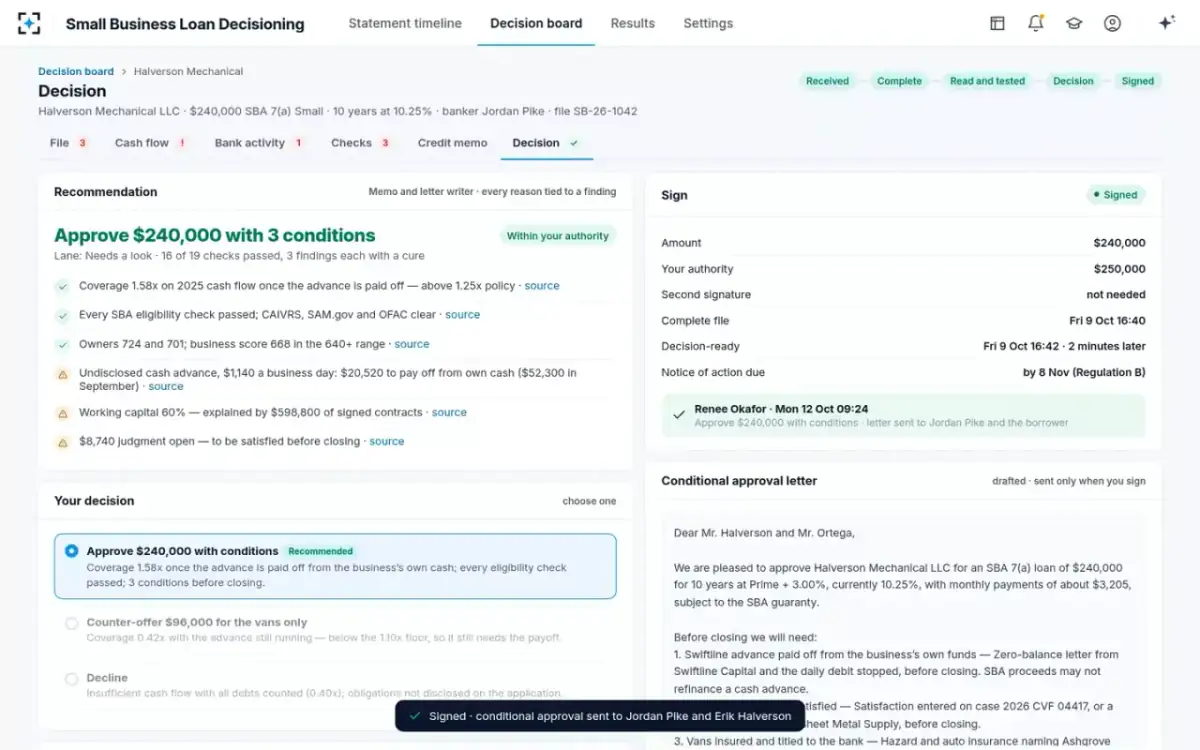
So the safe design has three parts. The reasons are generated from findings, not written freehand, so each one points to evidence. The officer who decides sees the findings and the drafted reasons together and adopts or changes them before signing. And the software that drafts never sends: in Small Business Loan Decisioning the memo and letter writer drafts the approval, counter-offer or decline letter, and the letter goes only after the officer signs.
The decision, its reasons and the notice date on one screen
How many days to send an adverse action notice, and when the clock starts
Thirty days for a business with revenue of $1 million or less, counted from a completed application, which Regulation B defines as one where the creditor has received all the information it regularly obtains and considers for that kind of credit. That definition is why a lender should know exactly when a file became complete. In the sample, the last of 38 documents arrived at 16:40 on Friday, October 9, 2026, so the notice was due by November 8.
The sample file used three of its thirty days
- Read, tested, drafted2 min
- Weekend2.7 d
- Unused before the deadline27 d
The sample borrower's revenue, $1.9 million, puts it in the larger tier, where the rule asks only for notice within a reasonable time. The solution tracks 30 days on every file anyway. That is a deliberate default: a lender that sorts its business applicants by revenue before deciding which clock applies has one more thing to get wrong, and a 30-day standard meets both tiers.
What SBA and federal AI policy add for SBA lenders
SBA's rules add one constraint relevant to automated reasons: for 7(a) Small and SBA Express loans, a lender's scoring model may not rely solely on consumer credit scores, must be one the bank uses on similar conventional loans, and supplements rather than replaces the credit analysis (SOP 50 10 8.1). A decline on an SBA file is therefore expected to rest on the analysis, which is exactly where specific reasons come from.
The federal view of AI in lending points the same way. SBA's Inspector General reported in 2026 that OMB treats AI that affects loan decisions in federal programs as high impact, needing independent review before use (SBA OIG Report 26-15), and GAO has listed "potentially biased lending decisions" among the risks of AI in financial services (GAO-25-107197). Neither binds a private lender's notice. Both explain why examiners will read a decline produced with software more closely, and why a reason the officer can trace to a page is the safest one to sign. The step-by-step trace shows where in the run each finding is made.
Before an officer signs a decline drafted with software
- Is each reason one the decision actually rested on?
Principal reasons, not every finding. Two or three is usual.
- Can each reason be traced to a page in the file?
A coverage figure to the spread, a debt to the statement line, a federal debt to the CAIVRS result.
- Does any reason name only a policy or a score?
"Below our standards" and "score below range" are insufficient by the rule's own words.
- Is a counter-offer being treated as adverse action until accepted?
A smaller amount or different terms, unaccepted, needs a notice.
- Is the clock right?
From the date the file became complete; 30 days for businesses at or under $1 million of revenue.
- Did any input touch a protected characteristic?
Including proxies the model could infer; the tester in the solution is barred from both.
- Who sends the notice, and is it kept with the file?
A person sends it after signing; the notice, the reasons and the evidence stay together.
Declines are not the only notices that matter. An approval with conditions, like the sample file's, is still action taken that the business must be told about within the same window, and the SBA credit memo behind a decline shows where each specific reason is documented before it is sent. For the full decision screen, start from Small Business Loan Decisioning.
Questions people ask
Is a counter-offer on a business loan adverse action?
Yes, unless the applicant uses or expressly accepts it. Regulation B defines adverse action to include a refusal to grant credit in substantially the amount or on the terms requested, unless the creditor counter-offers and the applicant accepts. If it is not accepted, the notice is due 90 days after the counter-offer.
Does a commercial loan adverse action notice need the ECOA notice?
For a business with revenue of $1 million or less, the notice must follow the content rules in 1002.9(a)(2), which include the ECOA statement and the name of the creditor's federal regulator. For larger businesses, the written reasons and the ECOA notice are owed when the applicant asks in writing within 60 days.
When is a business loan application complete under Regulation B?
When the creditor has received all the information it regularly obtains and considers for that amount and type of credit, and it must use reasonable diligence to get it. If an application stays incomplete, the creditor must within 30 days either act on it or send a written notice naming what is missing and a reasonable deadline.
Can a lender cite an SBA rule as the reason for a decline?
Yes, if it is specific: an owner's unresolved federal debt found in CAIVRS, or coverage below SBA's 1.10x minimum for 7(a) Small with the figure stated. "Does not qualify for SBA" alone would be as unhelpful as "below our standards". The applicant needs to know which test failed.
Who is responsible for the notice if a vendor's software drafted it?
The lender. The creditor owes the notice under Regulation B, and the federal banking agencies' guidance on third parties says using a vendor does not diminish a bank's responsibility to comply with consumer protection and fair lending laws. That is why the officer, not the software, should adopt the reasons and send it.