AI loan underwriting is software that reads a loan file, extracts and checks every figure, applies the lender's credit policy and the program's rules, and drafts the analysis a credit officer needs to decide. Done well on a small business loan, it does not approve anything: it turns 38 documents into a tested, cited file and leaves the decision with a named person. Botminds' Small Business Loan Decisioning does this with six agents for small business requests up to $350,000. This guide traces one SBA 7(a) Small request through every step, with the time each took and the evidence each left behind, because a buyer should see the work before trusting it.
The file is a sample on fictional parties: Halverson Mechanical, a heating and air conditioning contractor in Dayton, asks Ashgrove Community Bank for $240,000, $96,000 for two vans and $144,000 of working capital, over ten years at 10.25%. The last of its 38 documents lands at 16:40 on Friday, October 9, 2026.
Six agents, 112 seconds: where the run spends its time
- File reader14 s
- Cash-flow spreader21 s
- Bank statement analyst33 s
- Eligibility18 s
- Policy tester15 s
- Memo writer11 s
What is AI loan underwriting, and what is it not?
AI loan underwriting reads and tests; a credit decision engine scores and decides. The two are often sold under the same name, and the difference matters most on small business loans. A scoring engine takes structured inputs, such as bureau scores, time in business and revenue, and returns approve, refer or decline. It is fast, but it sees only what someone has already typed. A file-reading system starts from the documents: the returns, the transcripts, the bank statements, the forms. It produces the analysis a credit officer would otherwise wait two weeks for.
Automatic approval is rare in small business lending, and for good reason. The FDIC's survey of about 1,300 banks found that "less than one in thirty banks use a credit-scoring system to auto-approve loans, and less than one in one hundred banks will auto-approve a loan of $250,000" (FDIC, Small Business Lending Survey). A $240,000 SBA loan sits squarely in the range where banks keep a person in the decision, and where SBA expects a lender's analysis to stand up years later at purchase review.
Small business credit is still decided by people
1 in 10
banks have a scoring system that can automate some non-card underwriting
<1 in 30
banks use one to auto-approve loans
<1 in 100
banks will auto-approve a $250,000 loan
How does AI loan underwriting work on an SBA file?
It works as a chain of narrow agents, each with one job and a written limit, passing its output to the next. On the sample file the chain is six long. The order matters: the bank statement analyst runs before the coverage test, because the debt it finds changes the answer. Every output carries the page it came from, so the credit officer can check a finding in one click rather than re-read the file.
Who does what on one file: six agents, then one person
Agent
File readerSorts and reads all 38 documents and says when the file is complete.
Never: fill in an answer the borrower left blank
Agent
Cash-flow spreaderSpreads three years of Form 1120-S, ties each line to the return page and builds the debt schedule.
Never: add back anything but by rule, with the line cited
Agent
Bank statement analystClassifies 2,914 transactions, ties deposits to revenue and finds recurring debts by payee and rhythm.
Never: count a transfer, a loan or an advance as revenue
Agent
Eligibility checkerRuns nine SBA eligibility checks, each with its source.
Never: clear a hit; a person clears it
Agent
Credit and policy testerTests credit and coverage against the SBA floor and bank policy and places the file in a lane, with at most two reasons.
Never: decline, or use a protected characteristic
Agent
Memo and letter writerDrafts the memo, the conditions and the approval, counter-offer or decline letter.
Never: send a letter or decide
A person decides
Credit officer decides and signsChecks the findings at their sources, confirms the judgment sections and signs within her $250,000 authority.
Steps 1 and 2: read the file, spread the returns (35 seconds)
The file reader opens all 38 documents and works out what each is: the application, three Forms 1919 (the business and two owners), two Forms 413, three years of returns with their transcripts, twelve statements, the interim statement, the debt schedule and the contracts. It reports the file complete, or names what is missing. It never guesses a blank. If a borrower skips the legal-actions question on Form 1919, the reader lists it as missing; it does not infer "no".
The cash-flow spreader then spreads the returns line by line. For 2025: revenue $1,912,400, net income $65,400, interest $21,700 and depreciation $64,200 added back, operating cash flow of $151,300. The returns match the IRS transcripts to the dollar for all three years, which SOP 50 10 8.1 requires the lender to reconcile before the first disbursement. Existing debt service from the borrower's schedule comes to $57,120 a year; the new loan adds $38,460. Coverage, as the application shows it, is 1.58x.
Step 3: read every bank statement line (33 seconds)
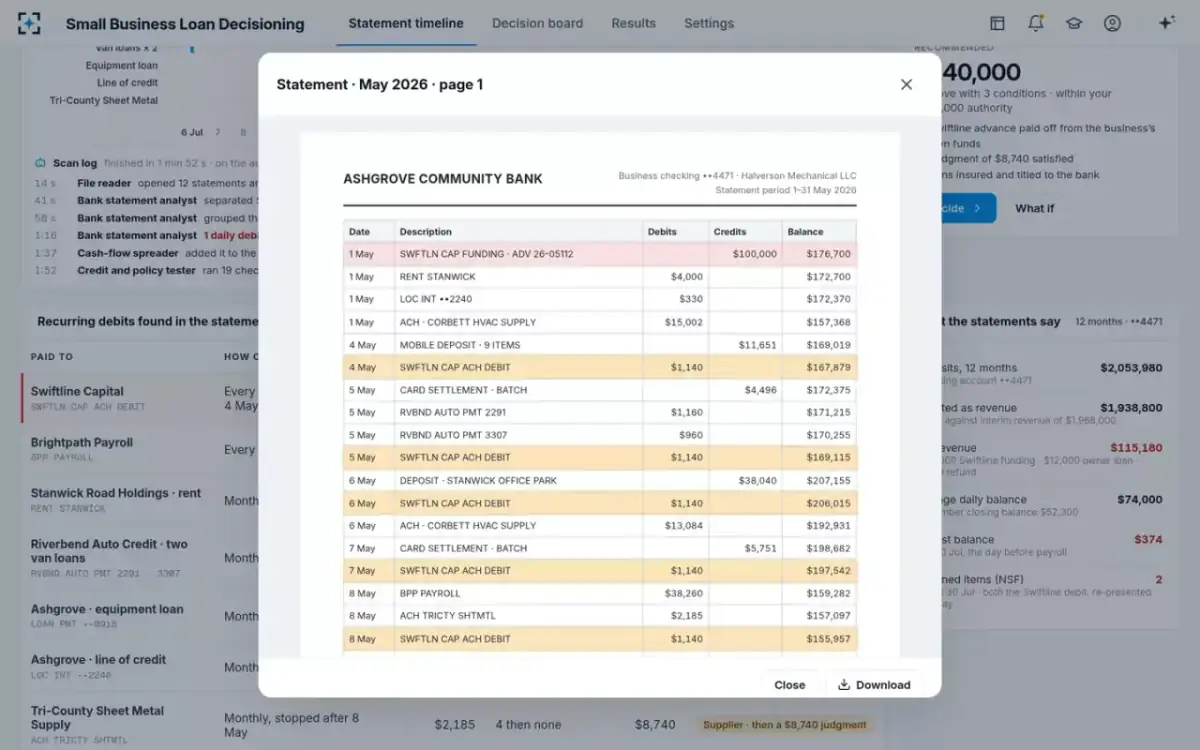
This is the longest step and the one that changes the answer. SBA requires a review of the two most recent months of operating-account activity for 7(a) Small loans. The analyst reads all twelve months the file holds: 2,914 transactions. It separates $115,180 of deposits that are not revenue, including a $100,000 credit on May 1 from Swiftline Capital, a $12,000 owner loan and a refund. Then it groups every debit by payee and rhythm. Seven patterns repeat; six match the debt schedule or the operating costs. One does not.
Swiftline Capital has taken $1,140 every business day since May 4: 104 debits paid, two returned for insufficient funds in July, $118,560 in all. It is a merchant cash advance, on neither the application nor the schedule. How to test whether a reviewer catches an advance like this is the subject of its own guide.
The finding, proved on the statement page it came from
Steps 4 and 5: the SBA checks and the coverage test (33 seconds)
The eligibility checker runs nine checks: an operating, for-profit business in the U.S.; size against the industry standard with affiliates; not an ineligible business type; every owner a U.S. citizen or national; CAIVRS, SAM.gov exclusions and OFAC for the business and both owners; use of proceeds; and credit not available elsewhere. Each result names its source, such as the Form 1919 question, the CAIVRS response or the screenshot of the exclusion search. On this file all nine pass. Had CAIVRS returned a hit, the checker would have stopped and routed it to the SBA lending manager. It cannot clear one.
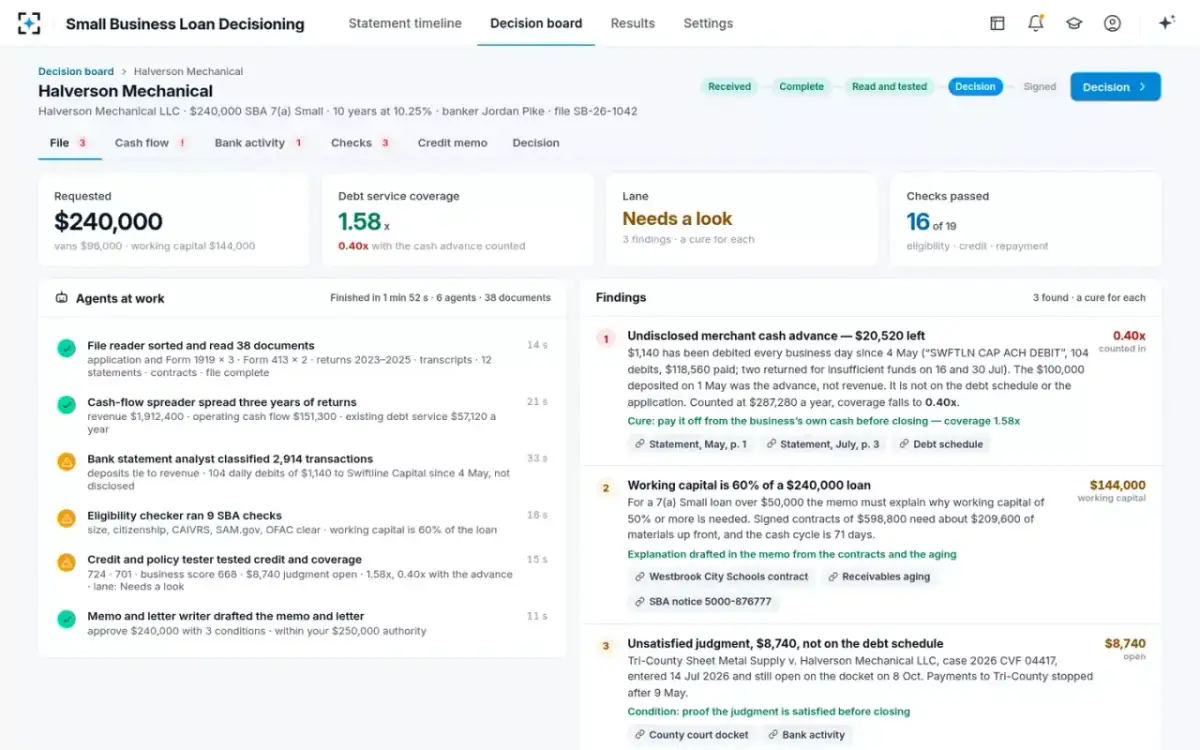
The credit and policy tester then puts the file together. Owners' scores are 724 and 701; the bank's own business score is 668 against its approval range of 640 and above. An $8,740 judgment from a supplier, entered in July and still open, appears on the county docket but not on the debt schedule. With the Swiftline advance counted at $1,140 a business day for 252 days, debt service rises to $382,860 and coverage falls to 0.40x, below SBA's 1.10x floor for 7(a) Small and the bank's 1.25x policy. The tester places the file in Needs a look, not Decline likely, because there is a cure it can name: paid off from the business's own cash before closing, coverage returns to 1.58x. The coverage arithmetic, with the owners added, is worked separately.
The file, read and tested: three findings, a cure for each
Step 6: the memo and the letter (11 seconds)
The memo and letter writer drafts the credit memorandum in the shape SBA sets for 7(a) Small loans: the business and owners, the request and why credit is not available elsewhere, credit history, repayment ability, working capital, collateral and insurance, liens and judgments, and a recommendation. Every figure is cited. One section is left for a person: working capital at 60% of the loan, which SBA's 7(a) Small rules require the lender to explain when the loan is over $50,000. The draft ties it to $598,800 of signed contracts and a 71-day cash cycle, and marks it "confirm".
It drafts the recommendation, approve $240,000 with three conditions, and the alternatives a credit officer might prefer: a counter-offer of $96,000 for the vans alone, which still fails at 0.42x while the advance runs, or a decline. Each reason in each draft is tied to a finding. None is sent.
Step 7: where the person decides, and why it is not optional
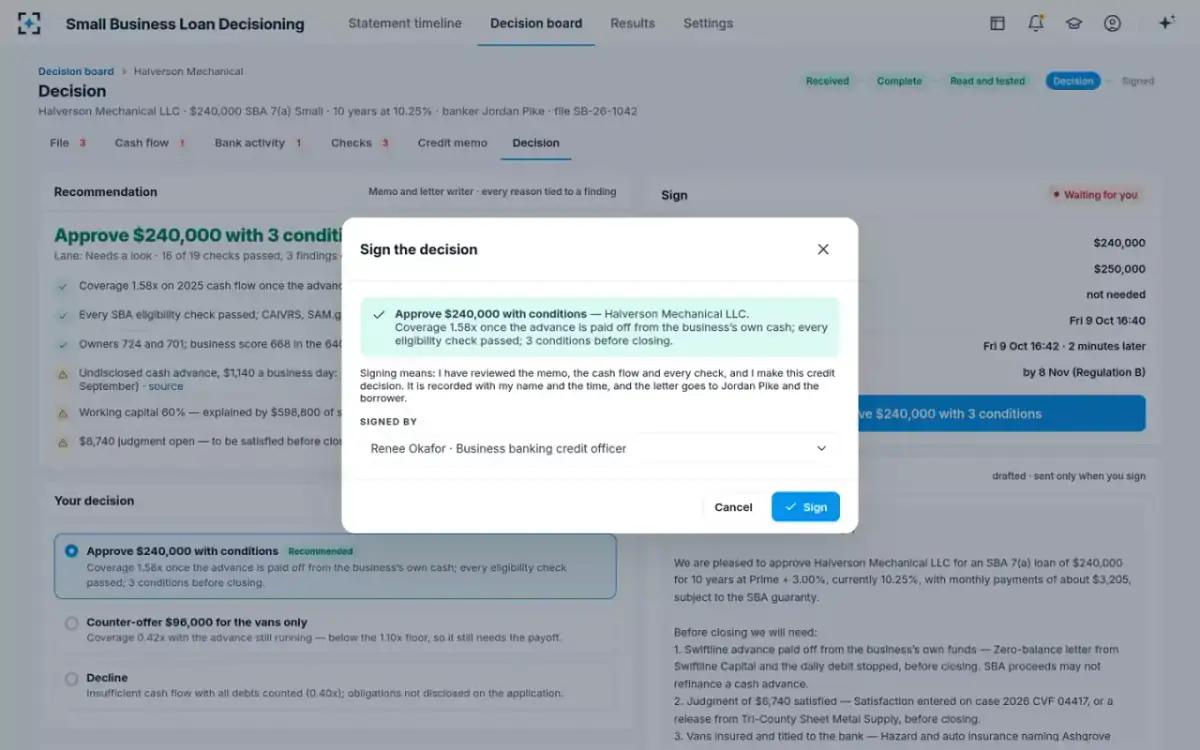
On Monday morning the credit officer opens the file on the statement timeline, clicks the red row, reads the May statement, checks the docket entry for the judgment and confirms the working capital explanation. The recommendation is within her $250,000 authority, so no second signature is needed. She approves with three conditions: the advance paid off from the business's own funds with a zero-balance letter, the judgment satisfied, and the vans insured and titled to the bank. She signs at 09:24, with the meaning of her signature stated on the screen.
The decision is the officer's, with what her signature means written beside it
The person in this step is a design requirement, not a courtesy. Treasury's 2024 report on AI in financial services notes that "AI has long been deployed in the financial services sector in a variety of ways, including credit underwriting", and warns that generative AI "can be susceptible to 'AI hallucinations,' producing confidently stated but incorrect output" (U.S. Treasury, December 2024). A cited finding can be checked; a confident paragraph cannot. That is why every agent output in the trace above links to a page, and why the decision step cannot be skipped.
Is AI underwriting high risk under federal guidance?
For federal agencies, yes by presumption. SBA's Inspector General reported in September 2026 that "OMB presumes any AI model that affects a person's request for critical federal services or benefits, to include loans, fraud detection and related adjudication, is high impact", and that such uses need an independent review and an impact assessment before deployment (SBA OIG Report 26-15). That OMB policy binds federal agencies, not private lenders. But it is the clearest federal statement of how AI touching a loan decision is viewed, and a bank's model risk and fair lending teams will read it the same way.
SBA's own lending rules say nothing about AI as such. What they do say is about scoring models: SOP 50 10 8.1 lets a lender use one for 7(a) Small and SBA Express loans if its regulator permits it, the bank uses it on similar conventional loans, and it does not lean on consumer scores alone (SOP 50 10 8.1). A design that reads documents and drafts analysis, while a person decides, stays inside both lines. A design that decides on its own invites the questions the OMB presumption was written to raise.
Two kinds of AI loan underwriting, side by side
A credit decision engine: Fields someone has keyed: scores, revenue, time in business.
Agents that read the file: The documents: returns, transcripts, statements, SBA forms, contracts.
A credit decision engine: Approve, refer or decline, often with a score.
Agents that read the file: A spread, tested checks, findings with cures, a drafted memo and letter.
A credit decision engine: Only if it is on the bureau report or keyed in.
Agents that read the file: From the rhythm of the bank statement debits.
A credit decision engine: Reason codes from the model.
Agents that read the file: Each reason tied to a finding and a page.
A credit decision engine: The engine, below a threshold.
Agents that read the file: A credit officer, always.
A credit decision engine: A scoring model may support, not replace, the credit analysis.
Agents that read the file: Produces the analysis the SOP asks the memo to contain.
What the research says about automating small business credit
The research supports reading and assembling more than deciding. A study of loan officers' written assessments of small firms found that "the text alone is surprisingly effective for predicting default. However, when combined with traditional data, it yields no additional predictive capability" (Stevenson, Mues and Bravo, European Journal of Operational Research, 2021). The value of a model that reads is in getting the traditional data right and fast, not in a new kind of prediction.
Automation can widen access. In the Paycheck Protection Program, researchers found that "process automation reduces racial disparities in credit access through enabling smaller loans, broadening banks' geographic reach, and removing human biases from decision-making" (Howell and others, NBER w29364, Journal of Finance 2024). The same program shows the other side: misreporting concentrated in certain fintech lenders, and suspicious lending in 2021 ran at four times the level at the program's start (Griffin, Kruger and Mahajan, Journal of Finance 2023). Speed without verification of returns and statements is how that happens. The trace above verifies first.
What should you ask an AI loan underwriting vendor?
Ask to see a trace like this one on a file of your own. A demonstration on clean sample data proves little; a file with a scanned return, a missing transcript and an awkward debit pattern proves a lot. These are the questions that separate a reader from a scorer.
Questions to put to any AI loan underwriting product
- Does every figure open the page it came from?
If a number cannot be traced to a return line or a statement row, the credit officer is signing on trust.
- What does it do with a debt the borrower did not list?
Ask for the rule: which rhythm, how many days a month, and whether you can change it.
- Can it decide, decline or send a letter on its own?
The safe answer is no. Find out exactly where the person signs.
- Who clears an eligibility hit?
CAIVRS, SAM.gov and OFAC hits belong to a named person at the bank.
- Which SBA rules does it apply, and from which date?
SOP 50 10 8.1 took effect October 1, 2026; a file in flight on that date needs the right version.
- Can you change the policy, and see who changed it?
Coverage, score range, authority limits and statement months should be settings with a history.
- How often do your officers agree with its recommendation?
A pilot on your own complete files should report agreement by lane, not just speed.
- Does it write into the systems you already have?
If it needs a second screen to key into, the hours come back.
Small Business Loan Decisioning fits small business requests up to $350,000: SBA 7(a) Small and SBA Express, and conventional term loans and lines. It does not price loans, prepare closing documents or service them, and it does not replace a loan origination system or SBA's own submission channel. Larger commercial credits, with their committee memos and covenant packages, need a different workflow. The decline that follows a recommendation still has to meet Regulation B, which is the subject of the guide to adverse action notices when AI has read the file. To see the whole run, start from Small Business Loan Decisioning.
Questions people ask
Can AI underwrite small business loans?
AI can do most of the underwriting work: read the returns and statements, spread cash flow, run the checks and draft the memo. On the sample SBA file that took 1 minute 52 seconds. The credit decision stays with a person; the FDIC found fewer than one bank in a hundred will auto-approve a $250,000 loan.
Can AI approve an SBA loan?
SBA has issued no guidance on AI in lender underwriting, and under delegated processing the lender answers for the analysis when it asks SBA to honour the guaranty. A lender may use a business scoring model for 7(a) Small and SBA Express loans within the SOP's limits, but the model supports the credit analysis rather than replacing it.
How long does AI loan underwriting take?
On the sample 38-document file the six agents took 112 seconds, and the longest step, the bank statement read, took 33. The design target is a decision-ready file within a day of the file being complete. The person's review then sets the pace.
Who signs off on an AI-underwritten loan?
A named credit officer within an authority limit, with a second signature above it or on a policy exception. In the sample, the officer decides alone up to $250,000 and the chief credit officer co-signs to $350,000. Every reason in the letter is tied to a finding she has seen.
What does an AI underwriting agent check?
On an SBA 7(a) Small file: completeness, the spread and its tie to IRS transcripts, every bank statement debit, SBA eligibility (size, ownership, CAIVRS, SAM.gov, OFAC, use of proceeds, credit elsewhere), credit history, liens and judgments, and coverage against the 1.10x SBA floor and the bank's policy. The sample file ran 19 checks; 16 passed and 3 found something.