An SBA credit memo is the lender's written analysis of a 7(a) application: it summarises the business, its owners and the request, and it must show why credit is not available elsewhere, what the credit history shows, and whether cash flow repays every debt including the new loan. It is also the document SBA reads at guaranty purchase, and the SOP says that failing to address the need for SBA credit in it can lead SBA to deny liability on a guaranty a delegated lender approved. Most SBA declines come from the same five tests the memo has to cover — eligibility, credit elsewhere, credit history, repayment ability and tax verification — so a lender that writes the memo well also documents its declines well. Botminds' Small Business Loan Decisioning reads the file, runs the tests and drafts the memo in the SBA small-loan shape; a credit officer decides every file and signs.
This guide is written for SBA credit officers, lending managers and the chief credit officer who answers for the portfolio. The rules come from SBA's SOP 50 10 8.1, effective October 1, 2026, 13 CFR Part 120 and Regulation B; worked examples use fictional sample businesses.
SBA files fail more often than any other small business credit
40%
of applicants for an SBA loan or line were denied in 2025, the highest rate of any credit product in the Fed’s survey
17of 40
SBA on-site lender reviews in fiscal 2016 found noncompliance with the credit elsewhere requirement
1.10x
minimum debt service coverage on a 7(a) Small loan; 1.15x and 1:1 global on a Standard 7(a)
What must an SBA credit memo contain?
For a 7(a) Small loan the memo must summarise the business, ownership and request, state why credit is not available elsewhere, and analyse credit history and repayment ability; for a Standard 7(a) it must add a fuller financial analysis, collateral, insurance, equity and the rationale for approval. The SOP lets 7(a) Small and SBA Express lenders use "their own forms, internal credit memoranda, notes" as long as they follow the procedures they use for similar non-SBA commercial loans, so the content is fixed but the template is the lender's.
What SOP 50 10 8.1 puts in the credit memo, by program
| Section of the memo | 7(a) Small (up to $350,000) | Standard 7(a) |
|---|---|---|
| Business and request | Summary of the operating business, ownership and loan request | History, time under current management, depth of management experience, who runs the business day to day |
| Credit elsewhere | Why credit is not available elsewhere | The factors showing credit is not available on reasonable terms, with support |
| Credit history | Applicant, associates and guarantors; any score stated with the approval range | Owners’ and guarantors’ credit reports analysed and any issues discussed |
| Repayment ability | Coverage of 1.10x or more; two most recent months of bank activity reviewed to confirm all debts | Three years plus interim; EBITDA and each adjustment justified; 1.15x and 1:1 global; projections’ assumptions |
| Balance sheet and collateral | Description of collateral and estimated value | Pro-forma balance sheet, ratios against industry, working capital for 12 months, collateral adequacy |
| Other matters | Working capital of 50% or more on loans over $50,000; seller financing; liens, judgments, litigation | Equity and injection, insurance, refinancing justification, delinquencies, trade disputes, citations |
The difference in depth is the point of the small-loan program: it trades a long narrative for a short memo built on the lender's own commercial credit procedures. What it does not trade away is any of the five tests. A 7(a) Small memo that is brief on business history is compliant; one that is silent on credit elsewhere or skipped the bank statements is not.
Why the memo decides the guaranty, not only the loan
Under delegated processing the lender approves the loan without SBA reviewing the file first, and SBA reviews it later — at a lender oversight review, or when the loan defaults and the lender asks SBA to buy the guaranteed portion. The memo is then the lender's evidence that it did what it certified.
“Failure of the SBA Lender to adequately address the Applicant’s need for the desired credit in the credit memorandum may result in SBA declining the application submitted under non-delegated processing or denying liability on the guaranty if the application is approved by a 7(a) Lender under its delegated authority.”
SBA SOP 50 10 8.1, Section A, Chapter 1 (credit not available elsewhere)
That sentence turns a documentation standard into a credit loss. A guaranty covering most of a defaulted loan can be reduced or refused because a paragraph was thin when the loan was made, and nobody at the lender will remember the conversation that would have filled it. A memo written for SBA's purchase reviewer rather than for the approval meeting is the cheapest loss mitigation an SBA department has.
Test one: is the business, and every owner, eligible?
Eligibility comes first because no amount of cash flow cures it. The memo must show that the business meets the size standard with its affiliates, is not an ineligible business type, uses the proceeds for an eligible purpose, and that its owners pass the character and citizenship tests, with the CAIVRS, SAM.gov and OFAC results for the business and each owner.
Two eligibility rules produce many recent declines. Since March 1, 2026, all direct and indirect owners must be U.S. citizens or U.S. nationals with their principal residence in the United States; SBA's policy notice says lawful permanent residents "will not be eligible to own any percentage interest in an Applicant/Borrower" (SBA Policy Notice 5000-876441). And the SOP is categorical on taxes: "If an Applicant has not filed required Federal tax returns, the Applicant is not eligible for SBA financial assistance" (SOP 50 10 8.1). The list of ineligible business types sits in 13 CFR 120.110, from businesses with an associate under felony indictment to those earning more than a third of gross revenue from legal gambling.
A decline on eligibility is the easiest to document and the hardest to explain to the business banker, because the business may be strong. The memo should name the rule, the evidence (the CAIVRS hit, the transcript that was not found, the ownership chart) and whether the defect can be cured before a loan number is issued, as divestiture by an ineligible owner sometimes can.
How do you document credit elsewhere in an SBA credit memo?
By naming an identifiable weakness that the lender's conventional policy cannot accept, with the evidence for it, and by showing the owners cannot fund the request themselves. The regulation is explicit that submitting the application "constitutes certification by the Lender or CDC that it has examined the availability of credit to the applicant, has based its certification upon that examination, and has substantiation in its file to support the certification" (13 CFR 120.101).
The SOP lists the acceptable factors: a longer maturity than conventional policy permits; a request above the lender's limit to one customer; collateral that does not meet policy; a business of two years or less, or in an industry the lender does not lend to conventionally; and other factors — credit history, management experience, leverage, global cash flow, loan size against the business's age — that "must be specifically explained" in the memo. It also lists what will not do on its own: the applicant's failure to meet the lender's conventional credit-score cut-off, the lender's reliance on selling the guaranteed portion, or SBA participation letting the lender exceed its legal lending limit.
The second half is personal resources. The memo must determine whether the liquidity of owners of 20% or more, their spouses and minor children, and the business itself could fund some or all of the request, with allowances for medical, education and retirement funds and for the business's working capital and next 24 months of capital spending. When GAO looked at SBA's fiscal 2016 on-site reviews, 17 of 40 found noncompliance with the credit elsewhere requirement (GAO-18-421), and it remains the paragraph most often written from a template.
Credit elsewhere, written two ways
A paragraph SBA can reject: “The applicant does not meet our conventional credit standards.”
A paragraph that survives purchase review: “Our conventional policy caps equipment terms at five years; the vans need seven to keep coverage above 1.25x.”
A paragraph SBA can reject: None cited.
A paragraph that survives purchase review: The policy section, the amortisation at five and seven years, and the coverage at each.
A paragraph SBA can reject: Not mentioned.
A paragraph that survives purchase review: Each 20% owner’s liquid assets from the personal financial statement, less the SOP’s allowances, against the request.
A paragraph SBA can reject: The only reason given.
A paragraph that survives purchase review: Stated with the approval range, as one factor among several.
Test three: credit history, and the score in the memo
The memo must analyse the credit history of the applicant, its associates and its guarantors, review the owners' and guarantors' personal credit reports and "discuss any credit issues". On 7(a) Small loans a lender may use a scoring model its primary federal regulator permits, if it uses the same model for similar non-SBA loans and the model "does not rely solely on consumer credit scores"; if it does, "the results (e.g., score) must be stated in the credit memorandum along with the acceptable approval range".
Stating the range is what makes a score auditable. In the sample file the business score is 668 against a lender approval range of 640 and above, and the two owners' personal scores are 724 and 701; the memo shows all three and the range in one line. Judgments and liens belong in the same section: an unpaid $8,740 supplier judgment did not decline the sample loan, but satisfying it became a closing condition. Since SBA retired its own small-loan score screen in March 2026, how lenders replaced it is covered in FICO SBSS after the sunset.
Repayment ability: the test that forces a decline
Repayment is the one test where the SOP removes the lender's discretion. "If the Lender's financial analysis demonstrates that the Applicant lacks reasonable assurance of repayment in a timely manner from the cash flow of the business, the loan request must be declined, regardless of the collateral available or outside sources of repayment" (SOP 50 10 8.1). Collateral and guarantor wealth cannot carry a loan the business cannot pay.
The floors are set out by program: at least 1.10x on a 7(a) Small loan, historical or projected within a year; 1.15x on a Standard 7(a), and 1:1 on a global basis with the owners' cash flow included. Debt service is "the future required principal and interest payments on all business debt, inclusive of new SBA loan proceeds", and on 7(a) Small loans the lender must review the two most recent months of bank activity on the primary operating account "to determine whether all debts were included in the debt service coverage calculation", and keep the statements in the file.
That last requirement is where undisclosed debt surfaces. In the sample file a contractor's coverage was 1.58x as the application showed it. The statements carried a merchant cash advance debiting $1,140 every business day, on neither the application nor the debt schedule; counted at 252 business days it adds $287,280 a year of debt service and coverage falls to 0.40x, below the SBA floor and the bank's own 1.25x policy. How such advances are found is set out in the hidden-advance test, and the owners' side of the arithmetic in global debt service coverage, line by line.
Coverage against the SBA floor and the bank's policy, with every debt counted
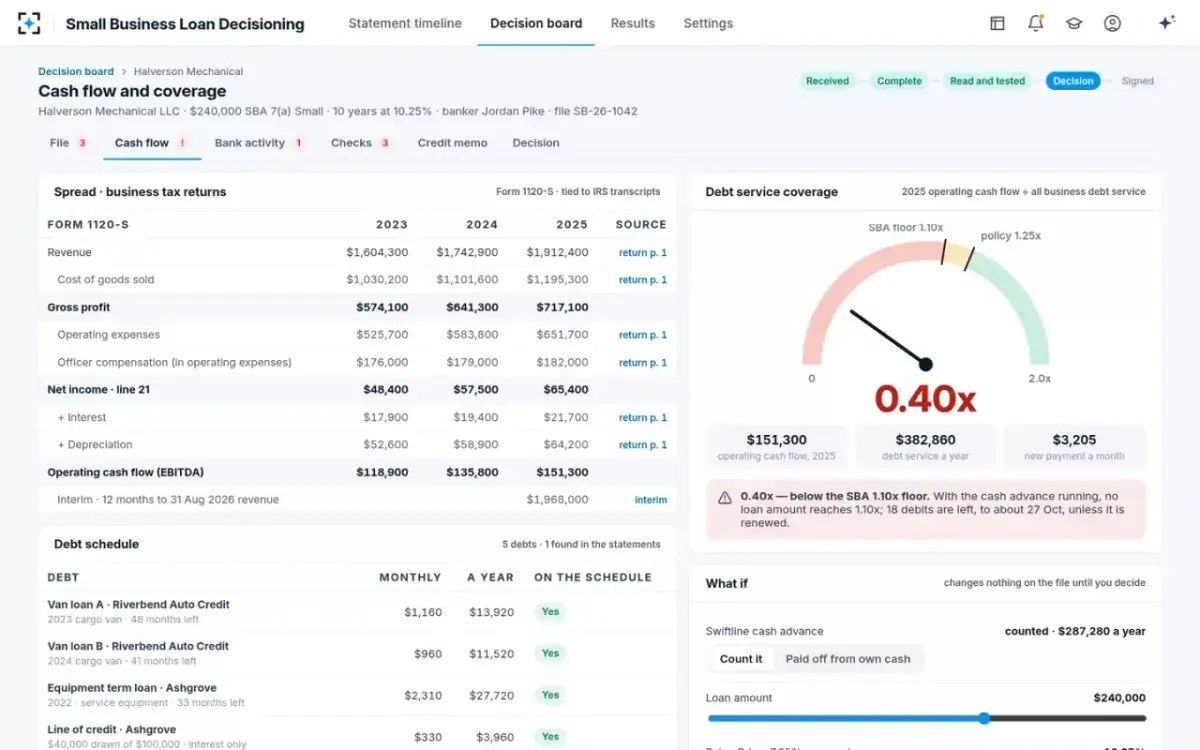
A file that misses the 7(a) Small floor is not automatically a decline. The SOP's instruction is that "the loan must be processed following the procedures for either Standard 7(a) or SBA Express Loans", which means a fuller analysis — projections with assumptions, a global view — and sometimes a different answer. The memo should say which route was tried before the decline.
Tax verification: the decline that arrives after approval
For most 7(a) loans the lender must obtain IRS transcripts and reconcile them with the financial statements used in the analysis, and the SOP bars disbursement where a required return cannot be verified. That makes tax verification the test most likely to fail late, after a loan is approved and the business banker has told the customer.
The common causes are mundane: an amended return the owner did not mention, a year filed under a different entity, a return on extension without proof of the estimated tax paid. Running the transcript request at intake rather than at closing turns most of them into a condition instead of a reversal. In the sample file all three years matched the transcripts to the dollar, recorded in the memo as a check passed with its source.
Where SBA files fail: what the denial data shows a lender
The Fed's survey is answered by firms, not lenders, but it shows where SBA demand meets declines. SBA loans and lines had the highest denial rate of any product, and across all small business credit, denial rates varied widely by type of lender.
Denial rates by lender type, all small business credit products
Two readings matter to a lending manager. A high SBA denial rate is partly structural — the program exists for credits conventional policy will not take — so it is not by itself a sign of a weak department. But a decline that consumed a full underwriting cycle before failing an eligibility or tax test is waste: those tests are cheap to run first. Ordering the five tests by cost, not by habit, is the most direct way to cut time spent on files that were never going to close.
Writing up a decline the lender can defend
A decline memo should be as specific as an approval memo: which test failed, the evidence, what was tried, and the principal reasons that will go to the applicant. Regulation B sets the floor for those reasons: they "must be specific", and statements that the decision "was based on the creditor's internal standards or policies" or on a failure "to achieve a qualifying score" are "insufficient" (12 CFR 1002.9(b)(2)).
For a business with gross revenue of $1 million or less, the notice of action may be oral or written, within 30 days of a completed application, with the reasons given or available on request; for a larger business, notice comes within a reasonable time, and written reasons follow a written request made within 60 days. A counter-offer the applicant does not accept is adverse action too. What the notice itself must say, including when software drafted the reasons, is the subject of the business loan adverse action notice.
Retention closes the loop. For business credit, Regulation B requires the lender to keep the application and "any other written or recorded information used in evaluating the application" for 12 months after notifying the applicant of the action (12 CFR 1002.12(b)), and longer if it has notice of an investigation. A decline memo with its evidence attached is that information; a decline recorded as a status code with no memo is a gap a fair-lending review will find.
Seven checks a reviewer runs on any SBA decision memo
- Eligibility evidence is attached, not asserted.
Size with affiliates, business type, use of proceeds, citizenship of every owner, CAIVRS, SAM.gov and OFAC, each with its result.
- Credit elsewhere names a weakness and its evidence.
Never the conventional score cut-off alone; owners’ liquidity tested for each 20% owner.
- Any score appears with the approval range.
And the model is one the lender uses for similar non-SBA loans.
- Coverage counts every debt.
Two months of operating-account activity reviewed and kept; every recurring debit reconciled to the schedule.
- Transcripts reconcile to the returns used.
Any missing or amended year resolved before disbursement.
- A decline states the test, the evidence and the route tried.
Including whether a Standard 7(a) or SBA Express analysis was run after a 7(a) Small miss.
- Principal reasons are specific enough for Regulation B.
“Did not meet our standards” is not a reason; the failed test and the figure are.
Where Small Business Loan Decisioning fits in the SBA credit memo
Small Business Loan Decisioning reads a complete file the moment it lands: it spreads the returns, reads twelve months of statements for debts the schedule missed, runs the eligibility checks, tests credit history and coverage against the SBA floor and the bank's own policy, and drafts the credit memo in the 7(a) Small shape with every figure linked to the page it came from. It places the file in a lane — ready to decide, needs a look, decline likely — with no more than two reasons, and drafts the approval, counter-offer or decline letter with its principal reasons.
The memo drafted in the 7(a) Small shape, each figure cited
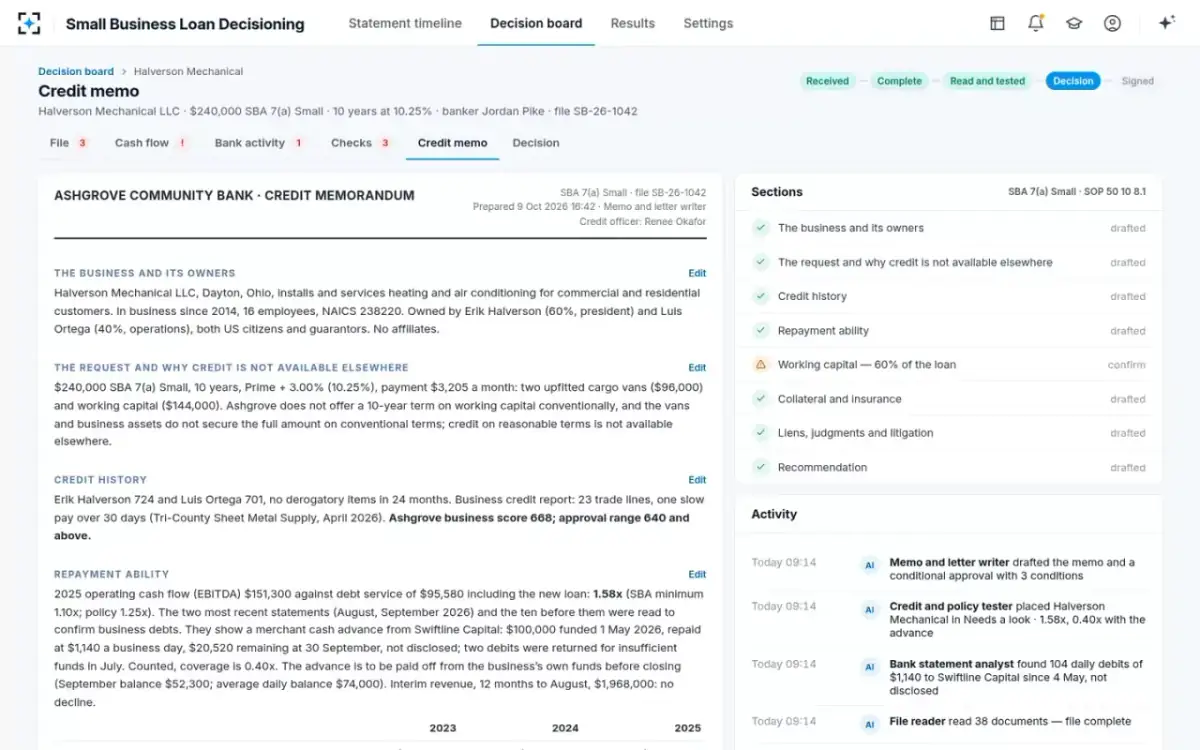
It does not decide. The agents recommend a lane and never decline a file, never clear an eligibility hit, never use or infer a protected characteristic, and never send a letter; the credit officer reviews the memo, chooses approve, counter-offer or decline, and signs with the authority and the notice date shown beside the decision. What changes is where the officer starts: at the decision, with the memo and its evidence already assembled, rather than at a stack of 38 documents. The time and cost that saves on a small file is worked through in the true cost of a $150,000 file.
Questions people ask
Is an SBA credit memo required for 7(a) Small loans?
Yes, but a shorter one. SOP 50 10 8.1 lets 7(a) Small and SBA Express lenders use their own internal credit memoranda, provided the memo summarises the business, ownership and request, states why credit is not available elsewhere, and analyses credit history and repayment ability, including the two months of bank activity used to confirm all debts.
What is the SBA credit elsewhere test?
It is the requirement in 13 CFR 120.101 that SBA guarantee only credit the applicant cannot get on reasonable terms without it. The lender certifies it by submitting the application and must substantiate it in the memo with an identifiable weakness, such as a longer term or a collateral shortfall, plus a test of the liquidity of each owner of 20% or more. A conventional credit-score cut-off cannot be the only reason.
Can a lender approve an SBA loan on collateral when cash flow is short?
No. The SOP states that where the analysis shows no reasonable assurance of repayment from the business's cash flow, the request "must be declined, regardless of the collateral available or outside sources of repayment". A 7(a) Small request below 1.10x may be re-processed as a Standard 7(a) or SBA Express loan, but the coverage test still has to be met.
What happens if the credit memo does not support the guaranty?
SBA can decline a non-delegated application, and for a delegated loan it can deny liability on the guaranty, in whole or part, when the lender asks SBA to purchase it after default. Purchase reviewers read the memo against the SOP in force when the loan was made, which is why each certification needs its evidence in the file.
How long must a lender keep a declined SBA application?
Regulation B requires 12 months for business credit, counted from the date the applicant was notified of the action, covering the application and any written or recorded information used to evaluate it. The period extends if the lender has notice of an investigation or enforcement proceeding, and many lenders keep declined files longer under their own policy.
What is the most common reason SBA loans are declined?
Insufficient cash flow once every debt is counted is the reason that ends most files, because the SOP removes discretion on repayment. In the Fed's 2025 survey 40% of SBA loan or line applicants were denied, and undisclosed debts found in bank statements, such as merchant cash advances, often turn a passing coverage ratio into a failing one.