The FICO SBSS score, short for FICO Small Business Scoring Service, was the credit score SBA used to screen every 7(a) Small loan application, with a minimum of 165 under SOP 50 10 8 and 155 before that. SBA discontinued it on March 1, 2026. Since then, 7(a) Small applications receive no SBSS score from SBA's system and are not screened by one; repayment ability rests on debt service coverage of at least 1.10:1, confirmed against the two most recent months of bank activity, inside the lender's own credit analysis, which may include its own scoring model if that model does not rely solely on consumer scores. Any decision flow built around an SBSS cut-off has had to be rebuilt. Botminds' Small Business Loan Decisioning was built for the test that replaced it, and this guide sets out what changed, when, and what a lender's file now has to show.
From a 155 floor to no score at all, in under three years
- SBSS minimum 155 (SOP 50 10 7.1)Nov 2023 – May 2025
- SBSS minimum 165 (SOP 50 10 8)Jun 2025 – Feb 2026
- No score: 1.10x and two months of statementsMar – Oct 2026
What is the FICO SBSS score?
It is a commercial credit score, on FICO's scale, that blends the business's and its owners' credit into one number. SBA used it as a threshold: under SOP 50 10 7.1 and SOP 50 10 8, "all 7(a) Small Loan applications will begin with a screening for a FICO® Small Business Scoring ServiceSM Score (SBSS Score)" (SOP 50 10 8). The lender keyed a minimal set of fields into E-Tran, SBA's system returned the score, and a score at or above SBA's minimum meant the file could proceed under the small-loan procedure.
A passing score did more than open the door. The SOP said an acceptable SBSS score "satisfies the requirement to consider" the credit history of the applicant, its associates and guarantors, among other factors. For many lenders that turned the score into the centre of the 7(a) Small decision: pull the score, check the floor, and write a short memo around it.
How is the FICO SBSS score generated?
From four kinds of data, according to SBA's own description. The SOP said "the SBSS Score is calculated based on a combination of consumer credit bureau data, business bureau data, Borrower financials, and application data" (SOP 50 10 7.1). The weighting is FICO's, and SBA's rulebooks did not publish it. That opacity is one reason a lender could not easily explain a failing SBSS score to an applicant, beyond the bureau and financial facts behind it.
SBA was also clear that the score was a screen, not a full analysis. SOP 50 10 8 described the system as "intended as a screening tool to determine whether a loan is eligible for an SBA guaranty under expedited small loan processing", and told lenders not to score the same loan more than once because of the cost.
What was the minimum SBSS score?
165 from June 1, 2025, and 155 before that. SOP 50 10 7.1 set "the minimum acceptable SBSS score is 155, but that score may be adjusted up or down from time to time", and explained that the minimum "is based on the lower end of the risk profile of the current SBA portfolio" (SOP 50 10 7.1). SOP 50 10 8 raised it to 165 when it took effect on June 1, 2025 (SOP 50 10 8).
The SBSS score's last three years
155
minimum SBSS under SOP 50 10 7.1, from November 15, 2023
165
minimum under SOP 50 10 8, from June 1, 2025
Mar 1, 2026
SBA stops scoring and screening 7(a) Small applications
Before the sunset, a file below the floor was not automatically dead. Under SOP 50 10 7.1 a lender could send it to SBA for non-delegated processing with a cash flow analysis showing the business could repay from its own cash flow. The cash flow test, in other words, was always the fallback. In 2026 it became the rule.
Is the SBSS score still required for SBA loans?
No. SBA Procedural Notice 5000-875701 announced that "SBA is discontinuing use of the FICO® Small Business Scoring ServiceSM Score (SBSS Score) effective March 1, 2026. Beginning on that date, 7(a) Small loan applications will no longer receive an SBSS Score and SBA will no longer screen 7(a) Small loan applications using the SBSS Score" (SBA Procedural Notice 5000-875701). Loans approved in E-Tran before 11:59 p.m. Eastern on February 28, 2026 could still use the score; everything approved from March 1 had to meet the new underwriting text.
A second notice, 5000-876777, published on February 20, 2026 and corrected four days later, replaced the first notice's changes to the SOP with a fuller version and the same effective date (SBA Procedural Notice 5000-876777). SOP 50 10 8.1, effective October 1, 2026, carries the post-SBSS rules forward. A lender page, broker guide or older internal policy that still quotes a minimum of 165 is quoting a rule that no longer exists.
What replaced the SBSS score?
A coverage test, a bank statement check and the lender's own credit analysis. For 7(a) Small loans, other than changes of ownership, the applicant's debt service coverage must be at least 1.10:1 on a historical or projected basis, measured as EBITDA divided by the future principal and interest on all business debt including the new loan. The two most recent months of operating-account activity must be reviewed to confirm every debt is in that calculation. And the credit memo must analyse the credit history of the business, its owners and guarantors, state why credit is not available elsewhere, and cover working capital, collateral, insurance, liens and judgments where they apply.
A 7(a) Small file before and after the SBSS sunset
Under the SBSS screen, to February 28, 2026: An SBSS score at or above SBA's minimum (165 under SOP 50 10 8)
From March 1, 2026, carried into SOP 50 10 8.1: The lender's own credit analysis for similarly sized conventional loans
Under the SBSS screen, to February 28, 2026: An acceptable score satisfied the requirement to consider credit history and other factors
From March 1, 2026, carried into SOP 50 10 8.1: Coverage of at least 1.10:1, confirmed by two months of bank activity
Under the SBSS screen, to February 28, 2026: Not part of the SBA screen
From March 1, 2026, carried into SOP 50 10 8.1: Two most recent months reviewed to confirm all debts, kept in the file
Under the SBSS screen, to February 28, 2026: SBA's SBSS score, pulled through E-Tran
From March 1, 2026, carried into SOP 50 10 8.1: The lender's own business scoring model, if its regulator permits it, it is used on similar conventional loans, and it does not rely solely on consumer scores
Under the SBSS screen, to February 28, 2026: The SBSS result
From March 1, 2026, carried into SOP 50 10 8.1: Any model's score with its acceptable approval range, plus the full credit history and repayment analysis
Under the SBSS screen, to February 28, 2026: Non-delegated processing with a cash flow analysis
From March 1, 2026, carried into SOP 50 10 8.1: Process as Standard 7(a), or as SBA Express if the lender has that authority
Under the SBSS screen, to February 28, 2026: Lender's own scoring, validated as predictive
From March 1, 2026, carried into SOP 50 10 8.1: Unchanged by the sunset
SBA's own question-and-answer notice closed the obvious gap. Lenders asked whether, with no passing score to rely on, there was any similar assurance that repayment ability had been established. SBA's answer was yes: an acceptable coverage ratio of at least 1.10:1, plus two months of bank activity used to confirm the debts in it, satisfies the requirement, though the memo must still address the request, operations, management and other key factors (SBA Information Notice 5000-877673). The same notice names merchant cash advances among the obligations the statements should confirm. How to test a reviewer on hidden advances is covered in its own guide.
Can lenders use their own credit scoring model for SBA loans?
Yes, within limits SBA wrote into the same notice. A lender "may use a business credit scoring model permitted by their primary Federal regulator to assess the credit history of the applicant if they do so for their similarly-sized, non-SBA guaranteed commercial loans, provided such model does not rely solely on consumer credit scores" (SBA Procedural Notice 5000-875701). The model "may only be used in addition to" the lender's credit analysis, and its results must be documented in each loan file and included in E-Tran with the submission.
Three details catch lenders out. The model has to be one the bank already uses on its own conventional small business loans, so a bank cannot adopt a model only for SBA files. A model built on owners' consumer scores alone does not qualify. And the credit elsewhere test can never rest on a credit-score policy: SOP 50 10 8.1 bars a lender from citing an applicant's failure to meet its conventional score policy as the sole reason credit is not available elsewhere (13 CFR 120.101 and SOP 50 10 8.1). Small business lending companies, which make no conventional loans, may still score, but must give SBA their model for review each year.
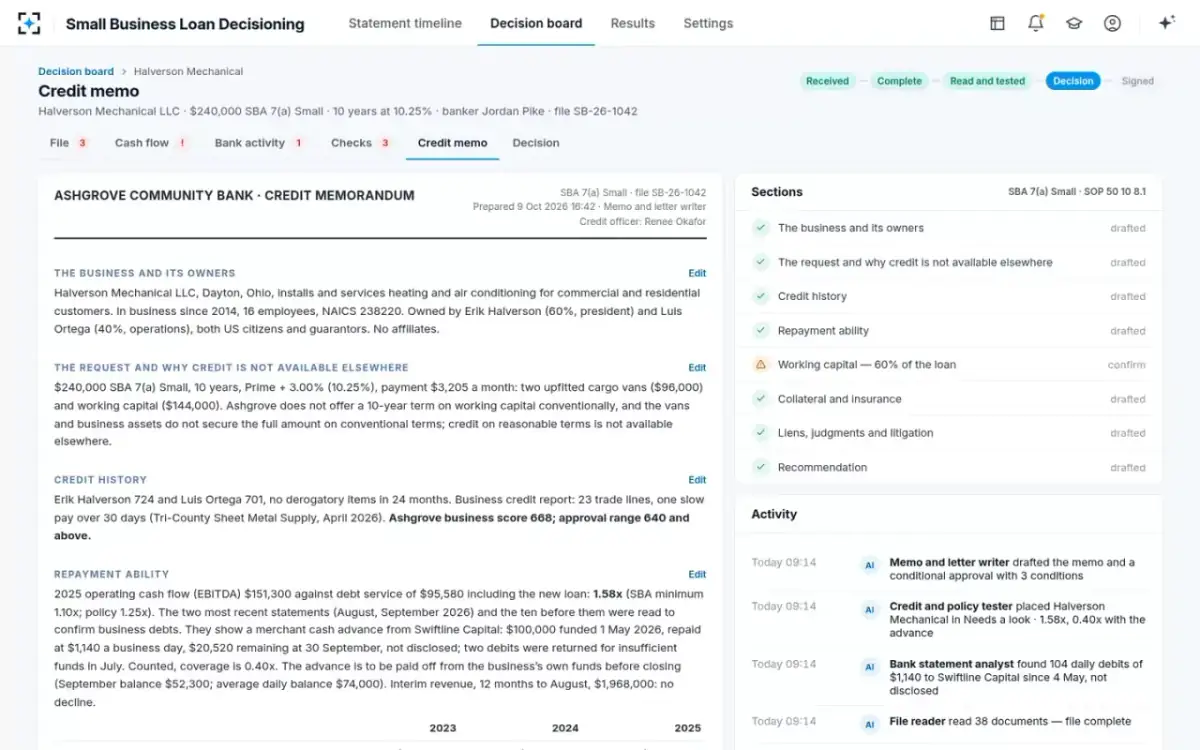
A lender's own score, stated in the memo with its approval range
What DSCR does a 7(a) Small loan need?
At least 1.10:1 on a historical or projected basis, for purposes other than a change of ownership. Operating cash flow is EBITDA, with additions and subtractions only under the Standard 7(a) rules; debt service is the future principal and interest on all business debt, including the new SBA loan. If the business is buying another business, Appendix 15 of SOP 50 10 8.1 applies in full, typically 1.25 on historical cash flow, and SBA says no reduced standard applies just because the loan is a 7(a) Small or SBA Express loan.
On the sample file in Small Business Loan Decisioning, a fictional contractor's $240,000 request, coverage on the 2025 return is 1.58x, comfortably over 1.10x. The two months of statements SBA asks for, read alongside the ten before them, show a cash advance not on the debt schedule; counted, coverage is 0.40x. Under the SBSS screen the file might have been scored, passed and moved on. Under the rule that replaced it, the advance is the test.
Rebuilding a 7(a) Small decision flow without the score
A flow that began with "pull the SBSS" needs a new first step and a new definition of done. The lender's coverage calculation becomes the first test, so the debt schedule behind it has to be confirmed rather than accepted, and the memo has to carry the analysis the score used to stand in for. The checklist below is the minimum rebuild.
Rebuilding a 7(a) Small decision after the SBSS sunset
- Remove the SBSS pull and the 165 cut-off
From the procedure, the system and any broker pre-qualification sheet. Applications approved from March 1, 2026 cannot rely on it.
- Make coverage the first test
EBITDA over all business debt service including the new loan, at least 1.10:1, with any add-back justified.
- Confirm every debt from two months of statements
The most recent two months of the primary operating account, kept in the file; read more if the file holds it.
- Decide whether to use your own scoring model
Only one your regulator permits, used on similar conventional loans, not reliant on consumer scores alone.
- State the score and its approval range in the memo
And include the results in the submission to SBA's Loan System.
- Write credit elsewhere without the score
A conventional score cut-off cannot be the only reason credit is not available elsewhere.
- Route the failures
A request under 1.10 can be considered as Standard 7(a), or as SBA Express with that authority.
- Check the date on every file in flight
SOP 50 10 8.1 applies from October 1, 2026; files under SOP 50 10 8 follow the March 2026 notice.
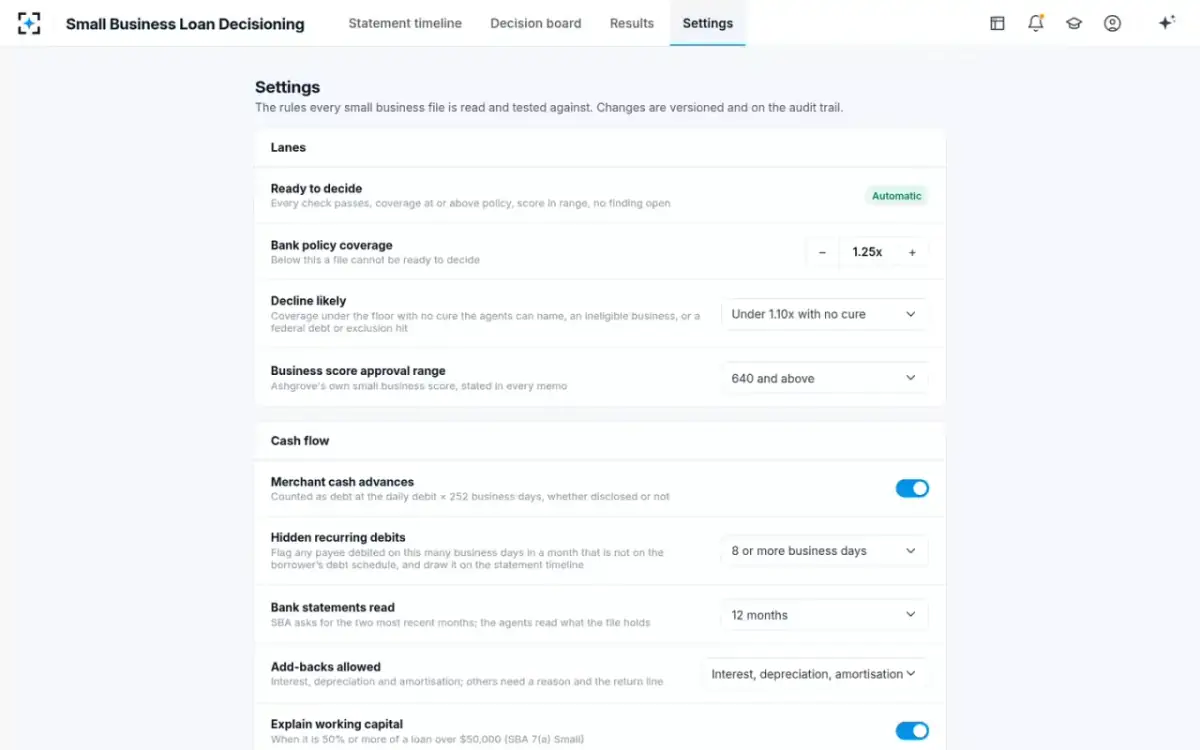
The post-SBSS rules a bank sets for its own small files
What the sunset means for brokers and borrowers
For brokers, the end of the SBSS screen removes a quick pre-qualification check and puts the weight on the file. A borrower who cleared 165 last year has no SBA score to quote this year; what the lender will test is cash flow against all debts, and the bank statements that confirm them. Consumer-facing tools may still offer an SBSS score, but SBA no longer uses one to screen 7(a) Small loans.
For borrowers, the change is mostly good news with one sharp edge. A thin credit file or a young business no longer fails a score it cannot see the workings of; a business with solid cash flow can show it. But every debt now has to be on the table, because the lender must look for the ones that are not. The 7(a) Small rules as a whole, and what a lender must say when it declines, are covered in companion guides. To see the post-SBSS test run on a file, start from Small Business Loan Decisioning.
Questions people ask
What is the FICO SBSS score range?
The scale is FICO's; SBA's rulebooks published only the minimum it accepted for 7(a) Small loans, 155 under SOP 50 10 7.1 and 165 under SOP 50 10 8. Since March 1, 2026 SBA publishes no SBSS minimum, because it no longer uses the score for 7(a) Small screening.
Does SBA Express use the SBSS score?
SBA's sunset notices say SBA Express loans are not affected. Express lenders may continue to use a business scoring model their regulator permits, which must be validated with accepted statistical methods as predictive of loan performance, alongside their credit analysis.
Does the SBSS sunset apply to loans approved before March 2026?
No. Applications approved in E-Tran before 11:59 p.m. Eastern on February 28, 2026 could continue to use the SBSS score. Every 7(a) Small loan approved on or after March 1, 2026 must meet the revised underwriting requirements.
Can a business improve its chances now that SBSS is gone?
Yes, by improving what the lender now tests: debt service coverage of at least 1.10:1 with every debt counted, two clean recent months of bank activity, filed returns that match IRS transcripts, and a clear reason for any large share of working capital. A cash advance on the statements that is missing from the application is the fastest way to fail.
What does SBA do with small business lending companies that score loans?
SBLCs make no conventional loans, so they have no similar non-SBA portfolio to borrow a model from. SBA lets them keep using credit scoring for 7(a) Small loans, but requires them to provide the scoring model to SBA for review every year.