SME loan origination software is the system a bank uses to take a small business loan from application to decision: collecting the documents, spreading the financials, running the credit checks, producing the memo and recording the decision. Its value is decided on the small file. Half of all SBA 7(a) loans in fiscal 2025 were $150,000 or less, and each carried nearly the same underwriting work as a loan ten times its size, so the cost per dollar lent is ten times higher. Botminds' Small Business Loan Decisioning attacks that cost directly: six agents read, spread and test a complete file and draft the memo and letter, leaving the credit officer the review and the decision. Before choosing any product, a head of small business banking should know what a $150,000 file costs today and which hours a tool can actually remove.
Where the hours on a $150,000 SBA file go, by hand and with agents
By hand: about 17 hours of staff time
- Sort and read · 12%
- Spread · 21%
- Transcripts · 6%
- Statements · 18%
- Eligibility, credit · 17%
- Memo, letter · 20%
- Decide · 6%
With agents: about 1.5 hours of a person
- Check findings · 33%
- Confirm memo · 17%
- Decide · 50%
What is SME loan origination software?
SME loan origination software manages a small business credit request from intake to a booked decision. The term covers three different kinds of product, and buyers often compare them as if they were one. A loan origination system holds the application, the workflow and the decision, and hands the loan to the core. A credit decision engine scores structured data and returns a recommendation. A decisioning layer reads the documents and produces the analysis: the spread, the statement review, the checks, the memo. Many banks need the third and buy the first, then find their analysts still keying returns into the new screens.
The distinction matters because the hours sit in the documents. On a small business file the application data is a few dozen fields; the evidence is 38 documents in the sample file this guide uses, a fictional contractor's $240,000 request to a fictional community bank. Software that organises the workflow but leaves the reading to people speeds up the queue and leaves the cost per file almost where it was.
Why are small business loans unprofitable for banks?
Because the cost of making them is largely fixed while the income scales with the loan. A Harvard Business School study put it plainly: "Small business loans, often defined as business loans below $1 million, are considerably less profitable than large business loans", and "high search costs and high transaction costs have made small dollar loans less profitable, causing a gap in small business loans under $250,000" (Mills and McCarthy, HBS Working Paper 15-004, 2014). The same paper calls small business underwriting "often inherently inefficient", a structural barrier rather than a choice.
The Philadelphia Fed captioned the problem in one line: "Firms want small loans, which aren't profitable for banks" (Federal Reserve Bank of Philadelphia, 2016). The banks that keep lending small find a cheaper way to underwrite or stop quoting below a threshold. In the solution's fictional sample bank, the head of small business banking had stopped quoting under $150,000 for the same reason: every one lost money.
What share of SBA loans are under $150,000?
About half. In fiscal 2025 SBA approved 78,078 7(a) loans for $37.29 billion, and 49.4% of them were $150,000 or less. Loans of $350,000 or less were 68.8% of the count and only 18.4% of the dollars (SBA 7(a) FOIA loan file, our computation). The median 7(a) approval was $166,850; the mean, pulled up by the large loans, was $477,571.
Most SBA loans are small; most SBA dollars are not
49.4%
of FY2025 7(a) loans were $150,000 or less
68.8%
were $350,000 or less
18.4%
of 7(a) dollars went to those loans of $350,000 or less
$166,850
median gross 7(a) approval in FY2025
That split is why the small file decides the economics of an SBA department. A bank that underwrites its small requests at the same cost as its large ones spends most of its underwriting hours on less than a fifth of its SBA dollars. What the size bands look like, and how often each defaults, is set out in a companion guide.
How many hours does a small business loan file take?
No federal survey measures underwriting hours per small business file, so any figure is an estimate and should say how it was built. Ours lists the tasks SBA's rules require on a complete 7(a) Small file and assigns hands-on hours to each: about two to sort and read the file, three and a half to spread three years of returns and build the debt schedule, one to reconcile the IRS transcripts, three to read the bank statements, three for eligibility and credit checks, three and a half for the memo and letter, and one for the decision. About seventeen hours in all, before any time waiting in a queue.
The total matters less than its shape. Sixteen of the seventeen hours go on assembling, checking and writing up evidence, and the hours barely move with loan size: a $150,000 contractor and a $1.5 million contractor both file three years of returns and a year of statements. What grows with size is the analysis around the structure, collateral and committee, which is judgment, and which a bank is happy to pay for on a large loan.
What does a $150,000 SBA file cost, and what does the bank keep of the fee?
At the median credit analyst wage of $83,510 a year (BLS, May 2025), about $40 an hour, seventeen hours is roughly $680 of wages, before benefits, overhead, systems, the officer's time and the processor who chased the documents. Set that against what SBA's fee structure lets the bank keep. For fiscal 2027 the upfront guaranty fee on a loan of $150,000 or less is 2% of the guaranteed portion, and "the Lender may retain no more than 25% of the fee" (SBA Information Notice 5000-881797). The bank also owes SBA an annual service fee of 0.55% of the guaranteed balance, which it may not pass to the borrower.
SBA fees on a $150,000 and a $350,000 7(a) loan, fiscal 2027
| Item | $150,000 loan | $350,000 loan |
|---|---|---|
| SBA guaranty share | 85% · $127,500 guaranteed | 75% · $262,500 guaranteed |
| Upfront guaranty fee | 2% of the guaranteed portion · $2,550 | 3% of the guaranteed portion · $7,875 |
| Share of that fee the lender may keep | Up to 25% · at most $637.50 | None stated in the notice |
| Lender's annual service fee, first year | 0.55% of guaranteed balance · about $701 | 0.55% · about $1,444 |
| Waivers | 0% upfront fee for manufacturers, food supply chain and rural businesses on loans to $700,000 | Same |
The fee table is not the bank's whole income on the loan: interest, and for many lenders the premium from selling the guaranteed portion, matter more. But it makes the point the HBS paper made in general terms. On a $150,000 loan the bank may keep at most $637.50 of the upfront fee and pays about $701 to SBA in the first year of servicing. Seventeen hours of underwriting wages costs about as much as either. The loan has to earn its underwriting back from interest over years, and a single early default wipes out several loans' worth of margin.
The cost per $1,000 lent: why the small file loses
Divide the same underwriting cost by the loan amount and the problem becomes a chart. If every file took seventeen hours, the wage cost per $1,000 lent would be about $13.65 on a $50,000 loan and about 70 cents on a $1 million one. Larger files do take longer, but nowhere near in proportion to their size.
The same 17 hours, divided by the loan: wage cost per $1,000 lent
This is why the target for any SME loan origination software should be stated in hours per file, not in screens or features. A tool that halves the time a file waits in a queue but leaves seventeen hands-on hours makes the bank faster without making the small loan pay. A tool that takes the hands-on hours to one or two changes which loans the bank can afford to make.
Where software should cut the hours, and where it should not
Software should take the assembly and leave the judgment. On the estimate above, that means the reading, spreading, transcript matching, statement review and eligibility checks, about twelve and a half of the seventeen hours, plus most of the memo's drafting. It should not take the decision, the clearing of an eligibility hit, or the explanation a person must stand behind, such as why 60% of a loan is working capital.
The cut also has to survive scrutiny. Under delegated processing SBA does not review a lender's analysis before numbering the loan; it reviews it at guaranty purchase, years later. A cheaper file that cannot show where each figure came from is not cheaper; it moves the cost to the day SBA asks. That is why the sample solution ties every figure in the memo to a page, and why speed is the last thing to test in a pilot, not the first.
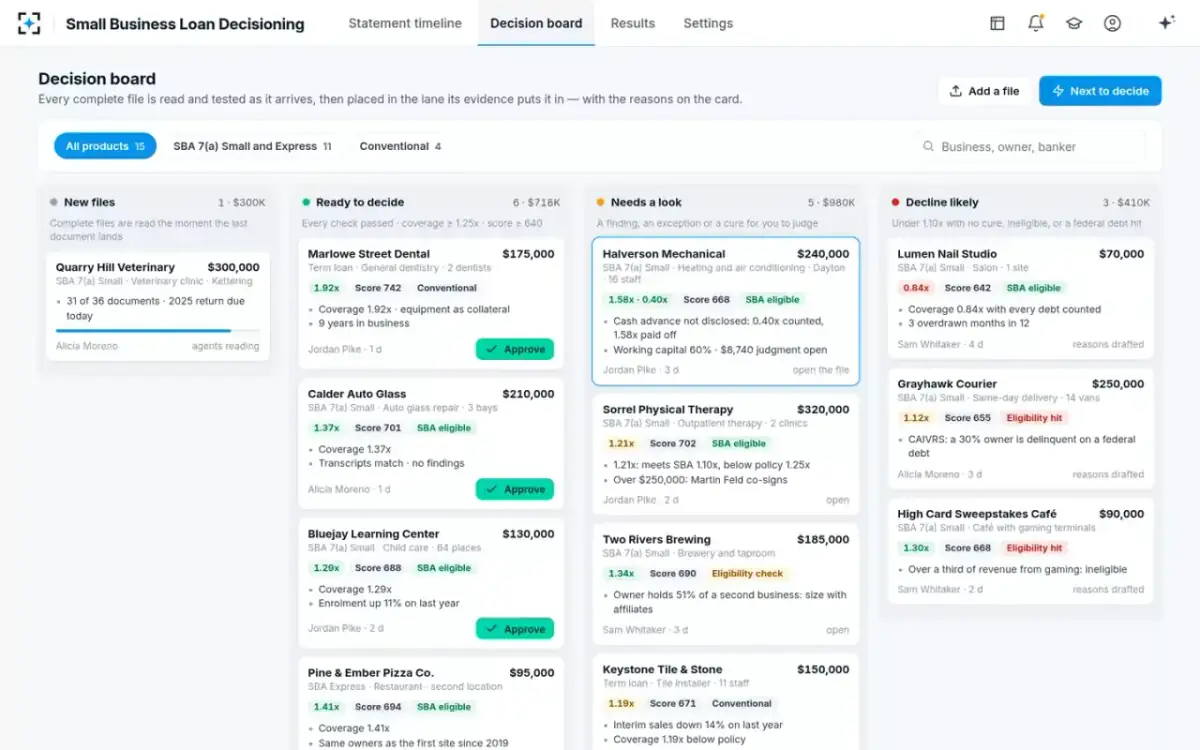
Every complete file in its lane, with the reasons on the card
What to look for in SME loan origination software
Judge a product on a sample of your own complete files, by hours per file and by how often your officers agree with what it recommends. The checklist below is written for a head of small business banking choosing between workflow systems, scoring engines and decisioning tools.
A buyer's checklist for SME loan origination software
- Hands-on hours per complete file, before and after
Measured on your files in a pilot, by task. Queue time is a staffing question; hands-on time is the software's.
- Does it read the documents, or only hold them?
Returns, transcripts, statements and SBA forms should come out as spread figures and findings, each linked to its page.
- Does it find debts the borrower did not list?
The bank statement read is a fifth of the hours and where hidden advances are caught or missed.
- Are SBA rules current and dated?
SOP 50 10 8.1 took effect October 1, 2026; the 7(a) Small scoring screen ended March 1, 2026. A tool should show which rule it applied.
- Are your policy limits settings?
Coverage, score range, authority, statement months and second-signature rules, versioned with who changed them.
- Who decides, and who clears eligibility hits?
A named officer and a named SBA lending manager. Anything else is a fair lending and SBA risk.
- Does it write into your existing loan origination system?
A second screen to re-key into brings the hours back.
- What does it report after go-live?
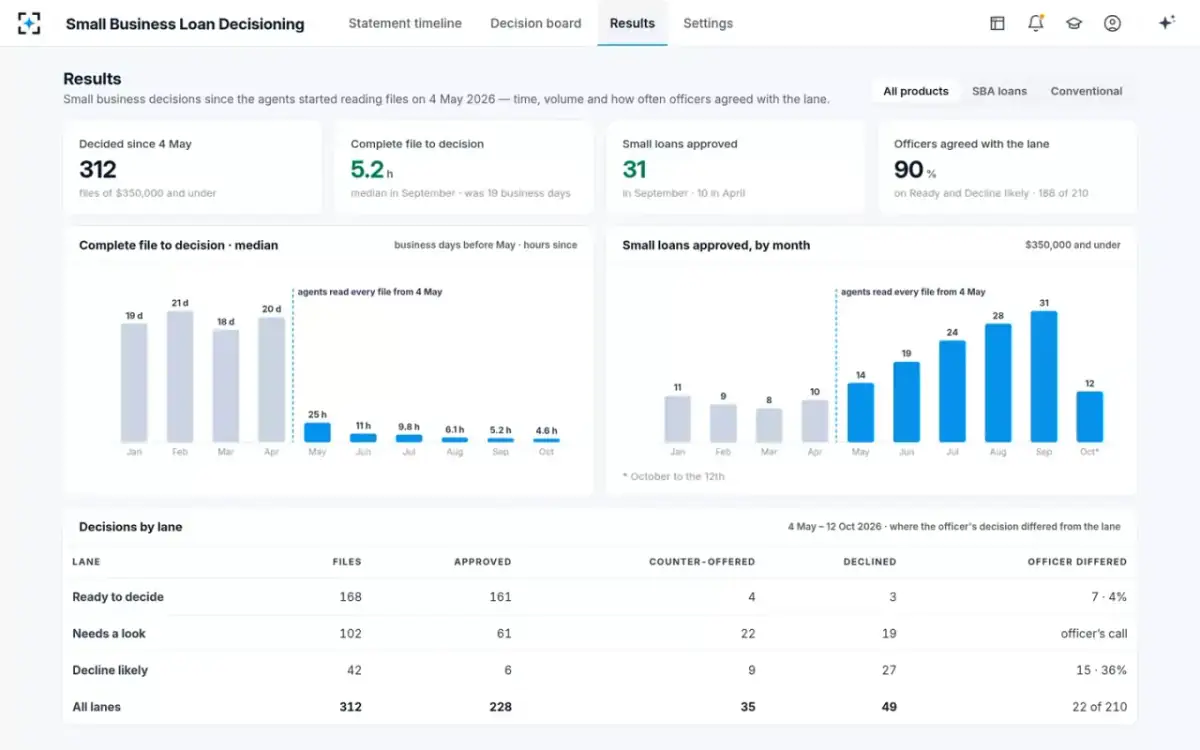
Time from complete file to decision, small loans approved, and officer agreement with the recommendation, by month.
The measures that show whether small files now pay
Where Small Business Loan Decisioning fits, and where it does not
Small Business Loan Decisioning is a decisioning layer for small business requests up to $350,000: SBA 7(a) Small, SBA Express, and conventional term loans and lines. It reads the complete file, spreads it, reads the statements, runs the SBA and policy checks, places the file on a decision board, and drafts the memo and the approval, counter-offer or decline letter. Its design target is a decision-ready file within a day of the file being complete. The credit officer decides and signs.
It is not a loan origination system. It does not take applications from borrowers, price loans, prepare closing documents, book loans or service them, and it does not replace SBA's own submission channel. Banks that already have a loan origination system keep it; how the agents sit beside an existing system is the subject of its own guide. Banks whose small business problem is the application itself, borrowers abandoning a paper form, need an intake portal first. And larger commercial credits, with committee memos and covenant packages, need a different workflow from the one built for a $150,000 file.
The fair test is the one in the checklist: a sample of your own complete files, hands-on hours before and after, and officer agreement by lane. To start that conversation, see Small Business Loan Decisioning.
Questions people ask
How much does it cost to underwrite a small business loan?
No federal source publishes a per-loan underwriting cost. Our estimate for a complete SBA 7(a) Small file is about 17 hands-on hours, roughly $680 of wages at the BLS median credit analyst wage, before benefits, overhead and the officer's time. Bank-specific figures vary widely with how much of the file is assembled by hand.
What is the SBA guaranty fee on a $150,000 loan?
For loans approved in fiscal 2027, 2% of the guaranteed portion. At SBA's 85% guaranty that is $2,550 on $127,500 guaranteed, of which the lender may keep up to 25%. Loans of $700,000 or less to manufacturers, food supply chain businesses and rural businesses pay no upfront fee.
Can the SBA annual service fee be passed to the borrower?
No. SBA's fiscal 2027 fee notice sets the lender's annual service fee at 0.55% of the guaranteed balance and says lenders may not pass it on. On a $150,000 loan that is about $701 in the first year, falling as the loan amortises.
How fast do banks approve small business loans?
The FDIC's 2022 survey of about 1,300 banks found that three in four approve their typical small business loan within ten business days. The FDIC also found that outside credit cards, automated lending "is used almost exclusively for smaller loans" (FDIC). On SBA files, time to assemble the file usually exceeds time to decide it.
Is loan decisioning software the same as a loan origination system?
No. A loan origination system holds the application and workflow and passes the loan to booking; decisioning software produces the analysis and the recommendation the credit officer decides on. They work together: the decisioning layer writes its results into the system the bank already uses.