The SBA loan underwriting process, as a lender's duty list usually describes it, reads: analyse the business's tax returns and financial statements, spread cash flow and calculate debt service coverage, confirm eligibility under SBA's lending rules, verify the returns against IRS transcripts, write the credit memorandum, and recommend approval, a counter-offer or a decline within the bank's credit policy. All of that is accurate. What it leaves out is the proportion: on a small SBA 7(a) loan the underwriter spends most of the day assembling and checking evidence, and an hour or so deciding. Botminds' Small Business Loan Decisioning exists for the assembly half. Six agents read, spread and test a complete small business file, draw twelve months of bank statements day by day, and draft the memo and letter, so the underwriter's day starts at the judgment.
The day below is a sample. The bank, the borrower and the people are fictional: Ashgrove Community Bank, its business banking credit officer Renee Okafor, and Halverson Mechanical, a 16-person heating and air conditioning contractor in Dayton asking for $240,000 under SBA 7(a) Small. The labour and rule figures come from federal sources, linked where they appear.
The seats around one SBA small-loan file, and what each keeps
Today
Sorts 38 documents, spreads three years of returns, keys the debt schedule, reads the statements and writes the memo before forming a view.
With agents
Starts from a file already read and spread, checks the findings against their source pages, and writes the parts that need an opinion.
Still theirs: the credit view, the add-backs, the structure
Today
The decision takes ten minutes; getting a file to where it can be decided takes two weeks.
With agents
Sees the borrower's money day by day, reads three findings with their cures, and decides from the panel beside them.
Still theirs: the decision and the signature
Today
A customer asked in July and still has no yes or no.
With agents
Sees each file in its lane with its reasons, and has the conditions to take back to the owner.
Still theirs: the relationship and the conversation about the cure
Today
Chases signatures, transcripts and missing statements by email.
With agents
Works a list of what is missing, named by document and page.
Still theirs: closing conditions and the borrower's paperwork
Today
Gets the whole file when only the exception matters.
With agents
Sees the exception, its evidence and its cure, and co-signs only where policy asks.
Still theirs: exceptions and loans above the officer's authority
What does an SBA underwriter do?
An SBA underwriter decides whether a small business can repay a loan from its cash flow and whether the loan qualifies for SBA's guaranty, and writes both cases down so that SBA can test them later. The second half is what makes the job different. SBA's rulebook for lenders, SOP 50 10 8.1, effective October 1, 2026, asks the lender to establish eligibility, show that credit is not available elsewhere on reasonable terms, measure debt service coverage against a stated minimum, and reconcile the applicant's financial data with IRS tax transcripts before the first dollar goes out.
In practice the work has four parts. The underwriter builds the evidence: returns spread line by line, interim statements, a debt schedule tied to what the bank statements show. Then the tests: eligibility, credit history, coverage. Then the memo, in the shape the SOP sets for the loan type. Then the recommendation, which a credit officer or committee accepts, changes or overrules. Only the last two are judgment in any real sense, and the first is where the hours go.
What the federal task lists say about SBA underwriting, and what they leave out
The federal occupation lists do not describe this work. There is no SBA occupation in the Bureau of Labor Statistics classification: an SBA underwriter is counted either as a credit analyst (code 13-2041) or as a loan officer (13-2072) (BLS Occupational Outlook Handbook).
O*NET, the Labor Department's task database, describes the loan officer's work in sentences any bank could use: "Analyze applicants' financial status, credit, and property evaluations to determine feasibility of granting loans," and "Approve loans within specified limits, and refer loan applications outside those limits to management for approval" (O*NET 13-2072.00). One task line hands the hard part elsewhere: "Submit applications to credit analysts for verification and recommendation." None of the task statements mentions SBA, a guaranty, a transcript or a bank statement.
The processor line matters for anyone planning a credit team. BLS expects employment of loan interviewers and clerks to fall about 2% by 2035, and names "productivity-enhancing technology" as the reason (BLS, Financial Clerks). The chasing and keying that sits between the processor and the underwriter is the work most exposed to change. A lender planning its underwriting desk in 2026 should say which side of that line each seat sits on.
Is SBA underwriting different from conventional underwriting?
Yes in its tests, no in its method. The regulation tells SBA lenders to use "appropriate and prudent generally acceptable commercial credit analysis processes and procedures consistent with those used for their similarly-sized, non-SBA guaranteed commercial loans" (13 CFR 120.150). An SBA file is analysed the way the bank analyses any small business loan. What SBA adds is a set of tests a conventional file does not face, each of which must be evidenced in the file.
What an SBA 7(a) Small file adds to a conventional small business loan
| Test | Conventional loan | SBA 7(a) Small under SOP 50 10 8.1 |
|---|---|---|
| Repayment | Bank policy coverage, often written as a minimum ratio | Debt service coverage of at least 1.10:1 on historical or projected cash flow, plus the bank's own policy |
| All debts counted | Debt schedule as the borrower states it | The two most recent months of operating-account activity reviewed to confirm every debt is in the coverage calculation |
| Credit elsewhere | Not a test | The memo must say why credit is not available elsewhere on reasonable terms |
| Eligibility | Bank policy and law | Size with affiliates, ineligible business types, 100% U.S. citizen or national ownership, CAIVRS, SAM.gov exclusions, OFAC |
| Tax verification | Often the returns alone | IRS transcripts obtained and reconciled before the first disbursement |
| Who reviews the file | The bank and its examiners | Under delegated authority, SBA first reads the file when the bank asks it to honour the guaranty |
The last row changes how the job feels. Under delegated (PLP) processing, SBA does not review the lender's credit analysis before it issues a loan number. The memo is written for a reader who may open it three years later, after a default, with every figure up for challenge. That is why an SBA underwriter cites sources more carefully than a conventional one, and why the evidence takes longer than the analysis.
One small-loan day: a $240,000 file, hour by hour
Take the sample file as it arrives on a Friday afternoon: 38 documents. The application and SBA Form 1919 for the business and each owner, personal financial statements, three years of Form 1120-S returns with transcripts, twelve months of statements for the operating account, an interim statement, the debt schedule, two signed contracts. By hand, the work on it looks like the lane below: about seventeen hours across two or three working days.
By hand, sixteen of a small SBA file's seventeen hours come before the decision
- Sort and read2 h
- Spread and debt schedule3.5 h
- Transcripts1 h
- Bank statements3 h
- Eligibility and credit3 h
- Memo and letter3.5 h
- Decide1 h
Morning, by hand. The underwriter opens the folder and sorts it. Three of the 38 documents are Forms 1919 (the business and two owners), two are Forms 413, and the returns arrive as one scanned PDF. Finding which pages hold Schedule L and line 21 takes longer than reading them. Then the spread: revenue of $1,604,300, $1,742,900 and $1,912,400 for 2023 to 2025, interest and depreciation added back to reach operating cash flow of $151,300 for 2025. Then the debt schedule, keyed from the borrower's own list: two van loans, an equipment loan, the line of credit, $57,120 a year.
Late morning. The transcripts arrive. Each year is matched to the return, line by line, because SOP 50 10 8.1 requires the lender to "reconcile any discrepancies" before disbursement. On this file they match to the dollar. On others the underwriter spends an hour on an amended return the borrower forgot to mention.
Afternoon. The bank statements. SBA asks for the two most recent months; a careful underwriter reads more, because a debt that started in May does not announce itself in September. Twelve months of this account hold 2,914 transactions. Reading them line by line is not realistic, so most people skim the deposits, total them against revenue, and scan the largest debits. That is exactly how a $1,140 daily debit gets missed: it is never the largest line on any page.
Twelve months of the account, drawn: the red row is the debt nobody listed
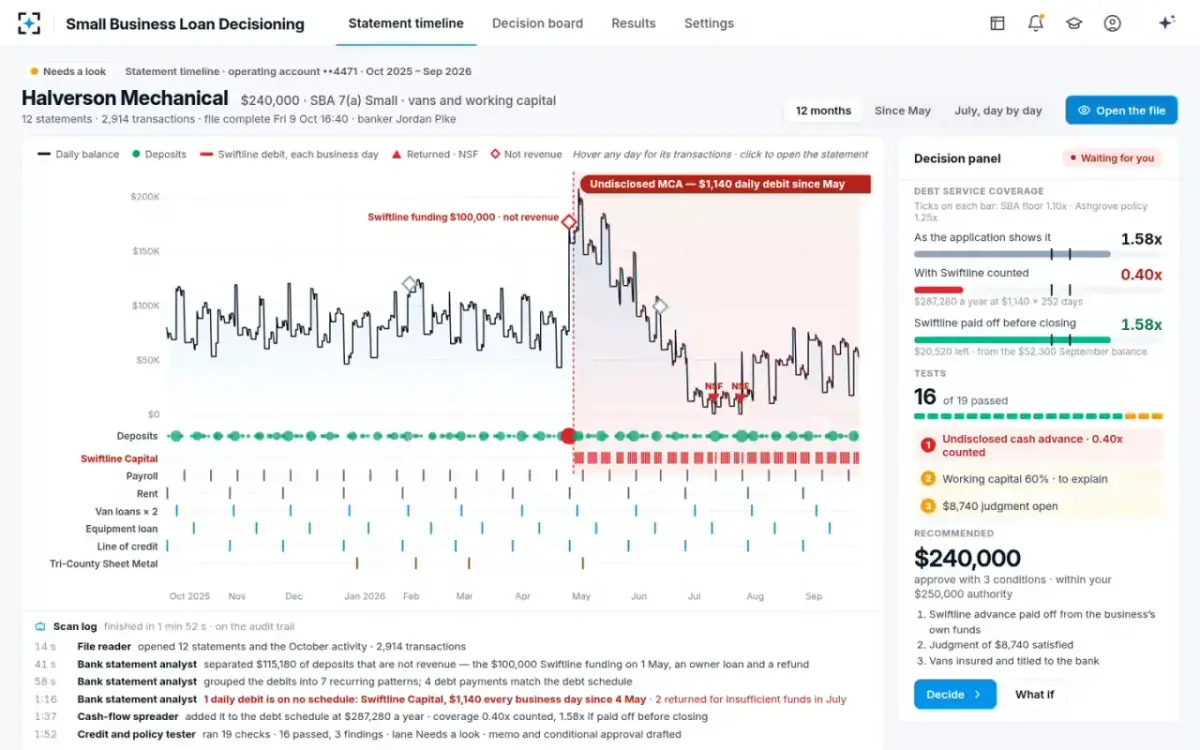
With the agents. The file was read and tested two minutes after its last document landed. On Monday the credit officer opens it on the statement timeline, sees the red row, clicks it and lands on the May statement, where the $100,000 credit from Swiftline Capital sits on page 1 with the daily debits beneath it. Her morning goes on three questions: is the advance real debt, what does it do to coverage, and what would cure it. Those are the questions the job exists to answer.
Where the hours go: assembly, not judgment
Across the estimate, about one hour in seventeen is the decision. The rest is evidence: finding it, keying it, reconciling it, writing it down with its source. That does not make the evidence unimportant. When SBA's Inspector General sampled 32 loans on which SBA had overturned its own staff's recommendation to deny or reduce a guaranty, it found 16 decided without sufficient evidence, and repayment ability was the weakest category, unsupported on 5 of the 6 loans reviewed (SBA OIG Report 26-12). The evidence is the job's defence. The point is that a person does not need to type it.
The estimate also shows where the risk sits. The statement read is a fifth of the time and the place a hidden debt is found or missed. The memo is a fifth of the time and the place a reviewer will look for the reasoning. A job description that lists "analyse bank statements" between "order credit reports" and "prepare documents" gives a new hire no idea that this is where the loan is won or lost. How that missed debit changes global coverage is worked through line by line in a companion guide.
What is in an SBA credit memo for a 7(a) Small loan?
A 7(a) Small credit memo must summarise the business, the owners and the request, state why credit is not available elsewhere, and analyse credit history and repayment ability, including debt service coverage and the two most recent months of bank activity. SBA's 2026 notice on 7(a) Small underwriting, written into SOP 50 10 8 and carried into 8.1, adds specific items the memo must address where they apply.
The 7(a) Small credit memo, section by section
- The business, its owners and the request
Who owns what, how long the business has operated, what the money is for and how it will be repaid.
- Why credit is not available elsewhere
An identifiable weakness, such as term or collateral, not a credit-score cut-off alone.
- Credit history
Owners', guarantors' and the business's credit; a scoring model's result and its approval range if the bank uses one.
- Repayment ability
Coverage of at least 1.10:1, with the two most recent months of operating-account activity reviewed to confirm all debts.
- Working capital, when it is half the loan
For loans over $50,000 with 50% or more of proceeds in working capital, why that level is necessary.
- Collateral and insurance
What secures the loan, its estimated value, and whether life or other insurance is required.
- Liens, judgments and litigation
Including divorce proceedings, named in the notice.
- Refinancing, franchises, affiliates, seller financing
Each where it applies, with the effect any affiliate has on repayment.
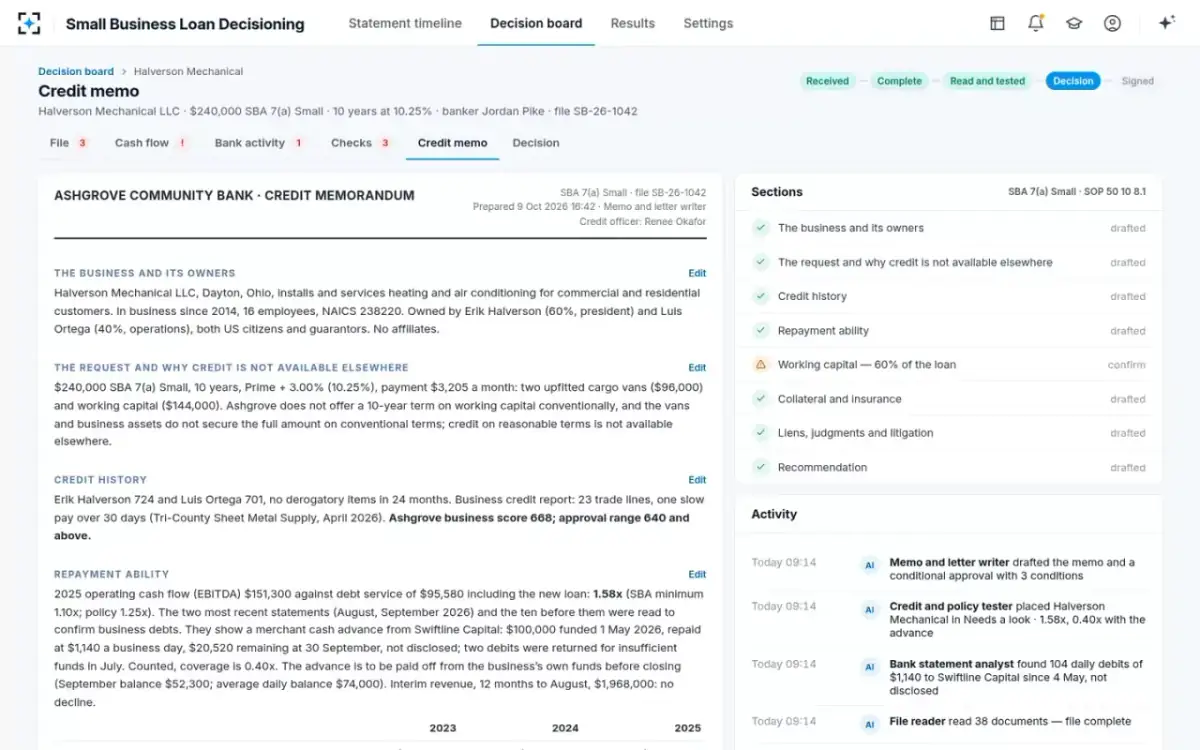
The memo, drafted in the 7(a) Small shape, with one section left for a person
What stays judgment in SBA loan underwriting
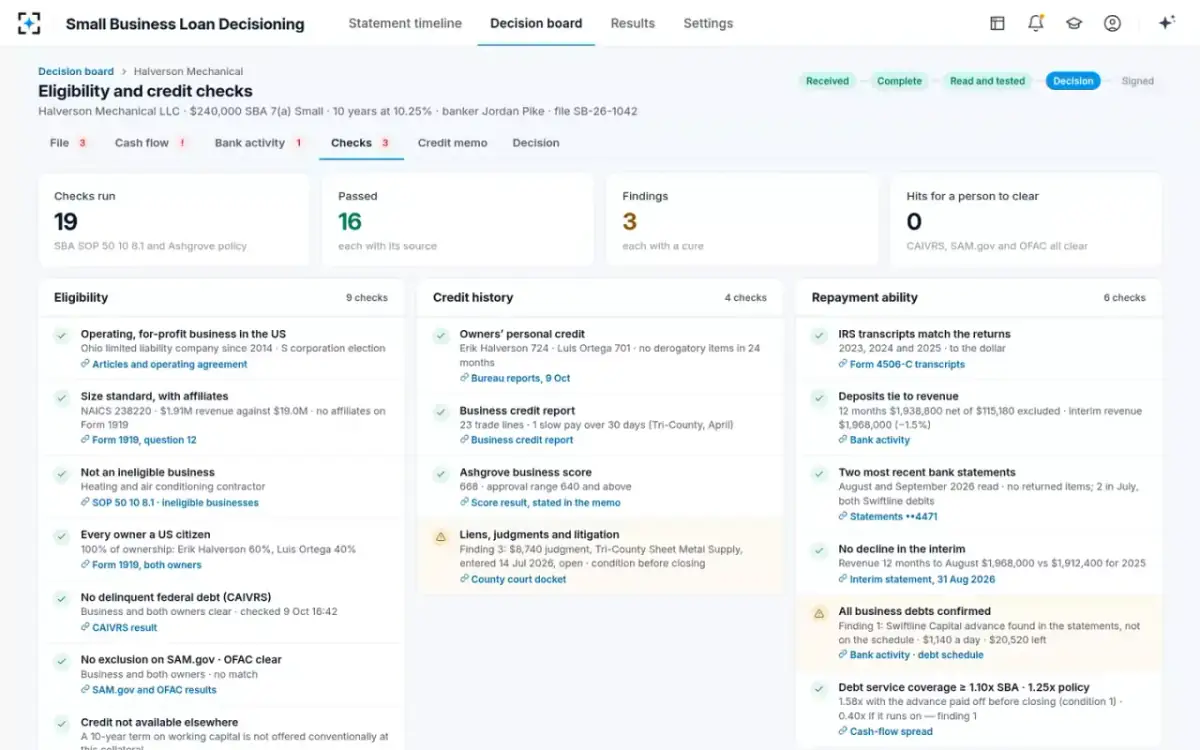
Four decisions on the sample file belong to a person, and none of them is arithmetic. The first is whether the daily debit is debt. The agents flag it and count it, but the underwriter decides whether a $1,140 daily ACH to a funder is a loan in substance, and what the bank will require before closing. The second is the working capital: 60% of the loan, which the SOP says must be explained. The agents tie it to $598,800 of signed contracts and a 71-day cash cycle; the officer decides whether that explanation is true of this business.
The third is the cure. With the advance counted, coverage is 0.40x, under the 1.10x SBA floor and the bank's 1.25x policy. Paid off from the business's own cash before closing, coverage returns to 1.58x. Whether to approve with that condition, counter-offer for the vans alone, or decline is a credit decision, and the letter that follows has to say why. The fourth is the signature itself: in the sample, the officer signs with the meaning stated, that she has reviewed the memo, the cash flow and every check.
Three findings, each with its evidence and its cure
How many files can one SBA underwriter handle?
No federal source publishes a caseload benchmark for SBA underwriters, so any number is an estimate. At seventeen hands-on hours a file, a full-time underwriter with nothing else to do would finish about two complete 7(a) Small files a week. Most also carry renewals, conventional requests and closing conditions, so the real figure is lower. With the assembly done by agents and checked by the person, the same underwriter's time per file falls to the review and the decision.
The constraint for most lenders is not the caseload but the volume. SBA's own loan-level data for fiscal 2025 lists 1,336 lenders making 7(a) loans, and 711 of them made five or fewer in the year (SBA 7(a) FOIA loan file, our count). A bank that makes five SBA loans a year cannot keep an SBA specialist busy, so its underwriter does the SBA file between conventional ones, from memory of a rulebook SBA rewrote in June 2025 and again in October 2026. That is the case for pricing the small file honestly before deciding who should underwrite it.
Most SBA lenders make few SBA loans
1,336
lenders made at least one 7(a) loan in FY2025
711
made five or fewer
50%
of all 7(a) loans came from the ten largest lenders
Who does each SBA underwriting duty on a small file
An honest account of the 2026 underwriting desk names the evidence work and then says who does it. The duties do not shrink; the typing does. On the sample file, the agents never decide, never clear an eligibility hit and never send a letter. The underwriter's work moves to checking each finding against its page, writing the parts of the memo that need an opinion, and making a recommendation the officer can sign.
SBA underwriter duties, and who does each on a small file
| Duty | Done by | The person's part |
|---|---|---|
| Sort and read the file; say when it is complete | File reader | Ask the borrower for what is missing |
| Spread returns and build the debt schedule | Cash-flow spreader | Approve any add-back beyond interest, depreciation and amortisation |
| Read the bank statements and find unlisted debts | Bank statement analyst | Decide whether a flagged payee is debt |
| Run eligibility checks: size, ownership, CAIVRS, SAM.gov, OFAC | Eligibility checker | Clear any hit; the agent cannot |
| Test credit and coverage against SBA and bank policy | Credit and policy tester | Accept or change the recommended lane |
| Draft the memo, conditions and letter | Memo and letter writer | Confirm the judgment sections; decide and sign |
The step-by-step trace of the same file shows each agent's work with its timing. For the full set of screens, start from Small Business Loan Decisioning.
Questions people ask
What does SBA expect a lender's underwriting to show?
SBA's SOP addresses its underwriting duties to "the Lender", and the lender answers for them when it asks SBA to honour the guaranty. Under delegated processing SBA does not review the credit analysis before it issues a loan number, so the memo has to stand on its own when SBA reads it after a default.
What is the difference between an SBA underwriter and a credit analyst?
Often none: many banks give the title to a credit analyst who handles the SBA files. Where the roles are split, the credit analyst spreads and writes, and the underwriter or credit officer tests the file against SBA's rules and decides within an authority limit.
Will AI replace SBA underwriters?
No. The work most exposed to automation is assembly, which is why BLS cites productivity-enhancing technology in its outlook for loan processors. The decision, the signature and the answer to SBA at purchase stay with a named person at the lender.
How long does SBA underwriting take on a small loan?
There is no federal benchmark for SBA files. The FDIC's 2022 survey found three in four banks approve their typical small business loan within ten business days. Most of that time is the file waiting for someone to assemble it, which is the part agents remove.