A small business loan origination system is the bank's system of record for a business credit request: it holds the application data and documents, runs the workflow from intake to decision, tracks conditions and hands the approved loan to booking. Adding AI to it does not mean replacing it. For an SBA loan there is a second system that cannot be replaced at all, SBA's own Loan System, still widely called E-Tran, through which the lender submits the guaranty request. Botminds' Small Business Loan Decisioning sits between the documents and those two systems. Its agents read the returns, transcripts, statements and SBA forms, test them, and write the results into the fields the origination system already has, so the analyst stops keying and the systems of record stay where they are.
Where the agents sit: between the documents and the two systems of record
Borrower and banker
Application, SBA Forms 1919 and 413, returns, statements, contracts
Arrive by portal, email or branch
Your loan origination system
The system of record: application data, documents, workflow, conditions, the decision
Unchanged; stays where it is
The agents
Read, spread, test and draft; write figures, findings and the memo into fields the system already has
Six agents, each with a written limit
The people
Credit officer decides and signs; SBA lending manager clears any eligibility hit
No agent decides, clears or sends
SBA Loan System (E-Tran)
Form 1919 information, 100% of ownership, the loan terms, scoring results where used; the loan number
Submitted by the bank, as today
Core and servicing
Booking, payments, SBA status reporting after closing
Outside the decision
Checked on the way through
IRS transcripts (IVES or Form 8821) · credit bureaus and the business credit report · CAIVRS · SAM.gov exclusions · OFAC · court dockets for liens and judgments
What is a small business loan origination system?
It is the software that carries a small business credit request from application to booked loan, and it is where the bank's evidence lives. A small business loan origination system typically holds the applicant and owner data, the document set, the workflow states, the credit decision and its conditions, and the hand-off to the core. For SBA lenders it also has to produce what SBA's Loan System needs: the borrower's Form 1919 information, the ownership, the loan terms.
That last point is why the system of record matters more for SBA loans than for conventional ones. SBA's Inspector General put it directly: "most loan documents and data reside only with the participating lender, which could be problematic if that lender dissolves or ceases to service the loan" (SBA OIG Report 26-01, Top Management Challenges for FY2026). The file the bank keeps is the file SBA will read at purchase. Anything an AI tool produces must land there, with its sources, not in a vendor's screen that may not exist in five years.
Does AI replace the loan origination system?
No, and a bank should be wary of any product that needs to. The origination system already holds the workflow, the permissions, the audit history and the integrations to the core, the credit bureaus and SBA. Replacing it to gain document reading is a multi-year project with a migration at the end. Adding a reading layer that writes into existing fields is a configuration project measured in weeks.
The responsibility does not move either. The federal banking agencies' guidance on third parties is explicit: "the use of third parties does not diminish or remove banking organizations' responsibilities to ensure that activities are performed in a safe and sound manner and in compliance with applicable laws and regulations, including ... fair lending laws" (Interagency Guidance on Third-Party Relationships, 2023). An agent that reads a statement is a third-party activity the bank must govern. Keeping the decision, the evidence and the submission in the bank's own systems is the simplest way to govern it.
What share of SBA loans are PLP, and why that raises the stakes
Most of them. In fiscal 2025, 64.1% of 7(a) loans were made under PLP delegated authority and 30.9% under SBA Express, which is delegated by definition; only 4.2% went through SBA's non-delegated review (SBA 7(a) FOIA loan file, our computation). For almost every SBA loan, then, the lender underwrites alone.
SBA reads the lender's underwriting at purchase, not before
64.1%
of FY2025 7(a) loans made under PLP delegated authority
30.9%
made under SBA Express, also delegated
4.2%
reviewed by SBA before approval (non-delegated)
SOP 50 10 8.1 spells out what delegation means: under PLP, "the Agency does not review the Lender's analysis of the credit or structure of the loan or line of credit prior to issuing a loan number", and "the PLP Lender's analysis is subject to SBA's review and determination of adequacy when the Lender requests SBA to purchase its guaranty or when SBA is conducting lender oversight activities" (SOP 50 10 8.1, Section B). The origination system is where that analysis has to be found, intact and sourced, when SBA asks.
What data goes into the SBA Loan System?
For a delegated loan, the information on SBA Form 1919 and the loan's terms and conditions, not the documents themselves. The SOP says the lender must enter "100% of the Applicant's direct and indirect owners", certify that no owner or required guarantor is an Ineligible Person, and submit "the information required in SBA Form 1919 and the loan terms and conditions"; the signed forms stay in the lender's file. For changes of ownership the lender also enters the business purchase price, the transaction type and the historical debt service coverage.
For 7(a) Small loans there is one more item since March 2026. If the lender uses a business credit scoring model, its results "must be documented in each loan file and included in E-Tran with submission" (SBA Procedural Notice 5000-875701). The name has shifted too: SOP 50 10 8.1 defines the "SBA Loan System" as all current and future SBA electronic loan systems, and uses that term far more often than "E-Tran". A field map built today should use the new name and survive the next system change.
How do agents connect to E-Tran and the SBA Loan System?
They do not submit to it; the bank does. In the design described here, the agents prepare the information the submission needs, from the ownership table to the coverage figures, inside the bank's origination system. A person reviews it and the bank's existing integration or staff submit it, as today. Keeping the submission with the bank keeps the certification with the bank, which is where SBA's rules put it.
The same principle applies to the external checks. CAIVRS, SAM.gov exclusions and OFAC are run and their results saved with the file, but a hit stops at a person: in Small Business Loan Decisioning the eligibility checker can find a hit and cannot clear one. IRS transcripts arrive through the bank's IVES participant or a Form 8821 naming the lender; the IRS says IVES participants using fax receive transcripts in "approximately 2-3 business days" (IRS). The agents match them to the returns when they arrive.
Each check is saved with its evidence, ready for the origination system
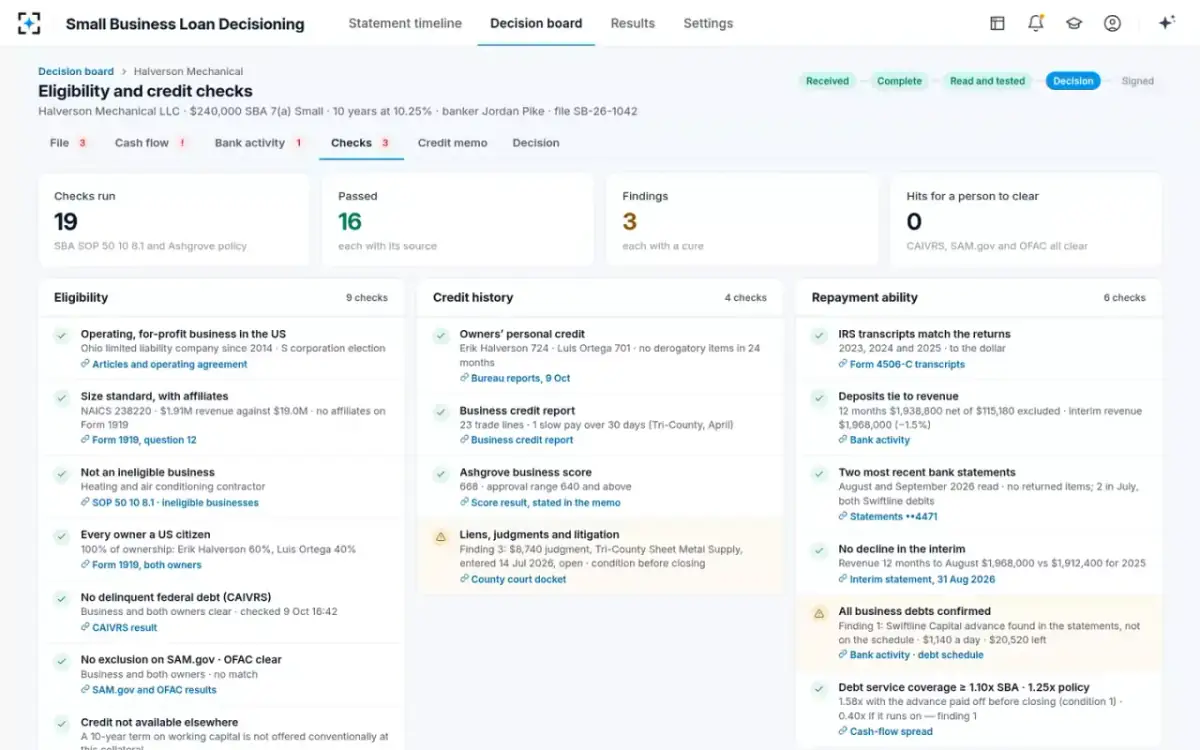
Field by field: from the document to the origination system to SBA
The integration is a field map, and it is short. Each agent reads a set of documents and produces values the origination system already has a place for. The table below follows the sample file, a fictional $240,000 SBA 7(a) Small request from a heating and air conditioning contractor to a fictional community bank.
What each agent reads, what it writes, and what reaches SBA
| Source documents | Agent | Written into the origination system | Reaches the SBA Loan System |
|---|---|---|---|
| Application, Forms 1919 and 413, entity documents | File reader | Owners and percentages, citizenship answers, legal-actions answers, completeness and what is missing | Form 1919 information; 100% of direct and indirect owners |
| Three years of returns, interim statements, IRS transcripts | Cash-flow spreader | Spread by year, EBITDA, debt schedule, coverage, transcript match | Coverage where SBA requires it entered |
| Twelve months of operating-account statements | Bank statement analyst | Revenue tie-out, non-revenue deposits, recurring payees, unlisted debts, returned items | No direct field; the findings support the memo SBA reviews |
| CAIVRS, SAM.gov, OFAC, Form 1919 answers | Eligibility checker | Each check, its result and its evidence | The lender's eligibility certification, made by a person |
| Credit reports, business credit report, court dockets | Credit and policy tester | Credit history, score and approval range, liens and judgments, the recommended lane | Scoring results, if a business scoring model is used on a 7(a) Small loan |
| Everything above | Memo and letter writer | Credit memo, conditions, approval, counter-offer or decline letter | Loan terms and conditions, once the officer decides |
Two rows deserve attention. The bank statement analyst writes nothing SBA receives directly, yet it is the row most likely to change the decision: on the sample file it found an undisclosed cash advance that took coverage from 1.58x to 0.40x. How to test that step before relying on it is covered separately. And the eligibility row ends in a person, because the certification SBA relies on is the bank's, not the software's.
How long does integration take?
The honest answer depends on the origination system's interfaces, but the shape is consistent: configure first, prove on closed files, then map fields, then run in parallel. Our planning estimate for a community bank with a modern origination system and a document repository the agents can read is about eight weeks to live use. Banks whose files live in email and shared drives should add time to connect the document source.
From kickoff to live files in about eight weeks
- Policy and documents2 wk
- Replay closed files2 wk
- Map fields2 wk
- Parallel run2 wk
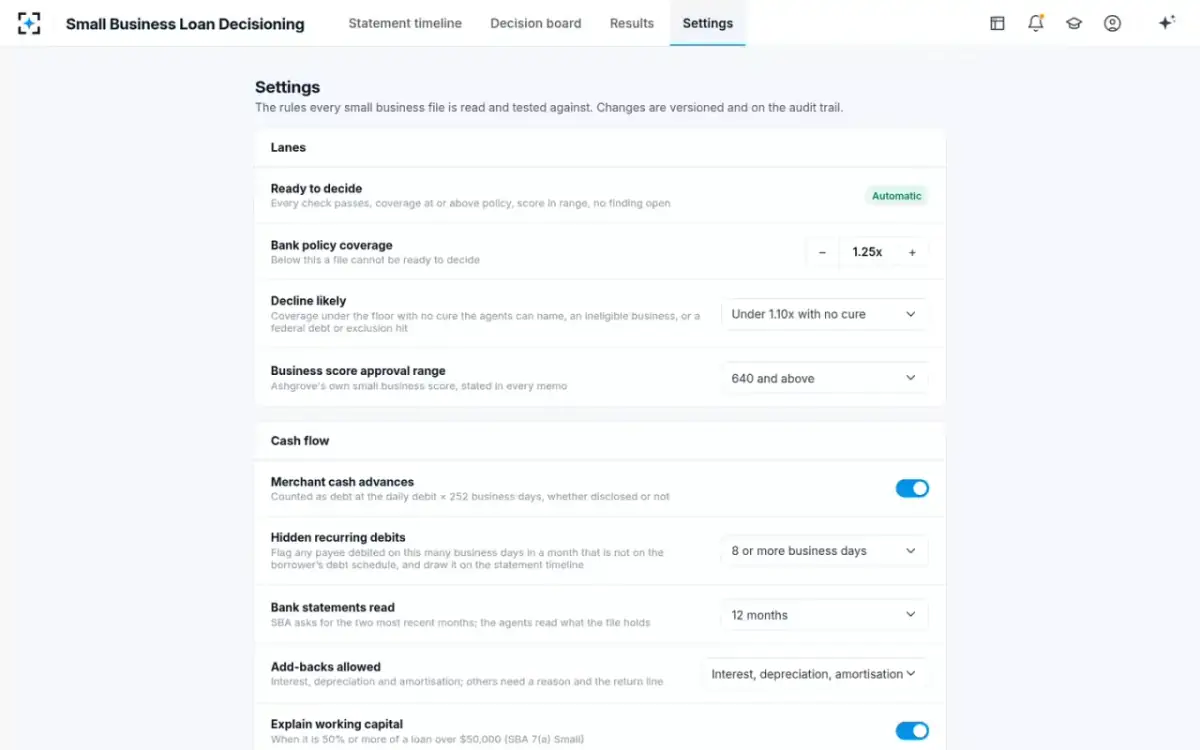
The replay in weeks three and four is the step that earns trust. Running the agents on files the bank has already decided shows, before any live use, how often the recommended lane matches what the officers did and where it differs. It is also where a bank should run a seeded test of the statement read, and settle the settings: coverage policy, score range, statement months, authority limits.
The lending rules the agents apply are settings the bank owns
What IT and lending operations should ask before go-live
The questions an IT team asks of an agent layer are the questions it asks of any system that writes into a system of record, plus two about evidence. A short list settles most of them.
Questions to settle before agents write into your origination system
- Which fields will the agents write, and which will they only suggest?
Figures and findings can be written; decisions, eligibility clearances and letters should only be drafted.
- Where does each source document live, and can the agents read it there?
Moving documents into a new store creates a second copy to reconcile.
- Does every written value carry a link to its page?
The file SBA reads at purchase must show where a figure came from without the agent's screen.
- Who submits to the SBA Loan System?
The bank, as today. Agents prepare the Form 1919 information and terms for a person to review.
- How are rule changes controlled?
Coverage, score ranges and authority limits as versioned settings, with who changed them and when.
- What happens when SBA changes the rules?
SOP 50 10 8.1 took effect October 1, 2026; files in flight need the version that applies to them.
- What does the bank keep if it stops using the product?
Everything that matters should already be in the origination system: spreads, findings, memo, decision.
The economics of the layer are worked through in the cost of a $150,000 file; the agents' own work, step by step, is in the AI underwriting trace. For the screens themselves, start from Small Business Loan Decisioning.
Questions people ask
What is the difference between a loan origination system and loan decisioning software?
A loan origination system holds the application, the documents, the workflow and the decision, and hands the loan to booking. Decisioning software produces the analysis the decision rests on: the spread, the statement review, the checks, the memo and a recommendation. In the design described here the second writes into the first.
Is E-Tran the same as the SBA Loan System?
E-Tran is the system lenders have used to submit 7(a) and 504 guaranty requests. SOP 50 10 8.1 uses "SBA Loan System" to mean all current and future SBA electronic loan systems, so references survive a system change. In practice lenders still call it E-Tran.
Do agents need direct access to the SBA Loan System?
No. The agents prepare the Form 1919 information, ownership and terms inside the bank's own systems; the bank submits as it does today. That keeps the lender's certification, for example that no owner is an Ineligible Person, with a person at the lender.
Which loans should go through the agents first?
Complete small business files up to $350,000: SBA 7(a) Small, SBA Express and conventional term loans and lines. They are most of the count (68.8% of FY2025 7(a) loans were $350,000 or less) and the files where hand assembly costs most per dollar lent.
Can a bank without a loan origination system use agents?
It can, with the solution's own decision board and file as the working screen and the documents kept in the bank's repository. But the evidence still has to end up in a system of record the bank controls, because SBA reviews the lender's file, not the vendor's, when it is asked to honour the guaranty.