MCA stacking is a business taking a second or third merchant cash advance while the first is still being repaid, often from a different funder, with each one pulling fixed daily or weekly payments from the same operating account. It matters to a small business underwriter because the advances rarely appear where debt normally does: not on the credit report, not on the borrower's debt schedule, often not on the application. They appear as a lump-sum credit and a run of identical debits. Botminds' Small Business Loan Decisioning reads every statement line for exactly that rhythm. But a buyer should not take any reviewer's word for it, ours included. The only honest measure is a seeded test: plant advances you know about in files you already understand, and count what is found.
Cash advances are common, and invisible to the usual checks
12%
of small employer firms seeking credit applied for a merchant cash advance in 2025
8%
of all small employer firms applied for one
2028
first year of Section 1071 small business lending data, which excludes cash advances
What is MCA stacking?
A merchant cash advance is a lump sum paid to a business in exchange for a larger amount repaid from its future receipts, usually by automatic debit every business day. The FTC described the product in its 2021 case against Yellowstone Capital as "a larger amount repaid through daily automatic payments" (FTC, April 2021). Stacking is the second advance on top of the first. Each funder sees its own payment; the business carries all of them; and the bank that underwrites a term loan sees none unless it reads the statements.
For an SBA lender the risk is direct. An undisclosed advance is debt service the coverage calculation never counted. On the sample file in this guide, a contractor's coverage was 1.58x on the application and 0.40x once one advance was counted. Two stacked advances would have made it worse. The bank would have lent against cash flow that was already promised to someone else.
Does SBA count merchant cash advances in debt service?
Yes. SBA counts every business debt in debt service, and since March 2026 it names cash advances explicitly. SOP 50 10 8.1 requires that for 7(a) Small loans "the two most recent months of commercial bank activity or statements, from the time of application, for the primary operating account must be reviewed as part of the Analysis to determine whether all debts were included in the debt service coverage calculation, and statements must be retained in the loan file" (SOP 50 10 8.1, Section B Chapter 2).
SBA's own answers to lenders' questions spell out what that review is for. The statements must be used "to validate the debts and obligations included in the Debt Service Coverage Ratio calculation. This includes confirming any sales-based repayment obligations, such as Merchant Cash Advances or similar arrangements" (SBA Information Notice 5000-877673). A lender that finds an advance after closing, at a default, will struggle to argue that its statement review met that standard.
How many months of bank statements does SBA require?
Two: the two most recent months of activity for the primary operating account, from the time of application, kept in the file. That is the floor, not the method. A two-month window shows any advance being repaid during those months. It does not show when the advance started, how much was funded, whether it was renewed, or whether the debits bounced. The sample advance in this guide was funded on May 1; a two-month read in September sees the debits but not the $100,000 credit that explains them.
Reading twelve months costs a person hours and costs software seconds. In the sample, the statements held 2,914 transactions. The solution reads what the file holds, twelve months by default, with six or twenty-four as settings, and draws them on a single timeline so the start of a pattern is visible at a glance.
Recurring debits grouped by payee: six on the schedule, one not
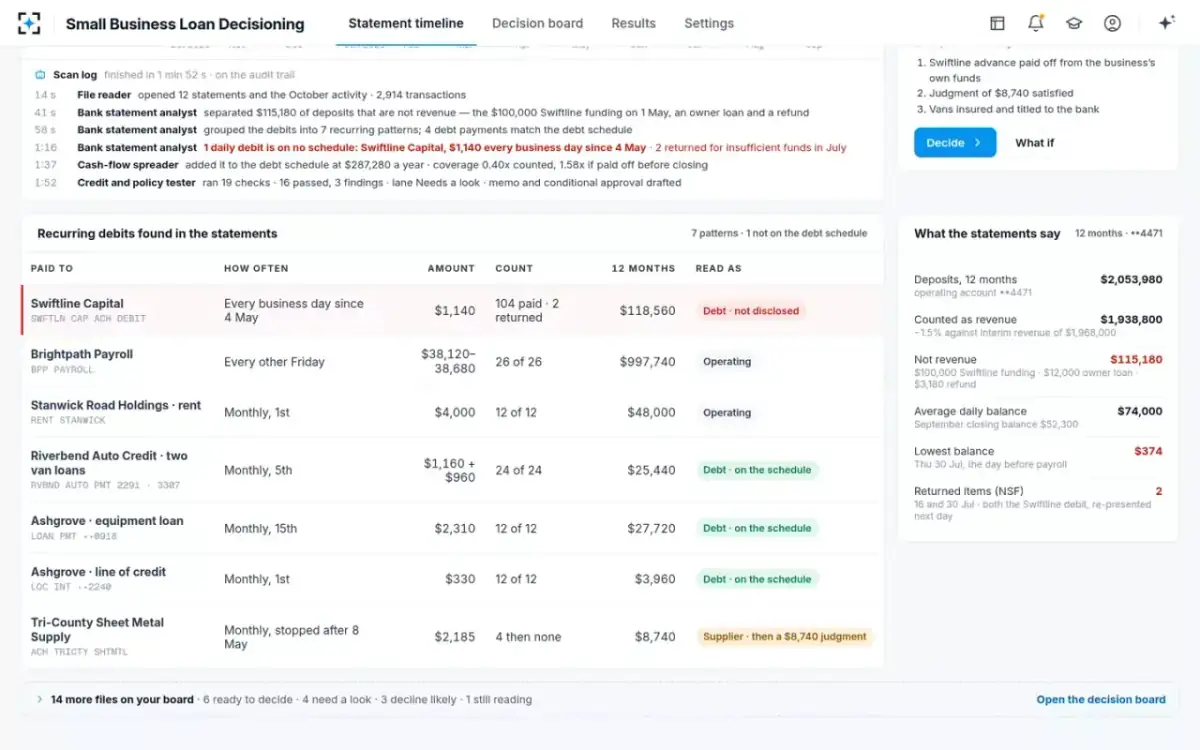
How do you spot a merchant cash advance on bank statements?
Look for five marks, and expect only some of them on any one advance. A credit from a funder with "funding", "advance" or "capital" in the descriptor, usually a round number. Debits of an identical amount on every business day, or on the same weekday each week, starting a day or two after that credit. Returned items, because a fixed daily debit does not care whether the account had a good day. A balance that saw-tooths, rising with deposits and falling by the same amount each morning. And card settlement deposits that shrink as a share of sales, which is how a split-funded advance shows itself.
One month, day by day: the saw-tooth of a daily debit
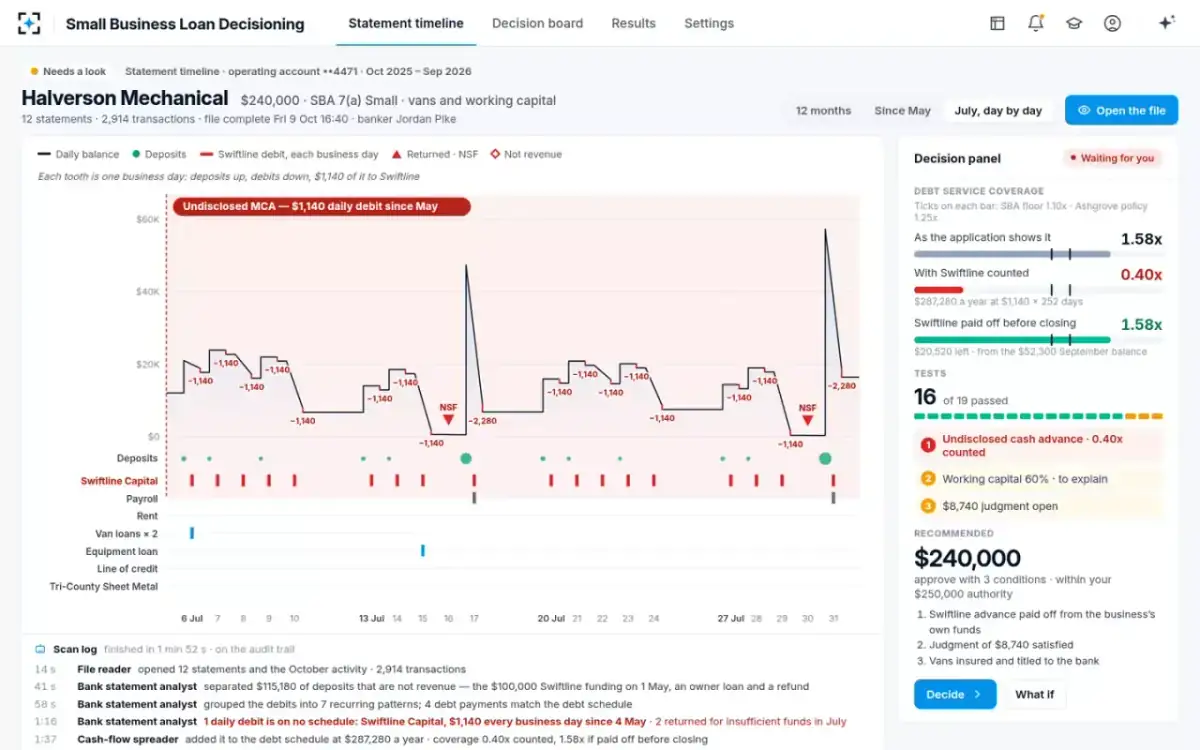
The fourth mark, the saw-tooth, is the most reliable on screen and the least visible on paper. A printed statement shows a debit of $1,140 between a $38,260 payroll and a $15,002 supplier payment. Nothing about it looks dangerous. Drawn as a daily balance, the same month shows a business paying a lender every morning and running out of cash before payroll.
The test: plant five hidden advances in files you already know
A seeded test measures a reviewer the way an auditor measures a control: by putting known errors in and counting what comes out. Take 40 complete small business files your bank has already decided, with statements you trust. Into five of them, add an advance that was not there, each in a different pattern. Into three more, add a decoy that looks like an advance and is not. Give the set to the reviewer, whether that is an analyst, a vendor's software or an agent, without saying which files were changed.
Five planted advances: debits each one leaves in SBA's two-month window
Each plant tests a different weakness. The daily debit is the baseline: any reviewer should find it. The stacked second advance tests whether a reviewer stops after the first find. The renamed payee tests whether patterns are grouped by what the payment is, not by the exact text on the statement, since a funder that changes its processor changes its descriptor. The weekly debit tests frequency rules: four or five debits a month can fall under a threshold built for daily payments. The split-funded advance tests whether anyone is reading the deposits at all.
The five plants and three decoys: what each looks like, and what should catch it
| Plant | On the statement | What should catch it |
|---|---|---|
| 1 · Daily fixed debit | A $100,000 funding credit, then the same debit every business day | Grouping debits by payee and rhythm; a payee debited on most business days that is not on the debt schedule |
| 2 · Stacked second advance | A second funding credit and a second daily debit beside the first | Counting every unlisted pattern, not the first one found; coverage recomputed with both |
| 3 · Renamed payee | The same amount and rhythm under two descriptors, one ending as the other begins | Grouping by amount, rhythm and funder name, so the halves join into one debt |
| 4 · Weekly debit | Same amount, same weekday, four or five times a month | A frequency setting low enough to see weekly rhythm; counted at 52 payments a year |
| 5 · Split-funded | No debit; card settlement deposits fall as a share of sales after a funding credit | Tying deposits to revenue month by month and to the returns; a person asking the borrower |
| Decoy A · Daily sweep | A fixed daily transfer to the business's own savings account | Recognising a transfer between the borrower's own accounts as neither debt nor revenue |
| Decoy B · PEO payroll | A large debit every other Friday to a payroll provider | Reading it as an operating cost, not a loan |
| Decoy C · Fuel card | Frequent small debits to a fuel card company, varying in amount | Varying amounts; an operating expense, not a fixed repayment |
Scoring the test: recall, false alarms, and the cost of each miss
Score two numbers and report both. Recall is the planted advances found, out of five. False alarms are the decoys flagged as debt, out of three, plus anything flagged in the 32 untouched files that the bank already knows was clean. A reviewer that finds all five and flags all three decoys is not good; it is noisy, and a credit officer will learn to ignore it. A reviewer that finds three and flags nothing has two holes you now know the shape of.
Then price each miss. On the sample file, the advance cost $1,140 a business day, $287,280 a year counted at 252 days, against operating cash flow of $151,300. A missed weekly plant of $4,800 is $249,600 a year. These are not rounding errors on a $240,000 loan. A miss is the difference between 1.58x and 0.40x coverage, which is the difference between a loan that repays and one that SBA may later find was never underwritten.
A reviewer that finds four advances out of five has not passed. It has told you which kind of debt your bank will keep missing.
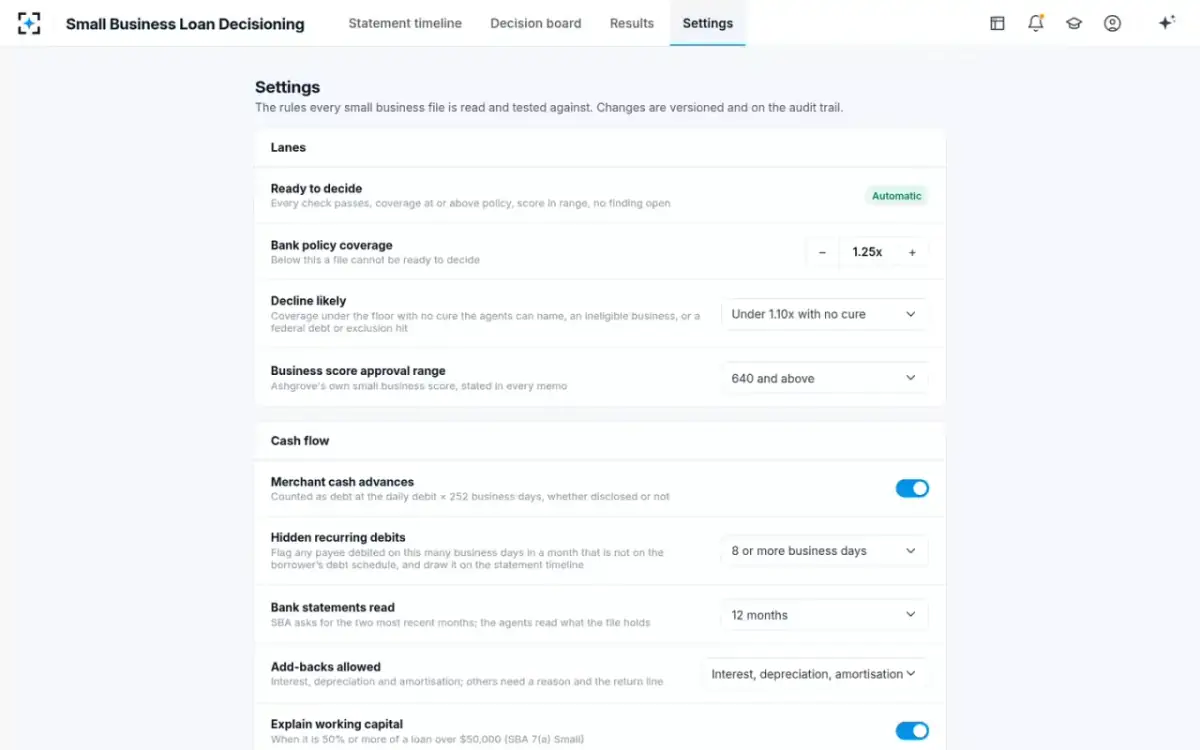
Run the test again after any change: a new analyst, a new vendor release, a new setting. In Small Business Loan Decisioning the frequency threshold for a hidden recurring debit is a setting, flagged at eight or more business days a month by default, with five and twelve as options. The weekly plant is the one to run against that setting before relying on it.
The rules a statement read is judged by are settings a credit team can test
What the sample file shows once the advance is counted
The sample file is the daily-debit plant, found in the wild. Halverson Mechanical's statements show a $100,000 credit from Swiftline Capital on May 1 and $1,140 debited every business day from May 4: 104 debits paid by September 30, two returned for insufficient funds in July, $118,560 paid of $139,080 owed. The borrower's debt schedule lists two van loans, an equipment loan and a line of credit. It does not list Swiftline.
Counted, the advance takes coverage from 1.58x to 0.40x. The bank's choices then become a credit question, not a detection question: approve with a condition that the advance is paid off from the business's own funds before closing, with a zero-balance letter; counter-offer for the vans alone, which still fails while the advance runs; or decline. The sample officer approved with the payoff condition. The global coverage calculation for the same file shows what the advance does once the owners' own debts are added.
What the FTC cases show about the debit pattern
The FTC's cases describe the same fingerprint from the borrower's side. Yellowstone Capital "continued withdrawing money from businesses' bank accounts for days after their balance had been repaid", and surrendered $9,837,000 for refunds to the businesses (FTC, April 2021). In 2022 the owners of RCG Advances were permanently banned from business financing after the FTC alleged they had lied to small business owners about terms and fees (FTC, June 2022).
For an underwriter the lesson is practical. A daily debit that continues past the expected payoff, or changes amount without a new funding credit, is a reason to ask the borrower for the funder's contract and a payoff letter, not to estimate. In the sample, the remaining $20,520 at 18 more debits ends around October 27; the condition asks for proof, not arithmetic.
What to look for in bank statement analysis software
Bank statement analysis software for lenders should do three things a person cannot do quickly: read every line, group lines into patterns, and show each pattern against the borrower's own debt schedule. The seeded test above is the way to check all three. Beyond it, these are the questions that separate a categoriser from an underwriting tool.
Questions for any bank statement analysis software used in underwriting
- Does it compare patterns with the borrower's signed debt schedule?
Categorising a debit as "loan payment" is not enough; the point is whether it is on the schedule.
- Does it separate deposits that are not revenue?
An advance, an owner loan or a transfer counted as sales inflates both revenue and coverage.
- Can every flag open the statement page it came from?
The officer must see the line before relying on it, and SBA may ask for it later.
- Does it show returned items and the lowest balance?
Two returned debits in July said more about this borrower than the average balance did.
- How does it count an advance in coverage?
Daily debit × 252 business days, weekly × 52, or something else; it should be a setting, stated in the memo.
- Does it read scanned statements, not only data feeds?
Small business files still arrive as PDFs from the borrower's own bank.
- What did it score on your seeded test?
Recall on five plants and false alarms on three decoys, on your files, before you sign.
Statement reading is one step in a longer chain; the full step-by-step trace shows where it sits and how its findings reach the coverage test and the memo. To run the five-advance test on your own files, start from Small Business Loan Decisioning.
Questions people ask
How long does it take to read twelve months of business bank statements?
By hand, a few hours for a small business account, longer if the statements are scans; our estimate for a 7(a) Small file is about three hours. On the sample file the bank statement analyst read 2,914 transactions in 33 seconds. The person's time then goes on the flags, not the lines.
Are MCAs covered by Section 1071?
No. The CFPB's rewritten Section 1071 rule, published May 1, 2026, excludes merchant cash advances from small business lending data reporting. Compliance with the rest of the rule starts January 1, 2028. So no federal data set will show how many advances a borrower carries.
How is a merchant cash advance counted in debt service coverage?
As a payment obligation for as long as it runs. A common convention annualises the debit: a daily debit times 252 business days, a weekly one times 52. On the sample file $1,140 a day becomes $287,280 a year, which took coverage from 1.58x to 0.40x.
Can an SBA loan pay off a merchant cash advance?
That is a debt refinancing question governed by SOP 50 10 8.1's refinancing rules, and lenders should read them against the advance's contract before relying on it. In the sample, the bank set the condition that the advance be paid off from the business's own funds before closing, with a zero-balance letter from the funder.
What is a returned item on a bank statement?
A debit the bank refused for insufficient funds, often marked NSF. A fixed daily debit that returns and is presented again the next day at double the amount is a common sign of a cash advance under strain. The sample account had two, on July 16 and 30.