An SBA 7(a) Small loan is a term 7(a) loan of $350,000 or less, underwritten under a shorter SBA procedure: debt service coverage of at least 1.10:1, two months of bank statements to confirm every debt, and the lender's own credit analysis for similar conventional loans. Loans of that size dominate the program by count: in fiscal 2025, 68.8% of all 7(a) approvals were $350,000 or less, yet they carried only 18.4% of the dollars, and the smallest of them have charged off at ten times the rate of loans over $1 million. Botminds' Small Business Loan Decisioning was built for this size band, where the file work is nearly as heavy as on a large loan and the evidence matters more. The figures below come from SBA's own loan-level data and its SOP.
The SBA 7(a) loan book by size band: most of the loans, little of the money
$50,000 or less
18,722
$50,001 – $150,000
19,852
$150,001 – $350,000
15,154
$350,001 – $500,000
8,075
$500,001 – $1 million
7,317
$1 – $2 million
4,628
$2 – $5 million
4,330
$350,000 or less
53,728
68.8% of loans · 18.4% of dollars
What is an SBA 7(a) Small loan?
It is SBA's procedure for small term loans. SOP 50 10 8.1 defines 7(a) Small loans as "term (non-revolving) 7(a) loans that are $350,000 or less", and excludes Standard 7(a), SBA Express, Export Express, CAPLines and the working capital programs (SOP 50 10 8.1, Section B Chapter 2). Any 7(a) lender can make one, under its delegated PLP authority or by sending it to SBA for non-delegated review. The point of the procedure is that the lender may use its own forms, memos and processes for similarly sized conventional loans, inside SBA's floors.
The floors are short but firm. The credit memo must state why credit is not available elsewhere and analyse the credit history of the business, its owners and guarantors. Repayment ability rests on debt service coverage of at least 1.10:1 on historical or projected cash flow, for purposes other than a change of ownership, with the two most recent months of operating-account activity reviewed to confirm every debt is counted. And IRS transcripts must be reconciled with the financial statements before the first disbursement.
What is the 7(a) Small loan limit?
$350,000 per project, including any other 7(a) loans made to the business within 90 days. A 7(a) Small loan may be increased only up to that amount; above it, the loan becomes a Standard 7(a) loan and must follow the Standard chapter's underwriting. SBA's guaranty is 85% on loans of $150,000 or less and 75% above, and the guaranteed amount counts toward SBA's $3.75 million limit on exposure to one business and its affiliates.
The size limit is also why the band matters for the program. 7(a) Small and SBA Express together cover the band where, in the FOIA data, almost seven loans in ten fall.
What share of SBA loans are under $350,000?
68.8% of fiscal 2025 7(a) approvals, 53,728 loans, were $350,000 or less, and they carried 18.4% of the program's $37.29 billion. Half of all approvals, 49.4%, were $150,000 or less. The pattern is stable: in fiscal 2024 loans of $350,000 or less were 70.8% of approvals and again 18.4% of dollars (SBA 7(a) FOIA loan file, our computation).
The band includes SBA Express loans, which made up 30.9% of fiscal 2025 approvals but only $2.56 billion of the dollars, as well as 7(a) Small and some Standard loans. The FOIA file does not flag 7(a) Small as a separate program, so the band is the honest unit. It is also the unit that matters to a lender: a $240,000 request costs the same to underwrite whichever procedure it goes through.
The small end of the 7(a) program in fiscal 2025
68.8%
of 7(a) loans were $350,000 or less
18.4%
of 7(a) dollars went to them
49.4%
of 7(a) loans were $150,000 or less
$166,850
median 7(a) loan; the mean was $477,571
What is the default rate on small SBA loans?
Much higher than on large ones. Among 7(a) loans approved in fiscal 2021 and 2022 and not cancelled, 6.4% of loans of $150,000 or less had been charged off by mid-2026, against 2.4% of loans from $150,000 to $350,000, 1.0% from $350,000 to $1 million, and 0.6% above $1 million (SBA 7(a) FOIA loan file, our computation). The smallest loans charged off at more than ten times the rate of the largest.
The smallest 7(a) loans charge off at ten times the rate of the largest
Two cautions apply. The cohorts are young; peer-reviewed work on SBA loans finds default risk rises in the early years and peaks in the second year of a loan's life (Glennon and Nigro, Journal of Money, Credit and Banking, 2005), so these rates will rise. And size is not the only difference between the bands: small loans go more often to younger and smaller businesses. But for a lender deciding how much checking a file deserves, the direction is not in doubt.
Why the smallest loans need more checking per dollar, not less
A lender that scales its underwriting to the loan amount gets the risk exactly backwards. The small file earns least and defaults most; it is also where the evidence is thinnest and the borrower is least likely to have audited statements or a controller. The cheap response is to read less: skim two months of statements, trust the debt schedule, approve on a score. That is how an undisclosed cash advance reaches closing.
SBA's 2026 changes push the other way. With the SBSS score screen sunset on March 1, 2026, a 7(a) Small loan's repayment ability rests on the coverage calculation and on the bank statements that confirm it. SBA's own answer to lenders is that when the lender "calculates an acceptable Debt Service Coverage Ratio (at least 1.10:1 on a historical or projected basis ...) and uses two months of bank activity to confirm the debts and obligations included in that calculation, the requirement to determine repayment ability is satisfied" (SBA Information Notice 5000-877673). The coverage number is now the test, and a coverage number built on an incomplete debt schedule is not a test at all. What replaced the SBSS score is set out in a companion guide.
The economic answer is to make the checking cheap rather than to do less of it. On the sample file in Small Business Loan Decisioning, a fictional contractor's $240,000 7(a) Small request, the agents read twelve months of statements, 2,914 transactions, in 33 seconds and found a cash advance that took coverage from 1.58x to 0.40x. What a small file costs to underwrite by hand is priced in a separate guide.
Who makes the small loans: a few large lenders and many occasional ones
The small band is concentrated in a few lenders and spread thinly across the rest. In fiscal 2025, 1,336 lender names appear in SBA's 7(a) loan file; the ten largest made 50.2% of all 7(a) loans but only 35.4% of the dollars, which tells you their loans run small. At the other end, 711 lenders made five or fewer 7(a) loans in the year, and only 94 made 100 or more (SBA 7(a) FOIA loan file, our computation).
Those two groups face the small file differently. A high-volume lender can build a small-loan factory, with SBA Express authority, scoring and a dedicated team; SBA Express alone made 24,157 loans for $2.56 billion. An occasional lender underwrites its handful of 7(a) Small files between conventional ones, from memory of a procedure that SBA rewrote in March 2026 and again in October. For the occasional lender the risk is not volume but consistency: the two-month statement review, the working capital explanation and the credit elsewhere wording are easy to forget on the fifth file of the year.
What is the difference between 7(a) Small and SBA Express?
Both are small-loan procedures, but SBA Express gives the lender more freedom and less guaranty. 7(a) Small is a term loan of up to $350,000 with an 85% or 75% guaranty, open to any 7(a) lender. SBA Express goes to $500,000, may be a revolving line, carries a 50% guaranty, and can only be made by a lender with SBA Express authority, under that delegated authority.
7(a) Small and SBA Express under SOP 50 10 8.1
7(a) Small: $350,000 per project, including 7(a) loans within 90 days
SBA Express: $500,000 aggregate, including other Express loans
7(a) Small: Term loan only
SBA Express: Term loan or revolving line
7(a) Small: Any 7(a) lender, delegated or non-delegated
SBA Express: Lenders with SBA Express authority, delegated only
7(a) Small: 85% to $150,000; 75% above
SBA Express: 50%
7(a) Small: Coverage of at least 1.10:1, two months of bank activity reviewed
SBA Express: The lender's own analysis for similar conventional loans
7(a) Small: Lender's model allowed if not solely consumer scores; score and approval range in the memo
SBA Express: Lender's model must be statistically validated as predictive of loan performance
7(a) Small: Obtained and reconciled before first disbursement
SBA Express: Not required before disbursement under this rule
7(a) Small: Appendix 15 applies; no reduced coverage standard for the small procedure
SBA Express: Same
Do small SBA loans need full underwriting?
They need a full credit analysis in the lender's own form, not the Standard 7(a) memo. SBA's guidance says a lender may choose to process a loan of $350,000 or less under Standard 7(a) instead, and if it does, "all Standard 7(a) requirements apply, including the full credit analysis". Under the 7(a) Small procedure the lender uses its conventional process, but the memo must still cover the business, the owners and the request, credit elsewhere, credit history, repayment ability, and, where they apply, working capital, collateral, insurance, liens and judgments, refinancing and affiliates.
If a small request fails the 1.10 test, the lender is not forced to decline. SBA's guidance is that it "may consider processing the request as a Standard 7(a) loan or, if the Lender has the applicable authority, as an SBA Express loan". Standard 7(a) asks for more coverage on the business, 1.15, but brings the full analysis, including projections where history falls short.
7(a) Small rates and fees, for loans approved in fiscal 2027
| Loan size | Maximum variable rate | Upfront guaranty fee | SBA guaranty |
|---|---|---|---|
| $50,000 or less | Prime + 6.5% | 2% of the guaranteed portion; lender may keep up to 25% | 85% |
| $50,001 – $150,000 | Prime + 6.0% | 2% of the guaranteed portion; lender may keep up to 25% | 85% |
| $150,001 – $250,000 | Prime + 6.0% | 3% of the guaranteed portion | 75% |
| $250,001 – $350,000 | Prime + 4.5% | 3% of the guaranteed portion | 75% |
How a $240,000 7(a) Small file meets the test
The sample file in the solution is a 7(a) Small request in the middle of the band: Halverson Mechanical, a 16-person heating and air conditioning contractor in Dayton, asking a fictional community bank for $240,000 over ten years at Prime plus 3.00%, 10.25%, inside the Prime plus 6.0% cap. Two vans account for $96,000 and working capital for $144,000, 60% of the loan, which the 7(a) Small rules say the memo must explain because the loan is over $50,000.
The agents test it against the floors above. Coverage on the 2025 return is 1.58x, over SBA's 1.10x and the bank's 1.25x. The two most recent months of statements, and the ten before them, show a cash advance not on the debt schedule; counted, coverage is 0.40x, which no loan amount can fix while the advance runs. The bank's own business score is 668 against its approval range of 640 and above, stated in the memo as SBA requires when a model is used. The transcripts match the returns to the dollar. Nine SBA eligibility checks pass.
Nineteen checks on a 7(a) Small file, each with its source
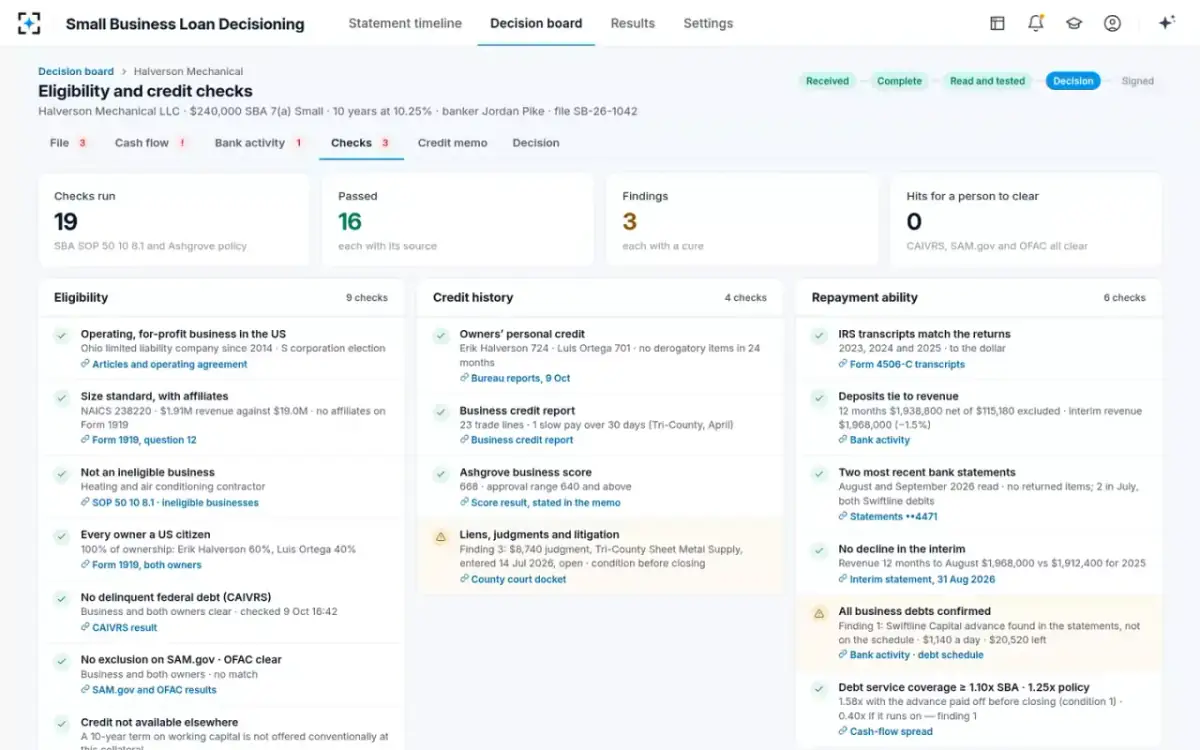
The outcome is a conditional approval, not a decline: the advance paid off from the business's own funds before closing, the open judgment satisfied, the vans insured and titled. That is a credit officer's decision, made from evidence the small-loan procedure asks for but a hand-built file rarely shows in full. The same file's global coverage adds the owners. To see the run, start from Small Business Loan Decisioning.
Questions people ask
What DSCR does an SBA 7(a) Small loan need?
At least 1.10:1 on a historical or projected basis, for purposes other than a change of ownership. Changes of ownership follow Appendix 15 of SOP 50 10 8.1, where acquisitions need 1.25 on historical cash flow, with no reduced standard for small loans. Many lenders set their own policy higher.
Can a 7(a) Small loan be used to buy a business?
Yes, under SOP 50 10 8.1's change-of-ownership rules in Appendix 15, which apply in full except for one concession: the lender may use an internal business valuation when the purchase price is $350,000 or less. The acquisition coverage standard applies without reduction.
What happens if a 7(a) Small loan is increased above $350,000?
It becomes a Standard 7(a) loan and must meet the Standard underwriting requirements, including 1.15 coverage on the business and 1:1 globally. SBA Express loans may not exceed $500,000.
Can a 7(a) Small loan have a fixed rate?
Yes. SOP 50 10 8.1 caps variable rates by loan size, from Prime plus 6.5% on loans of $50,000 or less to Prime plus 4.5% between $250,001 and $350,000, and says the maximum allowable fixed rate is published on SBA's wiki page. Either rate type must stay within the cap for the loan's size.
Do SBA Express loans need tax transcripts?
SOP 50 10 8.1 exempts SBA Express and Export Express from the requirement to obtain and reconcile IRS transcripts before the first disbursement. 7(a) Small and Standard 7(a) loans need them. A lender's own policy may still require transcripts on Express loans.