A qualified written request (QWR) is written correspondence from a borrower that identifies the borrower and the loan and either says why the borrower believes the account is in error or asks for information about the loan's servicing; a notice of error is the Regulation X term for written correspondence that asserts a servicing error; a request for information is the term for one that asks for servicing information. The difference between a qualified written request and a notice of error is one of law and history, not of substance: since 2014 a QWR that asserts an error "is a notice of error" and a QWR that asks for information "is a request for information", and one letter is often both (12 CFR 1024.35(a), 1024.36(a)). What matters is the content, because the two labels run on different clocks, only one freezes credit reporting, and neither depends on the words the borrower used. Botminds' RESPA Error Resolution Management classifies each letter by what it asserts and asks, assertion by assertion, the day it arrives.
Notice of error vs request for information, rule by rule
Notice of error · 12 CFR 1024.35: Any written notice that names the borrower, identifies the loan and says what error the borrower believes occurred.
Request for information · 12 CFR 1024.36: Any written request that names the borrower, identifies the loan and states the information requested about the loan.
Notice of error · 12 CFR 1024.35: The QWR asserts an error relating to the servicing of the loan.
Request for information · 12 CFR 1024.36: The QWR requests information relating to the servicing of the loan.
Notice of error · 12 CFR 1024.35: 5 business days.
Request for information · 12 CFR 1024.36: 5 business days.
Notice of error · 12 CFR 1024.35: 30 business days; 7 for a payoff error; before the sale or 30 days, whichever is earlier, for a foreclosure error.
Request for information · 12 CFR 1024.36: 30 business days; 10 for the identity of the loan's owner or assignee.
Notice of error · 12 CFR 1024.35: One 15-day extension, except payoff and foreclosure errors.
Request for information · 12 CFR 1024.36: One 15-day extension, except owner-identity requests.
Notice of error · 12 CFR 1024.35: No adverse information on the disputed payment for 60 days.
Request for information · 12 CFR 1024.36: No freeze: the servicer may furnish and pursue its remedies while the request is open.
Notice of error · 12 CFR 1024.35: Remedies continue, except for errors under (b)(9) and (b)(10).
Request for information · 12 CFR 1024.36: Remedies continue.
Notice of error · 12 CFR 1024.35: Duplicative, overbroad or untimely, on a reasonable determination with notice in 5 days.
Request for information · 12 CFR 1024.36: Duplicative, confidential, irrelevant, overbroad or unduly burdensome, or untimely, with notice in 5 days.
What is a qualified written request under RESPA?
A qualified written request is the borrower's letter that triggers the servicer's statutory duty to respond under RESPA section 6(e). The statute defines it as "a written correspondence, other than notice on a payment coupon or other payment medium supplied by the servicer", that identifies the borrower and account and "includes a statement of the reasons for the belief of the borrower, to the extent applicable, that the account is in error or provides sufficient detail to the servicer regarding other information sought by the borrower" (12 U.S.C. 2605(e)(1)(B)). Regulation X repeats the definition in 1024.31.
Before 2014 the QWR was the only door. The statute gave servicers 20 business days to acknowledge one and 60 to respond until the Dodd-Frank Act cut those to 5 and 30, and the phrase "qualified written request" was the key that opened the duty. Regulation X, effective 10 January 2014, opened two broader doors that do not need the label, and folded the QWR into them.
Is a QWR a notice of error?
A QWR that asserts a servicing error is a notice of error, and the servicer "must comply with all requirements applicable to a notice of error with respect to such qualified written request" (1024.35(a)). A QWR that only asks for information is a request for information under 1024.36. A QWR that does both, which is common, is both, and each part runs on its own clock.
The reverse is the part that catches servicers. A notice of error does not need to be a QWR, or say so. The rule covers "any written notice from the borrower that asserts an error" and contains the borrower's name, enough to identify the loan, and the error. The official commentary tells servicers not to trust labels in either direction: a servicer "should not rely solely on the borrower's description of a submission to determine whether the submission constitutes a notice of error", and its example is a letter titled "Notice of Error" that is, in substance, a request for an escrow statement (comment 35(a)-2).
One Tuesday's mail at the sample servicer: what the letters called themselves, and what they were
3
notices of error since Friday, none using the words
1
attorney's "qualified written request" that asserted no error: an information request
1
"formal complaint" that only asked a question: answered as service
9
items since Friday afternoon, across mail, email, fax, portal and the CFPB portal
What is a request for information under 1024.36?
A request for information is any written request from a borrower that names the borrower, identifies the loan and "states the information the borrower is requesting with respect to the borrower's mortgage loan" (1024.36(a)). The servicer must acknowledge it in 5 business days and, within 30, either provide the information or explain, after a reasonable search, that it is not available. A request for the identity and contact details of the loan's owner or assignee must be answered in 10 business days and cannot be extended.
The exits are wider than for errors. A servicer need not answer a request for information that is duplicative, seeks confidential, proprietary or privileged information, is irrelevant to the borrower's account, is overbroad or unduly burdensome, or is untimely, provided it tells the borrower in writing within 5 business days. And the stakes are lower in one respect: 1024.36(h) says nothing in the section prevents the servicer "from furnishing adverse information to any consumer reporting agency or pursuing any of its remedies" while the request is open. A letter that only asks questions does not freeze credit reporting.
Two requests look like information requests but are not. A payoff balance request "need not be treated" as one; it runs under Regulation Z's own 7-business-day payoff rule. And a note on a payment coupon is excluded from both sections, as it is from the statutory QWR.
Does a letter about loan terms count as a QWR?
Not if it challenges only the loan's validity or terms. In Medrano v. Flagstar Bank, the Ninth Circuit held that "letters challenging only a loan's validity or its terms are not qualified written requests that give rise to a duty to respond under § 2605(e)", because the statute's duty covers "information relating to the servicing of such loan" (Medrano v. Flagstar Bank, 9th Cir. 2012). The borrowers there disputed the monthly payment their loan required, a question about the contract, not about how the servicer handled it.
RESPA does not require magic words, and such letters may trigger a duty to respond under § 2605(e).
Medrano v. Flagstar Bank, 9th Cir. 2012
The same opinion warns against reading Medrano as a licence to ignore. Borrowers, the court said, "mistakenly may request modification or challenge a loan's validity or terms when they identify a problem in a servicer's accounting", and such letters can still be QWRs. Regulation X now draws the same line in its commentary: errors relating to origination, underwriting, a later sale or securitization, or the decision to transfer servicing are not covered errors, but a failure to transfer servicing information accurately is (comment 35(b)-1). A letter that says the loan was a fraud and that the escrow payment doubled has a servicing assertion inside a terms complaint, and the servicing assertion must be answered.
Is a note on a payment coupon or a payoff request covered?
A note on a payment coupon is not. The statute excludes "notice on a payment coupon or other payment medium supplied by the servicer" from the QWR, and both 1024.35(a) and 1024.36(a) say such a note "need not be treated" as a notice of error or a request for information. The words are permissive: a servicer may still choose to act on a coupon note, and the sample servicer reads them and routes them as service.
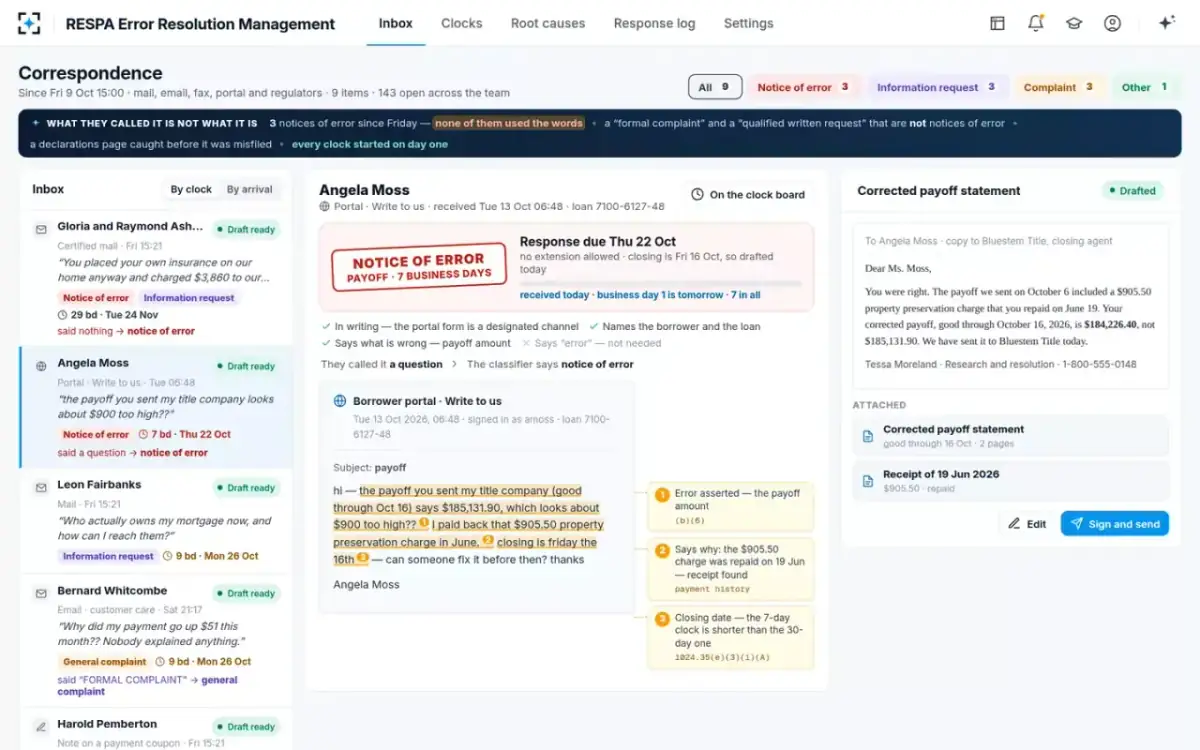
A payoff request is not an information request, but a complaint about a payoff is a notice of error. Failure to provide an accurate payoff balance is covered error (b)(6), with a 7-business-day response clock and no extension. At the sample servicer, a borrower who wrote through the portal that her payoff "looks about $900 too high" asked a question in form; in substance she asserted a (b)(6) error, and her closing date was three days away.
A question about a payoff, read as a payoff error on a 7-day clock
What is the difference between a QWR and a complaint?
A complaint is any expression of dissatisfaction, in any channel; a QWR, a notice of error or a request for information is a written communication with specific content that triggers specific legal duties. Every notice of error is a complaint in the everyday sense, but most complaints are not notices of error: a phone call is not one, a letter to an address other than the designated one is not one, and an email that asks why a payment rose without saying anything is wrong is not one.
The volumes make the distinction practical. The CFPB received about 30,400 mortgage complaints in 2025 and sent 83% of them to companies for a response, and companies closed 91% with an explanation (CFPB Consumer Response Annual Report, 2025). Some of those portal complaints contain a written servicing assertion that also meets the notice-of-error test, so the same text can carry a portal deadline and a Regulation X one. How complaint teams sort those cases, including whether a call can ever count, is the subject of a separate guide to notice-of-error myths.
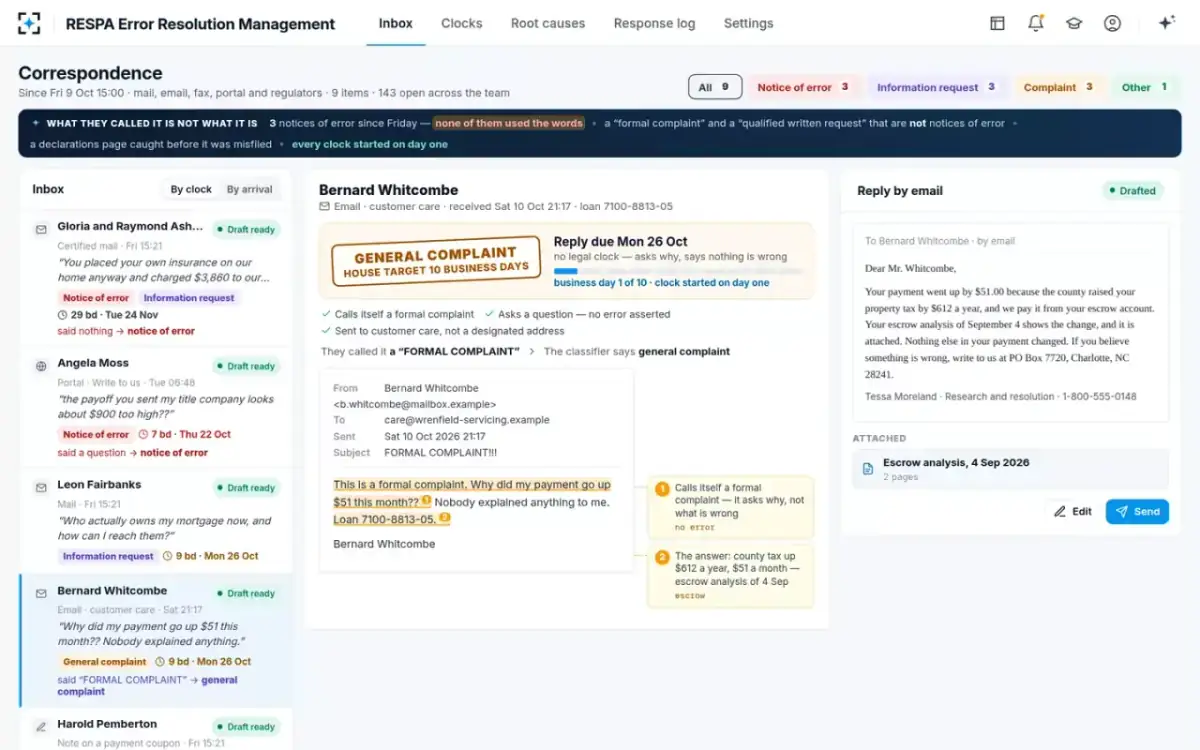
Called a formal complaint, answered as service
Why the label matters: clocks, freeze and remedies
The label decides four things: which clock runs, whether it can be extended, whether credit reporting freezes, and what a court will look for if the servicer gets it wrong. The table sorts the letters a desk sees in a normal week.
Eight letters, sorted by what they do
| The letter | What it is under Reg X | Clock | Freeze |
|---|---|---|---|
| Handwritten, to the designated address: force-placed insurance, payment raised, payments unapplied, a late mark; asks for the payment history | Notice of error (four assertions) and request for information | Acknowledge 5; respond 30 | Yes, on the disputed payments |
| Portal: "the payoff you sent my title company looks about $900 too high" | Notice of error, (b)(6) | 7 business days, no extension | Only if a disputed payment is involved |
| Attorney's "qualified written request" asking for life-of-loan history and notes, asserting nothing | Request for information | 30; may be partly overbroad | No |
| "Who actually owns my mortgage now?" | Request for information, owner identity | 10 business days, no extension | No |
| Email to customer care headed "FORMAL COMPLAINT" asking why the payment rose | Complaint, answered as service | Internal target | No |
| Same escrow refund dispute as one answered last month, nothing new | Proposed duplicative notice of error | Written notice 5 days after the decision | No, once confirmed |
| A letter challenging the loan's original terms only | Not covered (origination) | None under 1024.35 | No |
| A note written on the payment coupon | Need not be treated as either | None required | No |
The asymmetry in the right-hand column is the practical reason to classify by content. A servicer that treats every letter headed "qualified written request" as an information request misses the freeze on the ones that assert a payment error. One that treats every letter headed "notice of error" as an error may freeze reporting it was entitled to continue. Both are fixed by reading the assertions, and the payoff row shows the cost of reading late: by the time a notice of error is recognised on day four, a 7-day clock has three days left. The full list of covered errors and their clocks is in RESPA 1024.35, error by error.
How RESPA Error Resolution Management sorts one morning's mail
The solution's Intake classifier reads every letter, email, fax, portal message and regulator referral, checks whether it reached a designated address, names the borrower and loan, and then sorts its content: each assertion mapped to its paragraph of 1024.35(b), each request to 1024.36, in the borrower's own words. Proposed duplicates, overbroad letters and untimely ones are marked for a person to confirm, never closed by the agent.
What they called it is not what it is: the inbox in RESPA Error Resolution Management
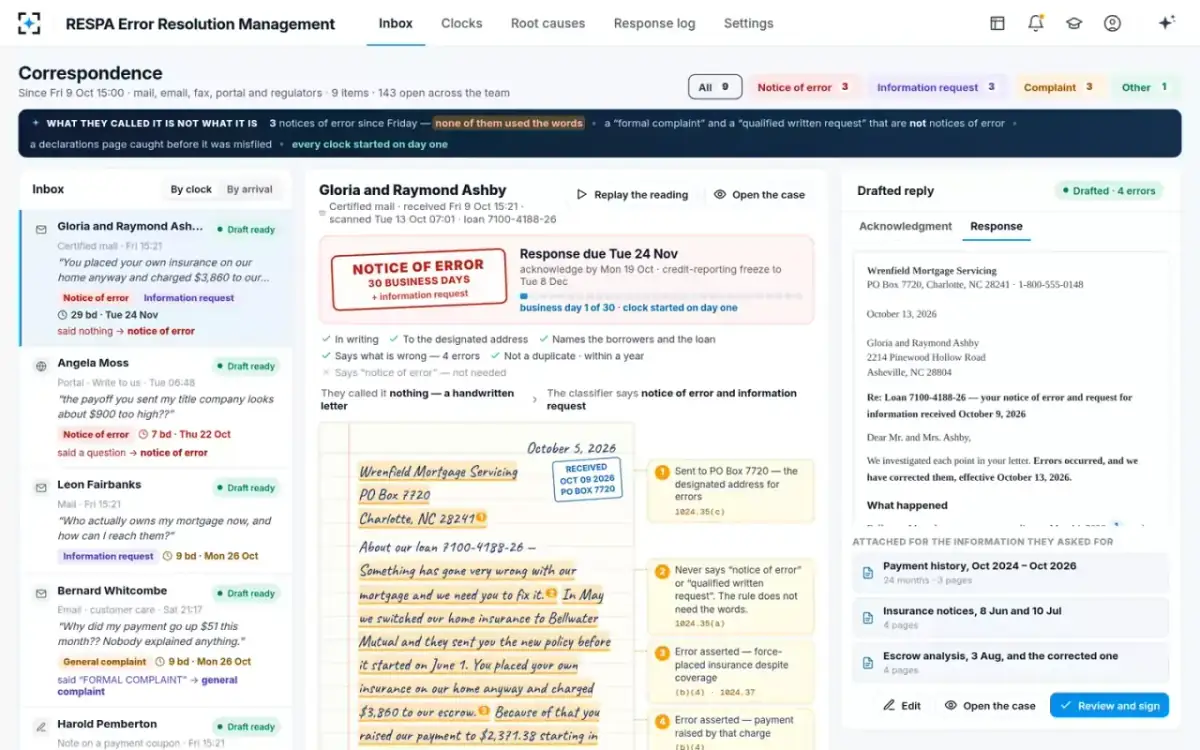
The classification is shown, not asserted: each margin note points at the phrase it relied on and the paragraph of the rule it applied, so the specialist can disagree in seconds. That matters because classification is the one step whose mistakes cannot be repaired later; a notice misread on day one is a missed clock on day thirty. The full product is at RESPA Error Resolution Management.
Questions people ask
Does a notice of error have to use the words "qualified written request"?
No. Regulation X looks at content: a written notice that identifies the borrower and loan and says what error the borrower believes occurred is a notice of error whatever it is called. The commentary tells servicers not to rely on the borrower's own label in either direction.
Can an email be a qualified written request?
It can be a notice of error or a request for information if it reaches an intake channel the servicer accepts. A servicer may set up email or web-form intake as an exclusive online channel, in addition to mail; if it has designated a mailing address and no online channel, an email elsewhere falls outside the procedure but is still a complaint.
Can someone other than the borrower send a QWR?
Yes, an agent of the borrower, such as an attorney or housing counsellor. The commentary lets a servicer use reasonable procedures to confirm the agent's authority, for example a document from the borrower, and once it is received the letter is treated as the borrower's.
Is a CFPB portal complaint a notice of error?
It can be, if its written content asserts a servicing error and it reaches the servicer in a way the rule recognises; if the servicer has a designated address, a complaint routed through the portal may fall outside it. The safer course is to read each portal complaint for assertions and run the Regulation X clock where one applies, alongside the portal's own deadline.
When did notices of error replace qualified written requests?
They did not replace them; they absorbed them. The CFPB's servicing rules took effect on 10 January 2014 and made any qualifying written notice of error or information request subject to the procedures, whether or not it met the statutory QWR definition. The statute's QWR still exists, and section 2605(e) still governs it.