QWR management is how a mortgage servicer receives, classifies, clocks, investigates, answers and logs qualified written requests and the notices of error and information requests they contain, each on its Regulation X deadline. It breaks into eight tasks: intake, classification, the clocks, research, drafting, the decision, the signature and the credit-reporting freeze. Five are mechanical and fill most of the hours; three are judgements that a regulator, a court or an examiner will hold a named person to. Botminds' RESPA Error Resolution Management is built on that split: its agents take the reading, the business-day arithmetic, the research across six servicing systems and the first draft, and the research and resolution specialist decides and signs.
The examples come from a fictional sample servicer, Wrenfield Mortgage Servicing, as it runs through the solution; hours marked as estimates are the solution's own estimate for one notice of error with several assertions, not a measured result.
Where the hours on one notice of error go, by hand and with RESPA Error Resolution Management
By hand · about 18½ hours
- Reading the letter and pulling payments, escrow, insurance, mail and calls · 8½ h · 46%
- Working out what happened and computing corrections · 8 h · 43%
- Writing, review and signatures · 2 h · 11%
With the agents · about 3½ hours
- Checking what the agents read and pulled · 0.6 h · 17%
- Testing findings and corrections · 1.5 h · 41%
- Editing, review and signatures · 1.5 h · 42%
What is QWR management?
QWR management is the operating discipline around one statutory duty: when a borrower writes to the servicer about the servicing of the loan, the servicer must acknowledge, investigate and answer within fixed business-day limits. The statute calls the letter a qualified written request; Regulation X splits it into notices of error under 1024.35 and requests for information under 1024.36, and a single letter can be both. Managing it well means no letter is misread, no clock is missed, and every answer rests on an investigation the servicer can show.
Volume is what turns a duty into a discipline. The CFPB estimates the paperwork burden of all of Regulation X, which includes error resolution and information requests, at 1,087,981 hours a year across 12,506 respondents (CFPB information collection notice, 2023). The sample servicer carries 143 open items on an ordinary Tuesday: 61 notices of error, 47 information requests and 35 complaints.
How to manage qualified written requests: the eight tasks
To manage qualified written requests, run every item through the same eight tasks and decide in advance which of them a person must do. The table sets out who does each one in the solution and the rule that governs it.
The eight QWR management tasks: what the agents do, what people keep
| Task | What the agents do | What a person keeps | Rule |
|---|---|---|---|
| 1. Intake | Read every letter, email, fax, portal message and regulator referral the day it arrives, and note whether it reached the designated address. | Nothing routine. A person handles any item the agents flag as unreadable. | 1024.35(c), 1024.36(b) |
| 2. Classify | Decide notice of error, information request, both, or complaint; map each assertion to 1024.35(b) and each request to 1024.36, in the borrower's own words. | Confirming any proposed duplicative, overbroad or untimely exclusion before the borrower is told. | 1024.35(a), (g); 1024.36(a), (f) |
| 3. Clock | Count business days without weekends and legal public holidays; run the acknowledgment, response, payoff, pre-sale and owner-identity clocks. | Approving any 15-day extension. | 1024.35(d), (e)(3); 1024.36(c), (d)(2) |
| 4. Research | Pull payments, suspense, fees, escrow, insurance, imaging, letters, calls and credit reporting into one loan timeline, read-only. | Asking the borrower for documents, if needed, without making them a condition. | 1024.35(e)(1), (e)(2) |
| 5. Draft | Test each assertion with the documents behind it, compute each correction, draft the acknowledgment, any extension notice and the response with enclosures. | Editing the letter. | 1024.35(e)(1); 1024.36(d)(1) |
| 6. Decide | Recommend error or no error for each assertion, citing the evidence. | The finding, the corrections and the amount credited. | 1024.35(e)(1)(i) |
| 7. Sign and send | Assemble the signed letter and its enclosures for the servicer's mail and portal. | The signature, with its meaning recorded; a second signature where policy requires it. | Servicer policy |
| 8. Freeze furnishing | Mark each disputed payment and the date the 60-day freeze ends. | Approving any correction sent to the credit bureaus. | 1024.35(i) |
The table puts the judgement where liability sits. A wrong exclusion is a missed notice of error, and the CFPB's 2013 rulemaking says a servicer is liable for an unreasonable determination that a notice is duplicative, overbroad or untimely; so the agents propose and a person confirms. An extension moves a legal deadline and has to reach the borrower in writing with reasons; so a person approves it. The finding is what a court reads; so a person makes it.
How many hours a notice of error takes, and where they move
Most of the hours are pulling and working out, and those are the hours that move. In the sample servicer's estimate, eight hours of a hand-worked notice go on gathering payments, escrow, insurance, mail and call records from separate systems, six on working out what happened and testing each assertion, and two on computing corrections. Writing the letter takes one. Review and signatures take one, and stay at one.
That is the honest limit of automation in QWR management. The specialist's time shifts from collecting evidence to checking it, and the checking cannot be skipped: the agents' findings are recommendations, and the response goes out over a person's name. The calendar effect is larger than the hours effect, because the research no longer waits in other departments' queues. The sample servicer's median response fell from 24 business days by hand to 6, and the Ashbys' four-error notice was signed and sent on business day 1 of 30.
Can AI respond to a qualified written request?
AI can draft the response; the servicer has to give it. Regulation X places the duty on the servicer, and no regulator has said that a model's answer satisfies it on its own. The CFPB's 2023 report on chatbots in consumer finance names mortgage servicers among the users and is plain about the standard: "Like the processes they replace, chatbots must comply with all applicable federal consumer financial laws" (CFPB, Chatbots in consumer finance, 2023). An AI-drafted answer to a notice of error is held to the same content, the same investigation and the same deadline as one written by hand.
Responsibility does not move to whoever supplies the tool. The CFPB's service-provider bulletin, still in force, says a business relationship with a provider "does not absolve" the servicer of responsibility for complying with federal consumer financial law (Bulletin 2016-02). That is why the design question is not whether to use AI but where its output stops and a person's decision begins.
Two failure modes decide the answer. The first is the generic reply: a system that answers every letter with the same no-error language repeats the "boilerplate" a borrower alleged in a case a federal appeals court revived, set out under QWR response requirements. The second is the silent exclusion: a model that labels a letter overbroad and closes it has decided a legal question nobody reviewed. The solution answers both by design. Every finding and every sentence of the draft cites the document it rests on, and exclusions are only ever proposed.
Who must sign a notice of error response?
Regulation X does not name a signer, so the servicer must decide and write it down. The rule requires a written response with specific content and contact information, including a telephone number; who signs is a matter of policy. A defensible policy names the person who reviewed the evidence and adds a second signature where the stakes justify one.
The signature carries its meaning, and the second signature its reason
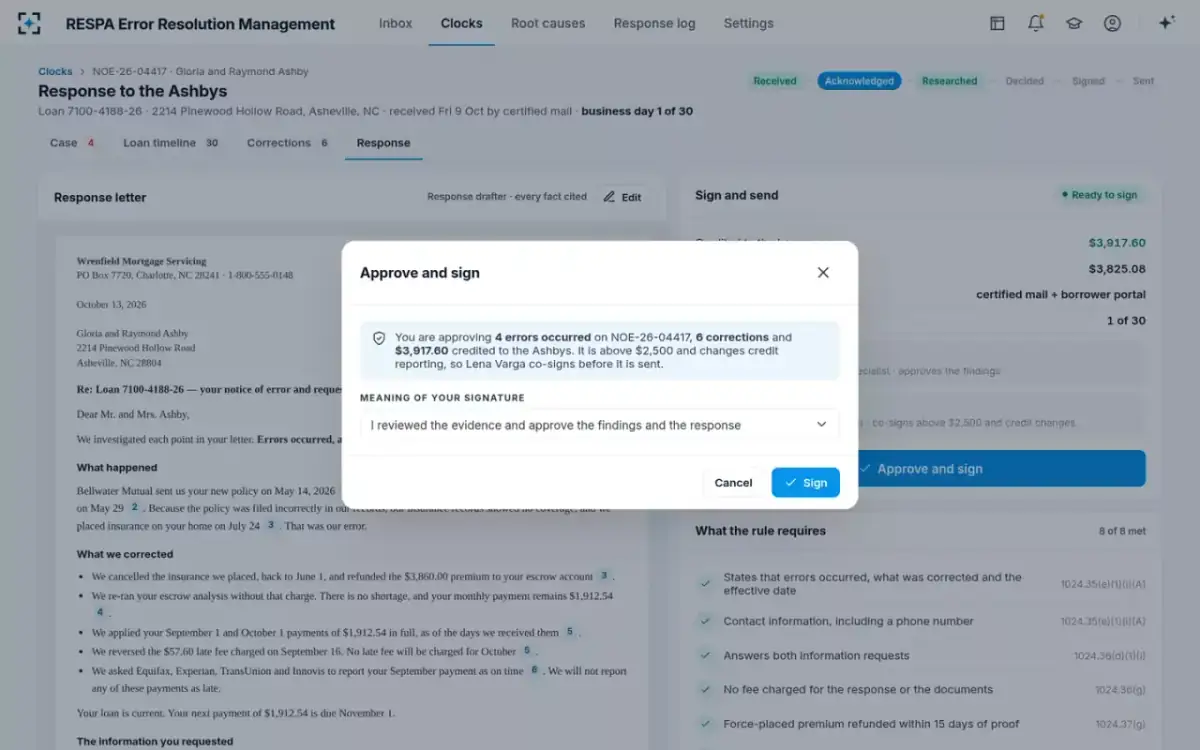
The sample servicer's matrix is a reasonable starting point. The research and resolution specialist signs every response. The servicing compliance officer co-signs remediation above $2,500 and any change to credit reporting. Regulator referrals and anything from an attorney go through the legal reviewer before signature. And the complaint manager, not the specialist, approves extensions and confirms proposed duplicates, so the person who owns the queue owns the decisions that change a deadline.
Can a servicer extend a QWR deadline, and who decides?
Yes, once, by 15 business days, and only for some errors. For a notice of error on the ordinary 30-day clock, the servicer may extend if, "before the end of the 30-day period, the servicer notifies the borrower of the extension and the reasons for the extension in writing" (1024.35(e)(3)(ii)). It may not extend a payoff error under (b)(6) or a foreclosure error under (b)(9) or (b)(10). Information requests work the same way, except that a request for the owner's identity, due in 10 business days, cannot be extended.
A letter with several assertions can be split. The commentary lets a servicer treat a notice alleging multiple errors as separate notices and extend only the ones that need it (comment 35(e)(3)(ii)-1). A practical consequence: the payoff assertion in a mixed letter keeps its 7-day clock while the escrow assertion beside it can, if needed, run to 45 days.
The clock board: every open item by business days left
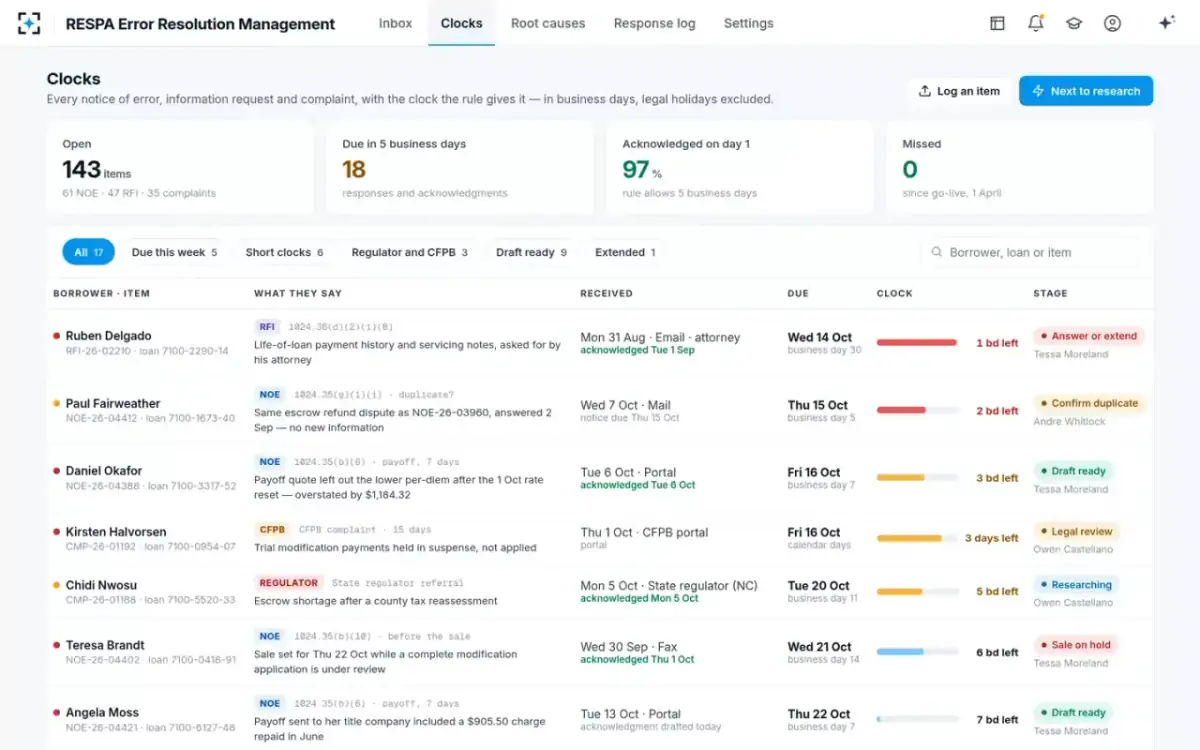
What to look for in notice of error software
Look for evidence, not features. The questions below separate a tool that reduces risk from one that moves it somewhere harder to see; ask a vendor to show each one on your own past letters, including the hard ones.
Ten questions to ask of any notice of error software
- Does it read what a letter does, not what it is called?
Test with a handwritten letter that never says “notice of error”, an email headed “formal complaint” that only asks a question, and an attorney's QWR that asserts nothing.
- Does it count the right days?
Business days without weekends and the federal legal public holidays, calendar days for the 60-day credit-reporting freeze, and the earlier-of rule for foreclosure errors.
- Does it know which clocks cannot be extended?
Payoff and foreclosure errors and owner-identity requests have no extension; a tool that offers one is wrong.
- Can every sentence of the draft be traced to a document?
If a reviewer cannot click from a claim to its evidence, the reviewer is signing on trust.
- Who decides an exclusion?
Duplicative, overbroad and untimely should be proposals with the reason shown, confirmed by a person, with the 5-day notice drafted.
- Does it write to your servicing systems?
Read-only access is safer: corrections should post through the people and controls that own the systems.
- Does it find the error the borrower did not assert?
The rule requires correcting additional errors found during the investigation, not just the ones in the letter.
- Does the freeze reach the furnishing system?
A freeze noted on a case screen but not in what is sent to the bureaus does not protect anyone.
- Can an examiner read the log?
Received, acknowledged and answered in business days, the outcome, the amount and who signed, exportable without rework.
- Does it group causes across loans?
One misfiled document type can sit behind dozens of loans; finding the others before they write is where remediation is cheapest.
Where RESPA Error Resolution Management fits, and where it does not
The solution is a working layer between the mailroom and the signature, not a replacement for the systems on either side. It is strongest where volume is high and evidence is scattered, and adds least where a servicer receives a handful of letters a month and one person can hold every loan in their head.
What the solution does, and what stays where it is
RESPA Error Resolution Management: Reads every item the day it arrives and drafts the acknowledgment, extension notice and response with enclosures.
Stays with your systems and people: Your mail, email and portal send them, after a person signs.
RESPA Error Resolution Management: Computes each correction with its system, amount and effective date.
Stays with your systems and people: Posting stays in the servicing, escrow and insurance systems under their own controls.
RESPA Error Resolution Management: Marks each disputed payment and the freeze end date; drafts the bureau correction for approval.
Stays with your systems and people: The furnishing process sends what is approved to the bureaus.
RESPA Error Resolution Management: Shows calls on the loan timeline, including those that never opened a ticket.
Stays with your systems and people: An oral complaint is not a notice of error under Reg X; your complaint process still handles it.
RESPA Error Resolution Management: Routes attorney letters and regulator referrals to legal review with every fact cited.
Stays with your systems and people: Counsel decides litigation strategy and anything beyond the response.
RESPA Error Resolution Management: Same clocks and log at any volume.
Stays with your systems and people: A servicer with a few letters a month may run the same procedure by hand with a good calendar.
Going live means bringing what the solution reads: the designated addresses, response templates, the approver matrix and a sample of past letters to replay, so the servicer can compare the agents' classification and findings with what its own team decided. The step-by-step order, from the designated address to the first exam, is in the RESPA compliance checklist for error resolution, and the full product is at RESPA Error Resolution Management.
Questions people ask
Is QWR management the same as complaint management?
It is a regulated part of it. Complaint management covers every expression of dissatisfaction in every channel; QWR management covers the written notices of error and information requests that carry Regulation X deadlines and remedies. A servicer needs both, and the hard part is sorting one from the other on the day a letter arrives.
Can the agents close a duplicate notice of error?
No. They can propose that a notice is substantially the same as one already answered, with no new and material information, and draft the written notice the rule requires within 5 business days of the decision. A person confirms first, because an unreasonable determination leaves the servicer liable.
Does the solution replace the servicing system?
No. It reads the servicing system, escrow, insurance tracking, imaging, call notes and credit reporting, and never writes to them. Corrections are proposed with their amounts and effective dates and post through the systems and people that own them.
How would we test it before relying on it?
Replay past letters whose outcomes you already know. Score the classification (notice of error, information request, both or complaint), the paragraph of 1024.35(b) for each assertion, the clock dates and the error or no-error finding against what your team decided, and look hardest at the letters your team got wrong.
What does the borrower see?
A letter from the servicer, signed by a person, in plain language with no internal codes or system names, and the documents they asked for. The borrower is never contacted by an agent; the agents do not send anything.