RESPA statutory damages are the additional damages a court may award under section 6(f) of the Real Estate Settlement Procedures Act, 12 U.S.C. 2605(f), when a mortgage servicer's failure to follow the servicing rules, including the duty to answer qualified written requests and notices of error, is "a pattern or practice of noncompliance": up to $2,000 for an individual borrower, and up to $2,000 per class member in a class action, capped at the lesser of $1,000,000 or 1% of the servicer's net worth. Actual damages, costs and reasonable attorneys' fees come on top (12 U.S.C. 2605(f)). The statute is small; the exposure is not, because the same failure that produces one lawsuit usually sits behind hundreds of loans. Botminds' RESPA Error Resolution Management is built around that fact: it answers each letter on its clock and groups every answered item by its cause, so a repeated error is found and fixed across the book before it becomes a pattern.
The damages ladder in RESPA section 6(f), and the rung above it
1
Actual damages
Whatever the borrower lost "as a result of the failure": overpayments not refunded, fees, sometimes credit harm. Courts require a causal link to the violation.
No cap
Every successful claim
2
Additional damages, one borrower
Only for "a pattern or practice of noncompliance", at the court's discretion. $1,000 before the Dodd-Frank Act.
Up to $2,000
Pattern or practice
3
Additional damages, a class
Capped in total at the lesser of $1,000,000 or 1% of the servicer's net worth. Actual damages for each member sit on top, uncapped.
Up to $2,000 each
Class action
4
Costs and attorneys' fees
In "any successful action", added to the amounts above. In small individual cases this is often the largest number.
Reasonable, uncapped
Every successful claim
5
Beyond the lawsuit
Supervisory findings, consent orders and redress to every harmed borrower, whether or not they sued. Not part of section 2605(f).
Redress and penalties
Regulators and investors
What are RESPA statutory damages?
They are the "additional damages" section 2605(f) allows on top of actual damages, and only where the servicer's noncompliance is a pattern or practice. For an individual borrower the ceiling is $2,000. In a class action each member may receive up to $2,000, but the total for the class may not exceed "the lesser of— (i) $1,000,000; or (ii) 1 percent of the net worth of the servicer." The award is discretionary: the statute says "as the court may allow", so the figures are ceilings, not entitlements.
The liability attaches to each failure. Section 2605(f) makes a servicer that "fails to comply with any provision of this section" liable "for each such failure", and section 2605 covers far more than error resolution: transfer notices, escrow disbursements, force-placed insurance, the owner's identity and the duty to correct errors. A single mishandled notice of error can therefore carry several failures at once, such as a late acknowledgment, a response with no reasons and a late payment reported during the freeze.
What the Dodd-Frank Act changed in section 6 of RESPA
| Provision | Before July 2010 | After the Dodd-Frank Act |
|---|---|---|
| Acknowledge a qualified written request | 20 business days | 5 business days |
| Respond to a qualified written request | 60 business days | 30 business days |
| Extension of the response time | None | 15 business days, with notice and reasons before day 30 |
| Additional damages, individual (pattern or practice) | Up to $1,000 | Up to $2,000 |
| Class cap on additional damages | Lesser of $500,000 or 1% of net worth | Lesser of $1,000,000 or 1% of net worth |
| Servicer prohibitions | None listed | Section 6(k): force-placed insurance without a reasonable basis, fees for answering a QWR, failing to correct payment, payoff and foreclosure-avoidance errors, owner identity in 10 business days |
The $2,000 has not moved since. Section 2605(f) is a private remedy, not a civil money penalty, and the CFPB's annual inflation table for penalties lists RESPA only for the escrow-statement penalty in section 2609, at $118 per failure and $236,451 a year (12 CFR 1083.1).
What counts as actual damages under RESPA?
Actual damages are losses the borrower would not have suffered if the servicer had complied, and the link has to be shown. The Eleventh Circuit read the words "as a result of" in section 2605(f)(1)(A) to mean there "must be a 'causal link' between the alleged violation and the damages" (Renfroe v. Nationstar, 2016). It joined other circuits in holding that damages are an essential element of a RESPA claim, so a borrower who proves a late acknowledgment but no loss has no claim under 2605(f)(1)(A).
Renfroe also shows how wide "as a result of" can reach. The servicer argued that the borrower's overpayments came before her notice of error, so they could not be damages from a failure to respond. The court disagreed: a reasonable investigation would have found and refunded them, so the failure to investigate caused the loss. For a servicer, the rule of thumb is simple: anything the correction would have refunded is at risk the day the response fails to find it.
What is the pattern or practice damages limit, and how many violations make one?
The limit is $2,000 per borrower; the number of violations is not fixed. RESPA does not define pattern or practice. In Renfroe, the Eleventh Circuit borrowed the Supreme Court's definition from employment law, "standard operating procedure—the regular rather than the unusual practice", and surveyed the trial courts: one held that two violations were not enough, another that allegations of five were adequate. It noted that the Tenth Circuit requires violations "with respect to other borrowers".
The numbers that decide a RESPA section 6 claim
$2,000
additional damages per borrower, only for a pattern or practice
$1M
class cap, or 1% of net worth if lower
5
alleged violations, four beyond her own letter, held enough to plead a pattern in Renfroe
3years
to sue under section 2605, from the violation
What carried Renfroe's pattern claim past dismissal was not the number but the shape. She alleged that Nationstar sent the same generic form letters to other borrowers who wrote with different problems, in Alabama and Maryland, and that her letter's wrong statement about a loan Nationstar no longer serviced showed a template had been used. A form reply is the definition of a regular practice. The defence against a pattern claim is therefore operational: answers that differ because the investigations differed, and a response file that shows it.
What is the RESPA class action cap?
The class cap limits only the additional damages: up to $2,000 per member, with the total held to the lesser of $1,000,000 or 1% of the servicer's net worth. Each member's actual damages, and the class's costs and fees, are outside it. For a smaller servicer, the 1% test usually binds first: a servicer with $60 million of net worth faces a ceiling of $600,000 on additional damages, however large the class.
The class cap at three sizes of repeated error
| A repeated cause at the sample servicer | Loans affected | $2,000 × loans | Cap if net worth were $60M | What sits outside the cap |
|---|---|---|---|---|
| Emailed declarations pages filed as general correspondence | 39 | $78,000 | $78,000 (below cap) | $45,140 of force-placed premiums on 12 loans, plus fees |
| Bank bill-pay amount not updated after an escrow change | 312 | $624,000 | $600,000 | Late fees and suspense on 312 loans, plus fees |
| Property inspection fees charged during forbearance | 1,204 | $2,408,000 | $600,000 | $63,180 of fee refunds, plus fees |
The middle and bottom rows make the point of the cap: past a few hundred loans it stops growing, while the refunds and fees that sit outside it keep growing with every loan. That is why the bigger number in most servicing failures is not the statutory award at all.
Can a borrower get attorney fees under RESPA?
Yes. In any successful action under section 2605, the court adds "the costs of the action, together with any attorneys fees incurred in connection with such action as the court may determine to be reasonable under the circumstances" (2605(f)(3)). The fee award has no cap and does not depend on a pattern or practice. In an individual case where actual damages are a few hundred dollars, the fees can be many times the damages, which is what makes a small notice-of-error dispute worth litigating.
The fee provision runs one way. Section 2605(f)(3) speaks of a "successful action" by the borrower; it gives the servicer no corresponding right. A servicer that wins still bears its own defence costs, which is one more reason the cheapest outcome is the response that leaves nothing to sue over.
Are there RESPA punitive damages?
Section 2605(f) does not provide for them. Its categories are actual damages, additional damages for a pattern or practice, and costs and fees; the additional damages are the closest thing to a penalty the private remedy contains, and they are capped. Borrowers sometimes pair a RESPA claim with state-law claims, such as breach of contract or a state consumer statute, whose remedies are set by state law, not by RESPA.
RESPA violations penalties beyond the lawsuit: redress, orders and the borrowers who never wrote
The largest costs in the servicing record come from regulators, not from section 2605(f), and they are measured in redress to every harmed borrower. In December 2020 Nationstar, doing business as Mr. Cooper, agreed with the CFPB and states to pay about $73 million in redress to more than 40,000 borrowers and a $1.5 million civil penalty, over escrow disbursements, escrow analyses in Chapter 13 and transfer failures (CFPB). In 2015 Green Tree paid $48 million in restitution and a $15 million penalty (CFPB and FTC). In 2024 a reverse-mortgage servicer and its subcontractor, cited among other things for failing to acknowledge and answer notices of error, faced $11.5 million of redress and a $5 million penalty (CFPB).
In servicing orders, redress to borrowers dwarfs the penalty
Penalties themselves are capped per violation, and the caps are high. For penalties assessed after 15 January 2025, the CFPB's inflation-adjusted maximums under the Consumer Financial Protection Act are $7,217, $36,083 and $1,443,275 for the three tiers of violation (12 CFR 1083.1). The CFPB's own supervision has narrowed since 2025, and it terminated two servicing orders early that year; state regulators and the investors, FHA, VA, Fannie Mae, Freddie Mac and Ginnie Mae, remain active checkers. The casebook of RESPA violations examples from servicing matches each order to the control that would have caught it.
The cure the statute offers: fix it before they write
Section 2605(f)(4) contains a safe harbour that most servicers never use on purpose. A transferor or transferee servicer is not liable under section 2605(f) for a failure if, "within 60 days after discovering an error (whether pursuant to a final written examination report or the servicer's own procedures)", and before a lawsuit is filed or the borrower sends written notice of the error, it notifies the borrower and makes the adjustments needed so the borrower pays no more than they should have. Its terms are written for servicers on either side of a transfer, so its reach beyond transfers is for counsel; its logic applies to every servicer.
The logic is the case for root-cause work. When the Ashbys' notice of error exposed a misfiled insurance document, the same pattern sat on 38 other loans whose borrowers had not written. Found then, those loans could be corrected on the servicer's own initiative. Found a year later, through 38 more notices of error or a class complaint, each becomes a dated failure.
Root causes in RESPA Error Resolution Management: each repeated error, its loans and its owner
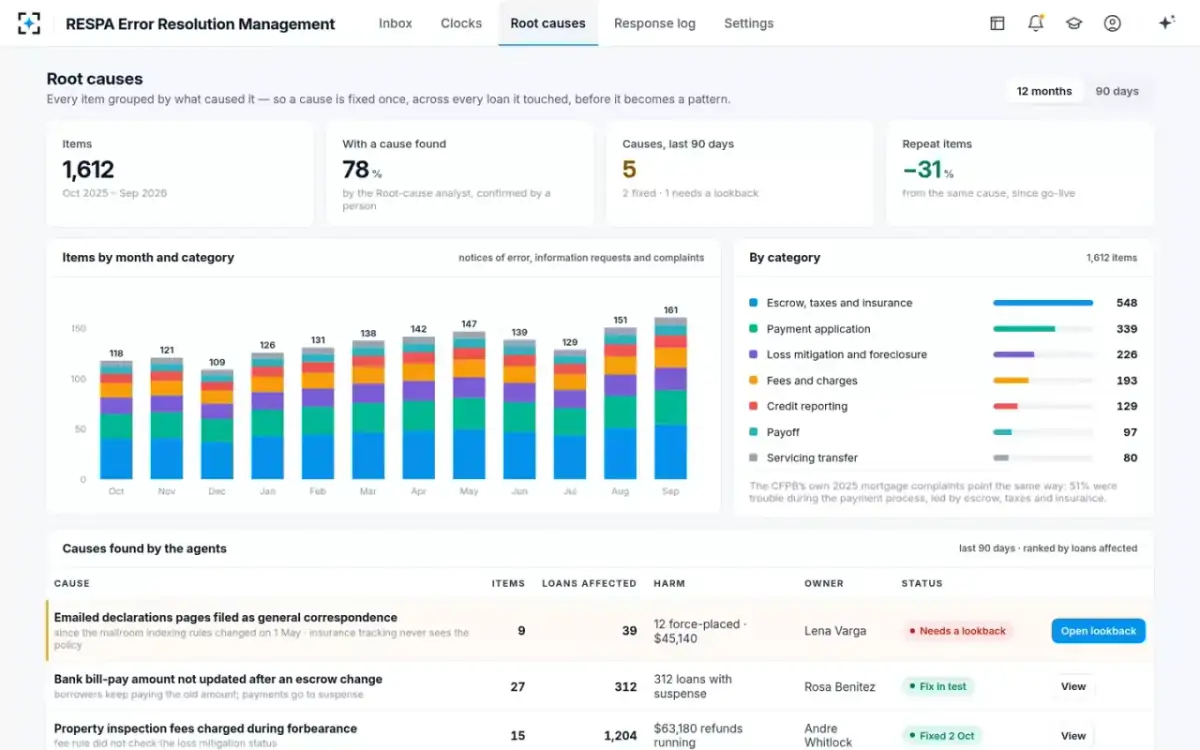
Where RESPA Error Resolution Management lowers the number, and where it cannot
The solution reduces the inputs to the damages ladder; it does not change the law. Each response is drafted from an investigation whose every step cites a document, which addresses the failure Renfroe turned on. Every clock is counted for every item, so late acknowledgments and missed extensions, the easiest violations to prove, stop happening quietly. The 60-day freeze is tracked per disputed payment. And causes are grouped across loans with a lookback proposed to the compliance officer, which is the step that turns a pattern into a fixed defect.
The response log: the evidence that a practice is regular, and lawful
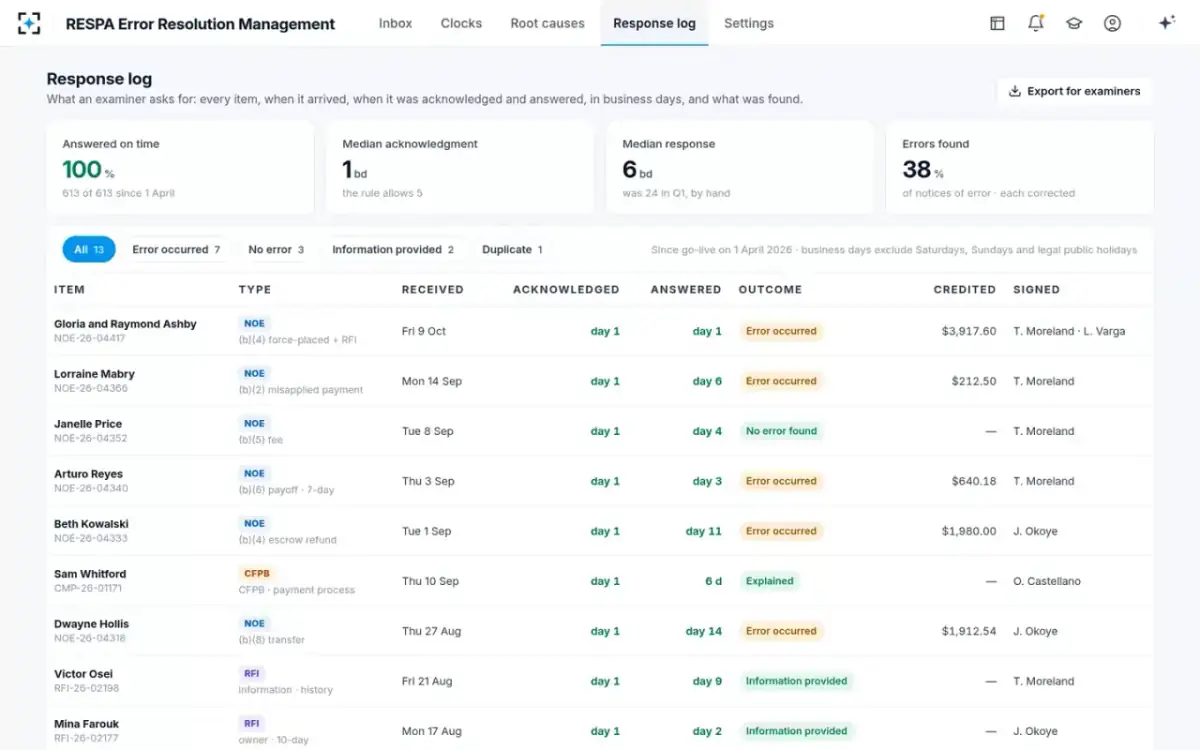
Three limits are worth stating plainly. The solution cannot make a wrong finding right: a specialist who approves a poorly reasoned no-error finding has signed it. It does not reach failures outside the letters it reads, such as a transfer notice that was never mailed. And the hours and dates on this page are sample data and estimates; a servicer should measure its own before and after, starting from the replay of past letters described under QWR management. The full product is at RESPA Error Resolution Management.
Questions people ask
Is the $2,000 RESPA damages limit adjusted for inflation?
No. Section 2605(f) is a private damages provision, not a civil money penalty, and the CFPB's inflation-adjustment table in 12 CFR 1083.1 does not list it. The figure has been $2,000 since the Dodd-Frank Act raised it from $1,000 in 2010.
How long does a borrower have to sue under RESPA section 6?
Three years from the violation for claims under section 2605, against one year for the kickback and title-insurance sections, 2607 and 2608 (12 U.S.C. 2614). A notice of error answered badly in 2026 can therefore be litigated into 2029.
Can a borrower sue for a late acknowledgment alone?
They can allege it, but a claim for damages needs a loss caused by the failure; the circuits that have decided the point treat damages as an essential element of a RESPA claim. A late acknowledgment that cost nothing is still a violation an examiner can cite, and it can count toward a pattern.
Does the class cap include attorneys' fees?
No. The cap of the lesser of $1,000,000 or 1% of net worth applies only to the additional, pattern-or-practice damages. Actual damages for each class member and the class's costs and reasonable attorneys' fees are awarded on top.
Are RESPA section 8 penalties the same as section 6 damages?
No. Section 8 (12 U.S.C. 2607) prohibits kickbacks and unearned fees in settlement services and carries its own remedies: liability for three times the charge paid for the settlement service, and fines of up to $10,000 or imprisonment of up to a year (12 U.S.C. 2607(d)). Section 6 governs servicing and carries the actual, additional and fee damages described here.