A servicer's qualified written request response usually starts with a sample or template: the form letter borrowers, their lawyers and third parties download and send to a mortgage servicer. Often twenty pages or more, it demands the loan's full history, the original note, the securitization documents, every check and the servicer's internal manuals, and disputes every charge on the account. Under RESPA and Regulation X a servicer must still treat it as what it contains: each specific servicing error it asserts is a notice of error, each servicing information request is a request for information, and only the parts that are overbroad, irrelevant, confidential, duplicative or untimely may be declined, with written notice within 5 business days. "To the extent a servicer can reasonably identify a valid assertion of an error in a notice of error that is otherwise overbroad, the servicer shall comply" (12 CFR 1024.35(g)(1)(ii)). Botminds' RESPA Error Resolution Management reads a template line by line, separates what must be answered from what may be declined, and leaves every exclusion for a person to confirm.
The template below is illustrative: we composed it from the request types the CFPB's own commentary lists as overbroad, irrelevant or confidential, plus one ordinary fee dispute. It is not a letter any servicer received.
A template QWR mapped by RESPA Error Resolution Management: what to answer, what may be declined
1
"Provide a complete life-of-loan transaction history, including every payment, fee, advance and escrow disbursement."
Request for information
Answer
1024.36(d)(1)
2
"Identify the current owner of the note, the trust and its trustee, and the master servicer."
Request for information: owner identity
Answer in 10 days
1024.36(d)(2)(i)(A); 2605(k)(1)(D)
3
"In March you charged a $35 property inspection fee although my loan was current."
Notice of error, (b)(5)
Answer, and freeze any disputed payment
1024.35(g)(1)(ii) last sentence
4
"I dispute every charge, every escrow transaction and the validity of the debt."
Overbroad assertion
May decline, with notice
Comment 35(g)(1)(ii)-1.i
5
"Copies of the front and back of every check I paid you and every remittance you sent the investor."
Overbroad request
May decline, with notice
Comment 36(f)(1)(iv)-1.iv
6
"Your servicing guide, training manuals and the investor's instructions on modifications."
Irrelevant information
May decline, with notice
Comment 36(f)(1)(iii)-1
7
"Compensation and bonuses of every employee who handled my loan, and your examination reports."
Confidential information
May decline, with notice
Comment 36(f)(1)(ii)-1
8
"Answer each numbered interrogatory below, in a columnar spreadsheet, under oath."
Overbroad form
May decline the form, not the substance
Comments 35(g)(1)(ii)-1.ii, 36(f)(1)(iv)-1.iii
What does a qualified written request template ask for?
Almost everything, by design. A typical template asks for the life-of-loan payment history; the identity of the owner, trust and trustee; the original note and every assignment; the pooling and servicing agreement; copies of every payment instrument; the servicer's policies, manuals and investor guidelines; employee compensation; and recorded calls. It usually also disputes "all" fees and escrow transactions in general terms, and often demands that each paragraph be answered like a discovery request.
Some of that is the borrower's right and some of it is not, and the regulation draws the line request by request. The statute's definition is the starting point: a QWR "provides sufficient detail to the servicer regarding other information sought by the borrower" or states the reasons the borrower believes the account is in error (12 U.S.C. 2605(e)(1)(B)). The servicing history and the owner's identity meet it. A demand for every securitization document does not, and the CFPB wrote that into its commentary.
What is an overbroad notice of error?
A notice of error is overbroad "if the servicer cannot reasonably determine from the notice of error the specific error that the borrower asserts has occurred" (1024.35(g)(1)(ii)). The commentary gives three examples: assertions covering "substantially all aspects of a mortgage loan", from origination through servicing and foreclosure, including "the crediting of substantially every borrower payment and escrow account transaction"; assertions "in the form of a judicial action complaint, subpoena, or discovery request that purports to require servicers to respond to each numbered paragraph"; and assertions that are not reasonably understandable or are buried in "voluminous tangential discussion" (comment 35(g)(1)(ii)-1).
The sentence that follows the definition is the one that matters. Where a servicer "can reasonably identify a valid assertion of an error" inside an overbroad notice, it must comply as to that assertion: acknowledge it, investigate it, answer it and freeze any disputed payment. In the template above, line 4 disputes everything and can be declined; line 3, a $35 inspection fee charged in March on a current loan, is a specific (b)(5) assertion and cannot.
Can a servicer refuse an overbroad request for information?
Yes, as to the overbroad part. An information request is overbroad if it asks for "an unreasonable volume of documents or information", and unduly burdensome if "a diligent servicer could not respond to the information request without either exceeding the maximum time limit" or incurring unreasonable costs (1024.36(f)(1)(iv)). The commentary's examples read like a template's table of contents: documents covering "substantially all aspects of mortgage origination, mortgage servicing, mortgage sale or securitization, and foreclosure"; requests buried in tangential discussion; demands for information "in specific formats, such as in a transcript, letter form in a columnar format, or spreadsheet" the servicer does not keep; and "a request for copies of the front and back of all physical payment instruments" (comment 36(f)(1)(iv)-1).
Three further exits apply only to information requests. Information that is confidential, proprietary or privileged, such as examination reports, compliance audits, compensation and attorney-client material. Information that is irrelevant to the borrower's account, which the commentary says includes the servicer's training program, its servicing guide and investor criteria for loss-mitigation decisions. And, as with errors, any valid request inside an overbroad one must still be answered.
The exits Regulation X allows, and what each still requires
| Exit | The test | What is still owed | Applies to |
|---|---|---|---|
| Duplicative | Substantially the same as one already answered, with no new and material information | Written notice of the decision and its basis within 5 business days | Errors and requests |
| Overbroad | The specific error cannot reasonably be determined; or an unreasonable volume is requested | Answer every valid assertion or request inside it; notice for the rest | Errors and requests |
| Unduly burdensome | A diligent servicer could not answer in time or at reasonable cost | Answer what can reasonably be identified; notice for the rest | Requests |
| Confidential, proprietary or privileged | For example exam reports, audits, compensation, attorney-client material | Notice with the basis | Requests |
| Irrelevant | Not directly related to the borrower's account: other loans, training, servicing guides, investor criteria | Notice with the basis | Requests |
| Untimely | Delivered more than a year after servicing was transferred away or the loan was discharged | Notice with the basis | Errors and requests |
How to answer a template QWR, request by request
Answer a template QWR by splitting it, not by labelling it. The exits are paragraph-level tools, and a servicer that declines a whole letter because most of it is overbroad has made the mistake the rule was written to prevent. The CFPB said so when it wrote the exclusions: "A servicer would be liable to the borrower for its unreasonable determination that any of the listed categories apply and resulting failure to comply" (78 FR 10696).
Answering a template QWR in six steps
- Start the clocks on receipt
The 5-day acknowledgment applies to every valid assertion and request inside the template; the owner-identity request runs on 10 business days.
- Split the letter into lines
Each specific assertion of a servicing error, each specific request for servicing information, and the general demands, each in the borrower's words.
- Map the valid lines
Assertions to their paragraph of 1024.35(b), with any disputed payment frozen for 60 days; requests to 1024.36, with the owner request flagged.
- Propose the exits, with the reason
Overbroad, irrelevant, confidential, duplicative or untimely, citing the commentary example each one matches. A person confirms each.
- Send the exit notice within 5 business days of deciding
In writing, stating the basis for each declined line, and how the borrower can narrow or resubmit.
- Answer the rest on the normal clocks
With the content the rule requires: corrections and effective dates, or reasons and the right to documents; the information or a statement that it is not available.
Done this way, the twenty-page template becomes three answers and one notice. In the example: the life-of-loan history and the owner's identity are provided, the $35 fee is investigated and either corrected or explained, and the rest is declined line by line with its basis. What a defensible answer to the valid lines contains is set out in QWR response requirements.
Can a servicer refuse a duplicative notice of error?
Yes, if the error is "substantially the same as an error previously asserted by the borrower" that the servicer has already properly answered, "unless the borrower provides new and material information" (1024.35(g)(1)(i)). New and material means information the servicer did not review before and that is "reasonably likely to change the servicer's prior determination". The commentary closes a loophole: a dispute about whether the servicer already reviewed something, or whether it was material, "does not itself constitute new and material information" (comment 35(g)(1)(i)-1).
For information requests the duplicate test has a twist. A request for information that changes over time is not duplicative if it covers a different period; a payment history requested in March and again in October is two requests (comment 36(f)(1)(i)-1).
A proposed duplicate waits for a person; the attorney's request runs to day 30
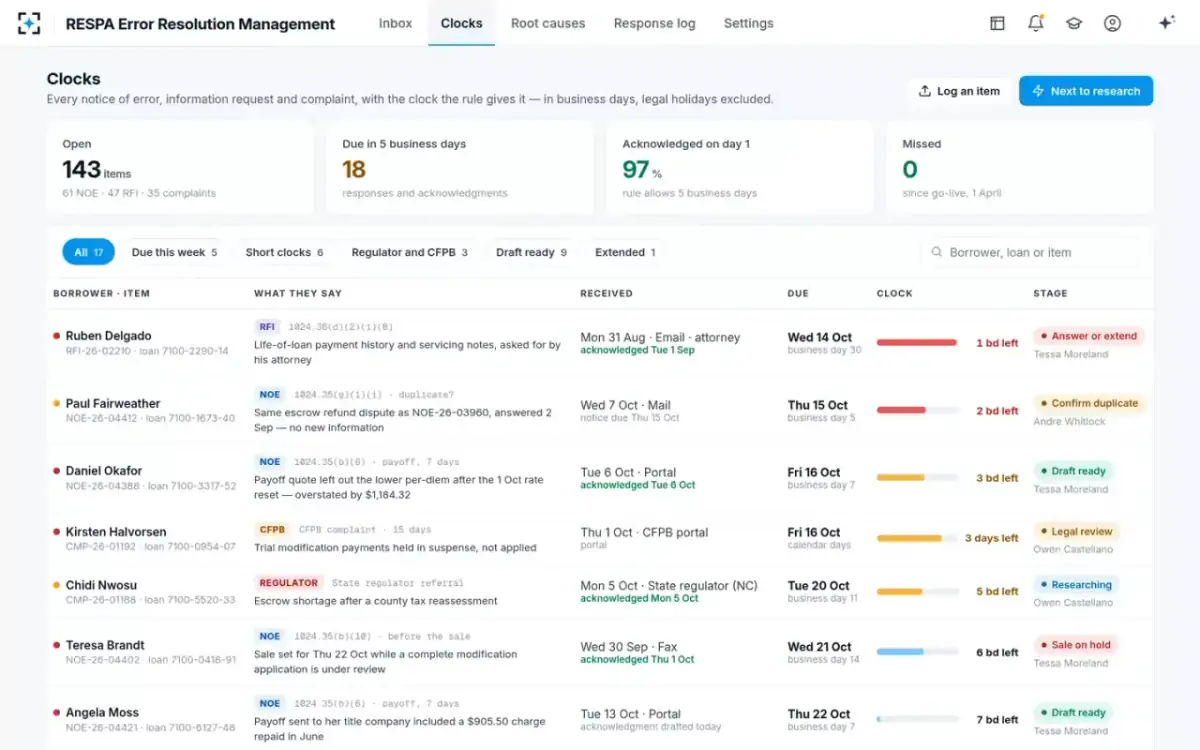
What if the QWR is sent to the wrong address?
If the servicer has designated an address for notices of error and information requests, and has published it as the rule requires, a template sent elsewhere does not trigger the Regulation X procedures. The 2013 rulemaking confirmed that servicers who designate an address need not follow the procedures for notices sent to the wrong one.
Three cautions apply. A servicer with several designated addresses must treat a letter at any of them as received, even if it was the address meant for another state. If the servicer never designated an address, any office counts. And a misdirected template is still a complaint the servicer should answer, if only to give the designated address, as the sample servicer does for every letter that misses it.
Can a third party send a qualified written request?
An agent of the borrower can. The commentary treats a notice or request "submitted by an agent of the borrower" as the borrower's, and lets the servicer use reasonable procedures to confirm the agent's authority, for example a document from the borrower (comment 35(a)-1, 36(a)-1). Attorneys, housing counsellors and family members acting for the borrower are covered once authority is shown.
Template disputes from third parties: the credit-reporting rule and the servicing rule differ
FCRA direct disputes · 12 CFR 1022.43: A furnisher need not investigate a direct dispute it reasonably believes was prepared by, or on a form supplied by, a credit repair organization.
Reg X notices of error · 12 CFR 1024.35: No such exception. A notice of error from an agent with the borrower's authority is the borrower's.
FCRA direct disputes · 12 CFR 1022.43: May be declined if it lacks the information needed to investigate, or repeats an earlier dispute.
Reg X notices of error · 12 CFR 1024.35: Duplicative, overbroad or untimely only, and valid assertions inside an overbroad notice must be answered.
FCRA direct disputes · 12 CFR 1022.43: Within 5 business days, with the reasons.
Reg X notices of error · 12 CFR 1024.35: Within 5 business days, with the basis.
The asymmetry is easy to miss. A credit-reporting team that dismisses a template dispute as credit repair may be right under Regulation V and still owe a Regulation X answer to the same letter, with a freeze on any payment it disputes. The 60-day credit-reporting freeze explains how the two sets of duties fit together.
Must a servicer identify the owner of the loan?
Yes, within 10 business days, with no extension. RESPA makes it a servicer violation to "fail to respond within 10 business days to a request from a borrower to provide the identity, address, and other relevant contact information about the owner or assignee of the loan" (12 U.S.C. 2605(k)(1)(D)), and Regulation X sets the same clock (1024.36(d)(2)(i)(A)). It is the one line of almost every template that is always answerable and always short.
The commentary says what a complete answer is. For a loan held in a private-label trust, the servicer names the trust and gives the trustee's name, address and contact information. Where Fannie Mae or Freddie Mac owns the loan or is trustee, naming the enterprise is enough unless the borrower expressly asked for the trust or pool. And the Government National Mortgage Association "is not the owner or assignee" merely because it guarantees the security (comment 36(a)-2). At the sample servicer, a borrower's one-line question, "who actually owns my mortgage now?", is classified as an owner-identity request and put on its 10-day clock the day it arrives.
One inbox in RESPA Error Resolution Management: a template, a question, an unlabelled letter
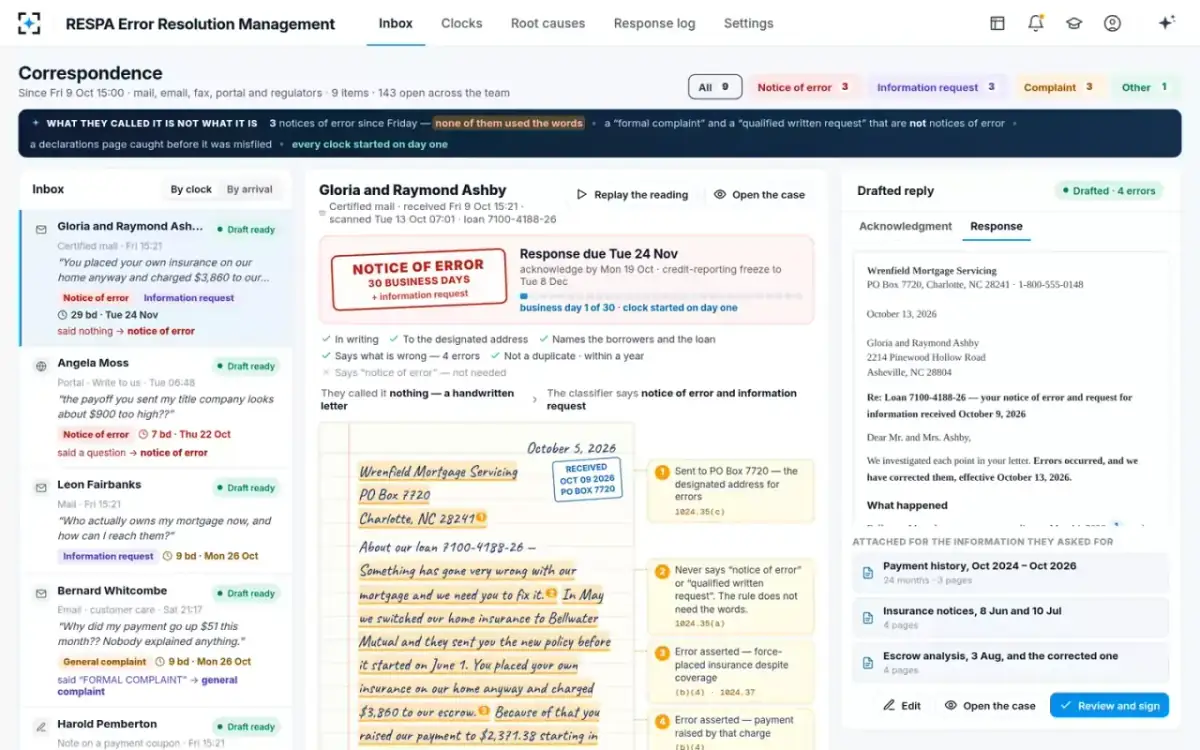
The solution's role on a template is the sorting and the paperwork: splitting the letter into lines, mapping the valid ones, proposing each exit with the commentary example it matches, drafting the 5-day notice and the answers, and putting all of it in front of a person before anything is sent. The full product is at RESPA Error Resolution Management.
Questions people ask
Is there an official qualified written request template?
No. Neither RESPA nor Regulation X prescribes a form. A letter that identifies the borrower and the loan and either explains what the borrower believes is wrong or describes the servicing information wanted is enough, and a short specific letter is more likely to be answered fully than a long general one.
Does a template QWR stop credit reporting?
Only for payments it specifically disputes, and only if it is, at least in part, a notice of error. A template that disputes "every transaction" in general terms may be declined as overbroad; a line that disputes a particular payment freezes adverse reporting on that payment for 60 days.
Can a servicer charge for answering a long template?
No. Regulation X bars fees and payment conditions for responding to notices of error and information requests, and RESPA section 6(k)(1)(B) prohibits fees for responding to valid qualified written requests. The remedy for an unreasonable volume is the overbroad or unduly burdensome exit, not a charge.
How long does a servicer have to send the notice that it is declining part of a QWR?
Five business days after it decides, in writing, stating the basis for the decision. The rule ties the deadline to the determination, not to receipt, and a servicer that takes long to decide risks missing the 5-day acknowledgment owed for the valid parts.
Should a template from an attorney be treated differently?
The rules are the same, but the stakes are higher, because an attorney's letter often precedes litigation and the answer becomes evidence. The sample servicer routes every attorney letter to its legal reviewer before signature and answers the valid lines with the same cited file as any other response.