RESPA violations by mortgage servicers, as the enforcement record shows them, fall into a few recurring patterns: failing to recognise or track notices of error, failing to acknowledge or answer them on time, answering without a real investigation, and losing or garbling borrower information when servicing moves. Examples include the CFPB's 2017 lawsuit against Ocwen, which alleged more than 580,000 notices of error and complaints in under two years; its 2024 orders against the reverse-mortgage servicer NOVAD and its subcontractor Sutherland, which had no system for notices of error at all; its 2020 settlement with Nationstar, with about $73 million in redress; and the Eleventh Circuit's 2016 decision in Renfroe v. Nationstar on a form-letter reply. Each failure had an ordinary control that would have caught it. Botminds' RESPA Error Resolution Management runs several of those controls for notices of error and information requests; others belong elsewhere, and this page says which.
How many borrowers each failure reached
What are examples of RESPA violations by servicers?
Five cases cover most of the ground. They come from the CFPB's enforcement actions and from federal appeals courts, and they span the life of a notice of error from the envelope to the transfer file. The table matches each to the control that would have caught it and says whether that control is one the solution runs.
RESPA violations examples, the control each missed, and RESPA Error Resolution Management
| Case | What went wrong | The control that would have caught it | In RESPA Error Resolution Management? |
|---|---|---|---|
| NOVAD and Sutherland, CFPB 2024 | No system to acknowledge, track or answer notices of error and information requests; notices not told apart from other mail. | Every item read and classified on arrival, with its clock started. | Yes: intake, classification and clocks. |
| Ocwen, CFPB lawsuit 2017 (alleged) | Complaints and notices of error not properly acknowledged or investigated; escalation only after repeated contact; bad system data. | Clock board for every open item; investigation from the servicing systems rather than from the complaint text. | Yes for the clocks and research; the servicing system's data quality is the servicer's. |
| Renfroe v. Nationstar, 11th Cir. 2016 | A form reply that concluded no error without explaining why. | A response drafted from the loan's own history, each statement traceable to a document. | Yes: cited findings and drafting; a person signs. |
| Nationstar, CFPB and states 2020 | Escrow tax disbursements late, Chapter 13 escrow analyses wrong, information lost in transfers. | Escrow and transfer controls in the servicing operation; error resolution catches individual cases and their causes. | In part: finds and groups the cases borrowers raise; does not run escrow or boarding. |
| Medrano v. Flagstar, 9th Cir. 2012 | Not a violation: letters challenging only the loan's terms were not qualified written requests. | Classification that separates servicing assertions from origination complaints, without dropping mixed letters. | Yes: each assertion mapped to 1024.35(b), or marked not covered for a person to confirm. |
What did the CFPB find against Ocwen?
The CFPB did not find; it alleged. In April 2017 it sued Ocwen, then one of the largest nonbank servicers, with "almost 1.4 million loans with an aggregate unpaid principal balance of $209 billion", claiming failures across the whole servicing process (CFPB, 20 April 2017). On error resolution the complaint was specific: "Since 2014, Ocwen has allegedly routinely failed to properly acknowledge and investigate complaints," and since April 2015 it had received "more than 580,000 notices of error and complaints" from "more than 300,000 different borrowers."
Borrowers still have to complain at least five times in nine days … before Ocwen automatically escalates their complaint to be resolved.
CFPB, lawsuit against Ocwen, 2017 (allegation)
The allegations point at a root cause outside the complaint desk. The CFPB said Ocwen "allegedly loaded inaccurate and incomplete information into its REALServicing system", that the system "generated errors because of system failures and deficient programming", and that escrow failures led to the lapse of homeowners insurance for more than 10,000 borrowers. A notice-of-error desk working from that data inherits its errors: an investigation that trusts the system answers "no error" to the borrower who is right. The control that matters is research that reads every source, including imaged mail and call notes, and flags where they disagree.
What is the NOVAD enforcement action?
In June 2024 the CFPB issued a consent order against NOVAD Management Consulting, which serviced reverse mortgages for HUD, for unfair, deceptive and abusive practices and for violating RESPA and Regulation X "by failing to acknowledge, investigate, and timely respond to notices of error and information requests" (CFPB consent order 2024-CFPB-0004). The findings describe a servicer with no error-resolution function at all: no system, no policies, no training, and "On many occasions, consumers received no response or severely delinquent responses to their notices of error."
The remedies were severe for what was, in one sense, a missing process. The order permanently bans NOVAD from reverse-mortgage servicing. It found at least $11.5 million of harm to consumers, set NOVAD's penalty at $1 because of its documented inability to pay, and recorded a larger penalty suspended on that basis. The control NOVAD lacked is the first one on any checklist: read every piece of mail, decide what it is, and start its clock.
The NOVAD and Sutherland orders in four numbers
$11.5M
redress ordered, jointly and severally, against the subcontractor
$5M
civil penalty on the subcontractor, Sutherland
$1
penalty on NOVAD, for documented inability to pay
½
of the staff on the HUD contract supplied by the subcontractor
Can a servicer be liable for a subcontractor's RESPA violations?
Yes, and the subcontractor can be liable too. The CFPB's companion order against Sutherland Global Services and two affiliates, NOVAD's subcontractor, repeats the findings almost word for word: the respondents "did not have a system for acknowledging or responding to notices of error in writing or otherwise", and did not acknowledge or respond within five business days (CFPB consent order 2024-CFPB-0005). Sutherland supplied space, equipment and about half the staff; it was ordered to pay $11.5 million in redress jointly and severally and a $5 million penalty.
The prime servicer's responsibility does not shrink when work is outsourced. The CFPB's service-provider bulletin, still in force, warns that "due diligence does not provide a shield against liability for actions by the service provider", though it can reduce the risk of violations (Bulletin 2016-02). A servicer that uses an outside firm for its mailroom, insurance tracking or correspondence remains the servicer to the borrower and to the regulator; the same logic applies to software, which is why the solution's agents recommend and named people decide.
What did Nationstar pay the CFPB in 2020?
A $1.5 million civil penalty, alongside about $73 million in redress to more than 40,000 borrowers under a settlement with the CFPB and states announced on 7 December 2020 (CFPB). The CFPB said Nationstar, doing business as Mr. Cooper, "failed to timely disburse borrowers' tax payments from their escrow accounts" and "failed to properly conduct escrow analyses for borrowers during their Chapter 13 bankruptcy proceedings", and required it to improve "transferring information during servicing transfers".
These are not error-resolution failures as such; they are the errors that notices of error report. Escrow errors fall under 1024.35(b)(4) and transfer errors under (b)(8), and a servicer that answers each such notice correctly but never asks why so many arrive is fixing symptoms. The useful control is grouping answered notices by cause and testing the rest of the book for the same pattern, the step that finds the other borrowers before a regulator does.
A court case: the reply that investigated nothing
Renfroe v. Nationstar is the case servicers cite when they talk about form letters. The borrower's payment rose about $100 after a transfer; she sent a notice of error; the reply concluded her loan complied with all state and federal guidelines and explained nothing. The Eleventh Circuit reversed the dismissal of her claim in 2016, and kept alive her claim for pattern-or-practice damages because she alleged that "On at least five separate occasions, including Mrs. Renfroe's case, Nationstar has used the same generic form letters to respond to [notices of error]" (Renfroe v. Nationstar, 11th Cir. 2016).
The counter-example is Medrano v. Flagstar Bank. There the Ninth Circuit held that letters disputing only the loan's terms were not qualified written requests, and the servicer won (9th Cir. 2012). The two cases together set the control: classify by what each assertion is about, answer every servicing assertion with its own reasons, and do not stretch an origination complaint into a reason to ignore the servicing assertion sitting beside it. What a reasoned reply contains is set out in QWR response requirements.
What are RESPA violations for lenders, as opposed to servicers?
For lenders and settlement-service providers, "RESPA violation" usually means section 8: kickbacks and unearned fees for referrals of settlement business, such as payments to real estate agents or title companies for steering customers. Section 8 carries criminal fines of up to $10,000 and up to a year in prison, and civil liability for three times the charge paid for the settlement service (12 U.S.C. 2607(d)). Section 10 governs escrow accounts.
For servicers, the violations that recur are under section 6 and Regulation X: the error-resolution and information-request rules, force-placed insurance, transfer notices, escrow disbursements and the loss-mitigation procedures. A bank that both originates and services carries both sets of exposure, in different departments, under different parts of the same statute. This page, and the solution, concern section 6.
How are RESPA violations discovered?
Mostly by borrowers, then by examiners, and least often by the servicer itself. Borrowers find them first, in letters, CFPB portal complaints and lawsuits; examiners find them in samples of files and in the response log; and the servicer finds them, if at all, by asking why the same error keeps arriving. The CFPB told servicers in 2016 that examiners would review "whether the servicer has an adequate process for expedited evaluation of complaints or notices of error" for borrowers facing imminent foreclosure, which is where a missed clock does the most harm (Supervisory Highlights, 2016).
Complaint data is the regulator's early warning. The CFPB received about 30,400 mortgage complaints in 2025, sent 83% of them to companies, and in 92% of those the consumer said they had first tried to resolve the problem with the company (CFPB Consumer Response Annual Report, 2025). A portal complaint is therefore often the second time a servicer hears about an error, and the first time a regulator does. The most common mortgage complaint in that report was trouble during the payment process, the territory of 1024.35(b)(1) to (b)(5).
Causes found by RESPA Error Resolution Management, ranked by loans affected
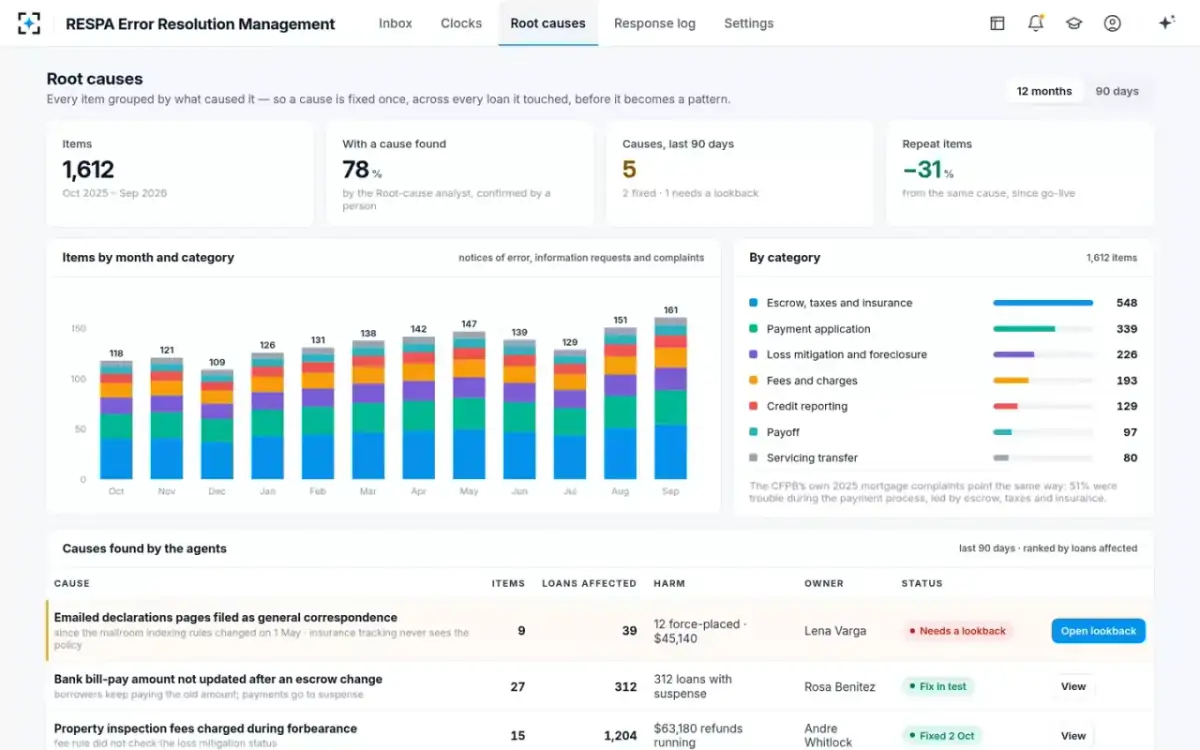
The last route is the cheapest. At the sample servicer, Wrenfield Mortgage Servicing, a single notice of error from fictional borrowers about a force-placed policy led the solution's Root-cause analyst to a mailroom indexing change that had hidden insurance documents on 38 more loans. Twelve had been force-placed. The lookback went to the compliance officer while most of those borrowers had not yet written, which is the difference between a correction and a case. The same grouping across a year shows which causes drive the volume, and the clock board shows which items are closest to becoming the next example on this page.
Every open item, its rule and its business days left
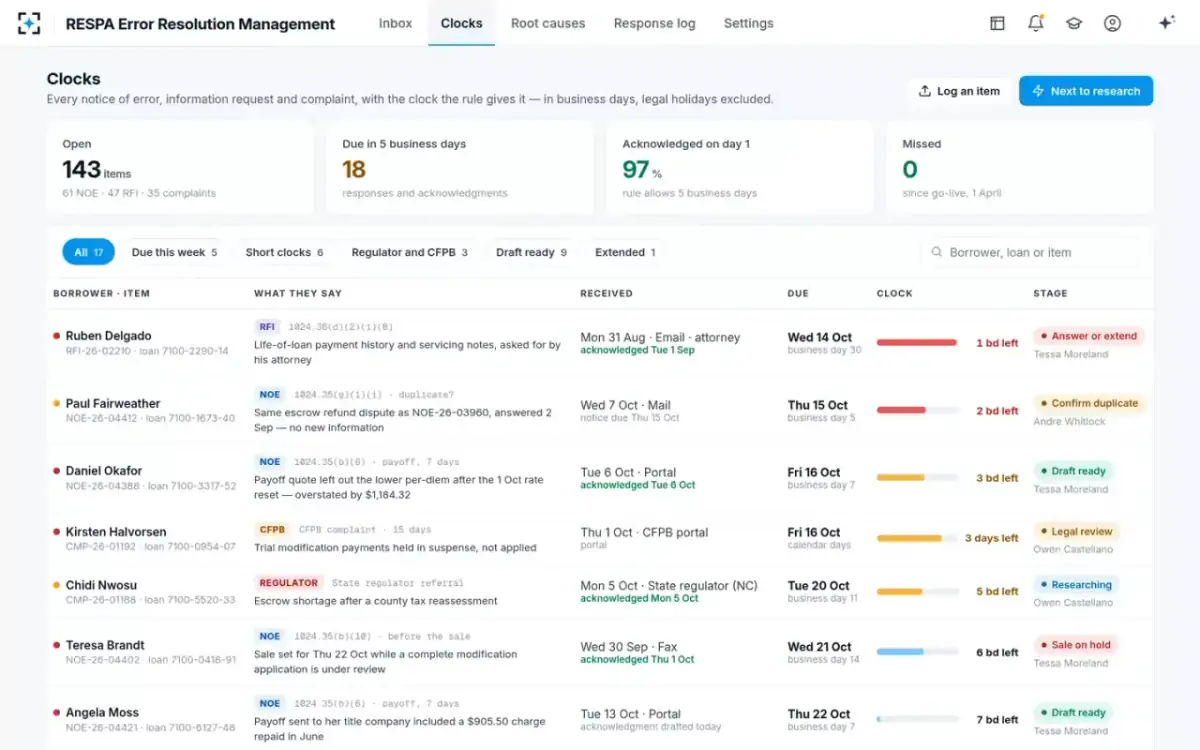
What the solution does not do is as important for this page. It does not fix a servicing system's data, run escrow or board transferred loans; it reads those systems, shows where they disagree, and puts the cause in front of the people who own them. The full product is at RESPA Error Resolution Management, and the costs these cases carry are set out in RESPA statutory damages.
Questions people ask
What are the most common RESPA servicing violations?
In the cases above: notices of error not recognised or tracked, acknowledgments and responses late or missing, responses without a reasoned investigation, escrow disbursement and analysis errors, and information lost in servicing transfers. The CFPB's supervisory reports add missing documentation of servicing actions and loss-mitigation notices without required content.
Is the Ocwen case a finding that Ocwen broke the law?
No. The 2017 action was a lawsuit, and the figures on this page are the CFPB's allegations in it. This page does not report the litigation's outcome, and the allegations should be read as what the regulator claimed, not what a court found.
Does a RESPA violation require harm to the borrower?
A regulator can cite a violation without proving individual harm; a borrower suing for damages under section 2605(f) must show actual damages caused by the failure, and courts treat damages as an element of the claim. Pattern-or-practice damages of up to $2,000 sit on top.
Are CFPB servicing orders still being enforced?
Some are and some were ended. The CFPB lists the NOVAD and Nationstar orders as post-order, not terminated; the CFPB terminated its orders against Fay Servicing and Carrington early in 2025. State regulators and the investors also enforce servicing standards, and their reviews start from the same federal rules.
How can a servicer find its own RESPA violations first?
Treat answered notices of error as data. Group them by cause, test the rest of the portfolio for the same pattern, and correct affected loans before their borrowers write. RESPA's cure provision in section 2605(f)(4), written for servicers on either side of a transfer, rewards corrections made within 60 days of discovery and before a borrower's notice or a lawsuit.