RESPA error resolution procedures are the steps Regulation X sets for a mortgage servicer that receives a written notice of error: acknowledge it in writing within 5 business days, investigate, and within 30 business days either correct the error or explain why there was none, with 7 days for a payoff error and less for one that touches a foreclosure sale (12 CFR 1024.35). The writing is the short part. The investigation needs the payment history, the escrow file, the insurance tracking system, the imaged mail, the call notes and the credit-reporting file, and each sits with a different desk. Botminds' RESPA Error Resolution Management exists for that gap: its agents start the clock the day a letter arrives, rebuild the loan's history from those systems and draft a cited answer, and a specialist decides and signs.
This guide walks the procedure in the order a servicer runs it, names who waits on whom at each step, and shows where the days go. The worked example is a fictional sample servicer, Wrenfield Mortgage Servicing, and one handwritten letter from fictional borrowers Gloria and Raymond Ashby, as both run through the solution. The rules are quoted from the regulation and its official commentary.
Four clocks a notice of error can start
5days
to acknowledge in writing, excluding weekends and legal public holidays
30days
to correct or explain, extendable once by 15 with written notice
7days
for a payoff balance error, with no extension
60days
with no adverse credit reporting on the disputed payment
What are the RESPA error resolution procedures, step by step?
The procedure has seven steps, and only two of them are writing. A servicer must recognise the letter as a notice of error, start the right clock, acknowledge it, investigate each assertion, decide, correct and respond, and then keep the file. The rule applies to "any written notice from the borrower that asserts an error" and identifies the borrower, the loan and the error, so the first step is reading what a letter does, not what it calls itself.
Recognition decides everything after it. A letter at the servicer's designated address that names the loan and says the escrow payment is wrong is a notice of error whether it says so or not. An email to customer care that only asks why a payment went up is a complaint, answered as service. The difference between a qualified written request, a notice of error and an information request is covered on its own page; for the procedure, the point is that the clock starts on receipt, not on the day someone works out what the letter is.
The RESPA error resolution procedure, as RESPA Error Resolution Management runs it
Agent
RecogniseReads each letter, email, fax and portal message the day it arrives; decides notice of error, information request, both, or complaint; maps each assertion to its paragraph of 1024.35(b).
Never: Closes an item as duplicative, overbroad or untimely without a person.
Agent
Start the clocksCounts business days without weekends and legal public holidays: acknowledgment, response, payoff, pre-sale and owner-identity clocks, and the 60-day credit-reporting freeze.
Never: Grants an extension.
Agent
InvestigatePulls payments, suspense and fees, escrow, insurance tracking, imaging, letters, calls and credit reporting into one timeline of the loan.
Never: Writes to any servicing system.
Agent
Test and draftTests each assertion as error or no error with the documents behind it, computes each correction, and drafts the acknowledgment and the response with enclosures.
Never: Concludes without a cited document, or sends.
A person decides
Decide and signThe research and resolution specialist approves the findings and signs; the compliance officer co-signs large credits and any credit-reporting change.
A person decides
Correct and closeCorrections post through the servicing system by the people who own it; the item lands on the response log with its dates in business days.
Two exits sit beside the main path. Under the early-correction rule, a servicer that corrects the asserted error and tells the borrower in writing within 5 business days owes neither the acknowledgment nor the full response (1024.35(f)(1)). And a notice that is duplicative, overbroad or untimely can be set aside, but only on a reasonable determination and with written notice within 5 business days (1024.35(g)). Both exits are decisions, and both are where a careless desk creates liability.
Who investigates a notice of error, and who waits on whom?
The notice-of-error desk owns the investigation, but it rarely owns the evidence. In most servicers the desk is a small team of specialists who read letters, request information from other departments and write the response, and each request is a queue they do not control. A single letter asserting four errors can need answers from six places before anyone can say whether an error occurred.
Six desks behind one notice of error, and what each is asked
Today
Asked for the payment history, suspense and fees after the letter arrives; answers when its own queue allows.
With agents
The history is read straight from the servicing system and placed on the loan timeline the day the letter arrives.
Still theirs: every posting and reversal.
Today
Asked which analysis set the payment and whether a disbursement went out; the analysis sits in a separate system.
With agents
Analyses and disbursements appear beside the payments that funded them.
Still theirs: the re-run analysis and the shortage decision.
Today
Often an outside provider; asked whether coverage was on file and why a force-placed policy was bought.
With agents
Policies on file, notices sent and premiums charged sit in their own lane.
Still theirs: cancelling force-placed cover and the refund.
Today
Asked to find what the borrower says they sent, under whatever document type it was indexed.
With agents
Every imaged item is read, including those filed under the wrong type.
Still theirs: the indexing rules.
Today
Asked for call notes; promises made on a call rarely reach the desk.
With agents
Calls appear on the timeline, with the ones that never opened a ticket marked.
Still theirs: the conversation with the borrower.
Today
Asked what was furnished and when; the freeze is often set by hand.
With agents
The disputed payments and their freeze dates are known from the day the notice arrives.
Still theirs: every correction sent to the bureaus.
The regulation already expects the servicer to get those answers quickly. Reg X's general servicing policies must be reasonably designed so the servicer can "Investigate, respond to, and, as appropriate, make corrections in response to complaints asserted by a borrower" (1024.38(b)(1)(ii)). When the evidence sits with an outside provider, the official commentary adds that the policies must provide "for promptly obtaining information from service providers to facilitate achieving the objective of correcting errors resulting from actions of service providers, including obligations arising pursuant to § 1024.35" (comment 38(b)(1)(ii)-1). A desk that waits two weeks for an insurance vendor's reply is not only slow; it is evidence that the policies were not designed for the clock.
How long does a notice of error investigation take?
Legally, up to 30 business days, about six calendar weeks; in practice, as long as the slowest desk takes to answer. The rule counts days "excluding legal public holidays, Saturdays, and Sundays", so a notice received the Friday before Columbus Day starts counting the following Tuesday. The Ashbys' letter reached Wrenfield's designated address on Friday 9 October 2026: the acknowledgment fell due on Monday 19 October and the response on Tuesday 24 November, because Columbus Day and Veterans Day do not count.
The RESPA error resolution timeline for one notice of error, by hand and with the agents
- Acknowledge5
- Investigate, decide, respond25
- Received to answered24
- Received to answered6
The shape of the hand-worked lane is the argument of this page. A median close to the deadline does not mean the work takes 24 days; it means the desk's requests sit in other queues until the deadline pulls them out, and the agents' lane is shorter because the pulling happens the day the letter arrives. The sample servicer's own estimate puts the hands-on work for a multi-assertion notice at about 18 hours, of which eight are spent pulling payments, escrow, insurance, mail and call records, and one is spent writing.
Some notices cannot wait that long at all. A payoff error under (b)(6) runs on 7 business days with no extension, so a request to another desk that takes a week has already failed. An error tied to a foreclosure sale under (b)(9) or (b)(10) must be answered before the sale or within 30 business days, whichever comes first; the commentary lets a servicer postpone the sale to meet the clock, but not ignore it. A 15-day extension is available only for the other errors, and only if the borrower is told in writing, with the reason, before day 30.
What records does a servicer need to answer a QWR?
Whatever records show what happened to the specific amounts and dates the borrower disputes, and nothing a template would add. A qualified written request that asserts an error is a notice of error, so the investigation is driven by its assertions. The table below maps the common assertions to the evidence that answers them and the desk that holds it.
The evidence each common assertion needs, and the desk that holds it
| What the borrower asserts | Paragraph of 1024.35(b) | Evidence that answers it | Usually held by |
|---|---|---|---|
| A payment was not applied, or applied wrongly | (b)(2), (b)(3) | Payment history with posting dates, suspense entries and the reason each went to suspense | Payments and cashiering |
| Taxes or insurance were not paid from escrow, or the payment rose for no reason | (b)(4) | Escrow analyses, the disbursement history and the bills they paid | Escrow |
| A force-placed policy was bought though coverage existed | (b)(5), (b)(11); 1024.37 | Policies on file, the force-placed notices and when each was sent, any evidence of coverage received | Insurance tracking; mailroom and imaging |
| A late fee or other charge has no basis | (b)(5) | The fee history and the event that triggered each fee | Payments and cashiering |
| The payoff statement is wrong | (b)(6) | Payoff calculation, per-diem interest and every charge included | Payoff desk |
| A late payment was reported to the credit bureaus | (b)(11) | What was furnished, on which date, for which payment | Credit reporting |
| Information was lost when servicing moved | (b)(8) | The boarding file and what the prior servicer sent | Transfer team; prior servicer |
| Foreclosure moved while an application was pending | (b)(9), (b)(10) | Loss-mitigation application dates, completeness notices and the foreclosure referral | Loss mitigation; foreclosure counsel |
The documents relied on matter twice. They are what the response stands on, and if the servicer finds no error the borrower may ask for them, free, within 15 business days. The commentary says those can be screen captures from the servicing system showing how a payment was applied, which means the evidence pulled during the investigation should be kept in a form that can be sent. What the response itself has to say is set out in the QWR response requirements.
What does 1024.38 require for error correction?
Section 1024.38 does not add a clock; it requires the policies that make the clock achievable. The objectives the CFPB wrote into it are the ones a notice-of-error desk depends on: accurate information for borrowers, the ability to investigate and correct, prompt information from service providers, and records that can be assembled into a servicing file within five days of a request, kept until one year after the loan is paid off or servicing is transferred.
Two of those objectives decide whether a desk can investigate at all. The servicer must "Provide appropriate servicer personnel with access to accurate and current documents and information reflecting actions performed by service providers" (1024.38(b)(3)(i)), and must share the status of loss-mitigation evaluations and foreclosure proceedings with service-provider staff, including those "responsible for handling foreclosure proceedings" (1024.38(b)(3)(iii)). A notice asserting a (b)(9) or (b)(10) error is unanswerable if the desk cannot see what foreclosure counsel filed and when.
Examiners test the same thing from the other end. In its Spring 2024 servicing edition the CFPB reported servicers that "failed to document certain actions in their servicing systems, such as establishing live contact with borrowers" (Supervisory Highlights, Issue 33). An action that is not in a system the desk can read did not happen, as far as the response is concerned.
Where the hand-offs break: one policy, three desks, five months
Most notices of error are not one mistake; they are one mistake carried across desks. The Ashbys' letter asserted four errors, and the research traced all four to a single filing decision made months earlier in a different department.
One loan, seven lanes: where it went wrong is marked
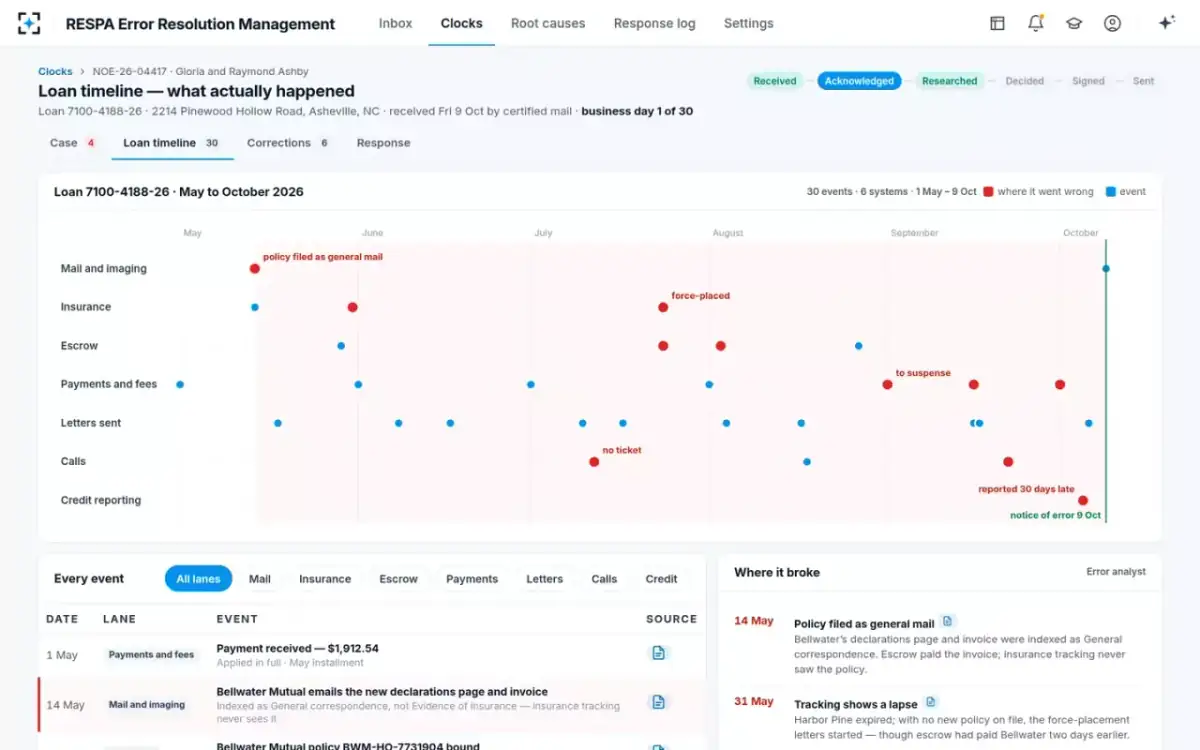
Bellwater Mutual emailed the new declarations page on 14 May. The mailroom indexed it as general correspondence, so insurance tracking never saw it, even though escrow paid Bellwater's $2,214 premium on 29 May. Tracking reported a lapse, force-placed notices went out in June and July, and a call on 12 July in which Mr Ashby said he had sent the policy in May never opened a ticket. A $3,860 force-placed premium was charged to escrow on 24 July, the August analysis raised the payment to $2,371.38, the borrowers kept paying $1,912.54, both payments went to suspense with a $57.60 late fee, and September was reported 30 days late on 5 October.
No single desk could have answered the letter. Insurance tracking held the force-placed policy, imaging held the misfiled page, escrow held the disbursement that proved coverage, payments held the suspense, care held the call and credit reporting held the late mark. By hand, that is six requests and six queues.
The letter takes an hour. Finding out what happened, across six desks, is where the thirty days go.
Do small servicers have to follow the error resolution procedures?
Yes. The small-servicer exemption covers 1024.38 through 1024.41, the policies, early intervention, continuity of contact and loss-mitigation rules, but not error resolution, information requests or force-placed insurance. The 2013 rule says plainly that institutions of $10 billion or less "must comply with the provisions regarding error resolution (Sec. 1024.35), requests for information (Sec. 1024.36), and force-placed insurance (Sec. 1024.37)" (78 FR 10696).
The exemption cuts the other way too. A small servicer has no 1024.38 duty to design policies for prompt information from its providers, but it still has the same 5- and 30-day clocks, so the hand-offs above matter more, not less, when the whole department is two people and an outside insurance tracker. The CFPB estimated in 2013 that about 97 percent of insured depositories and credit unions of $10 billion or less would qualify as small servicers.
Running the procedure with RESPA Error Resolution Management
The solution changes who waits, not who decides. Six agents do the reading, the clock arithmetic, the pulling and the drafting; the specialist reviews findings that already cite their documents, decides, and signs; a second person signs where the servicer's policy says so. For the Ashbys, the research took 2 minutes 6 seconds across six systems and the response was signed, co-signed and sent on business day 1 of 30.
Research in view: each agent's step, what it found, how long it took
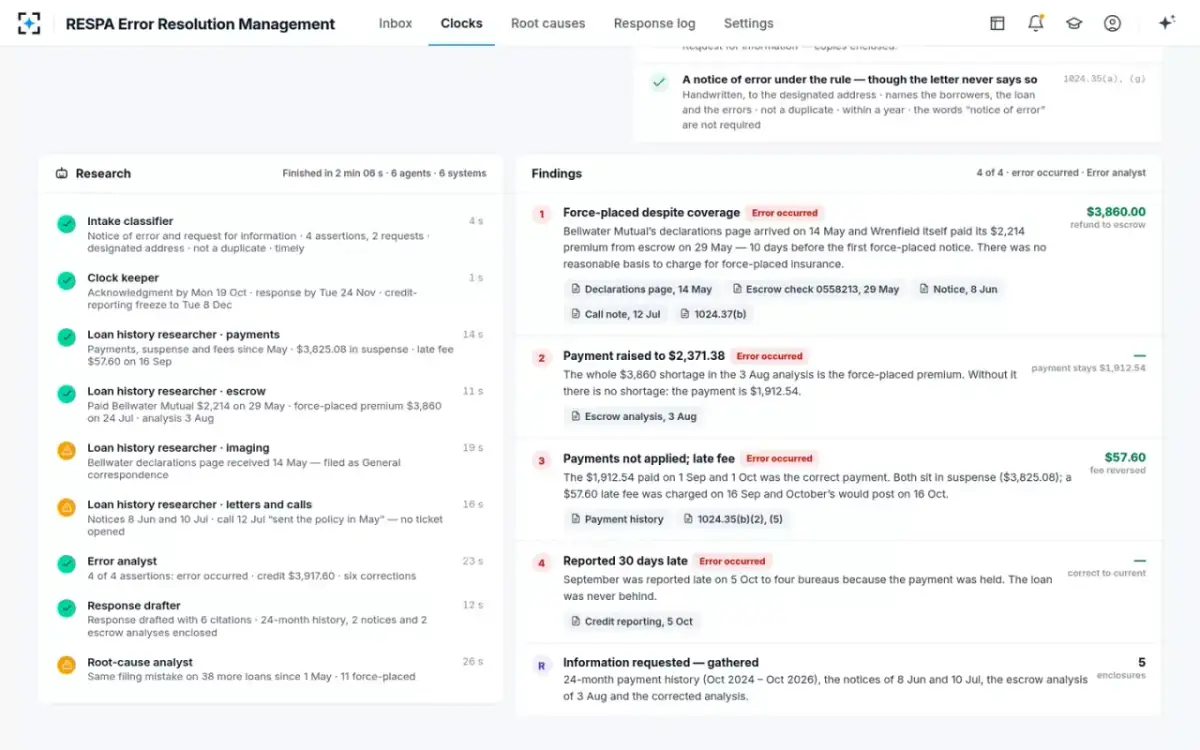
Three limits keep the procedure the servicer's own. The agents have read-only access to every servicing system, so corrections post through the people who own those systems. Duplicative, overbroad or untimely is only proposed until a person confirms, because a wrong exclusion is itself a violation. And extensions are approved by the complaint manager, never by an agent, which keeps the one decision that moves a legal deadline with a named person. How the tasks divide in detail is the subject of QWR management, task by task.
The same timeline that answers one letter also shows the cause behind it. The filing mistake that hid the Ashbys' policy had touched 38 more loans since the mailroom's indexing rules changed on 1 May, and the lookback went to the compliance officer before most of those borrowers had written. See the whole flow at RESPA Error Resolution Management.
Questions people ask
What is the RESPA error resolution timeline?
Acknowledge within 5 business days and respond within 30, extendable once by 15 business days if the borrower is told in writing before day 30. A payoff balance error must be answered within 7 business days and a foreclosure-related error before the sale or within 30 business days, whichever is earlier; neither can be extended.
Does a phone call start the error resolution procedures?
No. Section 1024.35 applies to written notices. The CFPB considered oral notices in 2013 and dropped them, while requiring that borrowers unhappy with a phone resolution be told how to submit a written notice (1024.38(b)(5)). A call can still be a complaint the servicer must handle.
What happens when a service provider caused the error?
The servicer still owns the response and the correction. The commentary to 1024.38 requires policies for promptly obtaining information from service providers so their errors can be corrected under 1024.35, and the servicer's 30-day clock does not pause while a vendor investigates.
Can a servicer require a payment before it investigates?
No. Section 1024.35(h) bars charging a fee or requiring any payment owed as a condition of responding. The borrower's obligation to keep paying under the loan is unchanged; the servicer simply cannot make the March payment a condition of investigating a dispute about February.
Who should sign a notice of error response?
The rule does not name a role, but someone who reviewed the evidence should. Many servicers have the specialist who investigated sign, and add a compliance or legal signature for large credits, credit-reporting changes, regulator referrals and attorney letters, as the sample servicer does above $2,500.