RESPA's credit reporting rule is a freeze: after a mortgage servicer receives a notice of error, it "may not, for 60 days, furnish adverse information to any consumer reporting agency regarding any payment that is the subject of the notice of error" (12 CFR 1024.35(i)(1)). The statute says the same for a qualified written request about the borrower's payments (12 U.S.C. 2605(e)(3)). The freeze runs on calendar days from receipt, covers only the disputed payments, does not apply to plain requests for information, and ends whether or not the investigation has. The rule is simple; keeping it is not, because the notice arrives at the error-resolution desk and the credit file goes out from a furnishing process on its own monthly cycle. Botminds' RESPA Error Resolution Management marks each disputed payment and the date its freeze ends the day the notice arrives, so the furnishing team can hold exactly those payments and nothing else.
The 60-day freeze in RESPA Error Resolution Management, from the envelope to the bureau file
Agent
Identify the disputed paymentsReads the notice and lists each payment it disputes: which installment, which month, and whether it has already been reported.
Never: Decides a payment is outside the dispute without a person.
Agent
Count 60 calendar daysSets the freeze end date from the day of receipt, not the day the notice was read.
A person decides
Hold in the furnishing fileThe credit-reporting team holds adverse information on those payments in every cycle that falls inside the 60 days.
Agent
Investigate and draftTests whether the payment was in fact late, with the payment history and suspense behind it.
Never: Sends a correction to a bureau.
A person decides
Correct, or let it lapseIf an error occurred, a person approves the correction to every bureau that received the data. If not, adverse reporting may resume after day 60, marked as disputed if the borrower still disputes it.
Can a servicer report late payments during a dispute?
Not adverse information about the disputed payment, for 60 days after it receives a notice of error. It may report everything else: payments the notice does not dispute, the account's balance and status, and, after day 60, the disputed payment too if the investigation found no error. The freeze is narrow on purpose. It protects the borrower's credit while the servicer investigates the specific payment in question, and it does not turn a dispute about one payment into a reporting holiday for the whole loan.
The freeze attaches to the notice, not to the finding. It applies whether or not the borrower turns out to be right, and it starts on receipt even if the letter sits unread. That makes recognition the first credit-reporting control: a notice of error that is filed as general correspondence for a week has already run a week of its freeze without anyone holding anything.
How long is the credit reporting freeze after a notice of error?
Sixty calendar days. Regulation X defines "day" as "calendar day" (12 CFR 1024.31), and unlike the acknowledgment and response clocks, the freeze paragraph does not exclude weekends or holidays. A notice received on Friday 9 October 2026 is protected through Tuesday 8 December, while the 30-business-day response is due on Tuesday 24 November.
Calendar days after a notice of error: the freeze, the response clock and the monthly file
- No adverse reporting on the disputed payments60 days
- AcknowledgeMon 19 Oct
- RespondTue 24 Nov
- If extended 15 business daysWed 16 Dec
- To 5 Nov5 Nov
- To 5 Dec5 Dec
- To 5 Jan5 Jan
The middle lane shows the trap. A 15-day extension moves the response to Wednesday 16 December, eight days after the freeze ends. The rule then allows adverse reporting on a payment the servicer has not finished investigating, and the January file would carry it unless the servicer chooses to hold longer. At the sample servicer an extension needs the complaint manager's approval, and the case screen shows the freeze end date beside the extension date, so the approver sees the gap before agreeing to it.
Does a QWR stop credit reporting? What 12 U.S.C. 2605(e)(3) says
A qualified written request "relating to a dispute regarding the borrower's payments" does. The statute's version reads: "During the 60-day period beginning on the date of the servicer's receipt from any borrower of a qualified written request relating to a dispute regarding the borrower's payments, a servicer may not provide information regarding any overdue payment, owed by such borrower and relating to such period or qualified written request, to any consumer reporting agency" (12 U.S.C. 2605(e)(3)). A QWR that asks only for information, without disputing payments, does not.
The statute's freeze and the regulation's freeze, side by side
RESPA §6(e)(3), 12 U.S.C. 2605: A qualified written request relating to a dispute about the borrower's payments.
Regulation X, 12 CFR 1024.35(i): Any notice of error, whatever it is called, that disputes a payment.
RESPA §6(e)(3), 12 U.S.C. 2605: Information about any overdue payment relating to the period or the request.
Regulation X, 12 CFR 1024.35(i): Adverse information about any payment that is the subject of the notice.
RESPA §6(e)(3), 12 U.S.C. 2605: 60 days from receipt.
Regulation X, 12 CFR 1024.35(i): 60 days from receipt; "day" means calendar day.
RESPA §6(e)(3), 12 U.S.C. 2605: None stated in (e)(3).
Regulation X, 12 CFR 1024.35(i): Not required if the notice is reasonably found duplicative, overbroad or untimely (1024.35(g)).
RESPA §6(e)(3), 12 U.S.C. 2605: Not addressed in (e)(3).
Regulation X, 12 CFR 1024.35(i): Other remedies, including foreclosure, continue except for (b)(9) and (b)(10) errors (1024.35(i)(2)).
In practice the regulation's trigger is the wider one. A handwritten letter that never says "qualified written request" but disputes a late fee and a late payment is a notice of error and starts the freeze. The exclusions are the only way out: if the servicer reasonably determines that a notice is duplicative, overbroad or untimely and tells the borrower in writing, the freeze provision, like the response duty, no longer applies.
Does a request for information stop credit reporting?
No. Section 1024.36(h) says nothing in the information-request rule prevents a servicer "from furnishing adverse information to any consumer reporting agency or pursuing any of its remedies, including initiating foreclosure or proceeding with a foreclosure sale" while a response is outstanding (12 CFR 1024.36(h)). A borrower who asks for a payment history and nothing more has not frozen anything.
That is why classifying each part of a letter matters for the furnishing team. An attorney's letter titled "qualified written request" that asks for life-of-loan records and asserts no error is an information request, and reporting continues. The same letter with one line saying the March payment was misapplied is also a notice of error, and the March payment freezes. The difference between a QWR, a notice of error and an information request decides which.
Which written communications freeze adverse credit reporting
| What arrives | Freeze? | Why |
|---|---|---|
| A notice of error disputing a payment, by any name | Yes, 60 days, on that payment | 1024.35(i)(1) |
| A notice of error about a fee or escrow item that is not a payment | Nothing to freeze unless a payment is disputed | The freeze covers payments that are the subject of the notice |
| A QWR disputing the borrower's payments | Yes, 60 days | 12 U.S.C. 2605(e)(3) |
| A request for information only | No | 1024.36(h) |
| A notice confirmed as duplicative, overbroad or untimely | No, once the borrower is told | 1024.35(g)(1) |
| A phone call disputing a payment | Not under Reg X; FCRA duties may still apply | 1024.35 covers written notices |
| A direct dispute under Regulation V | Not a freeze; an investigation duty and a "disputed" notice | FCRA section 623; 12 CFR 1022.43 |
Is a notice of error a direct dispute under the FCRA?
It can be. When the CFPB wrote the servicing rules it noted that "a notice of error may also constitute a direct dispute under Regulation V, which implements the Fair Credit Reporting Act, if it complies with the requirements in 12 CFR 1022.43" (78 FR 10696, note 98). A direct dispute is one a consumer sends straight to the furnisher, at the right address, identifying the account, the information disputed and the basis, with supporting documents (12 CFR 1022.43).
The two regimes stack rather than compete. Regulation X stops adverse reporting on the disputed payment for 60 days. The FCRA requires the furnisher to investigate a qualifying direct dispute and report the result to the consumer within the period a credit bureau would have, generally 30 days, and forbids furnishing disputed information "without notice that such information is disputed by the consumer" (15 U.S.C. 1681s-2(a)(3)). After day 60, then, a servicer that found no error may report the payment, but if the borrower still disputes it, the report should say so. One difference matters for template letters: Regulation V excuses a furnisher from investigating direct disputes it reasonably believes come from a credit repair organization, and Regulation X has no such exception for notices of error.
What happens to a late payment already reported before the notice of error?
The freeze does not erase it; correcting it is a separate duty. The freeze governs what is furnished after receipt. A late mark furnished before the notice stays on the bureau file unless the servicer corrects it, and if the investigation finds the payment was not late, two rules require the correction: Regulation X requires the servicer to correct the error, and the FCRA requires a furnisher that learns information it reported is "not complete or accurate" to "promptly notify the consumer reporting agency of that determination and provide to the agency any corrections" (15 U.S.C. 1681s-2(a)(2)).
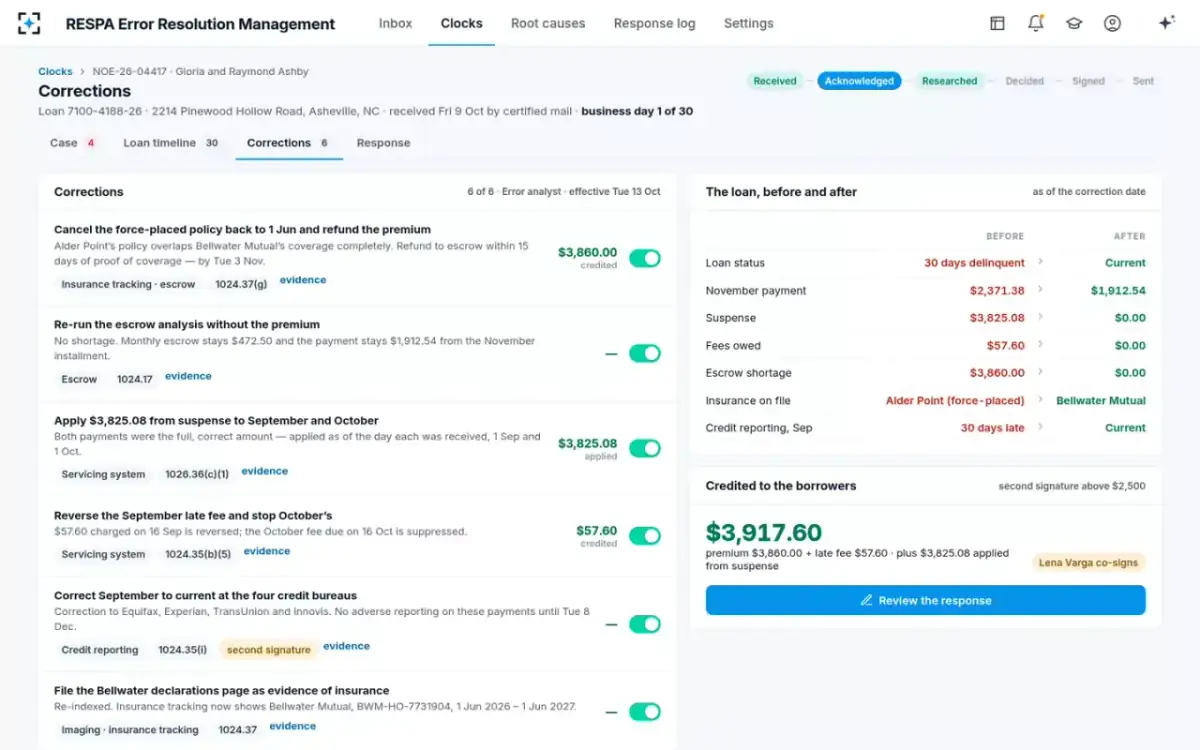
The correction has to go to every bureau that received the data, not only the one the borrower mentioned. At the sample servicer that meant four: Equifax, Experian, TransUnion and Innovis.
The credit-reporting correction sits with the other five, and needs a second signature
Why the freeze lives in the furnishing system, not the notice-of-error log
Because the furnishing system is what talks to the bureaus. The notice-of-error desk works item by item on a business-day clock; credit reporting works account by account on a monthly cycle, usually through a file built from the servicing system's delinquency status. A freeze recorded only on the case does nothing on the 5th of the month when the file is generated from a status that still says 30 days late.
The fix is a hold the furnishing process reads: a list of loan, installment and end date that the monthly build respects, and that expires on its own on day 60. Three details keep it honest. The hold is per payment, so undisputed months still report. It counts from receipt, so a notice recognised late still ends on the right day. And it records who released it if the servicer ever lifts it early, which it should only do if the notice is confirmed duplicative, overbroad or untimely. How the freeze fits among the other set-up steps is in the RESPA compliance checklist for error resolution.
The Ashby September, payment by payment
The fictional Ashbys' notice shows why per-payment tracking matters. A force-placed insurance premium raised their payment from $1,912.54 to $2,371.38 from September. They kept paying $1,912.54, the correct amount, on 1 September and 1 October; the servicing system held both payments in suspense as short, charged a $57.60 late fee, and on 5 October reported September 30 days late to four bureaus. Their notice of error arrived on 9 October.
The case in RESPA Error Resolution Management: the clock and the freeze dates side by side
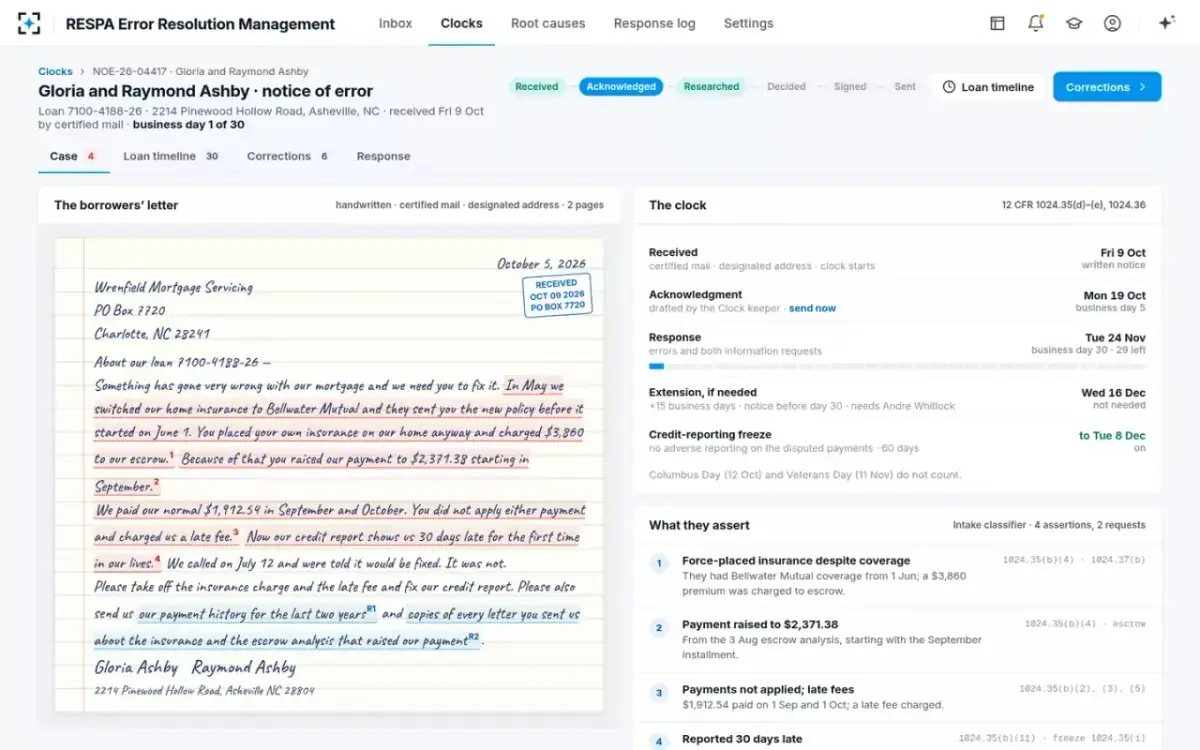
Without the freeze, the November file would most likely have reported September 60 days late and October 30 days late, because both payments were still in suspense. With it, both were held: they are the payments the notice disputes. The investigation found that both payments were the right amount and should have been applied on the days received, so the response, signed on business day 1, applied $3,825.08 from suspense, reversed the late fee, and corrected September to current at all four bureaus. Once the corrections posted there was no adverse information left to hold; on a harder file, the freeze is what protects the borrowers while the answer is still being worked out. The full product is at RESPA Error Resolution Management.
Questions people ask
Does the 60-day freeze use business days or calendar days?
Calendar days. Regulation X defines a day as a calendar day, and 1024.35(i) does not exclude weekends or holidays as the acknowledgment and response clocks do. A notice received on 9 October is protected through 8 December.
Can a servicer still foreclose during the 60-day freeze?
Generally yes. The freeze covers credit reporting only, and 1024.35(i)(2) says other remedies, including foreclosure, continue, except where the notice asserts a (b)(9) or (b)(10) foreclosure error. The loss-mitigation rules in 1024.41 impose their own separate limits.
Does the freeze cover the whole loan?
No. It covers adverse information about the payment or payments that are the subject of the notice. Other payments, and the account's ordinary status reporting, continue unless they are also disputed.
What if the servicer reports during the freeze by mistake?
It has violated 1024.35(i) and should correct the reporting at every bureau that received it, promptly, under its FCRA duty to correct inaccurate or incomplete information. The episode belongs on the response log, and in the root-cause review, because a freeze that failed once usually failed for a reason that will recur.
Does a CFPB portal complaint about a late payment start the freeze?
If the complaint is also a notice of error, yes: written, identifying the borrower and the loan, asserting the payment was not late, and received through a channel the rule recognises. The safer practice is to read portal complaints for payment disputes and hold the disputed payments while the servicer decides.