A RESPA compliance checklist for error resolution lists what a mortgage servicer must have in place to meet Regulation X's notice-of-error and information-request rules, 12 CFR 1024.35 and 1024.36, before the first letter arrives and when the first examiner asks: a designated address published where the rule requires, a classification method that reads what a letter does, a business-day calendar, clocks for every deadline, a link to credit reporting for the 60-day freeze, response templates with the required content, a sign-off matrix, a response log and records kept for the retention period. "RESPA compliance" also covers kickbacks under section 8 and escrow under section 10; this checklist is about section 6, servicing. Botminds' RESPA Error Resolution Management runs most of the list as settings, so the checklist becomes something a servicer can show rather than describe.
The order below is our suggested sequence for a servicer setting up or rebuilding the process, whether by hand or with a tool. Examples come from a fictional sample servicer, Wrenfield Mortgage Servicing, as configured in the solution.
RESPA error resolution go-live: the order the checklist should be built in
- Designated address, website, noticesWk 1–2
- Error map and templatesWk 3
- Calendar and clocksWk 4
- Freeze link to furnishingWk 5
- Sign-off matrixWk 6
- Replay past lettersWk 7–8
- Parallel runWk 9–10
What goes on a RESPA compliance checklist for error resolution?
Twenty checks cover the rule, grouped by the stage where each one bites. Every item cites the paragraph it comes from, so a reviewer can test the checklist against the regulation rather than against habit.
RESPA compliance checklist for notices of error and information requests
- Designated address set, or a decision not to set one
If set, the same address for notices of error and information requests (1024.35(c), 1024.36(b)); if not, any office receiving a letter starts the clock.
- The address published everywhere the commentary lists
The designating notice, periodic statements or coupon books, the servicing website, and early-intervention and loss-mitigation notices with contact details.
- Online intake, if any, declared and kept alongside mail
An email or web form can be an exclusive online channel, but only in addition to mail (comment 35(c)-4).
- Every channel read the day it arrives
Mail, fax, email, portal, regulator and CFPB referrals; a notice is received when it reaches the designated address, not when someone reads it.
- Classification by substance
Notice of error, information request, both, or complaint, regardless of what the letter calls itself (comment 35(a)-2).
- Each assertion mapped to 1024.35(b)
Payoff (b)(6) and foreclosure (b)(9)–(10) assertions flagged on intake for their shorter clocks.
- Business-day calendar
Weekends and the federal legal public holidays excluded; calendar days for the 60-day freeze.
- Clocks for every deadline
5-day acknowledgment; 30-day response; 7-day payoff; earlier of sale or 30 days for foreclosure errors; 10-day owner identity; 15-day document requests; 5-day notice of an exclusion.
- Extension rule enforced
One 15-day extension, notified in writing with reasons before day 30; never for (b)(6), (b)(9), (b)(10) or owner identity.
- Foreclosure hand-off
A (b)(9) or (b)(10) notice reaches foreclosure counsel at once; a sale can be postponed to meet the clock (comment 35(e)(3)(i)(B)-1).
- Credit-reporting freeze
No adverse information on a disputed payment for 60 days from receipt (1024.35(i)), set in the furnishing process, not only on the case.
- No fee and no payment condition
Neither a fee nor any payment owed may be required to investigate or respond (1024.35(h), 1024.36(g)).
- Exclusions decided by a person
Duplicative, overbroad and untimely only on a reasonable determination, with written notice within 5 business days (1024.35(g)).
- Response templates with required content
Correction and effective date; or no error, reasons and the right to documents; and a telephone number in each.
- Documents relied on, kept sendable
Free within 15 business days of a request; written notice within 15 days if any are withheld as confidential.
- Additional errors corrected
Errors found during the investigation are corrected and reported even if not asserted (1024.35(e)(1)(ii)).
- Sign-off matrix
Who signs, who co-signs above what amount or for credit-reporting changes, who approves extensions, who reviews attorney and regulator letters.
- Response log
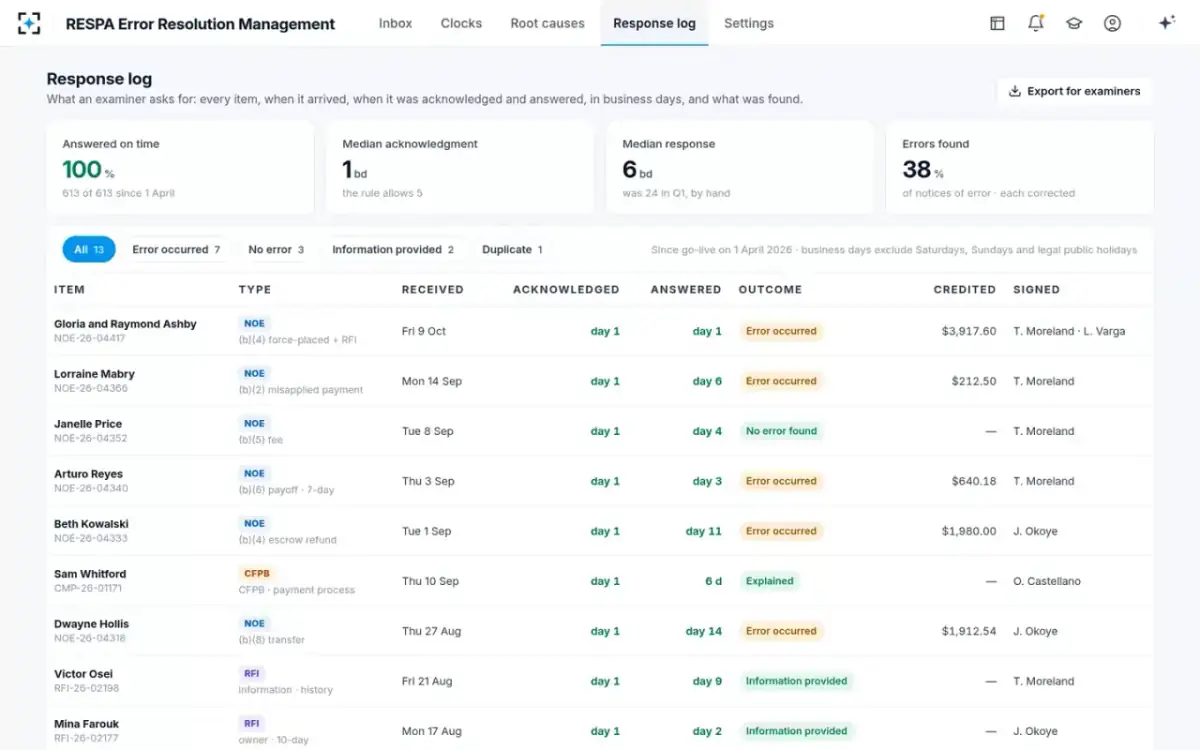
Received, acknowledged and answered dates in business days, outcome, amount credited and signer, exportable.
- Root-cause review
Answered items grouped by cause; repeated causes taken to a lookback across loans that did not complain.
- Retention
Servicing records kept until one year after payoff or transfer for servicers under 1024.38(c); longer is prudent given the three-year limitation period.
What is a designated address for QWRs, and where must it appear?
A designated address is the single address, set by written notice to the borrower, that a borrower "must use to submit a notice of error"; if a servicer sets one, it must use the same address for information requests and post it on its website (1024.35(c)). It is optional. A servicer that does not designate one must respond to a notice of error "received by any office of the servicer", according to the official commentary.
The trade-off is the point of the rule. With an address designated, a letter sent elsewhere does not start the Regulation X procedure; the 2013 rulemaking says servicers that designate an address "are not required to comply with error resolution procedures for notices sent to the wrong address" (78 FR 10696). The price is publicity. The CFPB required the website posting "to ensure that borrowers know how properly to assert an error and to avoid evasion by servicers of error resolution procedures."
Where a designated address must appear, and the traps in each
| Where | What the rule or commentary says | Common gap |
|---|---|---|
| Written designating notice | Must state that the borrower must use this address to assert an error; can ride with another disclosure, such as a transfer notice, if clear and conspicuous. | The notice exists for new loans but not for loans boarded from a prior servicer. |
| Periodic statement or coupon book | Must carry the address (comment 35(c)-2.ii). | Statement vendor prints the payment address, not the designated one. |
| Servicing website | Must be posted if the site lists any contact address (1024.35(c)). | A contact page with a general mailing address and no designated address. |
| Early-intervention and loss-mitigation notices | Any 1024.39 or 1024.41 notice that gives contact information must include it (comment 35(c)-2.iv). | Templates owned by the default team, updated separately. |
| A change of address | Written notice to the borrower before any change. | A PO box closed in a consolidation with no notice sent. |
| Several addresses | Allowed, e.g. by state; a letter at any designated address counts even if sent to the wrong one for that borrower (comment 35(c)-3). | Treating the out-of-region address as misdirected. |
A letter that misses the designated address is not ignorable. It falls outside 1024.35 and 1024.36, but it is still a complaint, and if it went to the CFPB or a state regulator it has a clock of its own. The sample servicer answers misdirected letters as service, with the designated address in the reply.
Which holidays count for RESPA business days?
Regulation X counts days "excluding legal public holidays, Saturdays, and Sundays", and the federal list of legal public holidays in 5 U.S.C. 6103(a) has eleven: New Year's Day, Martin Luther King Jr.'s Birthday, Washington's Birthday, Memorial Day, Juneteenth, Independence Day, Labor Day, Columbus Day, Veterans Day, Thanksgiving and Christmas (5 U.S.C. 6103). State holidays and company closures do not extend a federal deadline.
The numbers a checklist is built on
11
federal legal public holidays excluded from Reg X business days
5,000
loans or fewer, all owned or originated by the servicer or an affiliate: the small-servicer line
97%
of depositories and credit unions of $10B or less likely to be small servicers, per the CFPB in 2013
1year
record retention after payoff or transfer under 1024.38(c)
Two edge cases deserve a written decision. When a holiday falls on a weekend, 6103(b) moves the observed day to the Friday or Monday for federal pay and leave; Regulation X does not say whether the observed day is excluded, so the conservative calendar counts it as a business day and finishes a day early. And the 60-day credit-reporting freeze counts calendar days, because 1024.31 defines "day" as a calendar day and the freeze, unlike the response clocks, does not exclude holidays and weekends. Columbus Day and Veterans Day both fall inside an October notice's 30-day window, which is why the sample servicer's Ashby notice, received Friday 9 October 2026, was due Tuesday 24 November.
How to set up a notice of error process: the go-live order
Set up the notice of error process from the outside in: first what borrowers are told, then how letters are read, then the clocks, then the downstream systems, then the people who sign. Each step depends on the one before, and two of them depend on other teams' lead times.
The designated address comes first because it decides which letters start a clock. Changing it means a written notice to every borrower before the change, new statement and website text, and updated default-servicing templates, so it is the longest lead item. The error map and templates come next: the eleven covered errors of 1024.35(b), the information requests of 1024.36, and the response content for each outcome. The calendar and clocks follow, and must handle the short clocks and the no-extension cases before the first payoff error arrives.
The credit-reporting freeze is the step most often left on a case screen. The rule bars furnishing adverse information on a disputed payment for 60 days after receipt, and the system that furnishes is usually owned by another team on a monthly cycle. If the notice-of-error desk cannot set a hold that the monthly file respects, the freeze is a promise nobody keeps; the 60-day freeze, payment by payment shows how to wire it. The sign-off matrix closes the set-up: who signs every response, who co-signs large credits and credit-reporting changes, who approves extensions and exclusions, who reviews attorney and regulator letters.
The clocks and rules as settings in RESPA Error Resolution Management
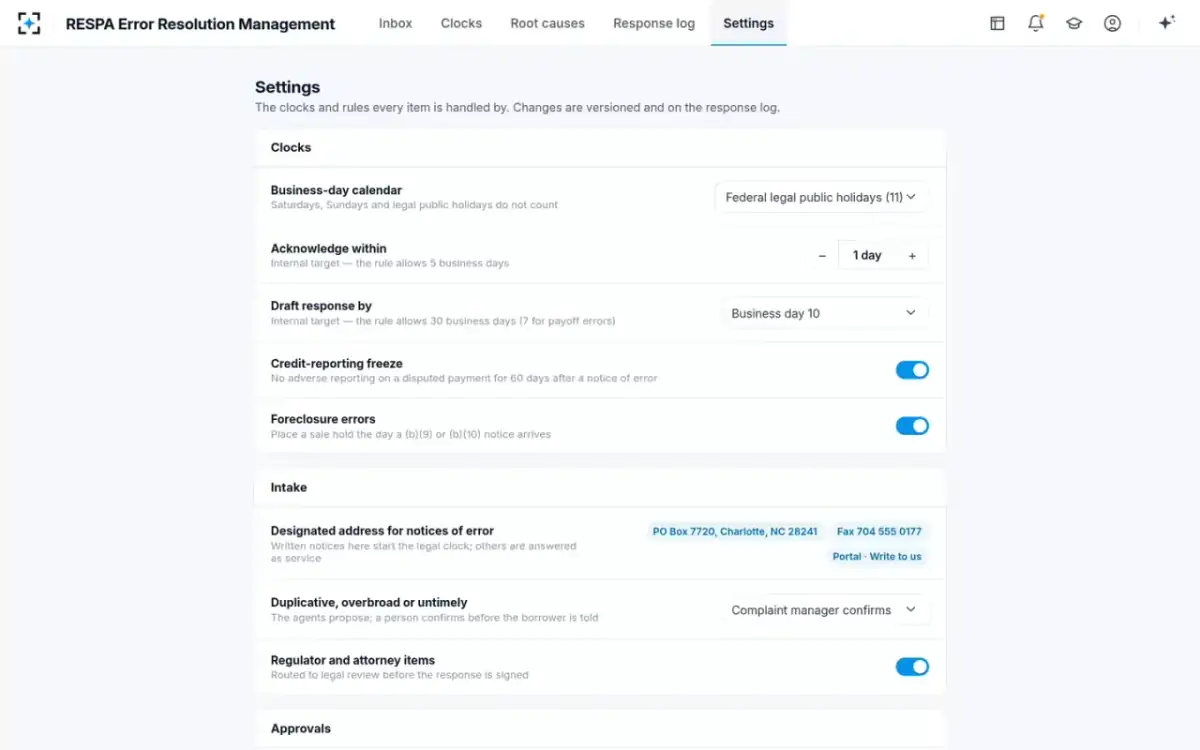
Then prove it. Replaying a few hundred past letters whose outcomes are known shows whether classification, clock dates and findings match what the team decided, and where they differ, who was right. A parallel run on live mail for a few weeks, with the existing process still signing, catches the letters a replay sample did not contain.
Do small servicers have to follow error resolution?
Yes. A small servicer, one that services 5,000 or fewer loans all owned or originated by it or an affiliate, is exempt from 1024.38 through 1024.41, but the 2013 rule is explicit that institutions of $10 billion or less "must comply with the provisions regarding error resolution (Sec. 1024.35), requests for information (Sec. 1024.36), and force-placed insurance (Sec. 1024.37)". The clocks, the content requirements, the freeze and the damages exposure are the same for a community bank servicing 3,000 of its own loans as for the largest nonbank.
What a small servicer loses is the policy scaffolding of 1024.38: no duty to document procedures for prompt information from providers, no regulatory retention rule. Its checklist should keep those items anyway, because the investigation still needs the information and a three-year limitation period still applies to claims.
What will examiners test in error resolution?
Examiners test whether letters are recognised, clocks met and answers reasoned, and whether the servicer learns from them. The CFPB's examination manual asks whether complaints, "regardless of the channel through which they are submitted", are recorded and categorised, and whether those raising "imminent foreclosures, or other regulatory compliance issues" are escalated (CFPB Supervision and Examination Manual, Compliance Management Review). In its 2016 servicing edition the CFPB said examiners would review "whether the servicer has an adequate process for expedited evaluation of complaints or notices of error" where the borrower faces imminent foreclosure (Supervisory Highlights, 2016).
The evidence they ask for is the response log and a sample of files: the letter, the acknowledgment date, the investigation, the response, the corrections and who signed. Missing documentation is itself a finding; the CFPB's Spring 2024 edition reported servicers that "failed to document certain actions in their servicing systems" (Issue 33). Since 2025 the CFPB has narrowed its supervision, and state regulators, who license nonbank servicers, and the investors have become the more frequent checkers; their tests start from the same federal rule.
How long must servicers keep notice of error records?
Under 1024.38(c)(1), until one year after the loan is discharged or servicing is transferred to another servicer, for servicers subject to that section. That is the regulatory floor, not the practical one. A borrower has three years from a violation to sue under section 2605 (12 U.S.C. 2614), and a file that was destroyed after one year cannot defend a response challenged in the third.
The useful unit of retention is the whole file, not the letter. Keeping the letter and the response without the timeline, the documents relied on and the signatures keeps the part of the file least likely to be disputed.
What to look for in a tool, and where RESPA Error Resolution Management fits
A tool should make the checklist provable: each item a setting with a history, each item on the log with its dates. Of the twenty checks above, the solution runs intake, classification, clocks, the freeze dates, drafting with required content, the documents relied on, additional-error detection, the response log and root-cause grouping. The servicer keeps the designated address and its publication, the furnishing system, the signatures and the policy decisions, and the solution enforces the policy once it is set: extensions only through the named approver, exclusions only by a person, second signatures above the threshold.
It is not the right first purchase for every servicer. One that receives a few notices a month and services its own loans from one system can meet the checklist with a calendar, templates and discipline. The case for the solution rises with letter volume, with the number of systems and providers an investigation crosses, and with the cost of a missed short clock. The tasks it takes and leaves are set out in QWR management, task by task, and the product at RESPA Error Resolution Management.
The response log: received, acknowledged and answered, in business days
Questions people ask
What must a servicer post on its website about notices of error?
If it designates an address for notices of error and its website lists any contact address, it must post the designated address there (1024.35(c)). Many servicers also explain the written procedure, which supports the 1024.38(b)(5) duty to inform borrowers how to submit notices of error and information requests.
Does a RESPA compliance checklist need to cover phone complaints?
Not for 1024.35, which covers written notices only, but a complete process does. Servicers subject to 1024.38 must inform borrowers who are unhappy with an oral resolution how to submit a written notice of error, and examiners expect complaints from every channel to be recorded and categorised.
Do the error resolution rules apply to reverse mortgages and HELOCs?
Subpart C of Regulation X applies to federally related mortgage loans, with some exclusions. Open-end lines of credit (home equity plans) are outside Reg X's definition of a mortgage loan, so 1024.35 and 1024.36 do not reach them; Regulation Z's open-end rules do. The NOVAD order of 2024 shows the rules apply to reverse-mortgage servicing.
Should internal targets be shorter than the legal deadlines?
Usually. The sample servicer acknowledges within one business day and drafts by business day 10, inside the legal 5 and 30, so a slow research step or a missed handoff still leaves time before the deadline. A target set at the legal limit leaves none.
Who should own the checklist?
The servicing compliance officer, with operational owners named for each item: mail and imaging for intake, the complaint manager for clocks and extensions, credit reporting for the freeze, legal for attorney and regulator letters. The response log is the shared evidence that each owner's item works.