RESPA 1024.35 is the Regulation X section, 12 CFR 1024.35, that sets the error resolution procedures a mortgage servicer must follow when a borrower sends a written notice asserting one of eleven "covered errors": refusing or misapplying payments, crediting them late, escrow failures, unjustified fees, an inaccurate payoff balance, inaccurate loss-mitigation information, transfer failures, two kinds of foreclosure step taken in breach of the loss-mitigation rules, and, in (b)(11), "Any other error relating to the servicing of a borrower's mortgage loan" (12 CFR 1024.35(b)). The paragraph an assertion falls under is not a filing detail: it decides whether the servicer has 7 business days, 30, or only until a foreclosure sale, and whether it may extend. Botminds' RESPA Error Resolution Management maps every assertion in a letter to its paragraph of 1024.35(b) on the day it arrives, so the shortest clock in the letter is the one the desk works to.
The eleven covered errors of 1024.35(b), sorted by the clock each one starts
7 business days
No extension
- (b)(6)Inaccurate payoff balance on request
Before the sale, or 30 days
Whichever is earlier · no extension · the sale is the risk
- (b)(9)First foreclosure notice or filing made in breach of 1024.41(f) or (j)
- (b)(10)Moving for judgment or order of sale, or selling, in breach of 1024.41(g) or (j)
30 business days
One 15-day extension with written notice before day 30
- (b)(1)Refusing a payment that meets the written requirements
- (b)(2)Misapplying an accepted payment
- (b)(3)Not crediting a payment on the day received
- (b)(4)Paying taxes or insurance late from escrow, or not refunding escrow
- (b)(5)A fee or charge with no reasonable basis
- (b)(7)Inaccurate loss-mitigation or foreclosure information under 1024.39
- (b)(8)Servicing information not transferred accurately and on time
- (b)(11)Any other error relating to servicing
What errors are covered under 1024.35?
Eleven categories, each tied to a duty somewhere else in the servicing rules. Ten describe specific failures; the eleventh catches the rest. The table gives each paragraph, the duty it points to, and the most common way it shows up in a borrower's letter.
RESPA 1024.35(b), paragraph by paragraph
| Paragraph | The covered error | Linked duty | How borrowers usually put it |
|---|---|---|---|
| (b)(1) | Failure to accept a payment that conforms to the servicer's written payment requirements | The servicer's own payment instructions | "You sent my payment back." |
| (b)(2) | Failure to apply an accepted payment to principal, interest, escrow or other charges as the loan and law require | Loan terms; applicable law | "My payment went to suspense." "You applied it to fees first." |
| (b)(3) | Failure to credit a payment as of the date of receipt | Reg Z 1026.36(c)(1) | "I paid on the 1st and you charged a late fee." |
| (b)(4) | Failure to pay taxes, insurance or other escrowed charges on time, or to refund an escrow balance | 1024.34(a), (b) | "The county says my taxes were late." "My policy lapsed." |
| (b)(5) | A fee or charge the servicer lacks a reasonable basis to impose | Commentary: late fees not owed, services not rendered, force-placed insurance not permitted by 1024.37 | "What is this inspection fee?" |
| (b)(6) | Failure to provide an accurate payoff balance on request | Reg Z 1026.36(c)(3) | "The payoff is too high." |
| (b)(7) | Inaccurate information about loss-mitigation options and foreclosure | 1024.39 (early intervention) | "Your letter said I didn't qualify for anything." |
| (b)(8) | Failure to transfer servicing information accurately and on time to a new servicer | Transfer duties; 1024.38(b)(4) | "My modification disappeared when my loan was sold." |
| (b)(9) | First foreclosure notice or filing made in breach of 1024.41(f) or (j) | The 120-day rule and the complete-application bar | "You started foreclosure while my application was in." |
| (b)(10) | Moving for judgment or sale, or selling, in breach of 1024.41(g) or (j) | The dual-tracking bar after a complete application | "The sale is set but I sent everything you asked for." |
| (b)(11) | Any other error relating to the servicing of the loan | Everything else in servicing | "You reported me late." "You never answered my call." |
Paragraph (b)(5) has the most useful commentary. A servicer lacks a reasonable basis for fees "that are not bona fide", and the examples are concrete: a late fee for a payment that was not late, a service provider's charge for a service not rendered, a default property-management fee on a loan not delinquent enough to justify it, and a force-placed insurance charge "in a circumstance not permitted by § 1024.37" (comment 35(b)-2). A disputed force-placed premium is therefore usually a (b)(5) assertion, often alongside a (b)(4) escrow assertion when the premium was drawn from escrow.
What is the catch-all error in 1024.35?
Paragraph (b)(11): "Any other error relating to the servicing of a borrower's mortgage loan." It means a servicer cannot answer a written servicing complaint by saying it is not on the list. The CFPB added it deliberately. Its 2012 proposal used a closed list, which industry commenters preferred for "certainty, clarity, and notice"; consumer advocates opposed it, and the final rule's preamble says the Bureau was "persuaded, for the reasons discussed further below, that it should not delimit the set of issues that consumers should be able to raise within the error resolution process" (78 FR 10696).
The catch-all came with a trade. The same passage explains that the CFPB dropped oral notices of error from the final rule, because telling an assertion from a question on a phone call "can be challenging", and widening the list while keeping oral notices would have made the duty unmanageable. So the scope is broad in subject and narrow in form: anything about servicing, but only in writing. Typical catch-all assertions include credit reporting of a payment the borrower says was not late, and failures of communication, such as a promised call-back or a lost document.
What errors are not covered by 1024.35?
Errors that are not about servicing. The official commentary lists four examples: errors relating to the origination of the loan, its underwriting, a later sale or securitization, and the decision to sell, assign or transfer the servicing (comment 35(b)-1). For a non-covered assertion the servicer need not follow the acknowledgment, response and credit-reporting provisions of 1024.35.
The fourth example has a carve-out that matters in practice. The decision to transfer servicing is not a covered error, but a failure to transfer servicing information "accurately and timely" is, under (b)(8). A borrower who objects that the loan was sold has no notice of error; one whose payment history, escrow balance or trial modification did not arrive with the loan has one. And a letter that mixes a non-covered complaint with a servicing assertion still requires an answer to the servicing part, as the Ninth Circuit itself recognised in Medrano. The difference between a QWR, a notice of error and a request for information covers that line in detail.
RESPA 1024.35 in four numbers
11
covered errors, the last a catch-all for any servicing error
7days
for a payoff error, raised from the 5 proposed in 2012
3
paragraphs that can never be extended: (b)(6), (b)(9) and (b)(10)
2014
the year the procedures took effect, on 10 January
What is the payoff error deadline?
Seven business days from receipt, with no extension. A notice asserting a (b)(6) error, "Failure to provide an accurate payoff balance amount upon a borrower's request", must be corrected or answered "Not later than seven days (excluding legal public holidays, Saturdays, and Sundays)" after the servicer receives it (1024.35(e)(3)(i)(A)). The CFPB had proposed five days and moved to seven, calling it a "modest increase in the timeline" that "strikes the right balance between prompt provision of payoff information to consumers and the need for servicers to have sufficient time to access the required information."
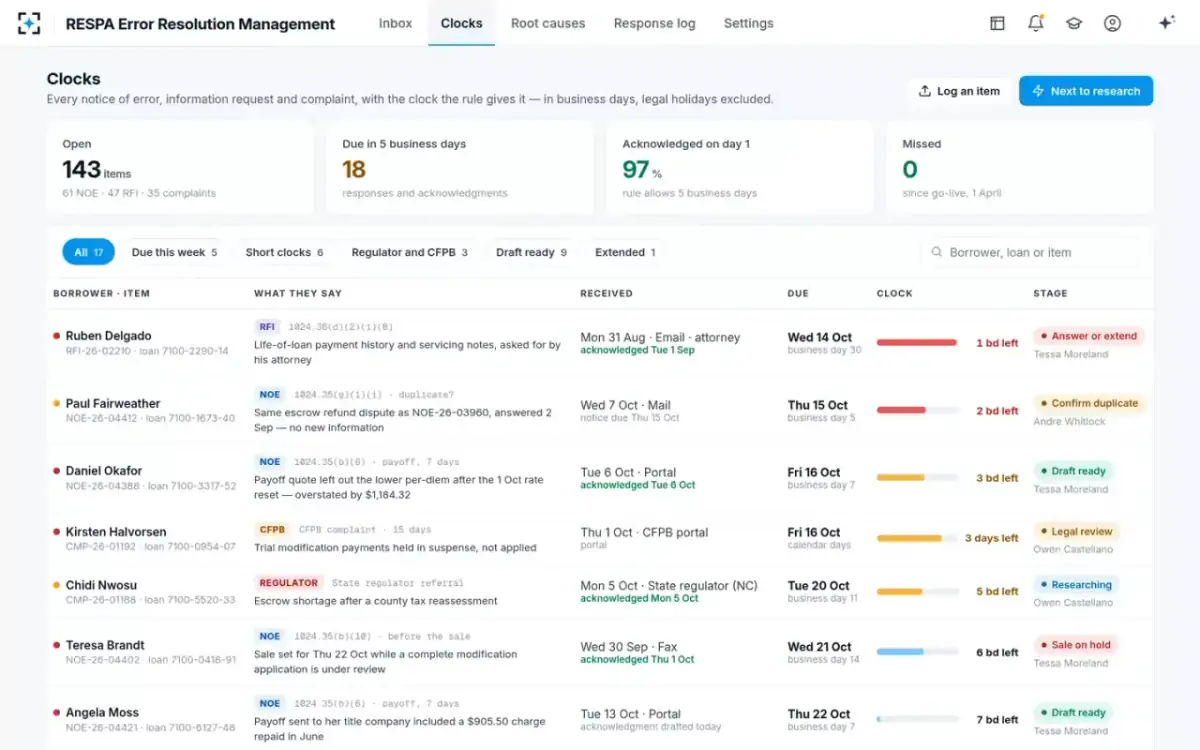
The short clock reflects what a payoff is for. A borrower disputes a payoff because a sale or refinance is about to close, and the closing date, not the regulation, is the real deadline. At the sample servicer, a portal message on Tuesday 13 October said a payoff sent to the title company looked about $900 too high; the closing was on Friday 16 October, and the 7-day clock ran to Thursday 22 October. The corrected statement, without a $905.50 property-preservation charge the borrower had already repaid, was drafted the same morning.
Does a notice of error stop foreclosure?
In general, no. Section 1024.35(i)(2) says that, except for (b)(9) and (b)(10) assertions, nothing in the section limits a servicer "from pursuing any remedy it has under applicable law, including initiating foreclosure or proceeding with a foreclosure sale." A notice disputing a late fee does not pause a foreclosure; the loss-mitigation rules in 1024.41 are what bar foreclosure steps while a complete application is pending.
The two foreclosure paragraphs are the exception, and they move fast. A notice asserting that the first filing or a sale motion breached 1024.41 must be answered before the sale or within 30 business days, whichever is earlier. The commentary allows a way out that is also a warning: if the servicer cannot answer in time, it "may cancel or postpone a foreclosure sale", and must then answer before the earlier of 30 days or the rescheduled sale (comment 35(e)(3)(i)(B)-1). A notice received seven or fewer days before a sale needs no formal acknowledgment and response, but the servicer must make a good-faith attempt to answer, orally or in writing (1024.35(f)(2)).
Every open item by business days left, with the sale on hold
When can a servicer extend the 1024.35 deadline?
Only for errors on the ordinary 30-day clock, once, by 15 business days, and only if the borrower is told in writing, with the reasons, before the 30 days end (1024.35(e)(3)(ii)). Payoff errors and the two foreclosure errors cannot be extended at all. A letter with several assertions may be split: the commentary lets a servicer treat a multi-error notice as separate notices and extend only the assertions that allow it.
Two other exits shorten the work rather than lengthen the clock. If a servicer corrects the asserted error and tells the borrower in writing within 5 business days, it need not send the acknowledgment or the full response (1024.35(f)(1)). And if a notice is duplicative, overbroad or untimely, the servicer may decline it on a reasonable determination, with written notice within 5 business days of deciding (1024.35(g)); untimely means delivered more than a year after servicing was transferred away or the loan was discharged.
The 1024.35 error resolution procedure in one page: RESPA section 6, 12 U.S.C. 2605
Section 1024.35 implements RESPA section 6, codified at 12 U.S.C. 2605. The statute supplies the qualified written request, the 5- and 30-day clocks, the 15-day extension, the 60-day credit protection and the damages; the regulation supplies the eleven errors, the content of each response, the designated address, the exclusions and the foreclosure clocks. Section 2605(k)(1)(C) also makes it a statutory violation to "fail to take timely action to respond to a borrower's requests to correct errors relating to allocation of payments, final balances for purposes of paying off the loan, or avoiding foreclosure, or other standard servicer's duties" (12 U.S.C. 2605(k)).
Where each part of the procedure comes from
| Part of the procedure | RESPA section 6 (12 U.S.C. 2605) | Regulation X |
|---|---|---|
| What starts it | A qualified written request, (e)(1)(B) | Any written notice of a covered error, 1024.35(a) |
| Acknowledge | 5 business days, (e)(1)(A) | 5 business days, 1024.35(d) |
| Respond | 30 business days, (e)(2) | 30; 7 for payoff; before sale for foreclosure, 1024.35(e)(3) |
| Extend | 15 days with notice, (e)(4) | Same, but never for (b)(6), (b)(9), (b)(10), 1024.35(e)(3)(ii) |
| Credit reporting | 60 days from receipt of a QWR about payments, (e)(3) | 60 days on any payment that is the subject of a notice, 1024.35(i) |
| Liability | Actual damages, up to $2,000 for a pattern or practice, fees, (f) | Enforced through the statute, including (k)(1)(E) |
The practical upshot is that the regulation is what a servicer works to and the statute is what a borrower sues under; the damages it carries are set out in RESPA statutory damages.
Sorting a real letter: four assertions, five paragraphs, one clock
Letters rarely assert one error. The fictional Ashbys' two handwritten pages to the sample servicer, Wrenfield Mortgage Servicing, asserted four, and mapping them shows how one letter can touch five paragraphs while running on a single 30-day clock, because none of them is a payoff or foreclosure error.
The borrowers' letter in RESPA Error Resolution Management, each assertion mapped to its paragraph
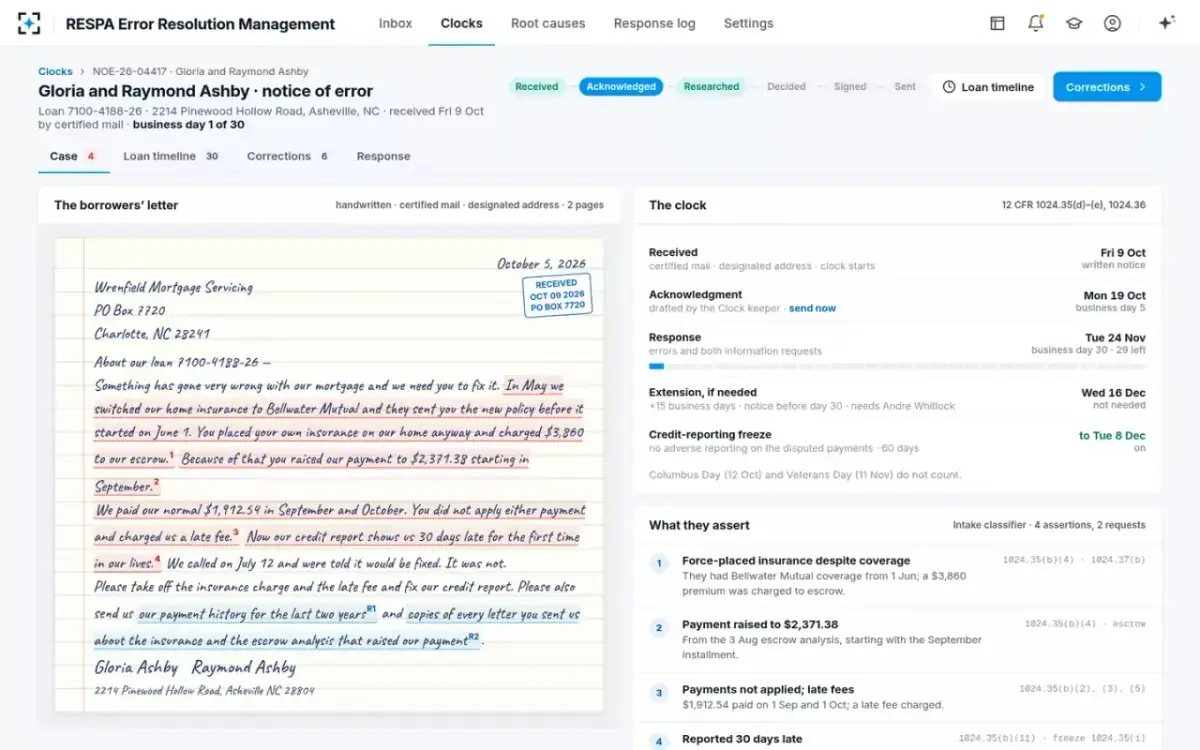
The force-placed policy, charged although the borrowers' own policy was in force, maps to (b)(4) and the force-placed insurance rule in 1024.37(b), and its premium to (b)(5) as a charge without basis. The payment increase maps to (b)(4), because the escrow analysis built the premium into the payment. The unapplied payments and the late fee map to (b)(2), (b)(3) and (b)(5). The 30-day late mark on the credit report has no paragraph of its own and falls under (b)(11), and it is also the payment the 60-day freeze protects, explained in RESPA credit reporting.
Across a year, the same mapping shows where a servicer's errors cluster. At the sample servicer, escrow, taxes and insurance account for about a third of all items, and payment application for a fifth.
Twelve months of borrower items in RESPA Error Resolution Management, by what they concerned
The solution's Intake classifier does this mapping for every assertion, keeps the borrower's own words beside it, and hands the shortest clock to the Clock keeper. A person can see, and correct, every mapping before the research starts. The full product is at RESPA Error Resolution Management.
Questions people ask
Is a force-placed insurance dispute a covered error?
Usually yes, under (b)(5) when the charge was not permitted by 1024.37, and often (b)(4) when the premium came from escrow. RESPA section 6(l)(3) separately requires a servicer, within 15 days of receiving confirmation of existing coverage, to cancel the force-placed insurance and refund the overlapping premiums and related fees.
Does 1024.35 apply to small servicers?
Yes. The small-servicer exemption covers 1024.38 through 1024.41 only. Error resolution under 1024.35, information requests under 1024.36 and force-placed insurance under 1024.37 apply to every servicer of a covered mortgage loan.
What does "untimely" mean under 1024.35(g)?
A notice delivered more than one year after servicing of the loan was transferred away from the servicer receiving it, or more than one year after the loan was discharged. A notice about a five-year-old error on a loan the servicer still services is not untimely.
Can a servicer charge for responding to a notice of error?
No. Section 1024.35(h) bars any fee, and any requirement to make a payment owed on the account, as a condition of responding. RESPA section 6(k)(1)(B) separately prohibits charging fees for responding to valid qualified written requests.
Has 1024.35 changed since 2016?
No. The eCFR history for the section ends with the 2016 amendments, which added successor-in-interest provisions. The CFPB's 2025 actions on Regulation X, the rescission of COVID-era exceptions and the withdrawal of some guidance, did not amend it.