QWR response requirements come from two places. RESPA section 6(e) requires a servicer to answer a qualified written request within 30 business days by correcting the account or explaining, after an investigation, why it is correct; Regulation X turns that into a checklist for each notice of error. A correction response must say the error was corrected, give the effective date and a telephone number; a no-error response must state that no error occurred, give the reasons, and tell the borrower they may request the documents relied on (12 CFR 1024.35(e)). The letter is what the borrower reads. The investigation behind it is what a court, an examiner or a plaintiff's lawyer reads, and since the Eleventh Circuit's 2016 decision in Renfroe v. Nationstar, a conclusion without that investigation has been an invitation to sue. Botminds' RESPA Error Resolution Management drafts every response from a loan timeline whose events link to their documents, so the file exists before the letter is signed.
The worked example is the fictional sample servicer Wrenfield Mortgage Servicing's response to a notice of error from fictional borrowers Gloria and Raymond Ashby, as drafted in the solution and signed on business day 1 of 30.
One response to a notice of error, annotated: what each part is there to prove
1
Re: Loan 7100-4188-26 — your notice of error and request for information received October 9, 2026
Names what the letter answers and the date of receipt, which is the day every clock started.
1024.35(d), (e)(3)
2
We investigated each point in your letter. Errors occurred, and we have corrected them, effective October 13, 2026.
The two things a correction response must state: that the error was corrected, and the effective date.
1024.35(e)(1)(i)(A)
3
Bellwater Mutual sent us your new policy on May 14, 2026 [1], and we paid its $2,214 premium from your escrow account on May 29 [2] … That was our error.
The investigation, shown. Each numbered citation points the reviewer to the document behind the sentence; the borrower sees plain words.
Renfroe: an explanation, not a conclusion
4
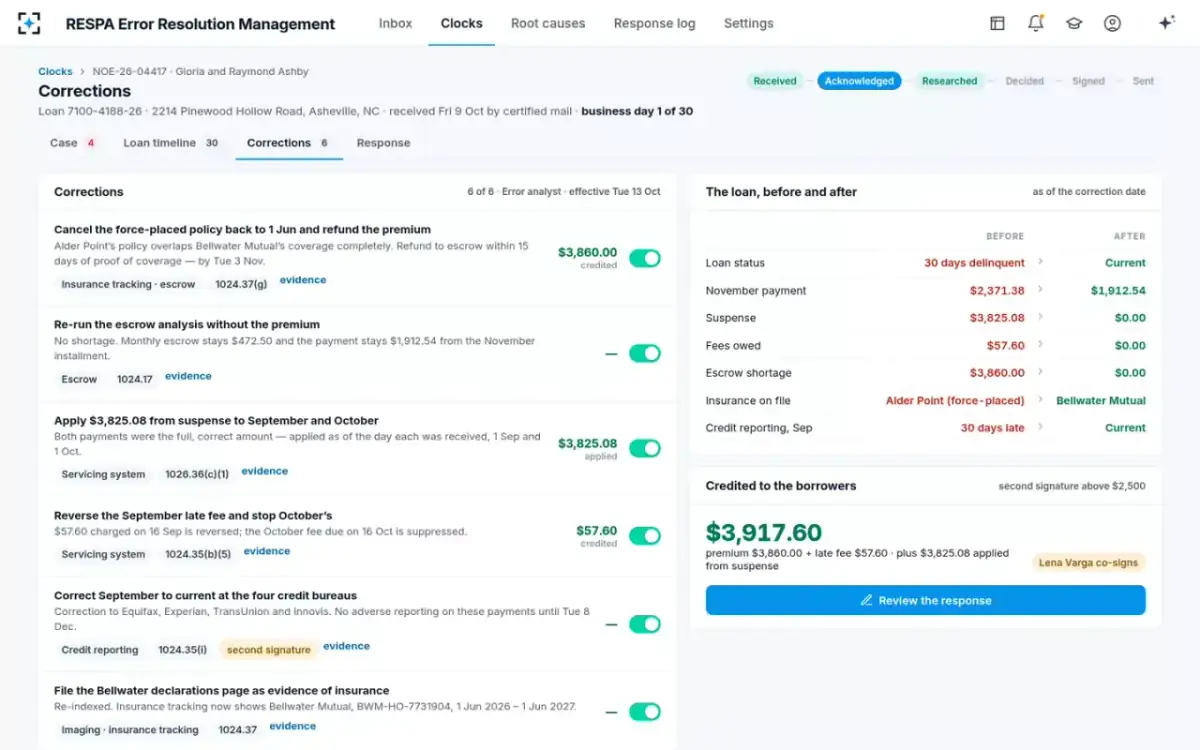
We cancelled the insurance we placed, back to June 1, and refunded the $3,860.00 premium … We reversed the $57.60 late fee …
One line per correction, including those the borrowers did not name, such as October's late fee that had not yet posted.
1024.35(e)(1)(ii)
5
Enclosed are your payment history for the last 24 months, our letters of June 8 and July 10 about your insurance, the escrow analysis …
The two information requests answered with the documents themselves, in writing, beside the findings.
1024.36(d)(1)(i)
6
Tessa Moreland · Research and resolution · 1-800-555-0148
Contact information including a telephone number, required in every response.
1024.35(e)(1)(i)(A)
What must a notice of error response include?
It depends on the finding, and the rule gives three versions. If the servicer corrects the asserted error, the response must state the correction, its effective date and contact information including a telephone number. If it finds no error after a reasonable investigation, the response must say so, give "a statement of the reason or reasons for this determination", tell the borrower of the right to request the documents relied upon and how, and give a telephone number. If it finds a different or additional error, it must correct that too and describe the error, the action taken and the effective date.
QWR response requirements in the statute and in Regulation X, side by side
| Outcome | RESPA §6(e)(2), 12 U.S.C. 2605 | Regulation X, 12 CFR 1024.35(e)(1) |
|---|---|---|
| Error found | Make appropriate corrections, "including the crediting of any late charges or penalties", and send written notice with the name and telephone number of a representative | Correct the error; written notice of the correction, its effective date and contact information including a telephone number |
| No error found | After an investigation, a written explanation of the reasons the servicer believes the account is correct, with an individual or office that can help | After a reasonable investigation: a statement that no error occurred, the reasons, the right to request documents relied on and how, and a telephone number |
| Different or additional error | Not addressed separately | Correct all such errors and describe each, the action taken and the effective date |
| Information requested | The information, or why it is unavailable, with a contact | Handled under 1024.36: the information with a contact, or a written statement after a reasonable search that it is not available, with the basis |
| Deadline | 30 business days; one 15-day extension with notice and reasons | 30 business days (7 for payoff; before the sale for foreclosure errors); one 15-day extension except for those |
Three details are often missed. A response may address several asserted errors in one letter or in separate letters, as the commentary allows. The servicer may not charge a fee, or require any payment owed on the loan, as a condition of responding (1024.35(h)). And the borrower's right to the documents relied on must be stated in a no-error response even when nobody has asked for them yet.
What is a reasonable investigation under RESPA?
Regulation X does not define it, so the content of the file defines it. A reasonable investigation tests each assertion against the servicer's own documents, follows the evidence across systems and service providers, and reaches a finding that someone can explain line by line. What it is not is easier to say: a review of "the loan and related documents" that does not engage with what the borrower said.
The rule sets two boundaries. A servicer may ask the borrower for supporting documents, but may not "Require a borrower to provide such information as a condition of investigating an asserted error", nor find no error because the borrower did not send them (1024.35(e)(2)). And the investigation must look beyond the letter: an error the servicer finds that the borrower never asserted must be corrected and reported too (1024.35(e)(1)(ii)). In the Ashby file, that meant reversing October's late fee before it posted and re-filing the declarations page as evidence of insurance, neither of which the borrowers asked for.
Six corrections, each with its system, rule and amount
Can a servicer send a boilerplate response? What Renfroe v. Nationstar decided
A servicer can send one, but after Renfroe it should expect the boilerplate to be read as evidence that no investigation took place. Margaret Renfroe's payment rose about $100 after her loan was transferred to Nationstar. She suspected a property-tax or amortization mistake and sent a notice of error asking for an investigation and an explanation. Nationstar replied that the "loan and related documents were reviewed and found to comply with all state and federal guidelines that regulate them", enclosed documents she had not asked for, and gave no explanation (Renfroe v. Nationstar Mortgage, 11th Cir. 2016).
The district court dismissed her suit, reasoning that saying documents had been reviewed was enough. The Eleventh Circuit reversed: the letter gave no reason she could check, so her claim that Nationstar failed to investigate could go forward. It also rejected the argument that she had no damages because the overpayments came before her letter, holding that "a notice of error triggers present RESPA obligations with respect to past error." A servicer that finds the error must fix it, refund included, whenever the error happened.
Two answers to a disputed payment increase
The reply in Renfroe (2014): Account found to comply with all state and federal guidelines.
A reasoned reply (the sample servicer, 2026): Errors occurred, corrected effective 13 October 2026.
The reply in Renfroe (2014): None specific to the borrower's question about taxes or amortization.
A reasoned reply (the sample servicer, 2026): What happened, in date order: the policy received, the premium paid, the misfiling, the force-placed charge.
The reply in Renfroe (2014): Documents enclosed that the borrower had not requested.
A reasoned reply (the sample servicer, 2026): The documents the borrowers requested, and every sentence traceable to its source for the reviewer.
The reply in Renfroe (2014): No refund of the overpayments.
A reasoned reply (the sample servicer, 2026): $3,917.60 credited and $3,825.08 applied from suspense.
The reply in Renfroe (2014): Dismissal reversed on appeal; the claim went back to the district court.
A reasoned reply (the sample servicer, 2026): Signed, co-signed and sent on business day 1 of 30.
Renfroe was decided at the pleading stage, on the borrower's allegations, and it is binding only in the Eleventh Circuit. Its practical lesson travels anyway: a response that would read the same for any borrower is the easiest kind to attack, because nothing in it shows the servicer looked. That is also why a page on RESPA statutory damages starts from the same case: Renfroe's allegation that Nationstar used the same form letter for other borrowers is what kept her pattern-or-practice claim alive.
What documents must a servicer provide on request?
Only the documents it actually relied on to find no error, free, within 15 business days of the borrower's request. The commentary is practical about form: the documents "may include documents reflecting information entered in a servicer's collection system", and for a payment-allocation dispute a servicer may send "a printed screen-capture showing amounts credited to principal, interest, escrow, or other charges" (comment 35(e)(4)-1).
There is one exception and one condition. A servicer need not produce confidential, proprietary or privileged documents, but if it withholds any for that reason it must tell the borrower in writing within the same 15 business days. And where the request involves a potential or confirmed successor in interest, it may omit other people's contact and personal financial information, though never the loan's terms, status and payment history (1024.35(e)(5)). A file that keeps the documents relied on in sendable form turns a 15-day duty into a same-day one.
What must a response to a request for information include?
Either the information, in writing, with contact information including a telephone number; or, after a reasonable search, a written statement that the information is not available, the basis for that determination, and a telephone number (12 CFR 1024.36(d)(1)). The owner's identity is due in 10 business days; everything else in 30, with one 15-day extension.
"Not available" has a narrow meaning. The commentary says information is unavailable only if it is not in the servicer's control or possession, or "cannot be retrieved in the ordinary course of business through reasonable efforts". Its examples cut both ways: call recordings that staff can find in the ordinary course are available; data that exists only on backup media needing extraordinary restoration is not; documents in an offsite store the servicer can reach are available. A desk that answers "not available" because the information sits in another department's system is giving the wrong answer.
Can a servicer require the borrower to send documents first?
No. A servicer may ask for supporting documents, and often should, but the investigation and the clock do not wait for them, and a missing document is not a reason to find no error. The rule's wording is direct: the servicer may not "Determine that no error occurred because the borrower failed to provide any requested information without conducting a reasonable investigation."
In practice the servicer's own documents usually settle the question. The Ashbys said they had sent their new policy in May; the servicer did not need them to send it again, because its own imaging system held the declarations page, filed under the wrong document type, and its own escrow account had paid the premium.
What if the servicer finds a different error than the one asserted?
It must correct that error too and tell the borrower, in the same response or a separate one: what the error was, the action taken, the effective date and a telephone number. This is the clause that makes a narrow investigation risky. A servicer that checks only the paragraph the borrower named, finds it correct and answers "no error" has not met the rule if the payment history shows a different mistake a reasonable investigation would have found.
The research that finds additional errors also finds other borrowers. In the Ashby file, the same misfiled document type turned up on 38 more loans since the mailroom changed its indexing rules on 1 May, which is a question for the compliance officer, not for the response letter.
The file behind the letter, as RESPA Error Resolution Management keeps it for reviewers and examiners
A response is defensible when someone who was not there can rebuild the decision from the file. The checklist below is what the solution keeps with each item; most servicers can keep the same set by hand, at a cost in hours.
The response file: eight things a reviewer should be able to open
- The letter as received
With the date and channel of receipt and the designated address it reached, which fix every clock.
- The classification and its reasons
Notice of error, information request or both, each assertion in the borrower's words mapped to its paragraph of 1024.35(b) or 1024.36.
- The clock dates
Acknowledgment, response, any extension notice and the credit-reporting freeze, counted without weekends and legal public holidays.
- The loan timeline
Every event the investigation relied on, from each system, linked to its source document.
- A finding per assertion
Error or no error, with the documents cited and the rule applied.
- Each correction
System, amount and effective date, and evidence that it posted.
- The documents relied on, in sendable form
So a 15-day request can be met the same day.
- Who signed, and what the signature meant
Names, dates and any second signature, with the reason it was needed.
Signed, co-signed, sent and logged in RESPA Error Resolution Management
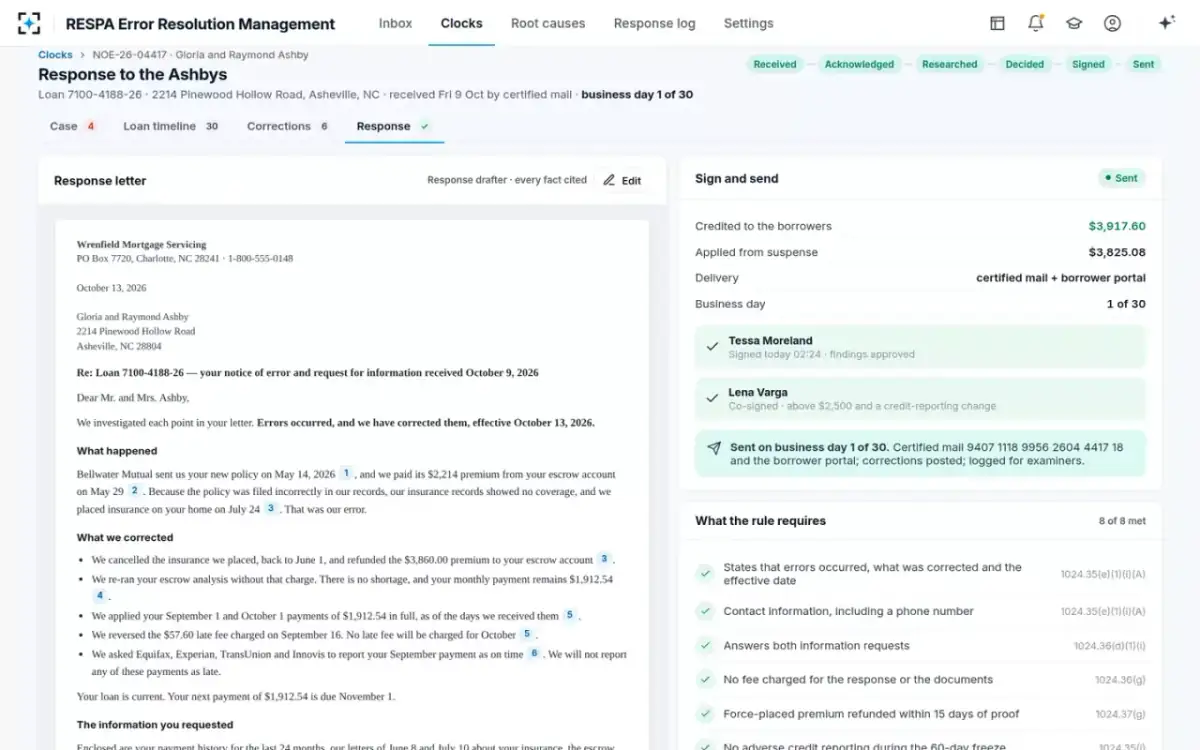
The file also answers the question the next letter will ask. If the borrowers write again with the same assertion and nothing new, the servicer can show it already complied, which is the condition for treating a notice as duplicative. How to tell a template QWR that must be answered from one that may be declined is covered separately. The full product is at RESPA Error Resolution Management.
Questions people ask
How long does a servicer have to respond to a QWR?
Acknowledge within 5 business days and respond within 30, with one 15-day extension if the borrower is told in writing, with reasons, before day 30. A payoff error must be answered in 7 business days, a request for the owner's identity in 10, and a foreclosure error before the sale; none of those can be extended.
Does a QWR response have to be in writing?
Yes. Both the statute and Regulation X require a written notification, whether the servicer corrects the error, finds none, or answers an information request. A phone call can supplement it but not replace it, except in the narrow case of a foreclosure error received seven or fewer days before a sale.
What is the early correction option?
If a servicer corrects the asserted error and tells the borrower in writing within 5 business days of receiving the notice, it need not send a separate acknowledgment or the full response (1024.35(f)(1)). It still has to get the correction right, and any information request in the same letter still needs its own answer.
Can a QWR response go out before the corrections post?
The rule asks for the correction and its effective date, so the safer order is to approve the corrections, set the effective date and send the response that describes them. In the sample servicer's flow the corrections post when the response is sent, so the letter never promises a change the account does not yet show.
Who should review a response to an attorney's QWR?
Legal, before it is signed. An attorney's letter is often the first step toward litigation, and the response and its file will be exhibits. The sample servicer routes every attorney letter and regulator referral to its legal reviewer, with every statement in the draft linked to its source.