Risk-weighted assets are reported in the Call Report on Schedule RC-R, Part II, and the instructions for it do something narrower than the name suggests. Part II is an allocation schedule: a balance is placed in a risk-weight column, each column is multiplied by its weight, and the sum becomes the denominator of the capital ratios. Nothing on the schedule asks why a loan was put in the 50% column rather than the 100% one. That answer lives in the loan's file, and the instructions assume the bank already has it. Regulatory Capital Calculation is Botminds' agentic solution for exactly that gap: it weights each loan from the documents in the file, and keeps the fact, the page it came from and the rule paragraph behind every weight, so any cell on the schedule can be walked back to the loan underneath it.
What follows is a reporting manager's reading of the schedule, written against the FFIEC 051 instruction book the FDIC publishes for the September 2026 report date — the Schedule RC-R, Part II pages, most last revised between 2020 and 2024, and the General Instructions. The FFIEC reissues pages every quarter, so quote the book you actually filed under, and check the page date in the footer.
One loan's path from the core system to a cell on Schedule RC-R
| What the bank holds | Where it is reported on the balance sheet | The condition the capital rules test | The Part II column |
|---|---|---|---|
| First-lien home loan, owner-occupied, current, never modified | Schedule RC-C, Part I, item 1.c.(2)(a) | All four qualifying criteria met | Column H — 50% |
| The same loan, carrying a hardship modification | Schedule RC-C, Part I, item 1.c.(2)(a) | Fails the fourth criterion | Column I — 100% |
| Construction loan whose borrower put in less than 15% of the as-completed value | Schedule RC-C, Part I, item 1.a | High-volatility commercial real estate | Column J — 150% |
| Unused commitment, original maturity one year or less, not unconditionally cancelable | Schedule RC-L, item 1, then Part II item 18.a | A 20% credit conversion factor applies | 20% of the face amount into column B, then a weight column |
| Unused commitment the bank may cancel at any time without cause | Schedule RC-L, item 1, then Part II item 19 | A zero percent conversion factor applies | No risk-weighted amount at all |
Where are risk-weighted assets reported in the Call Report?
Total risk-weighted assets are reported on Schedule RC-R, Part II, and the capital ratios built from them on Part I. Part II runs across lettered columns: column A carries the balance-sheet amount or the face amount of the item, column B carries what comes out or what is converted, and columns C through Q are the risk-weight buckets, running from 0% through 2%, 4%, 10%, 20%, 50%, 100%, 150% and 250% up to 1,250%. Every row of the schedule is one line of the balance sheet or one off-balance-sheet category, and every row has to be fully distributed across those columns.
That last point is the schedule's engineering. The instructions set it out as an identity rather than a suggestion: For items 1 through 8 and 11 of Schedule RC-R, Part II, the sum of columns B through R must equal the balance sheet asset amount reported in column A.
For the off-balance-sheet rows, items 12 through 21, the same discipline applies one step later — the sum of columns C through J, plus column R where it is used, must equal the credit equivalent amount in column B. Nothing may go missing, and nothing may be counted twice.
What goes in Schedule RC-R, Part II: the allocation, then the multiplication
The schedule does two things in sequence, and only the second one is arithmetic. First, every balance is allocated: taken off the balance sheet line it sits on and placed in the weight bucket its exposure class and its facts earn. Second, each bucket is multiplied by its weight and the results are added. The total is the denominator of the risk-based capital ratios, which is why a single loan in the wrong bucket moves three ratios at once; how one loan reaches the CET1 ratio follows that chain to the end.
Column B is where the schedule is most often misread, because it does two unrelated jobs depending on the row. On the asset rows it is a subtraction: it carries the amounts that are deducted from capital or otherwise excluded from risk weighting, such as goodwill, other intangibles, the allowance for credit losses and the threshold deductions. The instructions say column B should include the amount of the reporting bank's on-balance sheet assets that are deducted or excluded (not risk weighted) in the determination of risk-weighted assets.
On the off-balance-sheet rows it is the opposite: column B is the credit equivalent amount, the face amount after the credit conversion factor has been applied. The same column, two meanings, three pages apart in the book.
Column by column: how a weight becomes a cell
A reporting manager does not type a risk weight anywhere on Schedule RC-R. There is no weight field. The weight is expressed by the choice of column, and the choice of column is made by whoever — or whatever — decided the loan's exposure class and tested the conditions attached to it. The schedule is therefore a faithful record of a decision it cannot itself check.
This is the structural reason a capital number can be wrong without anything on the filing looking wrong. If 19 home loans carry hardship modifications that the core still codes as performing, they will sit in the 50% column, the row will foot to column A, the ratios will compute, and every validation check published for the quarter will pass. The error is one level below the schedule, in a fact the schedule never asked for.
Regulatory Capital Calculation: the whole book walked down the risk-weight tree
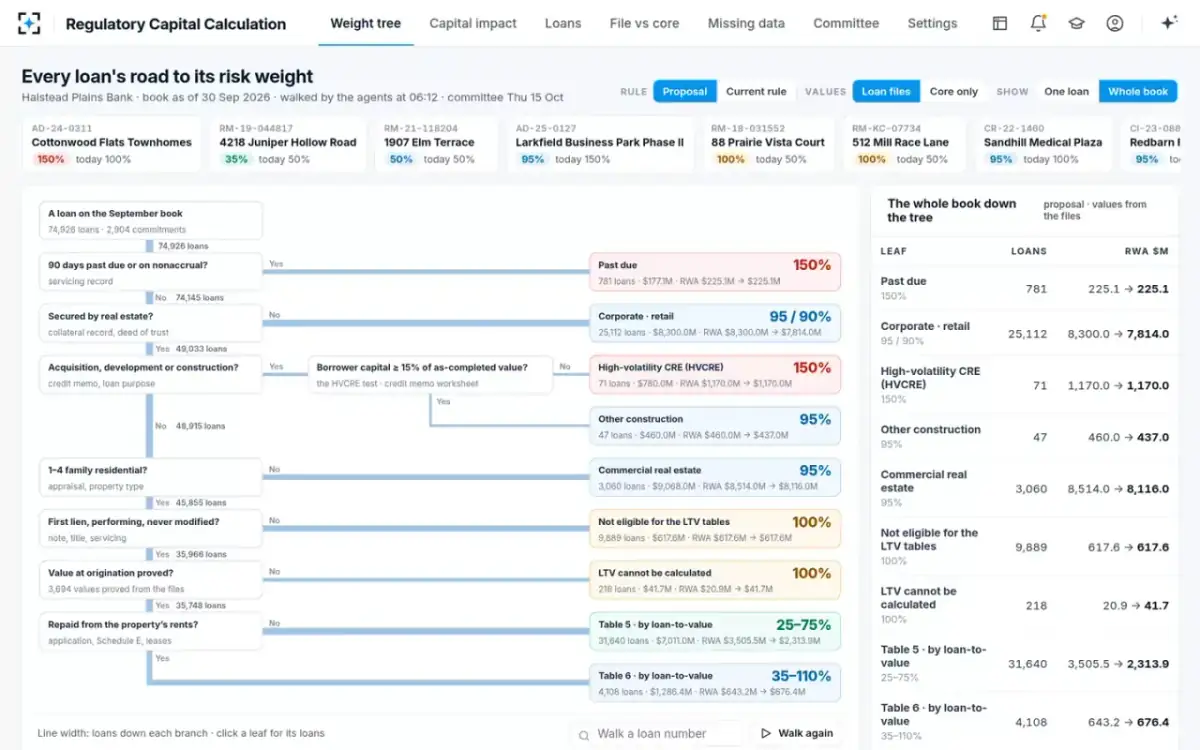
Which column does a qualifying first-lien home loan go in?
A qualifying first-lien home loan held for investment goes in item 5.a, column H, the 50% column. The instructions name the source rows precisely: in column H include the carrying value of loans HFI secured by 1-4 family residential properties included in Schedule RC-C, Part I, item 1.c.(1) (only include qualifying first mortgage loans); qualifying loans from Schedule RC-C, Part I, items 1.c.(2)(a) and 1.d; and those loans that meet the definition of a residential mortgage exposure and qualify for 50 percent risk weight under §.32(g) of the regulatory capital rules.
Loans held for sale follow the same rule one item up, in 4.a. A first-lien loan that does not qualify, and every junior-lien loan, goes in column I at 100%, and so does a qualifying loan once it has been restructured or modified.
Qualifying is where the work is. The instructions restate the capital rule's criteria as four plain conditions, and all four must hold at the report date — not at origination, and not at the last time anyone looked.
The four conditions behind a 50% column, and the document that proves each one
The property is owner-occupied or rented
The application and the servicing file: occupancy at origination, and whether the loan is now repaid from rents.
The loan is prudently underwritten, including the loan amount as a percentage of the appraised value of the collateral
The appraisal or evaluation made at origination, and the credit approval that used it.
The loan is not 90 days or more past due, and not on nonaccrual
The servicing system at the report date, not at boarding.
The loan is not restructured or modified
The modification agreement, if there is one — including a hardship modification nobody re-coded.
Two of these fail quietly, and only one of them changes today's column. Modification status is recorded by the servicing team for servicing purposes, and nobody tells the capital calculation that the loan has stopped qualifying: on the sample book in the screens below, 19 loans carried hardship modifications coded as performing and belong in column I, not H. Occupancy is the other: it is usually captured once, at boarding, and a loan that became a rental keeps the code it was given. Today that does not move the loan, because the 50% band accepts a property that is owner-occupied or rented. Under the March 2026 proposal it would, because a loan repaid from rents is weighted from a separate, higher table — which is why the 312 sample loans coded owner-occupied but repaid from rents are a finding for the proposal's numbers, not for this quarter's filing.
How unused commitments reach the schedule
Off-balance-sheet items take a longer road. They start on Schedule RC-L, are reported at face amount in column A of the relevant Part II row, are multiplied by a credit conversion factor into column B, and only then are allocated to a weight column. For a commitment, the factor turns on two facts: original maturity, and whether the bank may walk away.
The instructions put the cancelable case first in their summary of conversion factors. Off-balance-sheet items subject to a zero percent factor begin with unused portions of commitments that are unconditionally cancelable at any time by the bank
. Those are reported on item 19 and generate no risk-weighted assets at all. A commitment with an original maturity of one year or less that is not unconditionally cancelable goes on item 18.a, and the instruction for the cell is as blunt as it sounds: In column B, report 20 percent of the amount of unused commitments reported in column A.
Longer than a year and not cancelable, and the factor is 50%.
So the whole exposure turns on a sentence in a credit agreement. If the agreement is not in the file, or nobody has read it since the facility was renewed, the honest answer is that the bank does not know which item the commitment belongs on. The conservative treatment — assume it is not cancelable, apply the factor — costs capital; the convenient one understates the denominator. Neither is defensible without the document, which is why the solution treats a commitment with no agreement on file as a finding rather than an assumption, and shows what the assumption is worth.
Who signs and attests to the Call Report?
A named officer signs, and the signature is an attestation about the instructions, not about the arithmetic. The General Instructions are explicit about what the signer is claiming: that the report is prepared in accordance with the instructions and is true and correct, which is the wording of the signature page itself (FFIEC 051 General Instructions). How a bank builds the sub-certifications that let an officer sign that honestly is the subject of the sub-certification process. Where an electronic signature is used, the same book requires the process to carry the date of signing and to associate the signature with the full report.
Alongside that, the chief financial officer — or whoever performs the equivalent function — signs a declaration on the cover page attesting to the correctness of the reports the bank has filed, and directors other than that officer attest to the same correctness: at least three of them at a national bank, state member bank or savings association, at least two at a state nonmember bank. Several signatures, each a separate statement, and between them a chain of people who each certify a different thing.
The four seats a capital number passes through before it is filed
Today
Pulls the book into spreadsheets, samples the loans it cannot code, and extrapolates the rest.
With agents
Starts from every loan already weighted, with the page behind each weight, and spends the week on the exceptions.
Still theirs: Accepting or rejecting every finding, loan by loan.
Today
Argues the hard cases — construction, participations, modified loans — from memory and a memo.
With agents
Sees the memo open at the paragraph the weight rests on, and approves or refuses an override.
Still theirs: The second signature on any override of a weight.
Today
Receives a total, maps it into Part II, and reconciles until every row foots to column A.
With agents
Receives the corrections with the loan list and the page behind each one, before the filing closes.
Still theirs: The decision on what the schedule says, and whether an amendment is needed.
Today
Signs on the strength of the reconciliation and the preparer's word.
With agents
Signs a number any cell of which can be walked back to a document and a rule paragraph.
Still theirs: The attestation itself, which nothing and nobody else can give.
When does a bank have to file an amended Call Report?
When the supervisor says so, and on two separate grounds. The first is classification: the General Instructions let a bank's primary federal supervisor require an amended report where it finds significant errors in the line an item was reported on — which is exactly the Schedule RC-R failure mode, because a loan in the wrong weight column is an item on the wrong line. The second is recognition and measurement, where the test is materiality rather than line placement. The mechanics of refiling are set out in FFIEC Call Report resubmission; what follows is what they mean for a risk weight.
On the measurement side the book adds that amended reports may be required where the authority determines that the reports as previously submitted contain errors that are material for the reporting bank
, and it borrows the accounting definition of materiality to decide what that means. Note who holds the pen in both sentences: the agency determines, and the agency may require. A bank that finds its own error early and corrects it is in a conversation; one whose error is found at an examination is in a process.
There is a third route that catches banks by surprise. Where the agency reads an instruction differently from the bank, the General Instructions let it require the report to be prepared on the agency's reading and earlier reports to be amended — a point the Call Report analyst's guide works through for questions of interpretation. Nobody has to have made a mistake for this to bite. Two defensible readings of the same paragraph are enough, and the agency's reading wins — which is why the rule paragraph a weight rests on is worth recording next to the fact, not just in someone's head.
Where the loan file contradicts the core coding — this quarter's filing, not next year's
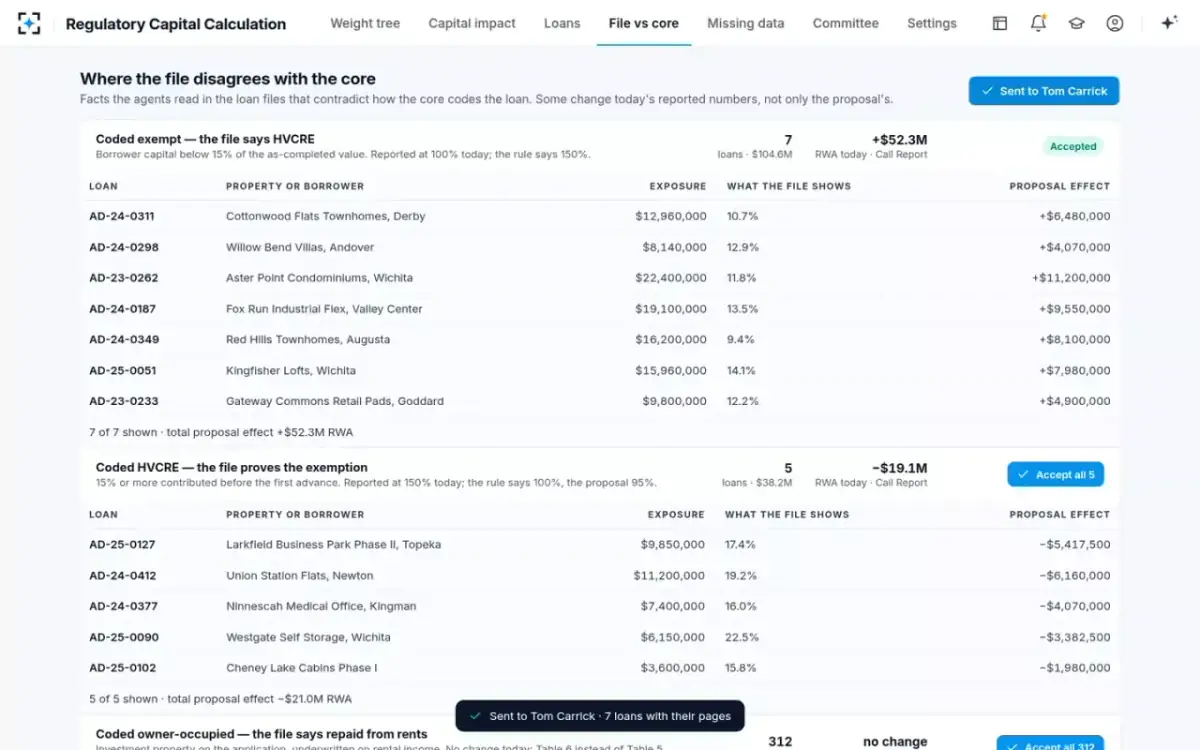
The three-year file behind every cell
The retention requirement is the quiet reason to keep evidence at the loan level rather than at the total. The General Instructions expect a bank to keep the signed and attested report, any amendments, and the related workpapers and supporting documentation for three years after the report date, or longer where state law requires it (FFIEC 051 General Instructions); what counts as evidence in that file is the subject of control evidence.
"Related workpapers and supporting documentation" is doing real work in that requirement. For Schedule RC-R it has to mean more than a reconciliation of the schedule to the general ledger, because the reconciliation proves only that the allocation was arithmetically clean. What an examiner tests is the step before it.
What the three-year file should hold for a single risk weight
- The fact the weight turned on
Occupancy, the value at origination, past-due and modification status, contributed capital, cancelability — stated as a value, not as a conclusion.
- The document and the page it came from
The appraisal, the application, the modification agreement or the credit memo, identified well enough that someone else can open it at the same place three years later.
- The rule paragraph applied
Which paragraph of the capital rules sent the loan to that weight, and which version of the rules was in force at the report date.
- The person who accepted it
Who reviewed the finding, when, and — where the answer was overridden — the written reason and the second approver.
- What was done when the fact could not be found
The treatment used instead, and the risk-weighted assets at stake if the document turns up later. A list is a defensible answer; silence is not.
What an examiner asks for when a cell looks wrong
Examiners do not start with the schedule. They start with a loan, usually one picked because something about it looks inconsistent — a construction facility in a 100% column, a modified loan still at 50%, a large unused commitment with no conversion factor applied. The question is always the same shape: show me why this loan is here.
A bank that answers with its calculation has answered the wrong question. The calculation was never in doubt. What is in doubt is the input, and the chain that has to be produced is: this fact, from this document, at this page, read on this date, applied under this paragraph, accepted by this person. If any link is reconstructed after the question is asked, the reconstruction is what gets tested next.
This is also where the proposal of March 2026 raises the stakes. The agencies built their own impact estimate on the schedule itself — in developing the estimates, they explain, they apply the proposal's risk weights to exposures included in Call Report schedule RC-R and FR Y-9C schedule HC-R for depository institutions and holding companies, respectively.
The industry-level number rests on what banks have reported. A bank's own number cannot, because the facts the new weights turn on were never reported in the first place; where the implementation work actually is takes that apart.
Why the validation checks can pass while the loan is still mis-coded
The FFIEC publishes validation criteria before each quarter end, and an acceptable submission passes the validity edits and explains any quality edit it does not pass. They are genuinely useful: they catch a row that does not foot, a negative where none is possible, a ratio outside a plausible band. What they cannot catch is a loan correctly allocated to the wrong column, because from the schedule's point of view nothing is wrong. Column A equals the sum of B through R either way.
So the control has to sit outside the filing software. Three habits do most of the work. Re-derive the facts rather than inheriting them — read occupancy, modification status and value at origination from the file at the report date, not from the field that was set at boarding. Keep the disagreements rather than resolving them silently: where the file and the core differ, record both and let a person decide which wins. And make the correction route explicit, so a finding reaches the person who owns the filing before the filing closes rather than after it.
That last habit is a governance rule in the solution rather than a preference. Agents never change a core record, the Call Report or the capital plan. They propose; the capital planning lead accepts; the regulatory reporting manager decides whether anything on Schedule RC-R changes. Where software may decide and where it may not sets out why that line is drawn exactly there.
The committee summary: drafted by agents, signed by people
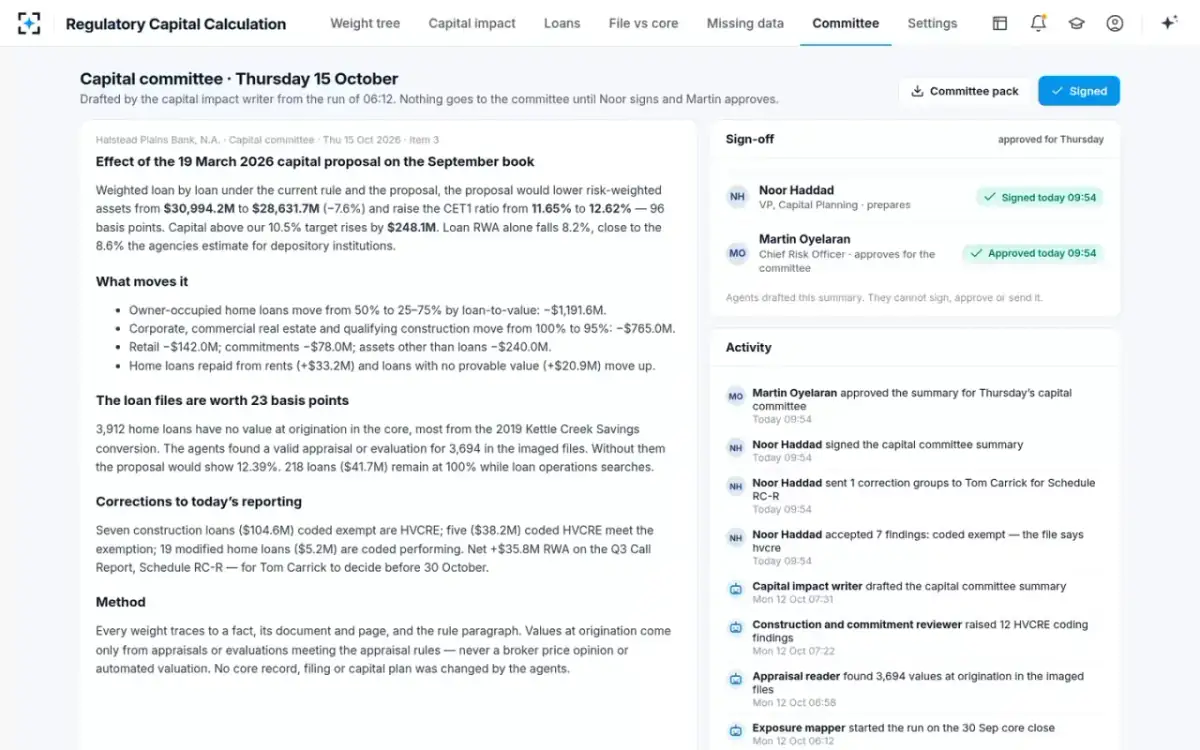
Questions people ask
What is the difference between column A and column B on Schedule RC-R, Part II?
Column A is the amount as reported on the balance sheet, or the face amount for an off-balance-sheet item. Column B differs by row: on the asset rows it carries amounts deducted from capital or excluded from risk weighting, such as goodwill and the allowance for credit losses, and on the off-balance-sheet rows it carries the credit equivalent amount after the conversion factor has been applied. For items 1 through 8 and 11, columns B through R must add back to column A.
Does Schedule RC-R tell a bank how to risk-weight a loan?
Only in part. The instructions tell a bank which column a loan belongs in once its exposure class and qualifying conditions are known, and they restate the capital rule's criteria for common cases such as a 50% home loan. They do not establish the facts — occupancy, value at origination, past-due status, contributed capital — and they direct banks to the capital rules of their primary federal supervisory authority for the complete description of capital requirements.
How long must the workpapers behind a risk weight be kept?
Three years after the report date, together with the signed and attested record of the completed Call Report and any amended reports, unless state requirements call for longer. For risk-weighted assets that means keeping evidence at the loan level, because the thing most likely to be questioned three years later is a single loan's column, not the schedule's arithmetic.
What happens when the agency reads an instruction differently from the bank?
The agency's reading governs. The General Instructions provide that where a bank's primary federal supervisory agency's interpretation differs from the bank's, the agency may require the bank to prepare its Call Report on the agency's interpretation and to amend reports already filed. Recording which rule paragraph each weight rests on makes that conversation a short one, because the disagreement can be isolated to a paragraph rather than relitigated loan by loan.
How are unconditionally cancelable commitments reported?
They are excluded from items 18.a and 18.b and reported on item 19, where a zero percent credit conversion factor applies and they produce no risk-weighted assets. The judgement is whether the bank really may cancel without cause at any time, which is a question about the loan agreement rather than about the core system's product code — so the agreement has to be in the file and have been read.
Can a Call Report pass every validation check and still be wrong?
Yes, and it is an easy failure to miss. The published validity and quality edits test internal consistency: whether rows foot, whether totals reconcile, whether values fall inside plausible ranges. A loan allocated to the 50% column that should be at 100% breaks none of those tests, because the schedule has no view of the loan's file. Errors of that kind are found by re-deriving the facts, or by an examiner pulling the loan.