The US standardized risk weights are a short list: zero for direct United States government exposures, 20 per cent for a US bank or a general obligation of a state or local authority, 50 per cent for a qualifying first-lien home loan, a pre-sold construction loan or a statutory multifamily mortgage, 100 per cent for corporate borrowers and for everything the rule does not name, and 150 per cent for high-volatility commercial real estate and for most exposures ninety days past due. The list takes a minute to read. What takes a quarter is that almost every one of those weights has a condition attached, and almost every condition is a fact about the borrower, the property or the file rather than a fact about the loan — which is how two banks can report an identical loan at 50 and at 100 per cent and both believe they are right. Botminds' Regulatory Capital Calculation settles that by weighting each loan under both the current rule and the proposal and naming the document behind every condition.
Weights below are those of the Federal Reserve Board's capital rule at 12 CFR part 217; national banks and Federal savings associations read the same text at 12 CFR part 3, and state non-member banks and state savings associations at 12 CFR part 324. The sample bank and loans named later are fictional data shown in the solution.
Every general risk weight in the current US standardized approach, and what each one turns on
| Exposure | Weight | The condition attached | What proves it |
|---|---|---|---|
| Direct US government exposure, or one unconditionally guaranteed by it | 0% | The guarantee must be direct and unconditional; a conditional guarantee takes 20% | The guarantee instrument |
| Supranational entities and multilateral development banks | 0% | Named in the rule — the BIS, the ECB, the IMF and others listed | The counterparty |
| US depository institutions and credit unions; exposures to a GSE | 20% | Not an exposure that may be included in the counterparty’s own capital, which takes 100% | Terms of the instrument |
| General obligation of a US public sector entity | 20% | A general obligation; a revenue obligation of the same body takes 50% | The obligation documents |
| First-lien residential mortgage exposure | 50% | Four conditions, all of them: owner-occupied or rented, prudent underwriting against appraised value, not 90 days past due or on nonaccrual, not restructured or modified | Application, appraisal, servicing history |
| Junior-lien residential mortgage, or a first lien failing any condition | 100% | None — this is the band a loan falls into when something cannot be shown | — |
| Pre-sold construction loan | 50% | The purchase contract must stand; if it is cancelled the loan takes 100% | The purchase contract and its status |
| Statutory multifamily mortgage | 50% | The statutory definition, which has its own occupancy and coverage tests | Rent roll, operating statements, the mortgage |
| High-volatility commercial real estate | 150% | Applies unless an exclusion or the four-part commercial real estate exemption is met | The credit approval memo’s contributed-capital worksheet |
| Exposure 90 days or more past due, or on nonaccrual | 150% | On the portion that is not guaranteed or is unsecured; sovereigns, residential mortgages and policy loans are outside this rule | Servicing history, guarantees, collateral |
| Corporate exposures | 100% | The default for a business borrower; cash collateral posted to a qualifying central counterparty is 2% or 4% | The borrower’s classification |
| Other assets | 100% | Everything not specifically assigned another weight and not deducted from capital | — |
What are the US standardized approach risk weights?
They are fixed percentages set by the regulation, one per category of exposure, and a bank's own view of a borrower's creditworthiness does not change them. That is the defining feature of the standardized approach and the reason it is both easy to audit and blunt: a strong corporate borrower and a weak one both weigh 100 per cent, while a home loan that misses one condition by a day jumps from 50 to 100.
Three things follow from that design. First, the weight is only ever as good as the classification, so an error at the sorting stage is invisible afterwards. Second, because the weights are fixed, the whole of a bank's discretion sits in whether it can demonstrate that a condition is met. Third, since conditions are tested at the reporting date rather than at origination, a loan's weight can change without anybody touching it — a borrower slips to ninety days past due, or signs a modification, and the 50 per cent band closes behind it.
First-lien home loans: 50% today, and the four conditions behind it
This is the most consequential weight in a community or regional bank's book, and the one most often claimed without evidence. The rule gives "a 50 percent risk weight to a first-lien residential mortgage exposure" that meets four conditions, and adds that the bank "must base all estimates of a property's value on an appraisal or evaluation of the property that satisfies subpart E of 12 CFR part 208" (12 CFR 217.32(g)(1)). All four must hold. There is no partial credit.
The four conditions a first-lien home loan must meet for 50%, and the page each one rests on
(i)
What the rule requiresSecured by a property that is either owner-occupied or rented
The fact behind itOccupancy at origination, and whether the property is let
Where the fact livesApplication, occupancy affidavit, underwriting file
(ii)
What the rule requiresMade in accordance with prudent underwriting standards, including the loan amount as a percent of the appraised value
The fact behind itValue of the property, resting on an appraisal or evaluation
Where the fact livesThe appraisal or evaluation in the imaged file
(iii)
What the rule requiresNot 90 days or more past due or carried in nonaccrual status
The fact behind itDelinquency and accrual status at the reporting date
Where the fact livesServicing history
(iv)
What the rule requiresNot restructured or modified
The fact behind itModification history, including hardship modifications still coded as performing
Where the fact livesModification agreements in the servicing file
A loan that fails any of the four does not sit somewhere between the bands. It takes the flat weight the rule reserves for the unqualified case, which is the same weight a junior lien takes.
A Board-regulated institution must assign a 100 percent risk weight to a first-lien residential mortgage exposure that does not meet the criteria in paragraph (g)(1) of this section, and to junior-lien residential mortgage exposures.
12 CFR 217.32(g)(2), General risk weights
Under the agencies' March 2026 proposal that same paragraph grows a clause: 100 per cent also applies to a first-lien exposure "for which the Board-regulated institution cannot calculate the LTV" (91 FR 15332). An unprovable loan-to-value becomes, in terms, a punitive weight. What counts as proof, and where to find it, is the subject of the guide on loan-to-original-value.
What risk weight does a past-due loan get?
150 per cent, on the part of it that is not protected, and the rule overrides whatever category the loan was in. "Except for an exposure to a sovereign entity or a residential mortgage exposure or a policy loan, if an exposure is 90 days or more past due or on nonaccrual: (1) A Board-regulated institution must assign a 150 percent risk weight to the portion of the exposure that is not guaranteed or that is unsecured" (12 CFR 217.32(k)). The guaranteed portion may take the weight that the guarantee earns under the rule's credit risk mitigation provisions, and a collateralized portion may take the weight the collateral earns.
Two exclusions catch people out. A residential mortgage that goes ninety days past due does not go to 150 per cent — it fails condition (iii) of the 50 per cent band and goes to 100. And nonaccrual is an alternative trigger, not a synonym for ninety days: a loan placed on nonaccrual at sixty days on judgement is caught by this paragraph as surely as one that aged into it.
Construction, pre-sold construction and statutory multifamily
Construction lending is where the standardized approach stops being a lookup. Three different weights are in play for loans that look alike on a trial balance. A pre-sold construction loan — one built against a binding purchase contract — takes 50 per cent, but the rule attaches the contract to the weight: the bank "must assign a 50 percent risk weight to a pre-sold construction loan unless the purchase contract is cancelled, in which case a Board-regulated institution must assign a 100 percent risk weight" (12 CFR 217.32(h)). A cancelled contract is an event in a file, not a field in a core system, which makes this one of the few weights that can silently become stale.
A statutory multifamily mortgage takes 50 per cent, on its own statutory conditions. Everything else in acquisition, development and construction runs into the high-volatility test, and if that test is not passed the loan is at 150. A construction loan therefore sits anywhere between 50 and 150 per cent depending on facts that live in the purchase contract, the rent roll or the credit approval memo.
HVCRE at 150%, and the loans it does not reach
The rule is one sentence — "High-volatility commercial real estate (HVCRE) exposures. A Board-regulated institution must assign a 150 percent risk weight to an HVCRE exposure" (12 CFR 217.32(j)) — and the work is all in the definition behind it. A credit facility is high-volatility commercial real estate when it primarily finances acquisition, development or construction, has the purpose of turning the property into income-producing real property, and depends on future income, sale or refinancing for repayment.
Several kinds of lending never reach the test at all. Credit facilities financing one- to four-family residential properties, community development investment property and agricultural land are excluded, as are loans on existing income-producing property whose cash flow already supports the debt. Beyond those exclusions sits the four-part commercial real estate exemption, whose contributed-capital test is the one that most often fails. The tests a construction loan must pass works through each branch with a sample loan.
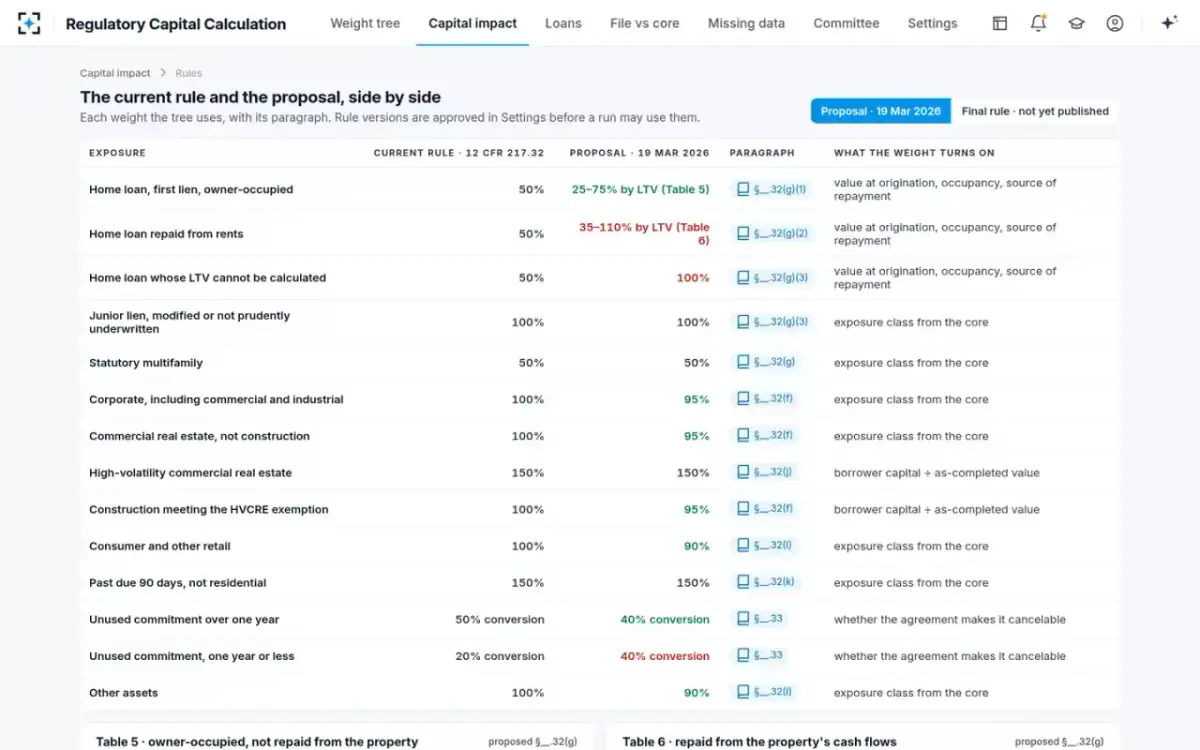
Both rules on one screen in Regulatory Capital Calculation, each weight beside its paragraph
Corporate exposures, and everything the rule does not name
A corporate exposure takes 100 per cent: "A Board-regulated institution must assign a 100 percent risk weight to all its corporate exposures, except as provided in paragraphs (f)(2) and (f)(3) of this section" (12 CFR 217.32(f)), the exceptions being 2 and 4 per cent for cash collateral posted to a qualifying central counterparty. Commercial and industrial lending, loans to non-depository financial institutions, certain farm loans and the unfunded commitments behind them all sit here — the agencies call this group other corporate exposures and count it as the largest asset class, by risk-weighted assets, for the banks the proposal covers.
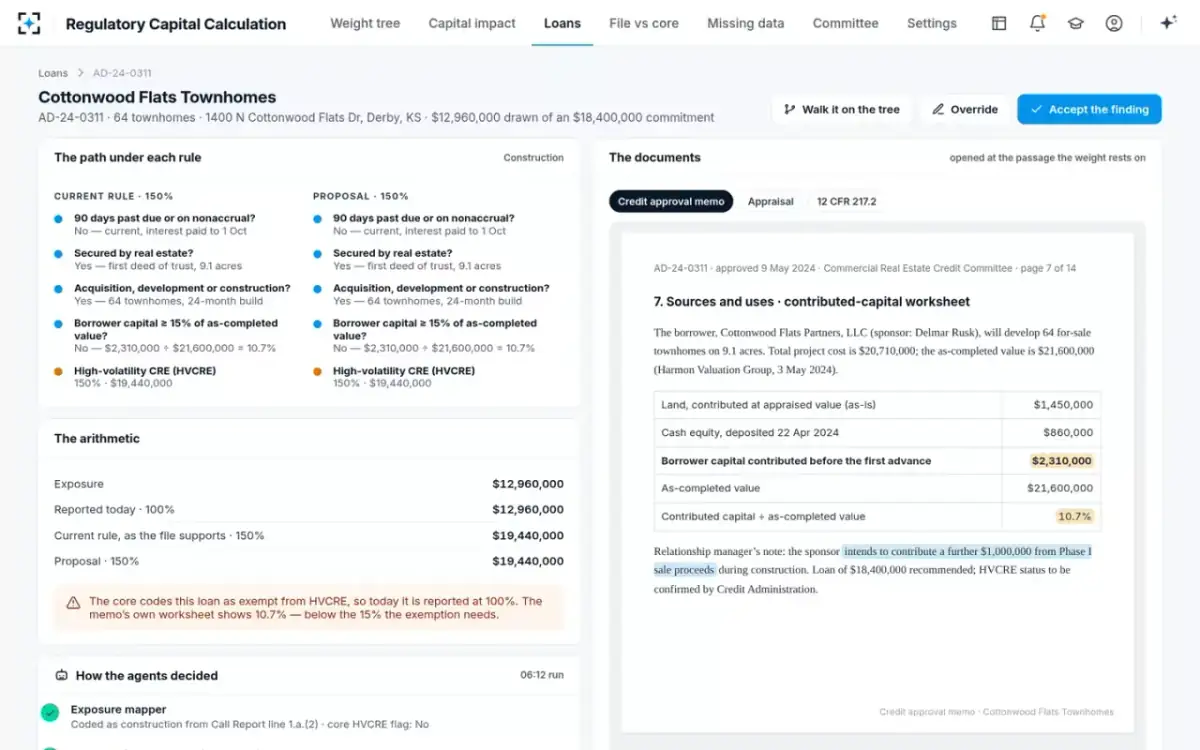
Other assets is the net beneath the net: anything not specifically assigned a weight and not deducted from capital takes 100 per cent. Premises, other real estate owned and sundry receivables land here, which is why a bank that cannot classify something still pays for it. There is one trap in the sample data worth naming, because it is a common one: a construction loan mis-coded as exempt from the high-volatility test is not weighted at the proposal's corporate figure of 95 per cent today. Today it is reported at 100 per cent, because 95 per cent is a number the agencies have proposed and not yet adopted. Writing the proposal's weights into a current-period filing is an error in the opposite direction from the one most banks worry about.
Off-balance sheet: the conversion factor comes first
A commitment carries no weight until it carries an amount. The rule converts the undrawn part first: zero per cent for a commitment that is unconditionally cancelable by the bank, 20 per cent where the original maturity is one year or less and the commitment is not unconditionally cancelable, 50 per cent where it is longer, and 100 per cent for guarantees, financial standby letters of credit, repurchase agreements and forward agreements (12 CFR 217.33). Only then does the counterparty's weight apply.
The conversion factor is therefore worth more than the weight on a revolving book. A $10 million unused line to a corporate borrower is $0, $2 million or $5 million of exposure depending on two terms of one agreement — whether the bank may cancel it at will, and its original maturity — and at 100 per cent that is the whole of the capital charge. Banks that treat cancelability as a product attribute rather than a document fact tend to discover the difference during an examination.
What the March 2026 proposal would move, and by how much
The agencies summarise their own changes in one sentence: "the proposal implements the following major changes: (1) broader range of risk weights for residential mortgage exposures, based on LTV ratios and source of repayment, (2) reduction in the risk weight assigned to corporate exposures from 100 percent to 95 percent, (3) reduction in the risk weight assigned to other assets from 100 percent to 90 percent and (4) replacement of the 20 percent and 50 percent maturity-based credit conversion factors for commitments that are not unconditionally cancelable with a single 40 percent credit conversion factor" (91 FR 15332).
Six exposures as the rule weights them today, and as the proposal would
Current rule: A flat 50% if all four conditions are met; otherwise 100%.
Under the proposal: Read from a table of loan-to-value bands: 25% at or below 50%, 30% to 60%, 35% to 80%, 45% to 90%, 55% to 100%, 75% above 100%.
Current rule: The same 50% band; the source of repayment is not asked about.
Under the proposal: A separate, higher table on the same bands: 35%, 40%, 50%, 65%, 80% and 110%.
Current rule: 100% where a condition cannot be met, with no clause naming the unmeasurable case.
Under the proposal: 100%, named in terms: the exposure takes it where the bank cannot calculate the ratio.
Current rule: 100%.
Under the proposal: 95%.
Current rule: 100%.
Under the proposal: 90%.
Current rule: 20% conversion at an original maturity of a year or less, 50% beyond it.
Under the proposal: One 40% conversion factor, whatever the maturity — which raises the charge on short commitments and lowers it on long ones.
The agencies also published their own estimate of what each category's weights do to risk-weighted assets, which is the closest thing to an answer for a bank that wants to know where its own number will move before it measures.
The agencies' estimated fall in risk-weighted assets, category by category
The aggregate hides a change that runs the other way. Because a one-year commitment would convert at 40 rather than 20 per cent, the agencies note that "this change doubles the recorded exposure amount," and with the corporate weight at 95 per cent the proposal "would increase the risk-weighted asset amount for unused commitments under one year by 90 percent, relative to the baseline." A bank whose commercial book is built on 364-day revolvers should measure before it celebrates; what the 2026 re-proposal changed sets the rulemaking out in full.
A single loan's weight, with the arithmetic under each rule side by side
Reading a weight back: the condition, the fact, the document
The practical test of a weight is whether it can be read backwards. Start from the percentage, name the paragraph that gives it, name the condition that paragraph attaches, name the fact that satisfies the condition, and open the page the fact came from. Five steps, and a weight that survives all five is a weight that survives an examination.
Most weights fail at step four or five rather than at step one. The classification is usually defensible and the arithmetic is always right; what is missing is the appraisal, the worksheet, the modification agreement or the loan agreement clause. That is a records problem that presents as a capital problem, and it is the reason a capital calculation built only from a core extract reconciles beautifully and proves nothing.
Where the weights land across a whole book: Regulatory Capital Calculation on one quarter
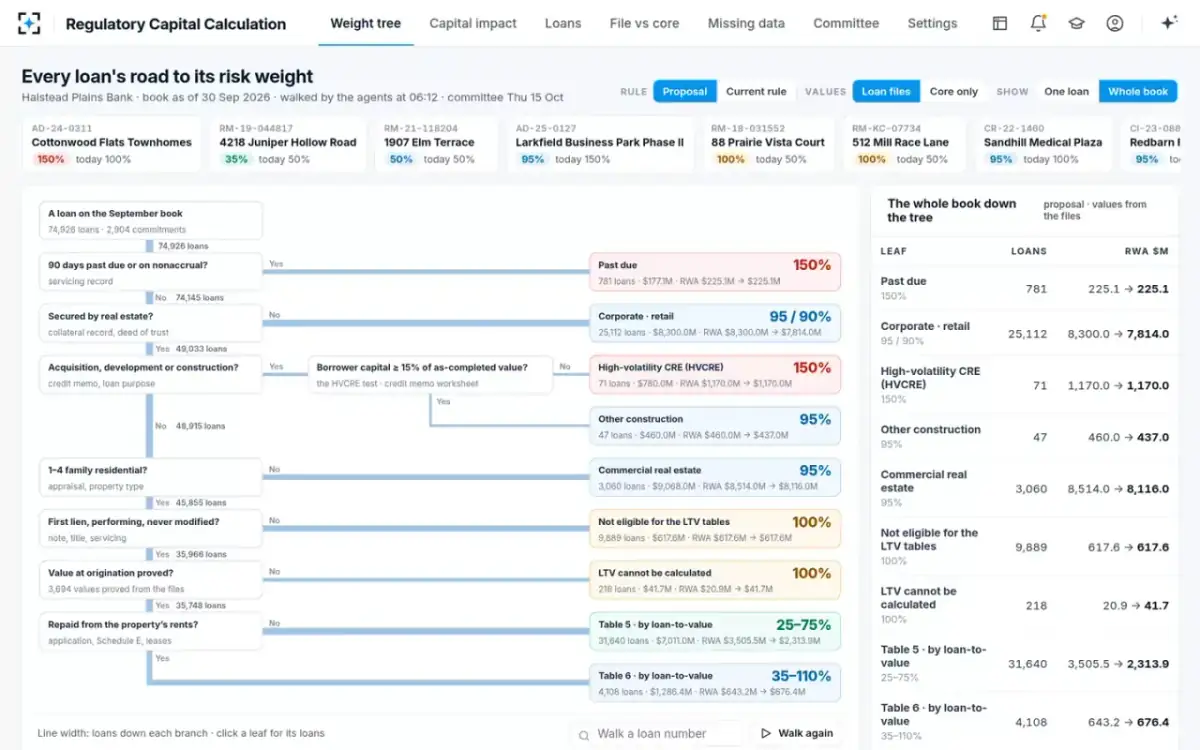
That is the whole of the discipline behind Regulatory Capital Calculation: not a better weight table, which anyone can type, but a weight that can be read back to the page it rests on. The method that produces it, step by step, is set out in how to calculate risk-weighted assets, loan by loan.
Questions people ask
What risk weight applies to a corporate loan?
100 per cent under the current rule, whatever the borrower's rating or the bank's internal grade, with narrow exceptions at 2 and 4 per cent for cash collateral posted to a qualifying central counterparty. The agencies' 2026 proposal would lower the general corporate weight to 95 per cent. Unused commitments to corporate borrowers are converted first and then weighted at the same percentage.
What is the risk weight for assets that do not fit a category?
100 per cent. The rule's other assets category is a deliberate catch-all for anything not specifically assigned a different weight and not deducted from tier 1 or tier 2 capital. Premises and fixed assets, other real estate owned and sundry receivables sit here. The proposal would lower it to 90 per cent, and the agencies estimate a 10 per cent fall in risk-weighted assets for the exposures in it.
Does a junior lien get the same weight as a first lien?
No. A junior-lien residential mortgage exposure takes 100 per cent, and no condition will bring it down. There is one important exception to how the liens are counted: where the bank holds both the first lien and the junior liens on the same property and no other party holds an intervening lien, it must combine them and treat the whole as a single first-lien exposure — which can qualify for 50 per cent if the combined exposure meets the four conditions.
What is a pre-sold construction loan worth in capital?
Half of what an ordinary construction loan is worth, while the contract stands. The weight is 50 per cent, and it reverts to 100 per cent if the purchase contract is cancelled. Because cancellation is an event recorded in the credit file rather than a status in the core, this is one of the few weights that can be correct at origination and wrong at the reporting date with nothing in the data to show it.
Which weights would the March 2026 proposal change?
Four groups. Residential mortgages move from a flat 50 per cent to a table of loan-to-value bands, with a second, higher table for loans repaid from the property's cash flows. Corporate exposures fall from 100 to 95 per cent and other assets from 100 to 90 per cent. The 20 and 50 per cent maturity-based conversion factors for commitments that are not unconditionally cancelable are replaced by a single 40 per cent factor. Comments closed on 18 June 2026 and the rule is not final.
Do national banks and state banks use different weights?
The same weights, in three parallel texts. The Federal Reserve Board's rule is at 12 CFR part 217, the Office of the Comptroller of the Currency's at 12 CFR part 3, and the FDIC's at 12 CFR part 324. The substantive provisions on general risk weights mirror one another, which is why a quotation from one part can be relied on by a bank supervised under another — but the paragraph citation a bank gives its own examiner should be from its own supervisor's part.