HVCRE exemptions come in two kinds, and confusing them is the commonest reason a construction loan is reported at the wrong weight. The first kind is an exclusion: certain lending never reaches the high-volatility definition at all — one- to four-family residential construction, community development property, agricultural land, loans on existing income-producing property that already covers its debt service, and anything made before 1 January 2015. The second kind is the commercial real estate exemption, a three-limb test a project loan has to pass on the evidence in its own file: loan-to-value within the supervisory limit, contributed capital of at least fifteen per cent of the as-completed appraised value, and that capital in before the bank advances funds and contractually required to stay. Miss any limb and the loan weighs 150 per cent. Botminds' Regulatory Capital Calculation tests each limb from the credit file rather than from a core system flag, which is how a loan coded exempt turns out not to be.
The regulation quoted throughout is the Federal Reserve Board's capital rule at 12 CFR part 217; the Office of the Comptroller of the Currency's part 3 and the FDIC's part 324 carry the same definition. The bank, the borrower and the project named below are fictional sample data shown in the solution.
The order the questions have to be asked in, and where each answer ends the walk
Is the facility secured by land or improved real property, and does it primarily finance acquisition, development or construction?
Yes — Keep going.
No — Not high-volatility. Weight it as whatever it is.
Is its purpose to acquire, develop or improve the property into income-producing real property?
Yes — Keep going.
No — Not high-volatility.
Does repayment depend on future income, sale proceeds or refinancing of that property?
Yes — All three limbs met — it is in scope unless an exclusion applies.
No — Not high-volatility.
Is it one- to four-family residential, community development property or agricultural land?
Yes — Excluded — and one- to four-family includes houses, duplexes and townhouses. A loan financing only sewers, water pipes and similar land improvements does not get the one- to four-family exclusion.
No — Keep going.
Is it the acquisition, refinance or improvement of existing income-producing property whose cash flow already supports the debt?
Yes — Excluded.
No — Keep going.
Was the loan made before 1 January 2015?
Yes — Excluded by date.
No — Keep going.
Does it meet all three limbs of the commercial real estate exemption — loan-to-value within the supervisory limit, contributed capital of at least 15% of as-completed value, and that capital in before the first advance and contractually locked in?
Yes — Exempt. Weight it as an ordinary commercial real estate exposure.
No — High-volatility commercial real estate: 150%.
What loans are exempt from HVCRE?
Four groups, and they are not all exemptions in the same sense. The first group never meets the definition: a facility fails to be high-volatility unless all three limbs hold together — it "primarily finances, has financed, or refinances the acquisition, development, or construction of real property," it "has the purpose of providing financing to acquire, develop, or improve such real property into income-producing real property," and it "is dependent upon future income or sales proceeds from, or refinancing of, such real property for the repayment of such credit facility" (12 CFR 217.2). A land loan to an owner-occupier who will repay from an operating business fails the third limb.
The second group is the list of excluded purposes. The third is the date: a loan made before 1 January 2015 is outside the definition entirely. The fourth is the commercial real estate exemption, which is the only one that a bank has to earn with evidence — and the only one an examiner will ask to see a worksheet for.
First, is it an HVCRE exposure at all? Three tests
The three limbs are cumulative and each is a fact about the credit, not about the collateral type. The first is what the money does: acquisition, development or construction, including a refinance of a facility that did one of those things. The second is purpose: turning the property into income-producing real property. The third is the source of repayment: future income, sale proceeds or a refinancing of that same property.
The third limb is where a careful credit officer can often end the analysis. A construction facility to a manufacturer building its own plant, repaid from the manufacturer's operating cash flow, does not depend on the property's future income or sale, so it is not high-volatility however large the construction risk. The distinction is between a project credit and a corporate credit that happens to build something.
The exclusions that come before the capital test
The definition then lifts several categories out before any arithmetic is required. A credit facility financing one- to four-family residential properties is excluded, with a carve-out worth reading twice: facilities "that do not finance the construction of one- to four-family residential structures, but instead solely finance improvements such as the laying of sewers, water pipes, and similar improvements to land, do not qualify for the one- to four-family residential properties exclusion." Property that would qualify as a community development investment is excluded, and so is agricultural land.
What counts as one- to four-family follows the Call Report rather than the lending guidelines. When the agencies finalised the definition in 2019, they said that construction loans on single-family houses, duplexes and townhouses — reported in item 1.a.(1) of Schedule RC-C — qualify for the exclusion, and that condominium and cooperative construction qualifies even for a building of five or more units "as long as the repayment of the loan comes from the sale of individual condominium dwelling units or individual cooperative housing units" (84 FR 68019). A rental apartment building of five or more units does not qualify, and neither does a loan secured by a vacant lot in an established multifamily section. So the first thing to read in a construction file is not the equity worksheet but the unit plan and the exit: sold one by one, or let as a whole.
Two further exclusions concern property that is already earning. The acquisition or refinance of existing income-producing real property is excluded "if the cash flow being generated by the real property is sufficient to support the debt service and expenses of the real property, in accordance with the Board-regulated institution's applicable loan underwriting criteria for permanent financings," and improvements to such property are excluded on the same condition. Note what the condition rests on: the bank's own underwriting criteria for permanent financing, which means the file has to show the test applied, not merely that the property is let.
The document that proves each branch, and what it has to show
- The loan agreement
What the facility finances, the advance mechanics, and any covenant locking the borrower’s equity into the project.
- The credit approval memo’s contributed-capital worksheet
What the borrower put in, in what form, and — the part that decides most cases — when.
- The as-completed appraisal
The denominator of the fifteen per cent test, and the figure the supervisory loan-to-value limit is measured against.
- The advance history
The date of the first advance other than a nominal sum taken to secure the lien, which sets the deadline the contribution had to beat.
- The underwriting file for permanent financing
Needed for the income-producing exclusions: it has to show the bank tested cash flow against its own permanent-financing criteria.
- The purchase contract, where there is one
A separate matter from the exemption, but it decides whether the loan is instead a pre-sold construction loan at 50 per cent.
What is the 15 percent contributed capital test?
It is the second limb of the commercial real estate exemption, and it is stated as a ratio with a very specific denominator. The borrower must have "contributed capital of at least 15 percent of the real property's appraised, `as completed' value to the project in the form of— (1) Cash; (2) Unencumbered readily marketable assets; (3) Paid development expenses out-of-pocket; or (4) Contributed real property or improvements" (12 CFR 217.2). The denominator is the as-completed appraised value of the project, not the loan amount and not the current value of the site.
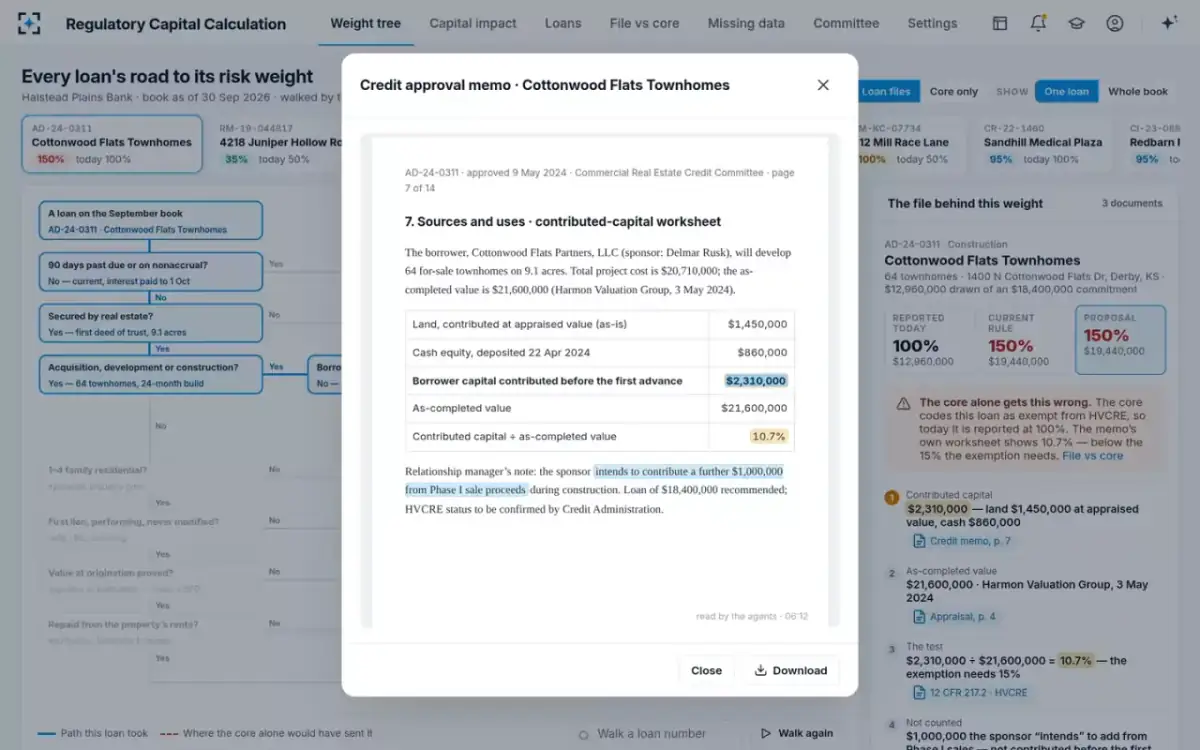
Worked on the sample loan: AD-24-0311, Cottonwood Flats, a construction facility in Derby, Kansas that meets all three limbs and none of the exclusions, with $12,960,000 drawn of an $18,400,000 commitment. The sponsor contributed land appraised at $1,450,000 and $860,000 of cash before the first advance, and says it intends to add a further $1,000,000 later in the project.
What counts towards the fifteen per cent on the sample construction loan, and what does not
Land contributed to the project
$1,450,000
Appraised in connection with the extension of credit, as the rule requires for contributed real property.
In before the first advance
Cash equity
$860,000
Paid into the project and contractually required to remain in it.
In before the first advance
Contribution the sponsor intends to make later
$1,000,000
Promised for later in the project. The rule counts capital contributed before the bank advances funds, so an intention is worth nothing to the test.
Not counted
The same project drawn against its as-completed value: what the sponsor put in, and what the exemption needed
As-completed appraised value, $21,600,000
- Contributed before the first advance · 10.7%
- The further capital the exemption needs · 4.3%
- The rest of the project, financed · 85%
“Before the institution advances funds”: the word that decides most cases
Timing is the limb most easily missed, and it fails quietly because nothing in the arithmetic looks wrong. The rule requires that "the borrower contributed the minimum amount of capital described under paragraph (2)(iv)(B) of this definition before the Board-regulated institution advances funds (other than the advance of a nominal sum made in order to secure the Board-regulated institution's lien against the real property) under the credit facility, and such minimum amount of capital contributed by the borrower is contractually required to remain in the project until the HVCRE exposure has been reclassified."
and such minimum amount of capital contributed by the borrower is contractually required to remain in the project until the HVCRE exposure has been reclassified by the Board-regulated institution as a non-HVCRE exposure
12 CFR 217.2, definition of high volatility commercial real estate exposure
Two requirements hide in that sentence. The capital has to be in before the first real advance, which means the exemption can be lost on a funding sequence rather than on a shortfall. And it has to be locked in by contract for the life of the exposure, so a sponsor free to take a distribution of its equity next year has not met the test even if the money is in the project today. A worksheet that shows only a number and a date answers the first requirement and not the second; the loan agreement has to answer the second.
The page the weight rests on, opened in Regulatory Capital Calculation at the line that decides it
What may be contributed, and at what value
Four forms count: cash, unencumbered readily marketable assets, development expenses paid out of pocket, and contributed real property or improvements. The fourth is the one that needs care, because the rule fixes how it is valued: "the value of any real property contributed by a borrower as a capital contribution is the appraised value of the property as determined under standards prescribed pursuant to section 1110 of the Financial Institutions Reform, Recovery, and Enforcement Act of 1989 (12 U.S.C. 3339), in connection with the extension of the credit facility or loan to such borrower."
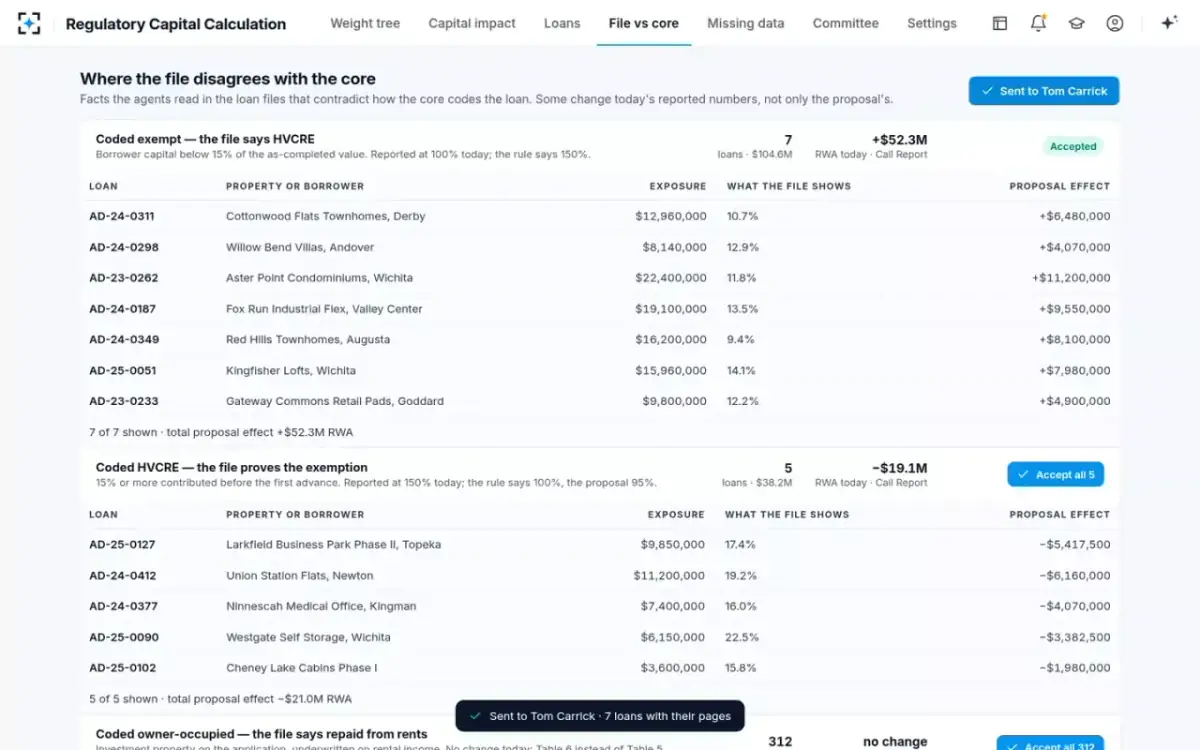
So land counts at its appraised value, appraised in connection with this credit — not at what the sponsor paid for it in 2016, and not at a number in a spreadsheet. A sponsor who bought a site cheaply and contributes it at a current appraised value is doing exactly what the rule allows; a bank that credits the purchase price because that is what the memo recorded is understating the contribution and may be reporting at 150 per cent a loan that qualifies. Coding errors run in both directions: alongside the loans wrongly coded exempt, the sample bank's review found five coded high-volatility that meet the exemption on their documents.
The supervisory loan-to-value limit the exemption also needs
The first limb of the exemption is easy to overlook because it points somewhere else: "The loan-to-value ratio is less than or equal to the applicable maximum supervisory loan-to-value ratio as determined by the Board." Those limits are in the interagency real estate lending guidelines, which say that institutions "should establish their own internal loan-to-value limits for real estate loans" and that "these internal limits should not exceed the following supervisory limits" (Appendix C to 12 CFR part 208).
The supervisory loan-to-value limits the exemption's first limb points at
| Loan category | Limit |
|---|---|
| Raw land | 65% |
| Land development | 75% |
| Construction: commercial, multifamily and other nonresidential | 80% |
| Construction: 1- to 4-family residential | 85% |
| Improved property | 85% |
| Owner-occupied 1- to 4-family and home equity | No limit set; at 90% or above at origination the guidelines expect mortgage insurance or readily marketable collateral |
The guidelines measure the ratio on the whole extension of credit, including the undrawn commitment, against the value of the property being improved. On the sample project, $18,400,000 of commitment against an as-completed value of $21,600,000 is about 85 per cent — above the 80 per cent limit for commercial and multifamily construction. So the loan misses the exemption on the contributed-capital limb, and on these figures the loan-to-value limb would need its own answer too: more equity alone would not necessarily make it exempt. A bank working through its construction book should test all three limbs before telling a sponsor what a further contribution would buy.
When an HVCRE loan stops being HVCRE
Reclassification is permitted, not automatic, and it needs two things at once. A bank "may reclassify an HVCRE exposure as a non-HVCRE exposure upon— (i) The substantial completion of the development or construction of the real property being financed by the credit facility; and (ii) Cash flow being generated by the real property being sufficient to support the debt service and expenses of the real property, in accordance with the Board-regulated institution's applicable loan underwriting criteria for permanent financings."
Substantial completion alone is not enough; the property has to be earning, measured against the bank's permanent-financing criteria. In practice that means reclassification is an event with evidence behind it — a certificate of occupancy or equivalent, a rent roll, an operating statement and a documented test — and a quarter in which it happens. A construction book that shows no reclassifications in two years is either unusually unlucky or is not looking.
What happens if the credit file has no worksheet?
The loan is high-volatility commercial real estate at 150 per cent, because the exemption is something the bank asserts and must be able to support. The rule gives one weight and one exemption with conditions; a condition nobody can demonstrate has not been met for reporting purposes, whatever happened at origination.
The defensible policy is to make that the default rather than the exception. In the sample bank the evidence standard is fixed: a loan is never treated as exempt without the worksheet, and three construction memos that arrived without one are weighted at 150 per cent until the document is produced. That is a smaller number than it sounds, and it is honest in a way an assumption is not — the alternative is a weight the bank cannot explain in an examination.
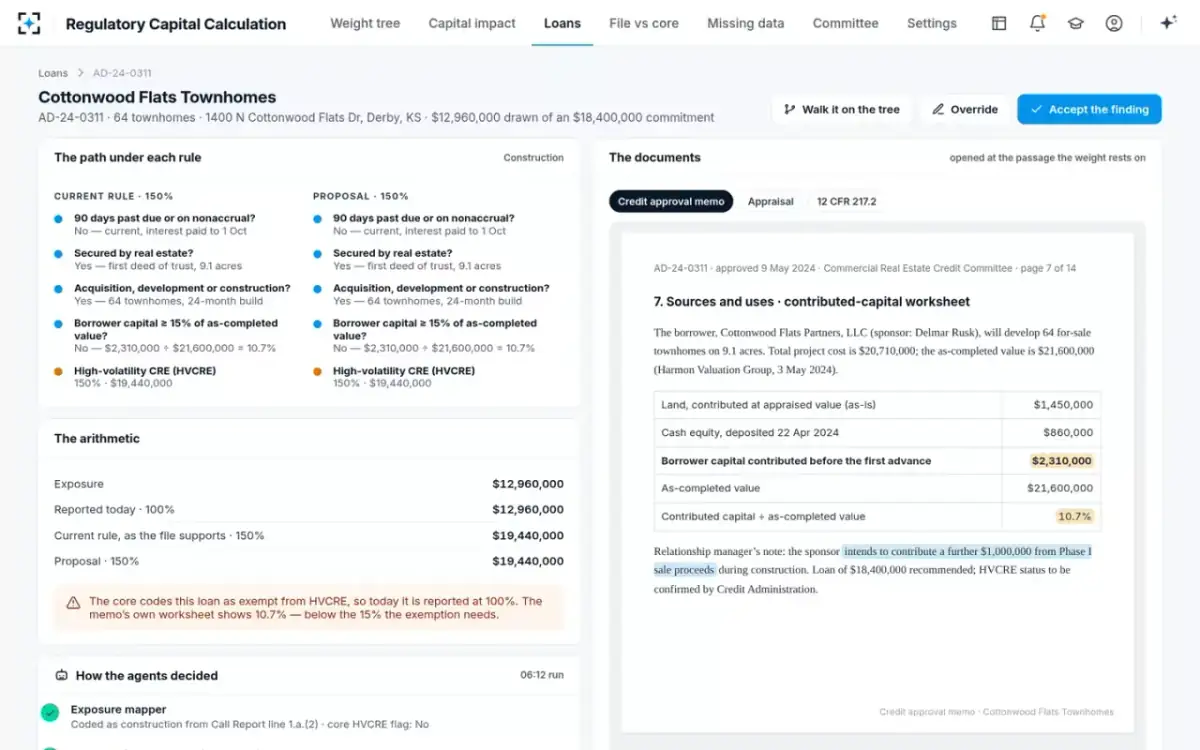
One construction loan's two paths: the weight the core would have given it, and the weight the file supports
What a mis-coded loan costs on this quarter's report
Fifty points of weight. The rule assigns "a 150 percent risk weight to an HVCRE exposure" (12 CFR 217.32(j)), while a construction loan that is not high-volatility sits with ordinary commercial real estate at 100 per cent under the current rule. The difference is therefore half the drawn balance in risk-weighted assets, and it lands in the current quarter rather than in some future rulemaking.
The sample bank's construction book, as coded and as the files test it
As the core codes it: $104.6M of drawn balance reported as ordinary commercial real estate at 100%.
As the file tests it: High-volatility on the file evidence: 150%, or +$52.3M of risk-weighted assets on this quarter’s report.
As the core codes it: $38.2M at 150%, because somebody was cautious at origination.
As the file tests it: They meet the exemption on the documents: 100%, or −$19.1M.
As the core codes it: Whatever the core says, nothing in the file supports an exemption.
As the file tests it: Treated as high-volatility until the worksheet is produced, and listed as a document to find.
As the core codes it: Nothing: the coding is consistent with itself, so a reconciliation finds no error.
As the file tests it: The findings go to the regulatory reporting manager with the pages, and the decision on the filing stays theirs.
Where the file disagrees with the core: Regulatory Capital Calculation on one construction book
That is the practical reason to treat construction coding as a documents exercise rather than a data exercise. The method behind it, step by step, is in how to calculate risk-weighted assets, loan by loan; where 150 per cent sits among the other weights is in the exposure-by-exposure table; what the agencies' 2026 proposal would and would not change about construction lending is in what the re-proposal changed; and the whole of it runs in Regulatory Capital Calculation.
Questions people ask
Can land count towards the borrower's contribution?
Yes. Contributed real property or improvements is one of the four permitted forms, alongside cash, unencumbered readily marketable assets and development expenses paid out of pocket. The rule fixes the value: contributed real property counts at its appraised value, determined under the appraisal standards prescribed under section 1110 of FIRREA, in connection with the extension of credit. A historic purchase price is not the figure the test uses.
What is the as-completed value for the HVCRE test?
The appraised value of the real property as completed — what the finished project is worth — and it is the denominator of the fifteen per cent test. It is not the loan amount and not the cost of construction. The agencies allow an "as is" value where no as-completed value exists, such as raw land with no near-term development plan, and an evaluation where the appraisal rules permit one instead of an appraisal. Because the same figure also carries the supervisory loan-to-value comparison, an as-completed appraisal that is missing from the file blocks two limbs of the exemption at once.
Are one-to-four family construction loans HVCRE?
No. Credit facilities financing the acquisition, development or construction of one- to four-family residential properties are excluded, and the agencies read that to include houses, duplexes, townhouses and condominium units built for sale one by one. Two boundaries are worth knowing: a facility that solely finances improvements such as laying sewers and water pipes does not get the exclusion, and neither does construction of a rental building of five or more units.
Does HVCRE apply to loans made before 2015?
No. The definition states that an HVCRE exposure "does not include any loan made prior to January 1, 2015." There is a second, narrower provision for loans just after that date: a bank is not required to reclassify a credit facility originated on or after 1 January 2015 and before 1 April 2020. Both are exclusions by date and need nothing proved beyond the origination date itself.
Does capital contributed after the first advance count?
Not towards the exemption. The rule requires the minimum contribution to be in before the bank advances funds, other than a nominal sum advanced to secure its lien. Capital put in later is real money and improves the credit, but it does not retrospectively qualify the loan. That is why a sponsor's commitment to contribute sale proceeds from a first phase, however firm, is worth nothing to the test when the advances have already started.
When can an HVCRE loan be reclassified?
On two conditions together: substantial completion of the development or construction, and cash flow from the property sufficient to support its debt service and expenses, measured against the bank's own underwriting criteria for permanent financing. Reclassification is permissive — the rule says a bank may reclassify — so it is also a decision with a date and evidence behind it, and it should be recorded as one rather than applied as a maturity rule.