Basel III endgame implementation is not a calculation project, and treating it as one is the most common way to spend a year and arrive with a number nobody can defend. The OCC's cost estimate inside the March 2026 re-proposal puts the hours into systems development, data acquisition, data aggregation and reporting, calculation and verification, training and risk management — six categories, of which exactly one is arithmetic. The part that cannot be compressed by better software alone is finding facts that were never in the core system: the value at origination of a loan booked in 1998, the occupancy of a house that became a rental, the contributed-capital worksheet behind a construction facility. Regulatory Capital Calculation is Botminds' agentic solution for that part, and this guide is the sequence a programme owner can plan against whether or not they use it.
Published figures below come from the agencies. Figures describing a bank come from the fictional sample book that ships with the solution, Halstead Plains Bank, and are sample data rather than a customer's result. The day estimates are our own, labelled where they appear.
The rule's own calendar, from board action to an illustrative effective date
- Comment period, 27 March to 18 June 202683 days
- Agencies consider comments, to an illustrative 1 January 2027 effective date197 days
How long does Basel III endgame implementation take?
Long enough that it should already be under way, and the honest unit is not months but person-hours. The OCC published its own estimate inside the proposal, and the arithmetic can be unpacked. Aggregating per-bank compliance costs for all 955 affected OCC-supervised banks results in an aggregate one-time implementation cost estimate of approximately $361 million
, and the OCC prices staff time at $131.10 per hour
, drawn from May 2024 Bureau of Labor Statistics wages for credit intermediation, adjusted for inflation and benefits.
Divide one by the other and the average affected bank is being asked to spend roughly $378,000, or about 2,880 hours — something close to a year and a half of one full-time person, spread across six functions and compressed into whatever window the final rule allows. That is our arithmetic on the agencies' two numbers, and it is an average across banks of every size: a $700 million community bank and a $90 billion regional are both inside it.
The agencies' own numbers for getting ready
$131.10
per hour, the OCC's compensation rate for bank staff doing this work
$361M
estimated one-time implementation cost across 955 affected OCC-supervised banks
~2,880hrs
implied per bank on average — our arithmetic on the two figures above
1,082
small FDIC-supervised institutions that report risk-weighted assets, as of 30 June 2025
What the agencies estimate it costs a bank
The estimate above is the one-time figure, and it is worth reading what the OCC says it covers before using it in a budget. In determining the total hours per bank, OCC staff considered the total hours needed per bank, on average, for systems development, data acquisition, data aggregation and reporting, calculation and verification, training, and risk management.
The agencies also note that these estimates are approximate and that banks within the same size category will differ.
Two things are missing from the number, and both matter to a plan. It is one-time, so it excludes the quarterly cost of running the new calculation for ever afterwards. And it is a compliance cost estimate, not a programme budget: it does not include the cost of reading documents that were never digitised, chasing appraisals held by a predecessor institution, or re-coding a portfolio acquired in a merger. On most books those three are where the time goes.
Where the hours actually go: the agencies' six categories
Take the OCC's six categories and ask, for each, whether the work is bounded by effort or by availability. Systems development, calculation and verification, training and risk management are bounded by effort: hire or buy, and they finish. Data acquisition and data aggregation are bounded by availability, because the answer is in a document that may or may not exist, and no amount of staffing conjures an appraisal that was never scanned.
That asymmetry is the whole planning insight. A programme that sequences the effort-bounded work first — build the calculation, then go looking for data — discovers its real problem in month seven. A programme that starts the document search on day one has the same total work but a far shorter critical path, because the searching runs in parallel with everything else.
Where a hand-run whole-book impact exercise spends its days
What a bank should do before the rule is final
Three things, none of which depend on the final text. Measure the book under the proposal as it stands, so the direction and rough size of the effect are known. Inventory the data the new weights need and find out how much of it exists. And fix what is already wrong, because a mis-coded loan is mis-reported today, under the rule in force, regardless of what happens to the proposal.
The third is the one programme plans usually omit, and it is the one with a deadline. On the fictional sample book, seven construction loans totalling $104.6M are coded exempt from the high-volatility test but fail it on their own worksheets: $52.3M of risk-weighted assets missing from the current quarter's filing, not from some future one. Five more are coded the other way, and 19 home loans carry hardship modifications coded as performing. Those are findings for this quarter — unlike the 312 home loans coded owner-occupied that are repaid from rents, which the current 50 per cent band accepts and only the proposal would re-weight; how a correction reaches Schedule RC-R is the route they take.
The decision before the project: compute risk-weighted assets at all?
For a community bank there is a prior question that the whole programme turns on, and 2026 changed its answer. The community bank leverage ratio framework lets a qualifying institution satisfy the risk-based requirements without computing them, and the final rule published on 29 April 2026, effective 1 July 2026, lowered the framework's leverage requirement from 9 to 8 per cent, the floor the 2018 Economic Growth, Regulatory Relief, and Consumer Protection Act allows. The FDIC estimated that the change makes 240 more institutions eligible, and that about 158 more small institutions would be expected to elect (91 FR 22973).
The agencies are blunt about what electing saves: These electing IDIs will benefit by avoiding the costs associated with gathering, recording, and reporting various risk-based capital measures. Those that operate internal recordkeeping systems to comply with risk-based capital regulations may discontinue or simplify these systems.
Against that, the proposal would expand by approximately $31 billion the aggregate balance sheet capacity of small institutions that do report risk-weighted assets — so the choice is between a genuine saving in effort and a genuine gain in capacity.
It is a board decision, not a project decision, and it should be taken before anyone is asked to build anything. A bank comfortably above 8% leverage with a simple balance sheet may rationally stop here. A bank whose book is mortgage-heavy, where the proposal's loan-to-value bands are worth real capital, probably should not; what a basis point is worth is the arithmetic that settles it.
First, measure: a whole-book impact run without a full build
The first deliverable is a number, not a system. A whole-book impact run weights every loan and commitment under the current rule and the proposal, in one pass on one close, and produces the difference by segment. It does not need integration, a data warehouse or a new reporting chain; it needs a copy of the book, access to the files, and a defensible method.
Doing it by hand takes about seven weeks of one person's time on a book of this size, dominated by the document search. Doing it with agents reading the files takes about a week, and the shape of the saving is as interesting as its size: the bars that shrink most are the ones where the work was searching rather than thinking.
One whole-book impact run: where the days go, by hand and with Regulatory Capital Calculation
By hand — about 35 days
- Pulling the book · 14.3%
- Finding appraisals · 42.9%
- Checking coding · 17.1%
- Weighting under both rules · 11.4%
- Summary, review and sign-off · 14.3%
With the agents — about 5 days
- Pulling the book · 10%
- Finding appraisals · 20%
- Checking coding · 20%
- Weighting under both rules · 10%
- Summary, review and sign-off · 40%
Second, find: the documents the new weights need
Start the search before the calculation is finished, and start it as an inventory rather than a retrieval. The question is not "fetch me 3,912 appraisals"; it is "for each of these six facts, which system should hold it, and in how many cases does it actually?" The answer is usually uncomfortable and always specific to the bank's acquisition history.
The six data items to inventory first, and where each one really lives
- Value at origination, for every real estate loan
Should be in the core or the collateral system. Is often only in the appraisal or evaluation in the imaged file — and for acquired portfolios, sometimes in neither.
- Occupancy, and whether the loan is repaid from rents
Captured once at boarding and rarely revisited. The current answer is in the application, the underwriting file and the servicing history, not in the field.
- Past-due and nonaccrual status at the report date
The one item the servicing system genuinely owns. Take it at the report date, not at the date the run happens.
- Modification and restructuring status
Recorded by the servicing team for servicing purposes. A hardship modification that nobody re-coded for capital purposes is the classic quiet failure.
- Contributed capital on construction loans, before the first advance
In the credit approval memo's worksheet, if there is one. Where there is no worksheet, the conservative treatment is the only defensible one.
- Whether a commitment is unconditionally cancelable
A sentence in the loan agreement. The product code in the core is a proxy for it, and proxies do not survive examination.
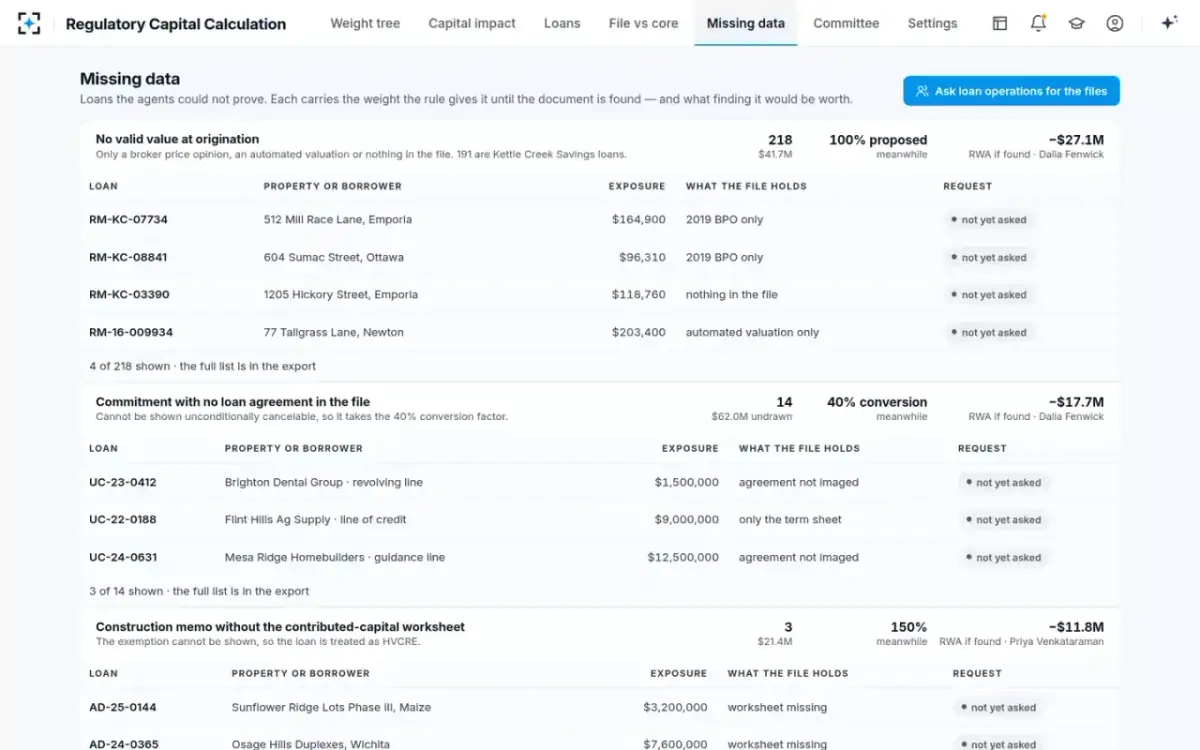
Expect the inventory to end with a list rather than a zero, and plan for that out loud. On the fictional sample bank, 218 loans — $41.7M of balances — still had no valid value at origination after the search, 191 of them from a single acquired portfolio whose files hold only a 2019 broker price opinion. They sit at the punitive weight meanwhile, and finding the documents would lower risk-weighted assets by about $27.1M. A programme that reports a clean total has either been lucky or has stopped looking.
The loans the run could not prove, and what each is worth if the document is found
Third, correct: the findings that change this quarter's filing
The third stream is the one with the nearest deadline and the least glamour. Every fact the search establishes is also a test of what the core says today, and some of those tests fail in the direction that costs capital now. Those findings belong to the regulatory reporting manager, not to the capital programme, and they need to arrive before the filing closes rather than in a project report afterwards.
Set the materiality threshold and the routing deliberately. On the sample bank, findings below $1,000,000 are listed but not escalated, findings above it go to the reporting manager with the loan, the document and the page, and nothing is changed by the software in either case. The reason to write that down early is that the first material finding always arrives at an inconvenient moment, and an argument about the route is a worse use of the week than the correction itself.
Who needs to be on the project, and what each person decides
Five seats, and the test of a plan is whether each has a decision rather than a task. A programme staffed with contributors and no decision-makers produces an excellent analysis that nobody can act on.
Five seats, and the one decision each one owns
Today
Builds the model, pulls the book, chases the facts and writes the paper — typically alone.
With agents
Reviews findings against a book already weighted twice, and spends the time on the exceptions.
Still theirs: Decides: whether each finding is accepted, and signs the result.
Today
Consulted late, usually to adjudicate a dispute about a handful of construction loans.
With agents
Sees the worksheet behind every construction loan, and approves or refuses overrides as they arise.
Still theirs: Decides: whether an override of a weight stands.
Today
Receives a broad request to improve data quality, with no way to price the work.
With agents
Receives a named list of loans and the risk-weighted assets at stake for each missing document.
Still theirs: Decides: the order documents are retrieved in, and when a file is genuinely exhausted.
Today
Learns of coding problems when the examination finds them.
With agents
Receives material findings with their evidence before the filing closes.
Still theirs: Decides: what the Call Report says, and whether an amendment is needed.
Today
Approves a capital estimate built on a sample and an extrapolation.
With agents
Approves a number where any loan can be walked back to a document and a rule paragraph.
Still theirs: Decides: whether the bank stands behind the number.
Re-running the book when the final rule is published
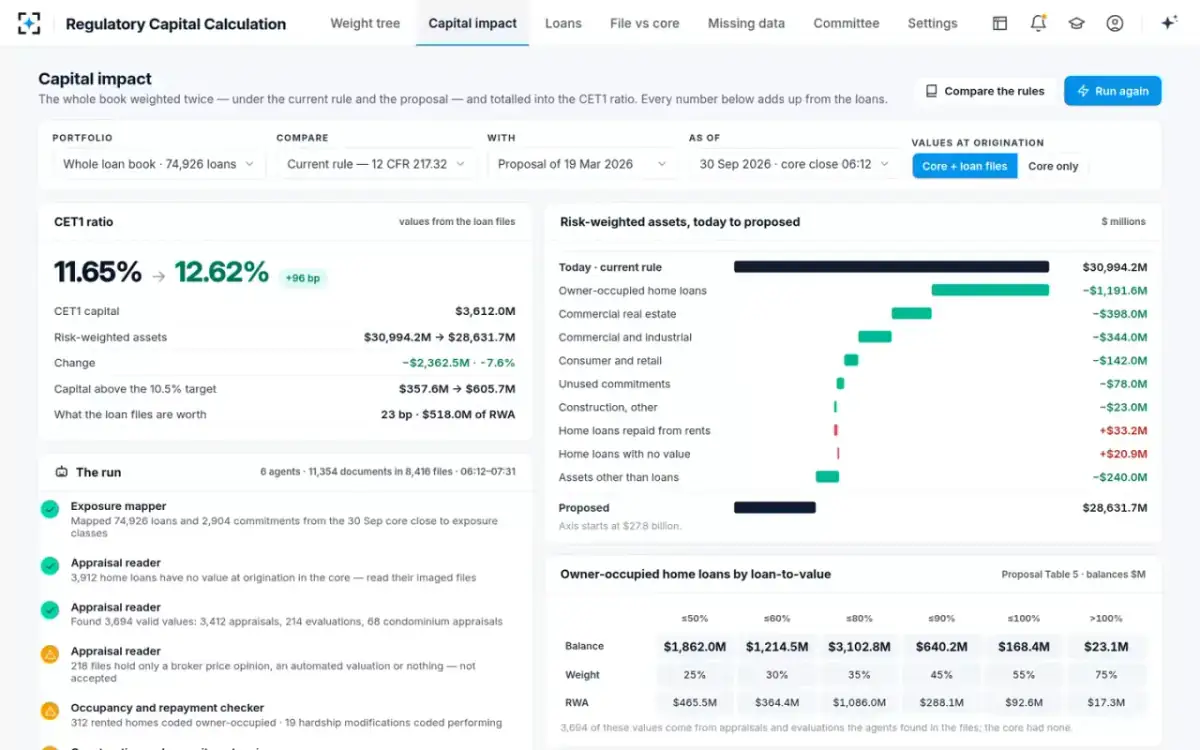
Assume the final rule will differ from the proposal — the agencies rescinded their 2023 proposal rather than finalise it (91 FR 14952) — and design so that the difference costs a re-run rather than a rebuild. That means treating a rule version as data: loaded, reviewed, approved by a named person, and recorded against every number produced under it. On the sample bank, the current rule and the proposal are both loaded, the proposal is approved for impact runs only, and the book is re-walked at every month-end close as well as whenever a new version is approved.
The part worth rehearsing before the final rule lands is the approval, not the calculation. If the only way to adopt a new rule version is a change request to a vendor, the bank's capital number is on someone else's release schedule. What to ask a vendor turns largely on that one question.
The capital effect, re-measured whenever a rule version is approved
What you should be able to show an examiner at the end
Not a model document and not a reconciliation, but a loan. The end state of a well-run programme is that someone can pick any loan from the book and get five things in about two minutes: the fact that set its weight, the document and page the fact came from, the rule paragraph applied, the version of the rules in force at the report date, and the name of the person who accepted it. Where the answer was overridden, the written reason and the second approver come with it.
The retention requirement behind that is three years from the report date for the signed and attested report, the related workpapers and the supporting documentation, longer if state law says so. Three years is long enough that nobody will remember, which is the argument for recording the chain while the decision is being made rather than assembling it when asked. The programme that produces that file as a by-product of running is finished; the one that can produce it only as a special exercise is not.
Questions people ask
How do you measure the impact without a full implementation?
Run the whole book once, on one close, under both rules at the same time, and accept that the output is an impact estimate rather than a reporting system. That gives the direction, the size and the segment attribution, and it surfaces the data problems that the real implementation will hit. On a book the size of the sample bank's it takes about seven weeks of one person's time by hand, or about a week when the document reading is done by agents — our estimate, not a measured result.
Which data is missing most often, and how do you find it?
Value at origination, by a wide margin, especially for portfolios acquired in a merger where the field was not carried across in conversion. After that, occupancy that was captured once at boarding, and modification status recorded for servicing purposes but never reflected in the capital coding. All three are usually in the imaged file rather than lost — the work is searching, which is why it is the longest bar in any honest plan.
Do we have to re-run the book when the final rule is published?
Yes, if the capital effect is to be stated under the rule that will actually apply. The practical requirement is that a rule version can be loaded and approved without a rebuild, and that every number carries the version it was produced under. A programme that has rehearsed this with the proposal will do it in days; one that has hard-coded a rule will do it in a release cycle.
What can be reused from the current reporting process?
The capital numerator, the general ledger reconciliation, the governance around who signs, and the non-loan risk-weighted assets that come from the regulatory reporting system. What cannot be reused is the loan-level attribute set, because the new weights turn on facts the current rule never asked for — which is why the work feels disproportionate to a schedule that is only being re-cut.
Should a community bank leave the leverage ratio framework to get the relief?
Only after doing the arithmetic on its own book. Electing into the framework avoids the cost of gathering and reporting risk-based measures entirely, which the agencies name as a real benefit; staying out and computing risk-weighted assets is worth more to a bank whose book the new weights treat kindly. The FDIC's own estimate of the benefit to small institutions that do report ranged from $1,600 to $7.1 million of additional capital buffer, which is a wide enough range that no general answer is useful.
How do you prove a weight to an examiner afterwards?
By producing the fact, the document and page, the rule paragraph, the rule version and the person who accepted it — on the loan the examiner picked, not on a representative sample. The supporting documentation behind a filing is kept for three years, so the chain has to be recorded at the time, as part of the run, rather than reconstructed when the question is asked.