To calculate risk-weighted assets, take every exposure the bank holds, put each one in the category the capital rule names, work out how much of it counts, find the single fact the rule makes the weight turn on, multiply the amount by the weight, and add the products together. The arithmetic is one line of a spreadsheet. The difficulty is in the third step, because the fact the rule asks for is very often not a fact the core banking system holds: whether a home is owner-occupied, what the property was worth on the day the loan closed, whether a construction borrower put fifteen per cent in before the first advance. Botminds' Regulatory Capital Calculation walks every loan down that tree under the current rule and the agencies' March 2026 proposal, and reads the loan file for each fact a weight turns on, so the number can be rebuilt loan by loan rather than estimated from a sample.
The bank, the people and the loans named below are fictional sample data, shown as they appear in the solution. The rules, the quotations and the arithmetic are real, and every regulatory source is linked under the figure that uses it.
One quarter's calculation, in the shape of the work behind it
74,926
loans to classify, measure and weight at one quarter end
2,904
commitments that never appear on the balance sheet but still carry capital
11,354docs
documents read in 8,416 loan files to answer the questions the rule asks
1number
that leaves the bank: total risk-weighted assets, the denominator of every ratio
How do you calculate risk-weighted assets?
Risk-weighted assets are calculated exposure by exposure, in four steps that always run in the same order. First, classify: decide which category of the capital rule the exposure belongs to — a sovereign, a bank, a corporate borrower, a first-lien home loan, a construction loan, a past-due loan, or the catch-all the rule calls other assets. Second, measure: for an asset on the balance sheet this is normally its carrying value, and for a commitment or a guarantee it is the amount converted to a credit equivalent. Third, find the fact: nearly every category in the rule carries a condition, and the condition is a fact about the borrower, the property or the paperwork. Fourth, weight: multiply the amount by the percentage the rule gives, then add the products.
The order matters because each step narrows the next. A loan misclassified at step one never reaches the condition that would have changed its weight at step three. This is why a capital calculation that starts from a core system extract and a lookup table is faster to build and harder to defend: the extract decides step one, and nothing afterwards questions it.
What each of the four steps actually needs, and which system normally holds it
| Step | The question it answers | What it needs | Where that normally lives |
|---|---|---|---|
| 1. Classify | Which category of the rule is this exposure in? | Borrower type, collateral type, lien position, purpose of the credit | Core system codes, set at boarding and rarely revisited |
| 2. Measure | How much of it counts? | Carrying value; for commitments, the undrawn amount and whether the agreement is unconditionally cancelable | Core system for the balance; the loan agreement for cancelability |
| 3. Find the fact | Which condition does the rule attach, and is it met? | Occupancy, value at origination, past-due and modification status, contributed capital, source of repayment | Appraisals, applications, credit approval memos, servicing history — the imaged loan file |
| 4. Weight | What percentage, and what does the sum come to? | The rule paragraph in force on the reporting date, and the arithmetic | The regulation, and the reporting system that totals it |
Step one: what kind of exposure is this?
The United States standardized approach does not grade borrowers; it sorts exposures into named categories and gives each a weight. Subpart D of the Federal Reserve Board's capital rule runs through them in order — sovereign exposures, certain supranational entities and multilateral development banks, government-sponsored enterprises, depository institutions and credit unions, public sector entities, corporate exposures, residential mortgage exposures, pre-sold construction loans, statutory multifamily mortgages, high-volatility commercial real estate, past-due exposures and other assets. Everything a bank holds lands in one of them, and the last one is deliberately a net: assets not specifically assigned a different weight take 100 per cent today.
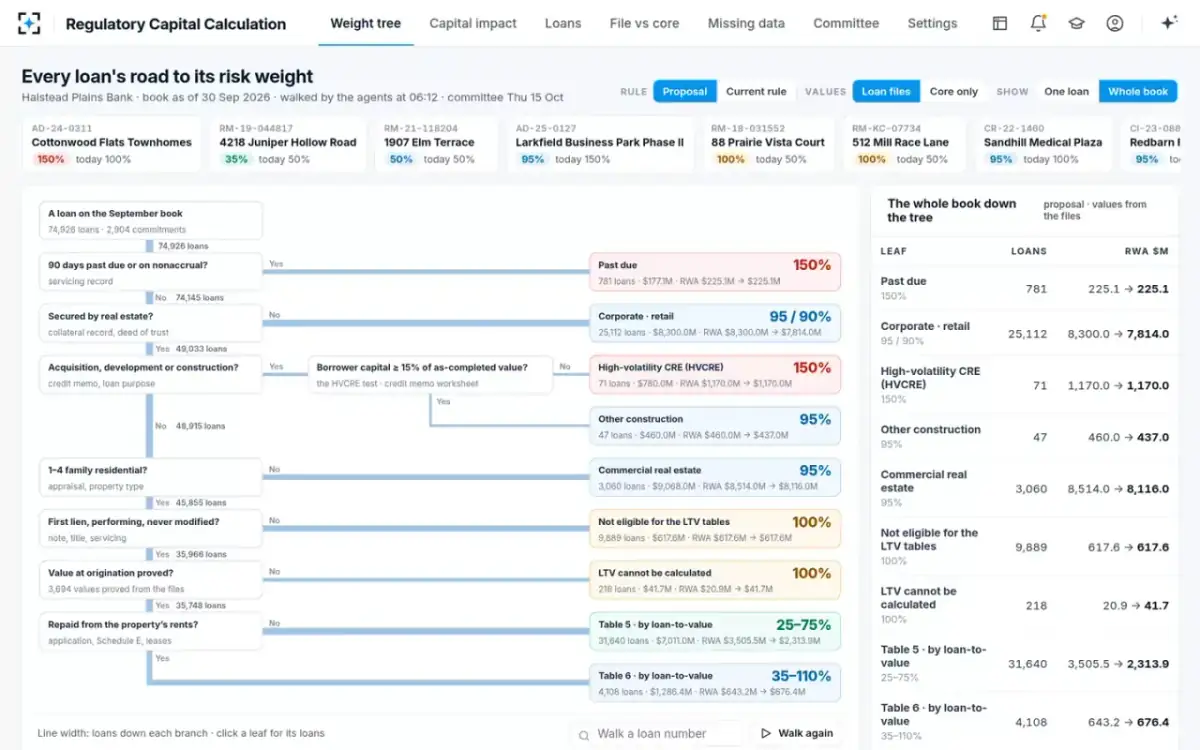
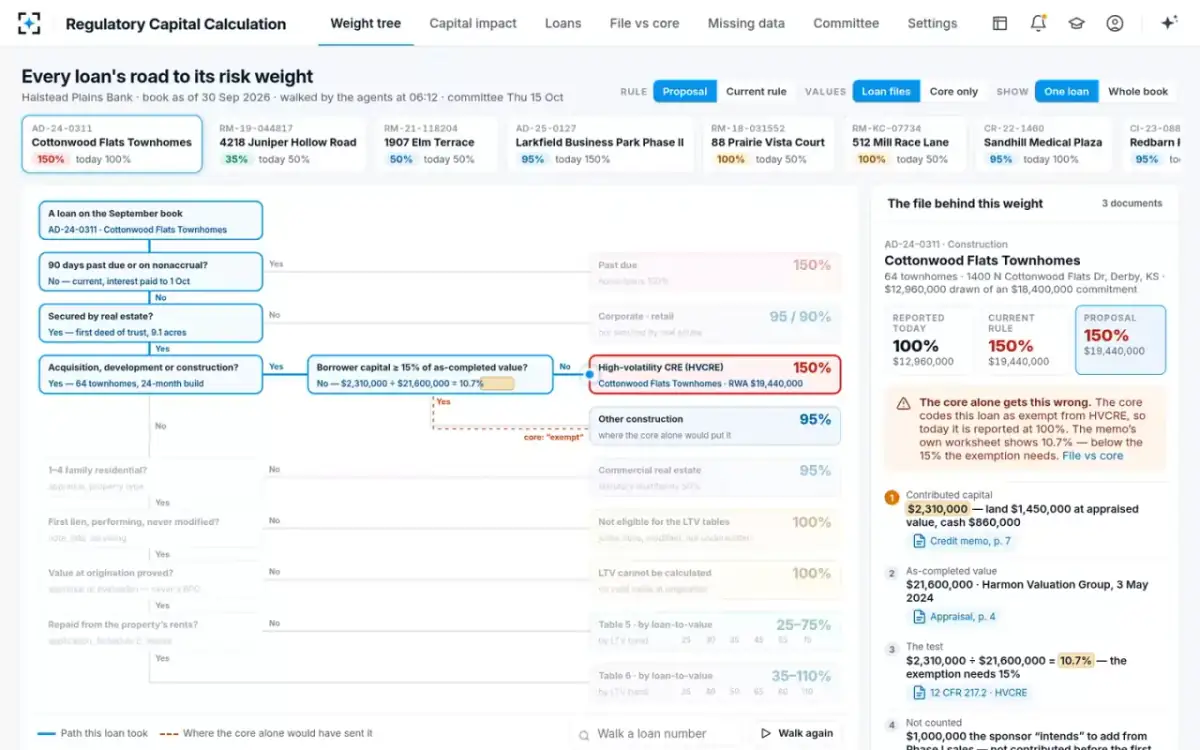
Two of those categories are traps for an automated classification. The first is high-volatility commercial real estate, which is not a kind of borrower but a test applied to a construction loan; a core system flag that says "exempt" is a summary of a judgement someone made at origination, not a fact. The second is past-due status, which overrides the category a loan was in: outside sovereign exposures, residential mortgages and policy loans, an exposure ninety days past due or on nonaccrual takes 150 per cent on the unguaranteed, unsecured portion. A loan can therefore move categories without anyone touching its coding.
The Call Report is where the classification becomes visible to a supervisor. Its instructions for Schedule RC-R, Part II, "provide general directions for the allocation of bank balance sheet assets, credit equivalent amounts of derivatives and off-balance sheet items, and unsettled transactions to the risk-weight categories in columns C through Q" (FFIEC 051 instructions, Schedule RC-R Part II). Every loan in the book ends up in one of those columns, and the examiner's first question is always why this loan is in that column.
Step two: how much of it counts, on and off the balance sheet
For an asset carried on the balance sheet, the exposure amount is normally its carrying value, and step two is a lookup. For anything off the balance sheet it is a conversion, and the conversion is where a commitment that costs nothing today becomes capital.
The rule converts off-balance sheet items with credit conversion factors. An unused commitment that the bank can cancel unconditionally converts at zero. A commitment with an original maturity of one year or less that is not unconditionally cancelable converts at 20 per cent; one with an original maturity of more than one year converts at 50 per cent. Guarantees, financial standby letters of credit, repurchase agreements and forward agreements convert at 100 per cent (12 CFR 217.33). The converted amount then takes the risk weight of the counterparty, exactly as an on-balance sheet exposure would.
Two details decide whether this step is right. One is cancelability, which is a term of the credit agreement and not a field in the core: a line the bank believes it can pull at will converts at zero, and a line whose agreement says otherwise converts at 20 or 50 per cent. The other is the ceiling the rule sets: the exposure amount of a commitment can be no greater than its maximum contractual amount, which matters for facilities whose drawn balance and committed amount move independently.
Total risk-weighted assets is one sum of four products, not one calculation
Balance sheet assets
carrying value × risk weight
Loans, securities, cash items and premises, each in the category the rule names for it.
Core system, collateral records and the loan file
Unused commitments
undrawn amount × credit conversion factor × risk weight
Zero if the agreement makes the line unconditionally cancelable; 20% at a year or less; 50% beyond a year.
The credit agreement decides the factor
Other off-balance sheet items
notional amount × credit conversion factor × risk weight
Guarantees, financial standby letters of credit, repurchase agreements and forward agreements convert at 100%.
Treasury and trade finance records
Derivatives and unsettled trades
credit equivalent amount × risk weight
Computed under the rule’s counterparty credit risk methods before any weight is applied.
Treasury systems
Step three: the fact the weight turns on, and where it lives
This is the step that takes the time, and the only one where a bank can be confidently wrong. Almost every category in the standardized approach carries a condition, and the condition is a fact about the borrower, the property or the file — not a fact about the loan's accounting.
Take the most common exposure in a community or regional book. The rule assigns "a 50 percent risk weight to a first-lien residential mortgage exposure that: (i) Is secured by a property that is either owner-occupied or rented; (ii) Is made in accordance with prudent underwriting standards, including relating to the loan amount as a percent of the appraised value of the property … (iii) Is not 90 days or more past due or carried in nonaccrual status; and (iv) Is not restructured or modified" (12 CFR 217.32(g)). Four conditions, and the same paragraph adds that the bank "must base all estimates of a property's value on an appraisal or evaluation of the property" that meets the appraisal rules. Condition (ii) is about how the loan was made, so what proves it is the appraisal or evaluation in the file, not the value field in the core. A blank field is a warning; a missing appraisal is the failure.
The questions a loan is asked on its way to a weight, and the document that answers each
| The question | The fact it needs | The document that proves it |
|---|---|---|
| Is it 90 days or more past due, or on nonaccrual? | Delinquency and accrual status at the reporting date | Servicing history — usually the one answer the core does hold |
| Is it secured by real property, and in what lien position? | Lien position, and whether the bank holds any junior liens on the same property | Mortgage, title work, collateral records |
| Is it acquisition, development or construction? | Purpose of the credit and the stage of the project | Loan agreement and the credit approval memo |
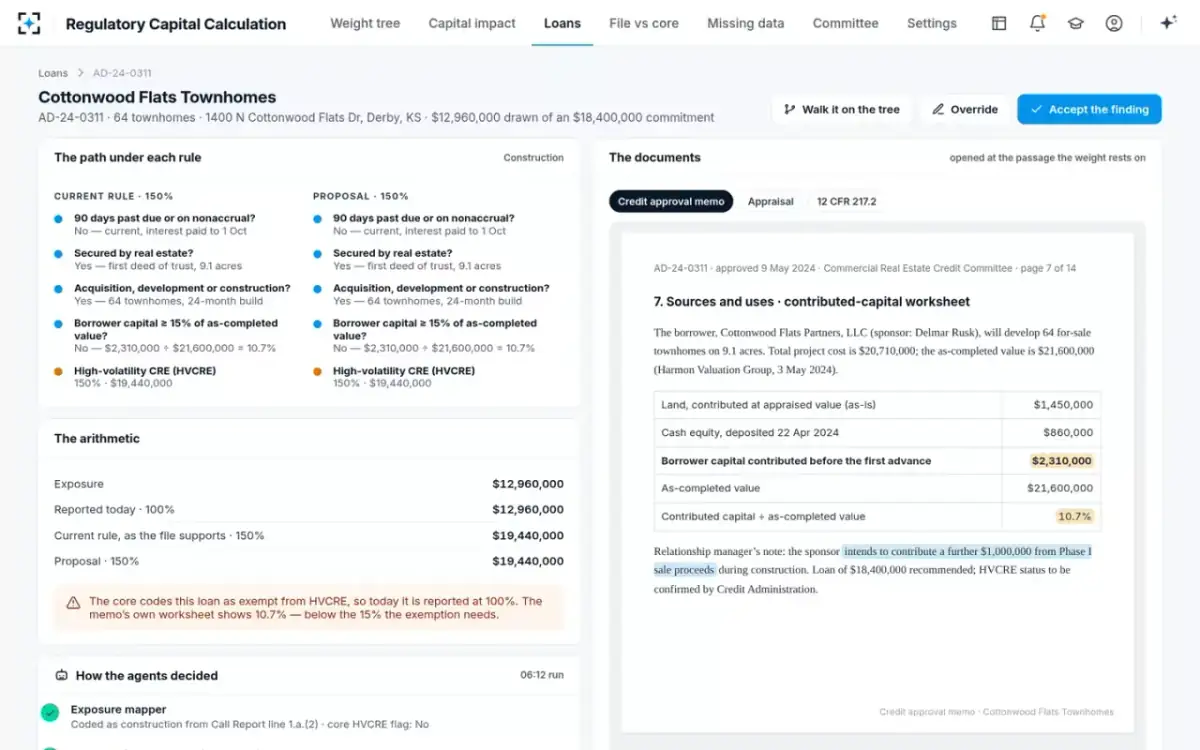
| If construction, does it meet the exemption from high-volatility treatment? | Capital contributed by the borrower before the first advance, against 15% of the as-completed value | The contributed-capital worksheet in the credit approval memo |
| Is it first lien, and is the property owner-occupied or rented? | Occupancy at origination, and whether rents are the source of repayment | Application, underwriting file, occupancy affidavit |
| What was the property worth when the loan was made? | Value at origination, from an appraisal or an evaluation | The appraisal in the imaged file — the fact most often missing |
| Has it been restructured or modified? | Modification history, including hardship modifications coded as performing | Modification agreements in the servicing file |
A bank that cannot answer one of these questions does not get to skip it. It gets the weight the rule gives to the unproved case, which is always the higher one. That is the quiet cost of a thin file, and it is measurable: it is the difference between the weight the loan would carry with its document and the weight it carries without. The guide on loan-to-original-value and where to find it works one of those questions all the way through.
Regulatory Capital Calculation walks the whole book down the tree, branch by branch
Step four: the weight, the multiplication and the sum
Only now does the calculation become arithmetic, and the instructions describe it in one sentence.
In general, the aggregate amount allocated to each risk-weight category is then multiplied by the risk weight associated with that category. The resulting risk-weighted values from each of the risk categories are added together, and generally this sum is the bank's total risk-weighted assets, which comprises the denominator of the risk-based capital ratios.
FFIEC, Instructions for Preparation of Consolidated Reports of Condition and Income (FFIEC 051), Schedule RC-R Part II
That last clause is the reason any of this matters. The capital rule defines the common equity tier 1 capital ratio as "the ratio of the Board-regulated institution's common equity tier 1 capital to standardized total risk-weighted assets" (12 CFR 217.10), and the tier 1 and total capital ratios in the same terms. Everything the bank reports about its capital strength has this sum underneath it, so an error in one loan's weight is an error, however small, in the ratio the board is given and the examiner reads.
What is the formula for risk-weighted assets?
For a single exposure the formula is exposure amount × risk weight = risk-weighted assets. For an off-balance sheet item it is notional or undrawn amount × credit conversion factor × risk weight. For the bank it is the sum of those products across every exposure it holds.
Worked on one sample loan: a first-lien home loan with a balance of $251,380 on a property appraised at $412,000 when the loan was made. Under the current rule it meets the four conditions of the 50 per cent band, so $251,380 × 50% = $125,690 of risk-weighted assets. Under the agencies' proposal the weight is read from a table of loan-to-value bands: $251,380 ÷ $412,000 is 61.0 per cent, which falls in the band above 60 and up to 80 per cent, weighted at 35 per cent, so $251,380 × 35% = $87,983. If the bank cannot calculate the loan-to-value at all, the proposal gives the loan 100 per cent and the same balance becomes $251,380 of risk-weighted assets — nearly three times the figure the appraisal supports.
The arithmetic took one line each. The three answers differ by a factor of almost three, and the only thing that moved between them was whether a 2017 appraisal could be found.
What happens to a loan whose risk weight cannot be determined?
It takes the punitive weight, and the rule says so in terms rather than leaving it to policy. Under the current rule, a first-lien residential mortgage exposure "that does not meet the criteria in paragraph (g)(1) of this section, and … junior-lien residential mortgage exposures" take 100 per cent (12 CFR 217.32(g)(2)). Under the proposal the same paragraph adds the case explicitly: 100 per cent applies to a first-lien exposure that fails the criteria "or for which the Board-regulated institution cannot calculate the LTV" (91 FR 15332). An unanswerable question is not neutral; it is expensive.
The same logic runs through the rest of the rule. A construction loan whose file does not show the borrower's contributed capital cannot be shown to meet the exemption, so it is high-volatility commercial real estate at 150 per cent. Anything that fits no named category falls into other assets at 100 per cent. In the sample book, 218 loans worth $41.7 million still had no valid value at origination after every file had been read, and they sit at the unproved weight until a document turns up.
Five places a whole-book calculation quietly goes wrong, and none of them are the arithmetic
- A blank value field
Common after a core conversion or an acquisition. The loan is not wrong in the core; it simply cannot be shown to meet the condition, so it takes the unproved weight.
- Occupancy coded at boarding and never revisited
A home loan coded owner-occupied years ago may now be repaid from rents, which the proposal weights from a different table.
- A high-volatility flag with no worksheet behind it
The core says exempt because someone decided it was at origination. Without the contributed-capital worksheet there is nothing to show an examiner.
- A missing loan agreement
Cancelability decides whether an unused commitment converts at zero or at 20 or 50 per cent. No agreement, no defensible zero.
- A hardship modification coded as performing
The 50 per cent band requires that the loan is not restructured or modified. A servicing-system modification that never reached the capital extract keeps the loan in a band it has left.
The same loan under the current rule and under the proposal
Running both rules at once is not an academic exercise; it is the only way to separate a change in the bank's book from a change in the rules. The agencies' March 2026 proposal keeps the four-step method and changes what flows through it: step two gets a new conversion factor, step three gets new facts to find, and step four gets new percentages — a broader range of weights for residential mortgages based on loan-to-value and source of repayment, corporate exposures from 100 to 95 per cent, other assets from 100 to 90 per cent, and a single 40 per cent conversion factor replacing the maturity-based 20 and 50 per cent factors.
That last change moves against the others for a bank with short commitments. The agencies' own analysis works it through: because a one-year commitment would convert at 40 per cent rather than 20, "this change doubles the recorded exposure amount," and with the corporate weight falling to 95 per cent the proposal "would increase the risk-weighted asset amount for unused commitments under one year by 90 percent, relative to the baseline" (91 FR 15332). A bank that reads only the headline direction of travel will be surprised by its own commitment book. The exposure-by-exposure weight table sets out what each category carries under each rule, and what the 2026 re-proposal changed covers the rulemaking itself.
One loan, both rules, and the page behind each fact
Where the number is checked before it leaves the bank
A risk-weighted asset total is filed on the Call Report and reported to the board, so the checking has to be as reconstructable as the calculation. Three checks do most of the work. The first is reconciliation: the total has to tie to the balance sheet, so every exposure is either in a risk-weight category or deducted from capital, with nothing in between. The second is the exception list: loans at the punitive weight because something could not be proved, which is both a capital number and a work list for loan operations. The third is review by a person who can see the fact behind each weight, one loan at a time.
Who does what in Regulatory Capital Calculation, and where a person has to decide
Agent
Exposure mapperMaps every loan and commitment to an exposure category from core codes and collateral records, keeping the field each answer came from.
Never: changes a core record
Agent
Appraisal readerFinds the value at origination in the file — appraisal, evaluation or condominium appraisal — and computes the loan-to-value the proposal defines.
Never: accepts a broker price opinion or an automated valuation, or estimates a value
Agent
Occupancy and repayment checkerReads the application, underwriting and servicing file for occupancy, reliance on rents, past-due, nonaccrual and modification status.
Never: decides eligibility without a document
Agent
Construction and commitment reviewerReads construction memos for the contributed-capital test and loan agreements for cancelability.
Never: treats a loan as exempt without the worksheet
Agent
Risk weight calculatorApplies the current rule and the proposal loan by loan, cites the paragraph, and totals by segment.
Never: uses a rule version that has not been approved
A person decides
Capital planning leadAccepts or overrides each finding and signs the quarter’s summary. An override keeps the core’s answer, needs a written reason and a second person’s approval.
A person decides
Chief Risk OfficerApproves the summary for the capital committee; corrections to Schedule RC-R remain the regulatory reporting manager’s decision.
What makes a review of this kind possible at all is that each weight carries its reason. An examiner who pulls a loan asks three questions in sequence — what weight did you give it, what fact decided that weight, and where is the page that shows the fact. A calculation built from a core extract can answer the first. A calculation built from the files can answer all three.
The risk-weight tree a reviewer actually reads, with the core's answer shown beside the file's
Why the hard part is never the arithmetic
Every capital team can calculate. Multiplying a balance by a percentage and adding up the column is not where quarters are lost. What is hard is that the rule asks questions a bank's systems were never built to answer, because the systems were built to service loans and the rule was written to measure risk. The two vocabularies overlap but do not match, and the gap between them is filled, loan by loan, with assumptions nobody writes down.
The useful test of a capital calculation is therefore not whether it reconciles. It is whether, for any loan an examiner points at, someone can name the fact that set its weight and open the page the fact came from inside a minute. A calculation that passes that test can be defended; one that does not is an estimate that happens to be presented to four decimal places. Making the third step real — reading the files rather than assuming past them — is the whole of the difference, and it is what Regulatory Capital Calculation is built to do.
Questions people ask
What counts as an exposure in the calculation?
Anything that can lose the bank money if a counterparty fails: loans and leases, securities, cash items in collection, premises and other assets on the balance sheet, plus commitments, guarantees, letters of credit, repurchase agreements and derivatives off it. The Call Report's Schedule RC-R allocates all of them, including "credit equivalent amounts of derivatives and off-balance sheet items, and unsettled transactions," to risk-weight categories. Anything the rule does not name specifically falls into other assets, weighted at 100 per cent today and 90 per cent under the agencies' proposal.
How are off-balance sheet items included in risk-weighted assets?
By conversion first, then weighting. The undrawn amount is multiplied by a credit conversion factor — zero if the commitment is unconditionally cancelable, 20 per cent at an original maturity of a year or less, 50 per cent beyond a year, and 100 per cent for guarantees and financial standby letters of credit — and the converted amount then takes the counterparty's risk weight. The proposal would replace the 20 and 50 per cent factors with a single 40 per cent factor for commitments that are not unconditionally cancelable.
Where do risk weights come from?
From the regulation, not from the bank. For a state member bank the weights are in 12 CFR 217.32, with parallel text at 12 CFR part 3 for national banks and part 324 for state non-member banks and state savings associations. The standardized approach gives a fixed percentage per category; a bank's own internal grading does not change it. What a bank does decide is whether its own evidence supports the condition a lower weight depends on.
Do you use the balance or the commitment?
Both, separately. The drawn balance is an on-balance sheet exposure at its carrying value. The undrawn part of the commitment is an off-balance sheet exposure converted by its credit conversion factor. The two are weighted and added. The rule also caps the exposure amount of a commitment at its maximum contractual amount, so a facility cannot be charged for more than the bank could ever be asked to fund.
How often does a bank recalculate risk-weighted assets?
At least quarterly, because the Call Report's Schedule RC-R is filed quarterly and the capital ratios are reported as of each quarter end. Many banks recompute monthly for internal reporting and capital planning, and run the calculation again whenever a rule changes, so that a movement in the ratio can be split between the book and the rules. In the sample bank the book is walked at every month-end close and again whenever a new rule version is approved.
Who checks the number before it is filed?
In most banks, three people in sequence: the capital planning analyst who builds it, a reviewer in credit or finance who tests the exceptions and the classification, and the regulatory reporting manager who owns the filing. Any change to what is reported on Schedule RC-R is the reporting manager's decision, not the capital team's and not an automated one — which is why a solution that finds a coding error raises it as a finding with the page behind it rather than correcting the filing itself.