Regulatory capital calculation software assigns each exposure a risk weight under the capital rules, totals risk-weighted assets and works out the capital ratios. That description fits every product on the market, which is precisely the problem with it: the arithmetic has been settled for a decade and nobody loses a tender on it. What separates one product from another is the loans where the fact the weight turns on — the value at origination, whether the property is owner-occupied, whether a construction borrower really contributed 15%, whether a commitment is unconditionally cancelable — is simply not in the core system. Regulatory Capital Calculation is Botminds' agentic solution for that half of the work: it reads the loan file for the fact and keeps the page it came from. This guide is the question list we would use to interrogate it, and anything else.
Worked examples use the fictional sample bank that ships with the solution, Halstead Plains Bank, with 74,926 loans and 2,904 commitments. Those are sample figures, not a customer's result. The rules quoted are the current capital rule, the March 2026 proposal and the Call Report instruction book as they stood in October 2026.
Twelve questions to ask, and the answer that should worry you
- Where does a risk weight come from when the core field is blank?
Worrying answer: "we use your data." That is a product that cannot help with the loans whose facts were never captured, which are exactly the loans an examiner argues about.
- Can it open the document the fact came from, at the page?
Worrying answer: a link to the whole file. A scanned bundle of several hundred pages is not evidence, it is a search problem handed back to you.
- What does it do with a broker price opinion or an automated valuation?
Worrying answer: "we accept it as a value." The agencies say these do not meet the appraisal standards; a weight built on one will not survive review.
- Can it run the current rule and a proposed rule on the same book, in the same run?
Worrying answer: "we will configure a scenario." Ask to see both weights on one loan, side by side, with both paragraphs.
- Who approves a new rule version, and can an un-approved version be used by accident?
Worrying answer: "it updates automatically." A capital number produced under a rule nobody approved is not defensible.
- What happens to a weight when a person disagrees with it?
Worrying answer: "the user can change it." Ask whether a written reason and a second person are required, and what stands until they approve.
- Does it write anything back to the core, the filing or the capital plan?
Worrying answer: "yes, we can automate that." The responsibility for the filing cannot be delegated outside the bank, so neither should the keystrokes.
- What does it report about the loans it could not prove?
Worrying answer: silence, or a clean 100% total. Ask for the list, the balances, and the risk-weighted assets at stake if the document is found.
- How is materiality set, and by whom?
Worrying answer: a vendor default. The threshold below which a finding is listed but not escalated is a bank policy decision.
- Which source wins when the loan file and the core disagree?
Worrying answer: "we reconcile automatically." The right answer is that the bank chooses, and the disagreement is kept as a finding either way.
- What exactly is out of scope?
Worrying answer: "nothing." A loan-level product does not hold your securities, derivatives or operational risk numbers, and should say so before the contract.
- Can we test it on our own loans and their files before we buy?
Worrying answer: a demonstration on the vendor's data. Your book's coding history is the thing being tested, and it is unique to you.
What does regulatory capital calculation software do?
In the narrow sense it does three things: it maps each exposure to an exposure class, it applies the risk weight the rules attach to that class and the exposure's attributes, and it totals the result into the denominator of the capital ratios. Most products also carry the capital numerator, produce the schedules for the regulatory report, and keep a history so that one quarter can be compared with the last.
What almost none of them do is establish the attributes. The rules are increasingly written around facts that live in documents rather than in fields. Under the March 2026 proposal, a residential mortgage exposure has to clear four conditions before the loan-to-value table can be used at all: to be eligible it must (1) be secured by a property that is either owner-occupied or rented; (2) be made in accordance with prudent underwriting standards, including relating to the loan amount as a percent of the value of the property; (3) not be 90 days or more past due or carried in nonaccrual status; and (4) not be restructured or modified.
A servicing system answers the third reliably. The first and fourth are often recorded once and never revisited, and the second is an appraisal or evaluation in the imaged file.
The three jobs, and why most products only do one
It helps to split the category into three jobs and ask which ones a product actually performs, because the pricing and the demonstration usually describe the first job while the project plan is dominated by the second.
Three jobs. Ask which one the demonstration is showing you
Classify and weight
What it means
Every product does this. Given an exposure class and a set of facts, apply the rule and multiply.
What a product that skips it does instead
Nothing. This is commodity arithmetic, and a competent spreadsheet does it too.
Find the facts
What it means
Read the appraisal, the application, the modification agreement, the credit memo and the loan agreement, and take the value out of the page.
What a product that skips it does instead
Without it, the product asks you for the facts. The project becomes a data-gathering exercise with a calculator attached.
Explain and evidence
What it means
Keep the fact, the document and page, the rule paragraph and the person who accepted it, for every weight.
What a product that skips it does instead
The weight is a number with no history. Three years later nobody can say why the loan was in that column.
The third job is the one that only matters later, which is why it is the one most often traded away in a tender. Three years after a filing, nobody is asked to reproduce a calculation. They are asked why one loan sat in one column, and the answer has to be a document.
What should a bank ask a capital calculation vendor?
Ask the twelve questions above, but ask them against a loan rather than in the abstract. The single most informative request in a procurement is: here is one of our construction loans and its credit memo; show us the weight, and show us why. A product that can only answer when handed a clean attribute table will say so within a minute.
The second most informative request is about the absence of evidence. Give the vendor a home loan whose value at origination is missing and watch what the product does with it.
The missing-data question, asked four ways
There are only four things a system can do with a loan whose deciding fact it does not have, and they are not equally defensible. Asking the question four ways — what do you assume, what do you extrapolate, what do you leave punitive, what do you go and find — forces a vendor off the first answer, which is almost always some version of "we use your data."
Four ways a product can treat a loan with no value at origination
What the product does: Takes a current automated valuation, a tax assessment or a broker price opinion and calls it the value at origination.
What it costs on the sample book, and whether it survives review: Cheap and fast, and not evidence. The agencies are explicit that these methods do not meet the minimum appraisal standards, so the weight has no support if the loan is pulled.
What the product does: Weights a few hundred loans by hand and scales the result to the segment.
What it costs on the sample book, and whether it survives review: Produces a portfolio estimate and no loan-level weight. Usable for a board discussion, not for a filing or for an examiner who picks one loan.
What the product does: Treats every loan with no calculable loan-to-value at 100% and moves on.
What it costs on the sample book, and whether it survives review: Entirely defensible, and expensive: on this book it would add $518.0M of risk-weighted assets and hold the ratio under the proposal at 12.39% instead of 12.62%.
What the product does: Searches the imaged file for an appraisal or evaluation made at origination, reads the value, date and appraiser, and computes the ratio.
What it costs on the sample book, and whether it survives review: 3,694 values found for the 3,912 loans the core had none for. 218 remain unproved, at $41.7M of balances and $27.1M of risk-weighted assets if the documents are found.
Can it show the fact, the page and the rule paragraph behind a weight?
This is the question that separates a calculator from an answer. A weight is defensible when four things travel with it: the fact that set it, the document and page that fact came from, the paragraph of the rules that was applied, and the person who accepted it. Anything less and the bank is relying on someone's recollection of a decision made in a quarter nobody remembers.
The agencies make the same point about appraisals in their standing guidance: when a bank reuses an existing appraisal, the credit file should hold the facts and the analysis behind that decision, not just the decision (Interagency Appraisal and Evaluation Guidelines). The principle generalises. The conclusion is not the evidence; the facts and the analysis behind it are.
It also matters that the valuation itself meets the standard. The proposal is explicit that, for exposures subject to the appraisal rules, the market value of real estate would be a valuation that meets all requirements of that rule
— which is why a product that accepts any number labelled "value" is doing the bank no favours.
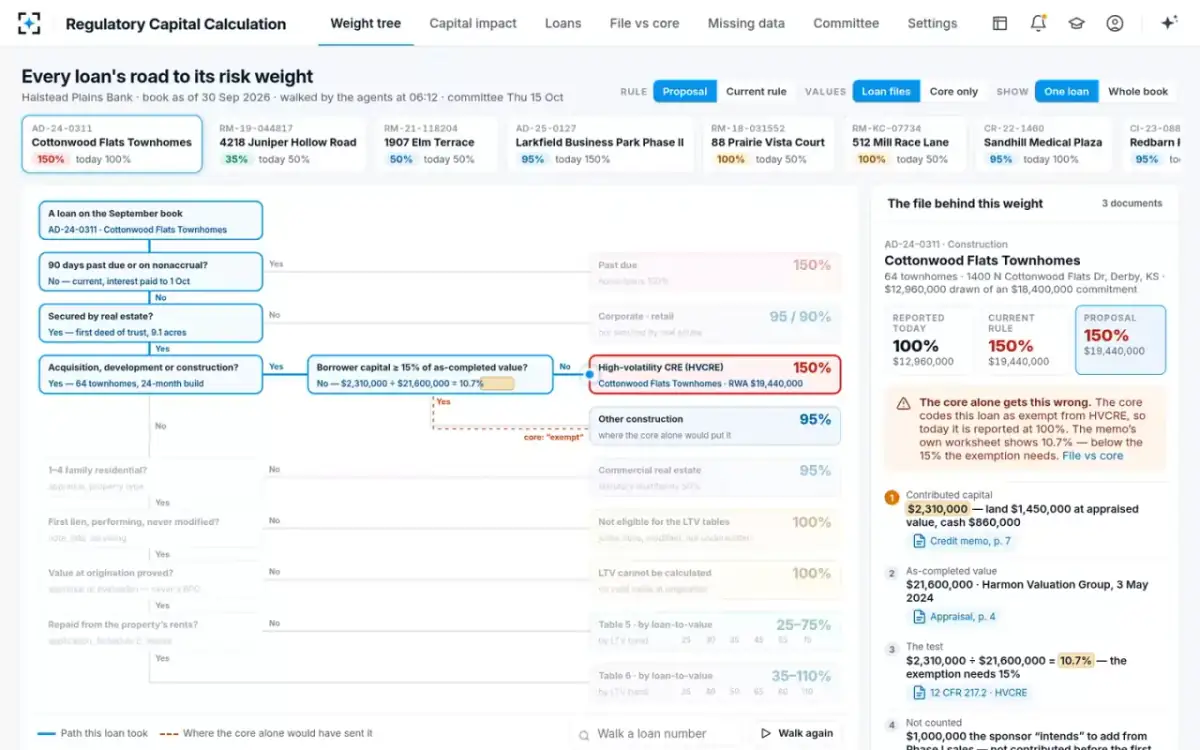
Regulatory Capital Calculation: the path a loan took, beside the path the core alone would have taken
Running two rule versions side by side, and approving a new one
Any bank weighing the March 2026 proposal needs two answers on the same book at the same time: what the capital number is today, under the rule in force, and what it would be under the proposal. Running those as separate exercises a month apart makes the comparison useless, because the book moves. Running them in one pass makes every difference attributable to the rule rather than to the quarter.
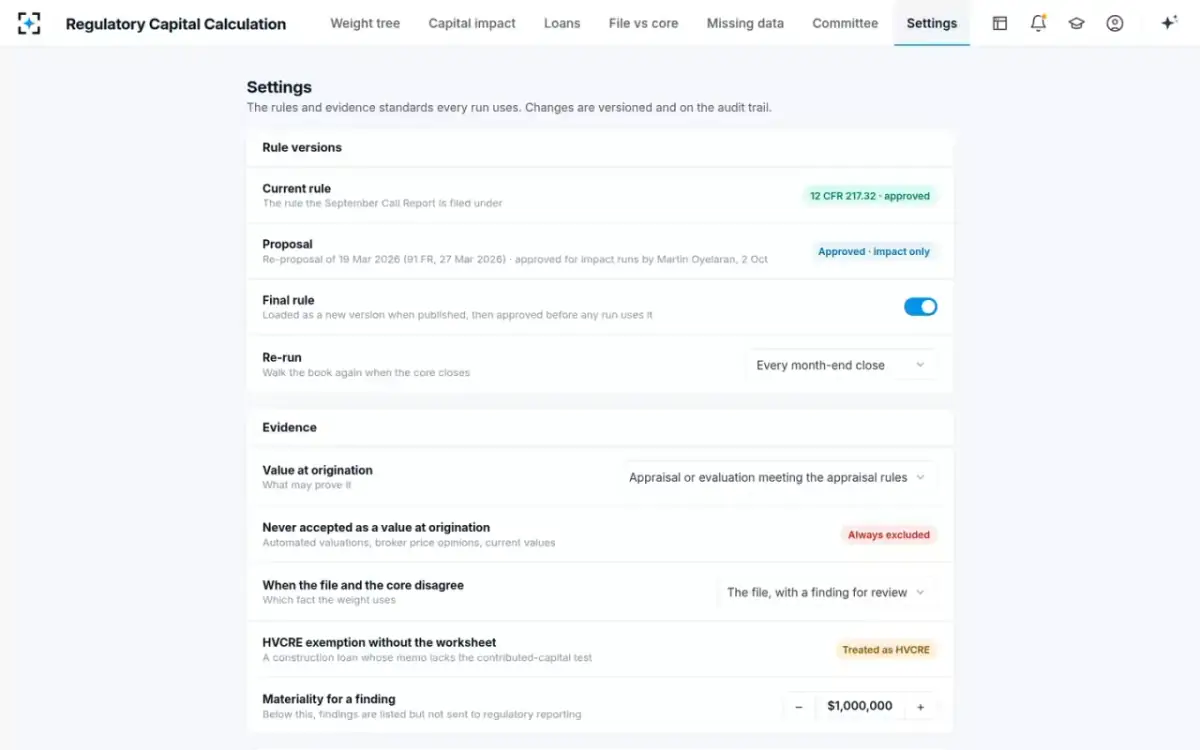
The governance question behind it matters more than the feature. A rule version should be loaded, reviewed and approved before any run may use it, and the approval should be recorded with who gave it. On the sample bank the setting reads: current rule 12 CFR 217.32, plus the proposal of 19 March 2026 approved for impact runs only. When the final rule is published it is loaded as a new version and approved before use, and the book is walked again. Nothing updates itself.
The settings a bank should expect to own, not inherit from a vendor
| Setting | What the sample bank chose | Why it is the bank's decision |
|---|---|---|
| Rule versions in force | Current rule, plus the March 2026 proposal for impact runs only | Which rule a number was produced under is the first question an examiner asks. |
| Re-run frequency | Every month-end close | Weekly is possible; quarterly makes the capital number a surprise rather than a trend. |
| What may prove a value at origination | An appraisal or evaluation meeting the appraisal rules | The alternative — appraisal only — is stricter and costs risk-weighted assets. Both are defensible; one is a policy. |
| When the file and the core disagree | The file wins, and a finding is raised either way | Some banks will prefer the core to win pending review. What is not optional is recording the disagreement. |
| Materiality for a finding | $1,000,000 | Below the threshold, findings are listed but not sent to regulatory reporting. That line is an accounting judgement, not a product default. |
| Internal capital target | 10.5% common equity tier 1 | The board's number, well above the 7% regulatory floor plus buffer, and the one the capital report is read against. |
| Who signs and who approves | Capital planning lead signs; the Chief Risk Officer approves | Named people, with an override needing an analyst and the capital planning lead. |
The settings screen: whose policy the numbers were produced under
Overrides: a reason, a second person, and a trail
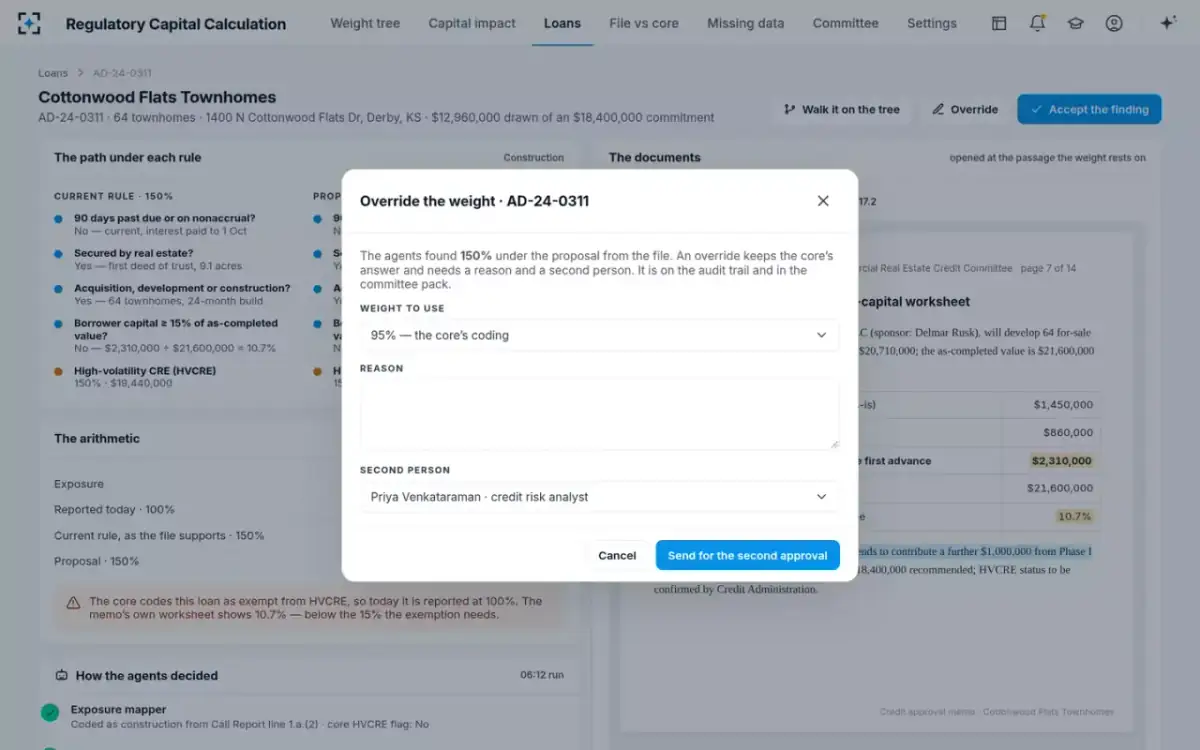
Every capital system needs an override, because every book has loans whose facts a competent person reads differently from the software. The design question is what an override costs. If a user can change a weight with a click, the weights are opinions. If an override needs a written reason and a second person's approval, and the original weight stands until that approval arrives, the weights are decisions.
On the sample bank the second rule is the one in force: an override keeps the core's answer only with a reason and a named approver — a credit risk analyst — and it goes to the capital committee with the summary rather than disappearing into the total. The limit that matters most is the one that cannot be overridden at all: a construction loan is never treated as exempt from the high-volatility test without the contributed-capital worksheet. A product with no un-overridable limits has no policy, only preferences.
An override, with its written reason and the person it goes to
What it must never do to your core, your filing or your plan
There is one sentence in the Call Report instruction book that should be read aloud in every procurement for software anywhere near a regulatory number: each bank is responsible for making sure the data it reports each quarter meets that quarter's requirements fully and accurately, and that responsibility cannot be transferred or delegated to software vendors, servicers or anyone else outside the bank (FFIEC 051 General Instructions). What it means for a reporting team choosing software is taken apart in piloting Call Report preparation software.
That is the boundary, and a well-designed product sits inside it by construction rather than by configuration. The agents in this solution never change a core record, never change the Call Report and never change the capital plan. Accepted corrections are sent to the regulatory reporting manager, who decides what the filing says; how a weight becomes a cell on Schedule RC-R follows that handover in detail. Nothing is signed or sent by software.
Being clear about the boundary also means being clear about scope. This is a loan-level product. It weights loans and commitments from the core and the loan files; it does not produce the Call Report, and it does not hold risk-weighted assets for anything other than loans — securities, derivatives and the rest come from the regulatory reporting system and are added there. A vendor who claims everything is either selling something else or has not been asked a hard question yet.
What you have to supply, and how long that really takes
The inputs are short to list and long to arrange. Loan, collateral and commitment data at each close, from the core. Access to the imaged loan files, which in most banks is a different system owned by a different team. Credit memos and loan agreements, often in a third place. The rule text, which is public. And the general ledger figure for capital at the quarter end.
The item that sets the timetable is almost always access to the imaged files, because it is the one nobody owns and the one with the most exceptions: loans acquired with a portfolio, loans whose files were scanned in a different format, loans whose documents exist but are indexed under a borrower name that has since changed. A realistic plan treats imaged-file access as the critical path and everything else as parallel. Where the implementation hours actually go puts numbers to that.
How to test a product on your own loans before you buy
Design the test so the product cannot pass it by arithmetic. Four things make a trial decisive, and all four are cheap.
First, pick the loans yourself, and pick badly: twenty loans you already know are awkward — an acquired portfolio with thin files, a couple of construction facilities, a loan modified in a hardship programme, a participation, a commitment whose agreement was renewed. Second, hand over the files as they are, without a cleanup pass; the cleanup is the thing you are trying to buy. Third, ask for the weight and the evidence together, and check the page references by opening them. Fourth, ask what it could not do, and treat a long, specific list as a better sign than a short one.
Then grade on the exceptions rather than the matches. Any product will agree with your existing coding on the easy nineteen out of twenty. The twentieth is the loan that will be pulled at the next examination, and the whole value of the category is in what happens there. On the subject of what software may decide on its own, where the supervisors draw the line is worth reading before the first demonstration, because it is also a good source of questions.
One last consideration for banks that will take the output into a model risk process: the supervisors' revised guidance notes that An important element of model risk management is the validation of vendor products, either by internal or outside parties.
Ask early what the vendor will give you to validate against — documentation of the decision logic, test data, and the ability to re-run a historical quarter — rather than discovering after signature that the product is a closed box.
Questions people ask
Can the software read our loan files, or only our core data?
That is the question to settle first, because it determines whether the project is a software implementation or a data-gathering programme with software at the end. A product that reads only core data will produce a weight for every loan whose attributes are populated and a problem for every loan whose attributes are not — and on most books the second group is where the capital is.
How do we check a risk weight the software produced?
Ask for the chain rather than the calculation: which fact set the weight, which document and page that fact came from, which paragraph of the rules was applied, which version of the rules was in force, and who accepted it. If all five are available on any loan you pick at random, the weight can be checked in about two minutes. If any link has to be reconstructed on request, it cannot.
What happens when a loan's data is missing?
In a well-built product, three things: the punitive treatment is applied so the capital number is never flattered, the loan appears on a missing-data list with what is needed, and the risk-weighted assets at stake if the document is found are quantified. On the fictional sample book that list runs to 218 loans, $41.7M of balances and $27.1M of risk-weighted assets, which is a far more useful output than a clean total.
Does it change our core system or our Call Report?
It should not, and in this solution it does not. Agents never change a core record, the Call Report or the capital plan. Accepted corrections go to the regulatory reporting manager with the loan list and the page behind each finding, and that person decides what, if anything, changes on the filing. The responsibility for the report cannot be delegated outside the bank, so the software should not be holding the pen.
How is a new rule version added and approved?
A version is loaded as a distinct, named rule set and approved in settings before any run may use it, with the approval recorded. On the sample bank the current rule is approved for all runs and the March 2026 proposal only for impact runs. When a final rule is published it becomes a new version, is approved, and the book is re-run — so every number can be traced to the rule it was produced under.
What do we have to supply to get started?
Loan, collateral and commitment data from the core at each close; access to the imaged loan files; credit memos and loan agreements; the capital figure from the general ledger at quarter end; and your own policy decisions on evidence standards, materiality, the internal target and who signs. In practice the long pole is file access rather than data, so start that conversation before the contract rather than after it.