AI can be used in a bank's capital planning — the work of measuring risk-weighted assets, projecting the capital ratios and taking them to a capital committee — and the interesting question is not whether but where. Most of the debate inside banks is spent on the wrong layer: people argue about whether a risk-weight calculation is a model and needs validating, when the arithmetic is the one part of the chain that behaves identically every time it is run. The judgement that actually carries risk is upstream of it — somebody, or something, read a loan file and decided that the property was owner-occupied, that an appraisal was made at origination, that a construction borrower had contributed 15% before the first advance. Regulatory Capital Calculation is Botminds' agentic solution for the capital number, and it is built on that distinction: agents read and recommend, people decide, and every answer carries the page it came from.
The supervisory text relied on here is SR 26-2, the revised interagency guidance on model risk management issued on 17 April 2026, which superseded SR 11-7. Examples of a bank come from the fictional sample book in the solution and are sample data, not a customer's result.
Three layers, three different controls — only the middle one is a judgement
What happens here
Past due? Secured by real estate? Construction? Does the borrower clear the 15% contributed-capital test? First lien? What is the loan-to-value? Is the loan repaid from rents?
What kind of thing it is
Deterministic. Same inputs, same answer, every time, with no statistical or economic theory underneath it.
The control that belongs to it
Version control and approval. Which rule version was in force, who approved it, and which paragraph each branch cites.
What happens here
Finding the appraisal in a long imaged file, reading the effective date and the value, deciding whether a worksheet shows capital contributed before the first advance.
What kind of thing it is
A judgement. Two careful people can read the same file and differ, which is exactly what makes it the thing to govern.
The control that belongs to it
Effective challenge: independent testing against known answers, a sample re-read by a person, and every answer carrying the page it came from.
What happens here
Accepting a finding, overriding a weight, correcting the coding on a filing, signing the summary, attesting to the report.
What kind of thing it is
Not a technical question at all. Someone is answerable for it by name.
The control that belongs to it
Named people, a second approver on overrides, and an audit trail that records who did what and when.
Can AI be used in bank capital planning?
Yes, with the boundary drawn at the point where a person becomes answerable. Nothing in the supervisory framework prohibits software from reading loan files, computing exposures, running the book under a proposed rule or drafting a capital committee paper. What the framework does is fix responsibility: the bank prepares the report, a named officer attests to it, and that responsibility cannot be moved outside the institution. Software can do a great deal of the work and none of the answering.
The practical form of the question in most banks is narrower. It is not "may we use AI", it is "will our model risk function require this to be validated as a model, and if so, against what?" The revised guidance answers the first half in two sentences and sets the direction for the second.
Is a risk-weight calculation a model?
On the guidance's own definition, generally not. SR 26-2 reserves the word for a complex quantitative method that applies statistical, economic or financial theory to turn input data into quantitative estimates, and it expressly leaves out simple spreadsheet arithmetic and deterministic rule-based processes and software with no such theory behind them (SR 26-2). The definition is quoted and worked through in the guide on whether spreading software is a model; what matters here is where a risk-weight calculation lands.
A risk-weight tree is a deterministic rule-based process. It applies a published rule to stated facts and produces the same answer every time; there is no estimation, no fitted parameter and no theory about how the world behaves. It is closer to a tax calculation than to a credit loss forecast. That does not make it unimportant — an error in it is a reporting error — but it does mean the control that fits is version management and testing against the rule text, not back-testing and benchmarking.
The exclusion has limits worth naming. If a bank uses a statistical method to estimate a property value, or fits a model to predict which loans are likely to be miscoded, that is a model on any reading, and it should be governed as one. The line is not "software versus people"; it is whether a theory is being used to produce an estimate.
What the revised guidance says about rule-based software
Two further points in SR 26-2 matter to anyone applying it. The first is its scope: the cover letter aims it chiefly at Federal Reserve-regulated banking organizations with more than $30 billion in total assets, and the guidance itself expects to be most useful for the models behind a bank's significant business lines and functions. Smaller banks are not outside good practice, but they are not being measured against this document line by line.
The second is its status. The guidance does not set forth enforceable standards or prescriptive requirements; accordingly, non-compliance with this guidance will not result in supervisory criticism against a banking organization.
It is the supervisors' description of sound practice. Treating it as a rule produces a defensive, box-ticking programme; treating it as a well-informed opinion about what goes wrong produces a useful one.
And what goes wrong, in the guidance's own words, is as often use as construction: even a fundamentally sound model producing accurate outputs consistent with the model's design objective can exhibit high model risk if it is misapplied or misused.
The earlier guidance made the same point more bluntly, naming two causes — fundamental errors producing inaccurate outputs, and being used incorrectly or inappropriately
amid a misunderstanding of limitations and assumptions. A correct risk weight applied to the wrong loan is still a reporting error.
The part that is a judgement: reading a document for a fact
Consider what actually happens when a value at origination is established for a 1998 home loan. Someone opens an imaged file. They decide which of three documents is the appraisal rather than a later valuation. They read an effective date and judge whether it falls at origination. They read a value. They decide whether the document is an appraisal or an evaluation, and whether either is acceptable under the bank's evidence standard. Five judgements, any of which a second careful reader might make differently.
This is not arithmetic and it is not a model either; it is document comprehension, the thing a junior analyst does on a Tuesday. Software doing it does not become a model by doing it faster, but it does inherit the full weight of the judgement — and that is what deserves independent challenge, sampling and testing. Everything downstream of the reading is deterministic, so the quality of the capital number is almost entirely the quality of the reading.
One fact's path, and what is left behind at each step
Agent
Find and read the documentSearches the imaged loan file for an appraisal or evaluation made at origination, then takes the effective date, the value and the appraiser from the page and records which page it was.
Never: A broker price opinion, an automated valuation, an estimated value, or a current value in place of the value at origination
Agent
Apply the ruleComputes the loan-to-value and walks the tree to a weight under each approved rule version, citing the paragraph.
Never: A rule version that has not been approved in settings
A person decides
Accept or overrideThe capital planning lead reads the fact, opens the page, and accepts the weight or overrides it with a written reason.
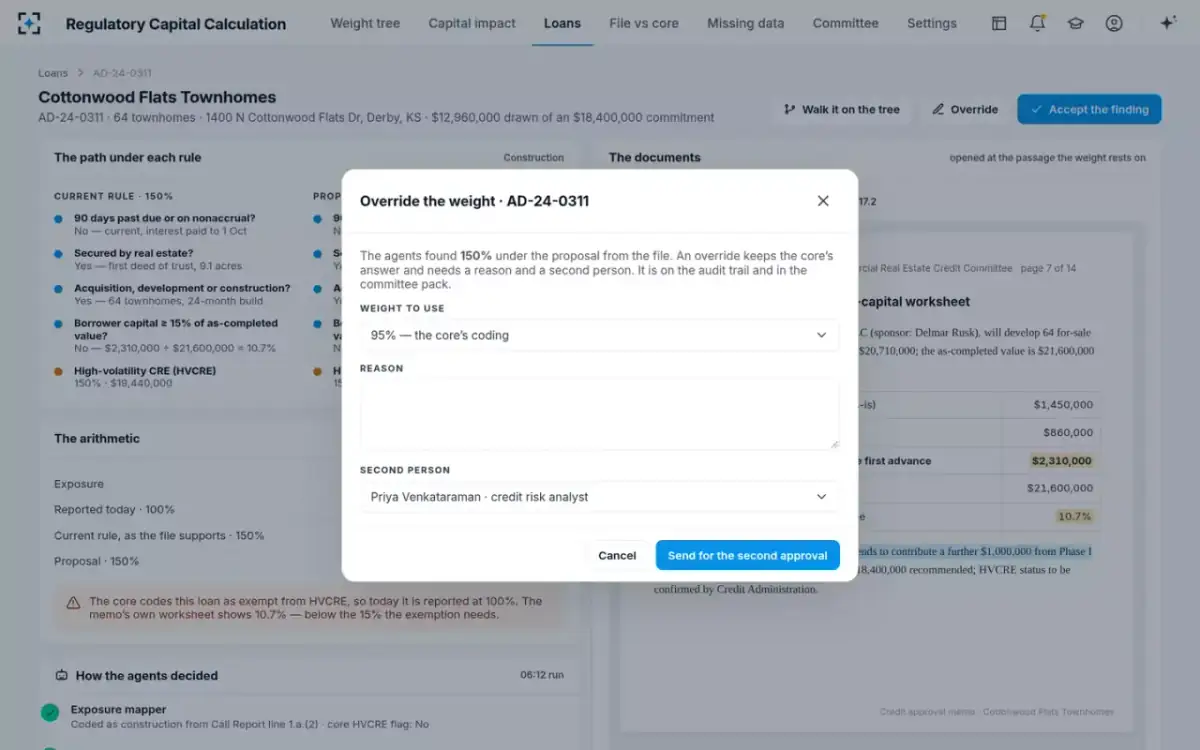
Never: An override does not count until a second person approves it
A person decides
Sign and approveThe capital planning lead signs the summary; the Chief Risk Officer approves it for the committee.
Never: Agents cannot sign, approve or send anything
A person decides
Decide the filingThe regulatory reporting manager decides whether anything changes on the regulatory schedule, and files it.
Never: Agents never change a core record, the Call Report or the capital plan
Effective challenge, and who is allowed to perform it
The guidance's idea of effective challenge is the most portable thing in it, and it applies cleanly to a document reader even where the reader is not a model. SR 26-2 describes it as critical analysis by objective experts who can change what they find wrong, across the whole life of the model, and names three things those people need: the expertise to challenge, the independence to stay objective, and the standing and influence to make a change happen (SR 26-2). How a credit team staffs that for a rating model is set out in credit risk model validation; for a capital number the same three tests fall on different people.
Three conditions, and each is a staffing question rather than a documentation one. Expertise means someone who can read an appraisal and knows what the rule requires — a credit risk analyst or an appraisal reviewer, not a technologist. Independence means not the person whose capital number improves if the reading is generous. Standing means the challenge can actually stop a filing, which in practice means the challenger reports somewhere other than to the person being challenged.
On the sample bank that shape is visible in the override route: the capital planning lead may disagree with a weight, but the override goes to a credit risk analyst, and the agents' weight stands until she approves. The person with the incentive is not the person with the pen.
What an agent must never be allowed to do
Limits are more useful than principles because they can be tested. The list below is the set of limits built into the solution; each line is a thing the software refuses to do, not a thing a policy discourages.
The limits to write into a specification, and test on day one
- Never accept a broker price opinion or an automated valuation as a value
The agencies are explicit that these do not meet the minimum appraisal standards. A system that quietly accepts one produces weights that fail on inspection.
- Never estimate a value, or substitute a current value for the value at origination
Where no acceptable document exists, the honest output is "missing", with the punitive weight applied meanwhile.
- Never treat a construction loan as exempt from the high-volatility test without the worksheet
The exemption has to be shown, not assumed. This is the one limit on the sample bank that cannot be relaxed in settings.
- Never use a rule version that has not been approved
A capital number produced under an unapproved version cannot be defended, however correct the arithmetic.
- Never change a core record, a regulatory filing or the capital plan
Corrections are proposed with their evidence and routed to the person who owns the filing. Nothing is written back.
- Never sign, approve or send
The committee summary is drafted by software and signed by a named person. The attestation on the report stays with an officer of the bank.
How to validate a document reader: the facts, not the prose
Validation of a document reader is easier than validation of a model, because the ground truth exists. For a forecast, nobody knows the right answer until later. For a value at origination, the right answer is printed in the appraisal, and a human reviewer can establish it in a minute.
So build a truth set rather than a test harness. Take a few hundred loans, stratified to over-represent the awkward ones: acquired portfolios, condominium appraisals, files with more than one valuation, construction memos with and without worksheets, loans modified in a hardship programme. Have two qualified people establish each fact independently and reconcile where they differ — the disagreements are themselves the most informative output, because they mark the facts that are genuinely ambiguous. Then measure the software on exactly those facts: how often the extracted value matches, how often the wrong document was chosen, and critically, how often it claimed a fact it should have reported as missing.
That last measure is the one to weight heaviest. An over-confident reader is far more dangerous than a cautious one, because a loan on a missing-data list gets attention and a wrong value does not. The guidance frames testing broadly — Model testing is a core component of model development that evaluates whether a model performs as intended. Testing may include a range of activities, from out-of-sample and out-of-time testing, to a comparison of alternative assumptions and methodologies, to a critical assessment of data quality, relevance, and inputs.
For a document reader, out-of-time testing has a concrete meaning: test on files from the oldest vintages, because those are the ones the core does not cover.
Why every answer has to carry its page
A citation is not a courtesy; it is what converts an assertion into something a second person can check in under a minute. Without it, every review is a re-performance, and re-performance does not scale past a sample. With it, a reviewer can accept ninety loans quickly and spend the afternoon on the ten that look wrong.
Two answers to the same question, and which one survives the follow-up
A general assistant, asked about the loan: "This loan appears to qualify for the 50% risk weight based on the information provided."
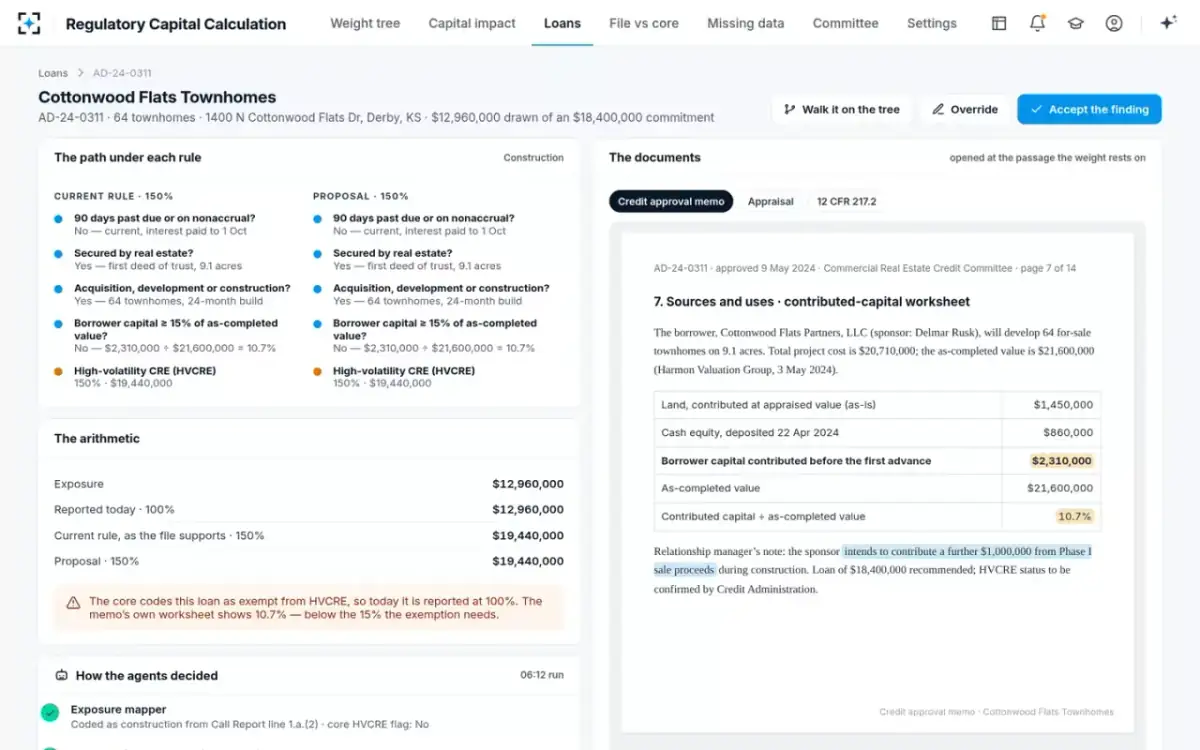
An answer tied to a page: "150%. High-volatility commercial real estate: contributed capital of $2,310,000 against an as-completed value of $21,600,000 is 10.7%, below the 15% the exemption needs."
A general assistant, asked about the loan: A restatement of the answer, or a plausible-sounding reference that does not exist.
An answer tied to a page: The credit approval memo at page 7 — land contributed at $1,450,000 and $860,000 of cash equity — and the as-completed value from the appraisal.
A general assistant, asked about the loan: Usually nothing, because nothing was weighed.
An answer tied to a page: $1,000,000 the sponsor intends to add from later sales, excluded because it was not contributed before the first advance.
A general assistant, asked about the loan: Ask for the file and start again.
An answer tied to a page: Open the page and agree, or disagree with a specific number on a specific line.
One loan, the arithmetic, and the document open at the passage
Who is accountable when the answer is wrong
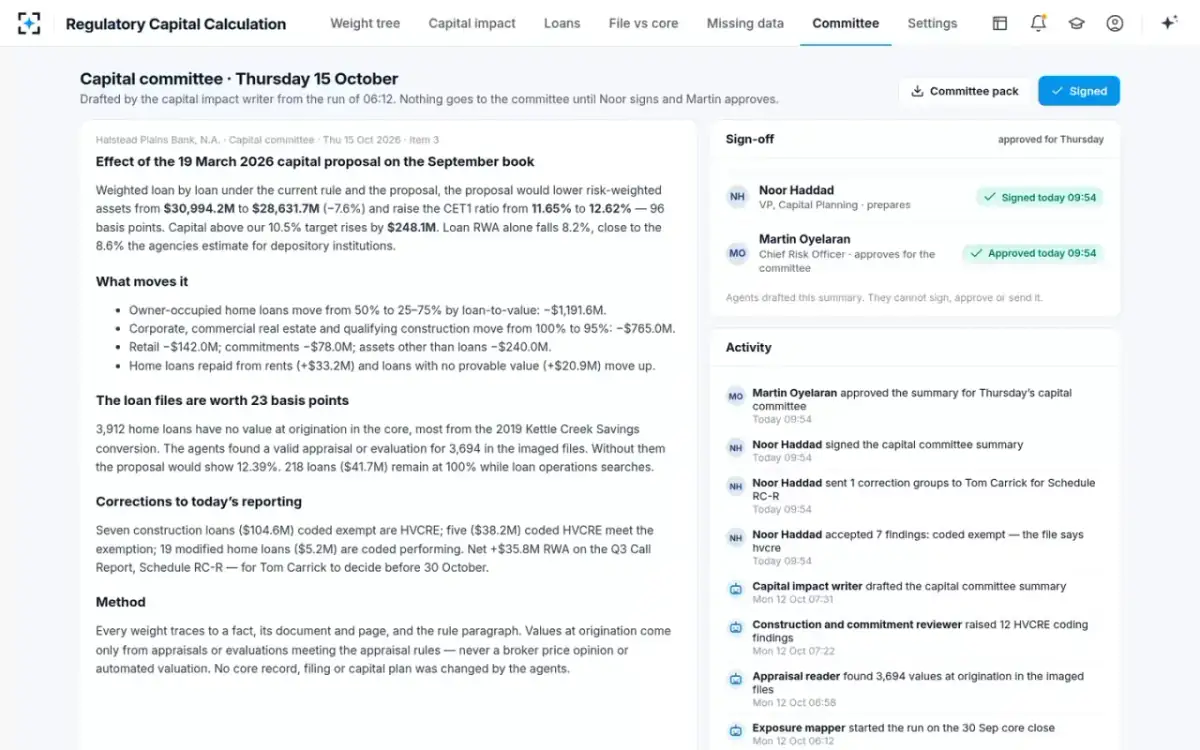
A person, always — and in capital planning there are more of them than on the filing. On the sample bank the capital planning lead accepts each finding and signs the committee summary, the Chief Risk Officer approves it, and the capital committee chaired by the chief financial officer decides what the bank does with the number. None of those roles can be handed to software, and the summary says so on its face.
The filing side is fixed by the reporting rules. The signing officer attests that the Call Report is prepared in accordance with the instructions and is true and correct, and where that signature is electronic, the instructions require the bank to use a reliable information technology system identification and authentication method or process that associates access to and execution of the electronic signature transaction with the identity of the signer, such as requiring the institution's officer or director to log into the institution's systems to verify identity.
A signature has to belong to a person who logged in as themselves, and the chief financial officer's declaration and the directors' attestation sit beside it. How that responsibility applies to AI-drafted lines on the Call Report itself is taken apart in AI in regulatory reporting. For the capital number the consequence is the same: the system's job is to make signing well-informed, not to make it unnecessary.
An override: a written reason, a second person, and the weight that stands meanwhile
What an examiner should be able to walk back from any number
Pick a cell in the capital report. Walk to the segment. Walk to the loan. On the loan, five things should be immediately available: the fact that set the weight, the document and page it came from, the rule paragraph applied, the rule version in force at the report date, and the person who accepted it. Where there was an override, the written reason and the second approver come with it; where the fact could not be established, the treatment used instead and what finding it would be worth.
Nothing in that list is an artefact of using software. It is what a meticulous analyst would leave behind, written down at the time rather than reconstructed afterwards, which is the only part most banks find hard. The supporting documentation behind a filing is kept for three years, and three years is long past the point where anyone remembers why a loan was in a particular column; what belongs in that three-year file sets out the contents in detail.
If a programme is being planned around the new capital rules, the order of the work matters more than the technology choice: where the implementation hours actually go is the companion to this page, and what to ask a vendor turns most of the governance above into procurement questions.
The summary the committee sees, and the sentence at the bottom of it
Questions people ask
What does the model risk guidance say about rule-based software?
The revised interagency guidance issued in April 2026 defines a model as a complex quantitative method that applies statistical, economic or financial theories to produce quantitative estimates, and expressly excludes simple arithmetic calculations and deterministic rule-based processes where no such theories underpin the design or use. A risk-weight tree applying a published rule to stated facts falls in the excluded category — which does not remove the need for version control and testing, only the need to treat it as a model.
What is effective challenge, and who performs it?
It is critical analysis by objective experts who can evaluate the risk and actually effect change. The guidance names three conditions: appropriate expertise, sufficient independence to stay objective, and the organizational standing to make a change happen. In practice that means someone who can read the underlying documents, who does not benefit from the answer, and whose objection can stop the number being used.
What are the AI use cases in capital planning?
Four hold up under examination: reading loan files for the facts a weight turns on, running the whole book under the current rule and a proposal side by side, listing what could not be proved with the capital at stake on each loan, and drafting the committee summary. In each, the software prepares and a named person accepts, signs or approves. Estimating a value or forecasting with a statistical method is possible too, but that is a model under SR 26-2 and is governed as one.
How do you stop an AI system from inventing a number?
Require every value to carry the document and page it came from, make "missing" an acceptable and visible output, and test specifically for over-confidence — the rate at which the system asserts a fact it should have reported as unfound. On the fictional sample book, 218 loans stayed on the missing list rather than being given a plausible value, which is the behaviour to design for.
Does the model risk guidance even apply to our bank?
It is stated to be most relevant to banking organizations with over $30 billion in total assets, and most useful for models supporting significant business lines. It also sets no enforceable standard, and non-compliance with it does not by itself draw supervisory criticism. A smaller bank can therefore borrow its ideas — effective challenge, testing, attention to misuse — without adopting its full apparatus.
Who is accountable when the AI is wrong?
The bank, through the people who accepted the answer and signed. That is why the useful controls are organizational rather than technical: a named person accepts each finding, an override needs a written reason and a second approver, the person who owns the filing decides what the filing says, and every step carries a name and a time. Software that makes those roles easier to perform is helping; software that obscures them is not.