The Basel III endgame work resumed in 2026 as two separate rulemakings published on the same day, and most of the commentary has been about the wrong one. The proposal that would introduce a new expanded risk-based approach applies to the very largest banking organizations. Alongside it the agencies proposed a revised standardized approach that would lower nearly every weight an ordinary commercial bank uses — and make three of those weights depend on facts that live in the loan file rather than in the core banking system. That second proposal is the one that reaches a $4 billion bank, and it is the reason Botminds built Regulatory Capital Calculation to read loan files rather than extracts: the relief the proposal offers is only available to a bank that can prove the facts the new weights turn on.
Everything below comes from the agencies' own documents. The proposal is a proposal: comments closed on 18 June 2026 and nothing in it is in force. Figures attributed to a sample bank are fictional data shown in the solution, labelled where they appear.
The revised standardized approach in four numbers the agencies published themselves
−8.6%
estimated fall in aggregate risk-weighted assets for covered depository institutions, against today’s standardized approach
−29.8%
estimated fall for residential mortgage exposures, the single largest move in the proposal
95%
the proposed corporate weight, down from 100%; other assets would fall from 100% to 90%
40%
one conversion factor for commitments that are not unconditionally cancelable, replacing 20% and 50%
What is the Basel III endgame re-proposal of 2026?
It is a package of two proposed rules issued jointly by the Office of the Comptroller of the Currency, the Board of Governors of the Federal Reserve System and the FDIC, and published in the Federal Register on 27 March 2026 at 91 FR 15332 and alongside it. The agencies describe the first as a proposal to "revise the risk-based capital treatment of certain exposure categories under the standardized approach, focusing on improving the calibration and risk sensitivity of risk weights that are particularly material to covered banking organizations' lending activities." The second, published concurrently, "would require Category I and II banking organizations to use a new framework to calculate risk-weighted assets, called the expanded risk-based approach" and would let other banking organizations elect into it.
Two other changes travel with the standardized approach proposal and are easy to miss because they sit in the definition of capital rather than in the weights. The threshold-based deduction for mortgage servicing assets would be removed and all such assets would take a 250 per cent risk weight — a change that "would apply to all banking organizations subject to the regulatory capital rule," including those in the community bank leverage ratio framework. And Category III and IV banking organizations would have to recognise most elements of accumulated other comprehensive income in common equity tier 1 capital.
Two proposals, and which one reaches your bank
The split is by category, and the categories were set in 2019 for organizations at or above $100 billion in total consolidated assets. Below that threshold, the question for a bank is not which of the two proposals applies but whether it calculates risk-weighted assets at all.
The two 2026 proposals, as the agencies describe their own scope
The revised standardized approach: Banking organizations subject to the standardized approach — the agencies call them covered banking organizations. In practice, everyone from a community bank that computes risk-weighted assets up to Category III and IV organizations.
The expanded risk-based approach: Category I and II banking organizations — the global systemically important banks and the largest internationally active ones — and those with significant trading activity.
The revised standardized approach: No election: it is the default framework for anyone it covers.
The expanded risk-based approach: The proposal "would allow banking organizations of any size to elect to use the expanded risk-based approach … in place of the standardized approach."
The revised standardized approach: A banking organization that has elected the community bank leverage ratio framework: the agencies note that "the standardized approach does not apply" to it.
The expanded risk-based approach: Anyone who does not elect in and is not Category I or II.
The revised standardized approach: Risk weights for residential mortgages, corporate exposures and other assets, and the conversion factors for commitments.
The expanded risk-based approach: A new framework for credit risk, equity risk and operational risk, and a revised market risk framework.
The revised standardized approach: Mortgage servicing assets: the threshold deduction removed, all of them at 250%. For Category III and IV, most accumulated other comprehensive income into common equity tier 1 capital.
The expanded risk-based approach: The agencies note the expanded risk-based proposal "contains a corresponding change" on mortgage servicing assets for Category I and II organizations.
The four changes to the standardized approach, in order of size
The agencies set out the substance in a single sentence, and it is worth reading in their words because the order they give is not the order of importance to any particular bank.
the proposal implements the following major changes: (1) broader range of risk weights for residential mortgage exposures, based on LTV ratios and source of repayment, (2) reduction in the risk weight assigned to corporate exposures from 100 percent to 95 percent, (3) reduction in the risk weight assigned to other assets from 100 percent to 90 percent and (4) replacement of the 20 percent and 50 percent maturity-based credit conversion factors for commitments that are not unconditionally cancelable with a single 40 percent credit conversion factor.
OCC, Federal Reserve Board and FDIC, 91 FR 15332, 27 March 2026
The first is by far the largest, and it is the only one that is not a recalibration. Today a qualifying first-lien home loan takes a flat 50 per cent whatever the equity behind it. The proposal replaces that with a table of loan-to-value bands, and a second, higher table for loans whose repayment depends on cash flows the property generates. The agencies explain why: "LTV ratios are a useful credit risk indicator as higher levels of homeowner equity generally reduce the likelihood of borrower default and provide lenders with a degree of protection against credit losses."
The three recalibrations are arithmetic. The structural change is the first, because it introduces two facts — the ratio and the source of repayment — that the current rule never asks for. The weight table, exposure by exposure sets out both tables in full.
Does the 2026 re-proposal apply to community banks?
Yes, if the bank calculates risk-weighted assets, and the agencies estimated the effect for the smallest cohort separately. Relative to today's rules, total risk-weighted assets would fall by 9.1 per cent for Category III and IV depository institutions, by 8.3 per cent for depository institutions between $10 billion and $100 billion, and by 7.7 per cent for covered depository institutions under $10 billion.
The estimated fall in risk-weighted assets is broadly similar across bank sizes — and smallest at the smallest banks
That ordering is the opposite of what most summaries imply. The relief is real at every size, but it is slightly smaller at the smallest banks, and the reason is a single line item.
The banks the proposal never reaches: the community bank leverage ratio
Before a bank asks what the proposal does to it, it should ask whether it computes risk-weighted assets at all. A qualifying community banking organization that has elected the community bank leverage ratio framework "is considered to satisfy the risk-based capital requirements and any other applicable capital or leverage requirements and, in the case of an insured depository institution, to meet the capital ratio requirements for the well capitalized capital category under the PCA framework" (91 FR 22973). A bank inside that framework has no risk-weighted assets to lower, so the proposal's relief simply is not available to it.
The agencies also moved that threshold in 2026. In a final rule published on 29 April 2026 and effective on 1 July 2026, they lowered the leverage requirement from 9 to 8 per cent and lengthened the grace period for a bank that slips out of the qualifying criteria from two quarters to four, with a cap of eight quarters in any five years — finalising their December 2025 proposal without modification (91 FR 22973). How the Call Report absorbed the change is covered in the September 2026 supplemental instructions. For a bank near the edge, the election and the proposal are now one decision rather than two.
The four tests that make a bank a qualifying community banking organization
- Less than $10 billion in total consolidated assets
Calculated under the Call Report or FR Y-9C instructions, as of the end of the most recent calendar quarter.
- A leverage ratio above the requirement
The framework as defined in the original final rule used a leverage ratio greater than 9 per cent; the agencies lowered the requirement to 8 per cent in a final rule effective 1 July 2026.
- Off-balance sheet exposures of 25 per cent or less of total consolidated assets
Excluding derivatives other than sold credit derivatives, and excluding unconditionally cancelable commitments.
- Trading assets and liabilities of 5 per cent or less of total consolidated assets
A qualifying organization also cannot be an advanced approaches banking organization.
The one change that moves the wrong way for smaller banks
Replacing two maturity-based conversion factors with one flat 40 per cent factor is presented as simplification, and for commitments longer than a year it is also relief: 40 per cent instead of 50. For a commitment of a year or less it doubles the exposure. The agencies work the arithmetic through and say where the pain lands.
Covered depository institutions and holding companies with assets under $10 billion, they note, "have a greater proportion of unused commitments that are not unconditionally cancelable and that have a maturity of under one year, which would, under the proposal, have a credit conversion factor change from 20 percent to 40 percent. This change doubles the recorded exposure amount." Because corporate exposures would also fall to 95 per cent, the combined effect is that the proposal "would increase the risk-weighted asset amount for unused commitments under one year by 90 percent, relative to the baseline."
Ninety per cent more capital on a slice of the book is not a rounding difference for a bank whose commercial lending runs on 364-day facilities. It is also the one effect a bank can size without reading a single loan file, because cancelability and original maturity are terms of the credit agreement — which is itself the point: the bank needs the agreements, not the core's product codes, to know which commitments are in scope.
What the agencies estimate the proposal is worth
In aggregate, "the agencies estimate that the proposal would decrease aggregate risk-weighted assets by 8.6 percent for covered banking organizations that are depository institutions (covered depository institutions), relative to the current standardized approach," with common equity tier 1 capital requirements falling by the same 8.6 per cent and tier 1 requirements by 7.4 per cent once leverage requirements are taken into account.
Those are industry numbers, and the agencies attach a condition to them that should be quoted wherever they are: "Importantly, risk-weighted asset and capital impact estimates assume banking activity and risk exposures remain unchanged." A bank's own answer depends on its mix of mortgages, commitments and other assets, and on how much of its mortgage book it can actually place in a loan-to-value band.
A sample bank's own answer in Regulatory Capital Calculation, built up from its loans
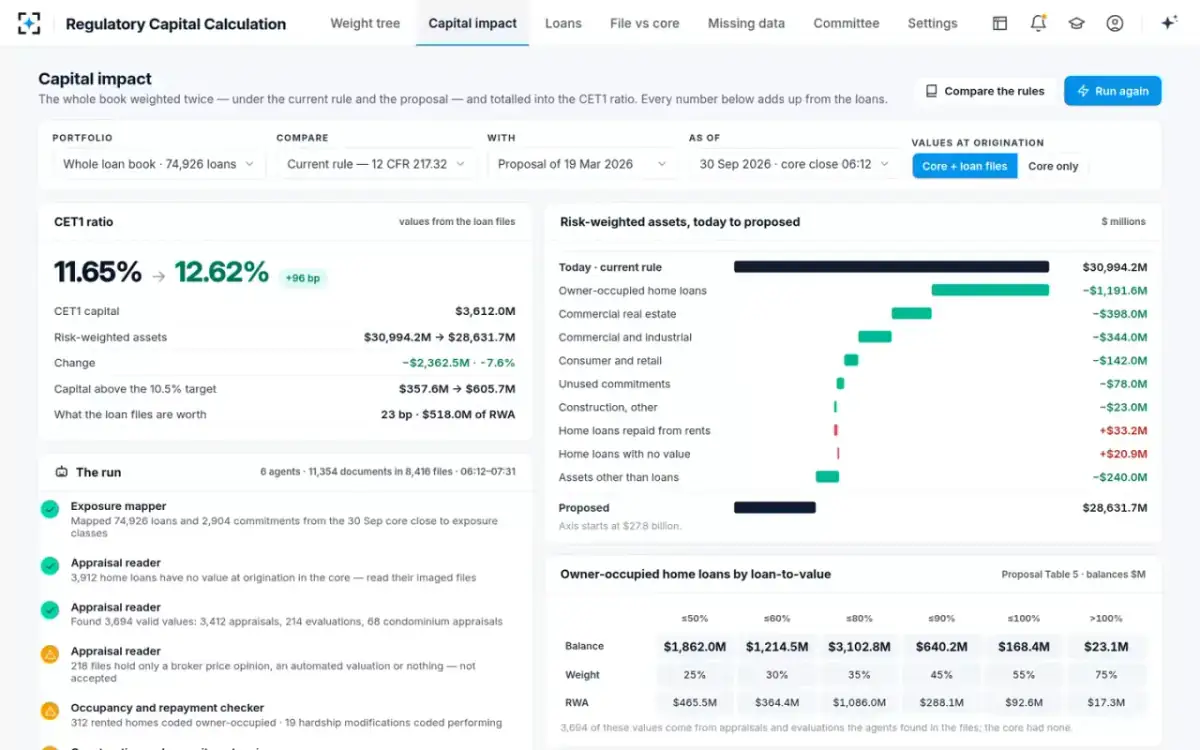
The difference between the two kinds of number matters more than it sounds. An industry estimate tells a board what the direction of travel is. A bridge built from the bank's own loans tells it which segments produced the move, which of them rest on documents the bank has, and how much of the gain would evaporate if those documents could not be found.
When would the new risk weights take effect?
No date is set, because nothing is final. The proposal's own transition table carries an illustrative date and labels it as one: "For simplicity and illustrative purposes, the transition table assumes an effective date of January 1, 2027." Comments closed on 18 June 2026, and a final rule would have to be issued, published and given its own effective and transition dates before anything changes.
The 2026 rulemaking, and the community bank leverage ratio rule that moved alongside it
- Published at 91 FR 15332 · comment period open27 Mar – 18 Jun 2026
- Comments closed · the agencies consider themto the illustrative 1 Jan 2027 date
- Published at 91 FR 22973 · awaiting effect29 Apr – 1 Jul 2026
- In force: the requirement lowered to 8%, grace period four quartersfrom 1 Jul 2026
The data the proposal assumes you already have
The proposal's most demanding sentence is not about weights at all; it is about measurement. The agencies had to estimate the industry's loan-to-value distribution from a one-off collection because the regular reports do not carry it: "Due to the limitations of current regulatory reports, the agencies utilize the 2023 special data collection to estimate the LTV distribution of residential mortgage exposures and the proportion of them that are dependent on the cash flows of the underlying real estate."
If the supervisors could not get those two facts out of regulatory reporting, most banks cannot get them out of a core extract either. And under the proposal a first-lien exposure for which the bank "cannot calculate the LTV" takes 100 per cent — the worst weight in the residential table, worse than the 50 per cent the same loan carries today. The relief and the data requirement arrive together.
Six facts the proposal needs that most core banking systems do not hold
- The value of the property at origination
The denominator of the ratio, and the fact most often lost in a conversion or an acquisition. It has to rest on an appraisal or an evaluation.
- Whether the property is owner-occupied or rented
Usually coded at boarding and rarely revisited, which makes it current only by accident.
- Whether repayment depends on the property’s cash flows
Decides which of the proposal’s two tables applies, and the second table is materially higher at every band.
- Past-due and nonaccrual status at the reporting date
The one fact the core normally does hold well — and the one that ends the walk earliest.
- Modification and restructuring history
A hardship modification recorded in servicing but not in the capital extract leaves a loan in a band it has left.
- Whether each commitment is unconditionally cancelable
A term of the credit agreement, not a product attribute, and now worth twice what it was on short facilities.
What changed between the 2023 proposal and the 2026 re-proposal?
Scope, direction and size. The 2023 proposal would have put every banking organization with $100 billion or more in total assets, and its subsidiary banks, on the new expanded risk-based approach, with a 72.5 per cent output floor, and it said in terms that it "would not amend the capital requirements applicable to smaller, less complex banking organizations" (88 FR 64028). The agencies estimated that it would raise the binding common equity tier 1 requirement of large holding companies by around 16 per cent.
The 2026 package reverses each of those. The expanded approach is confined to Category I and II organizations, with no output floor, and the agencies now estimate it would raise the aggregate common equity tier 1 requirement of those holding companies by about 1.4 per cent while lowering it by about 4.8 per cent at their bank subsidiaries. Category III and IV organizations move onto the revised standardized approach instead — and that revision, the part of the package with no counterpart in 2023, reaches every bank that computes risk-weighted assets. The agencies are rescinding the 2023 proposal rather than finalising it (91 FR 14952).
The 2023 proposal and the 2026 package, side by side
| Point of difference | September 2023 proposal | March 2026 package |
|---|---|---|
| Who must use the expanded risk-based approach | Every banking organization with $100 billion or more in total assets, and its subsidiary banks | Category I and II organizations only; any other organization may elect it |
| Banks below $100 billion | Capital requirements not amended | Revised standardized approach: loan-to-value mortgage tables, 95% corporate, 90% other assets, one 40% conversion factor |
| Output floor | 72.5% of risk-weighted assets under the standardized approaches | None proposed |
| Agencies’ estimate for common equity tier 1 requirements | About +16% for large holding companies | About +1.4% for Category I and II holding companies; −8.6% for depository institutions under the standardized revision |
| Status | Being rescinded | Proposed; comments closed 18 June 2026; not in force |
For a bank under $100 billion, that is the whole story in one line: in 2023 the endgame was somebody else's rule, and in 2026 it is theirs. What a bank should do before the text is final — measure, find the documents, correct what is already wrong — is set out step by step in Basel III endgame implementation.
Running a proposal safely: the rule versions Regulatory Capital Calculation is allowed to use
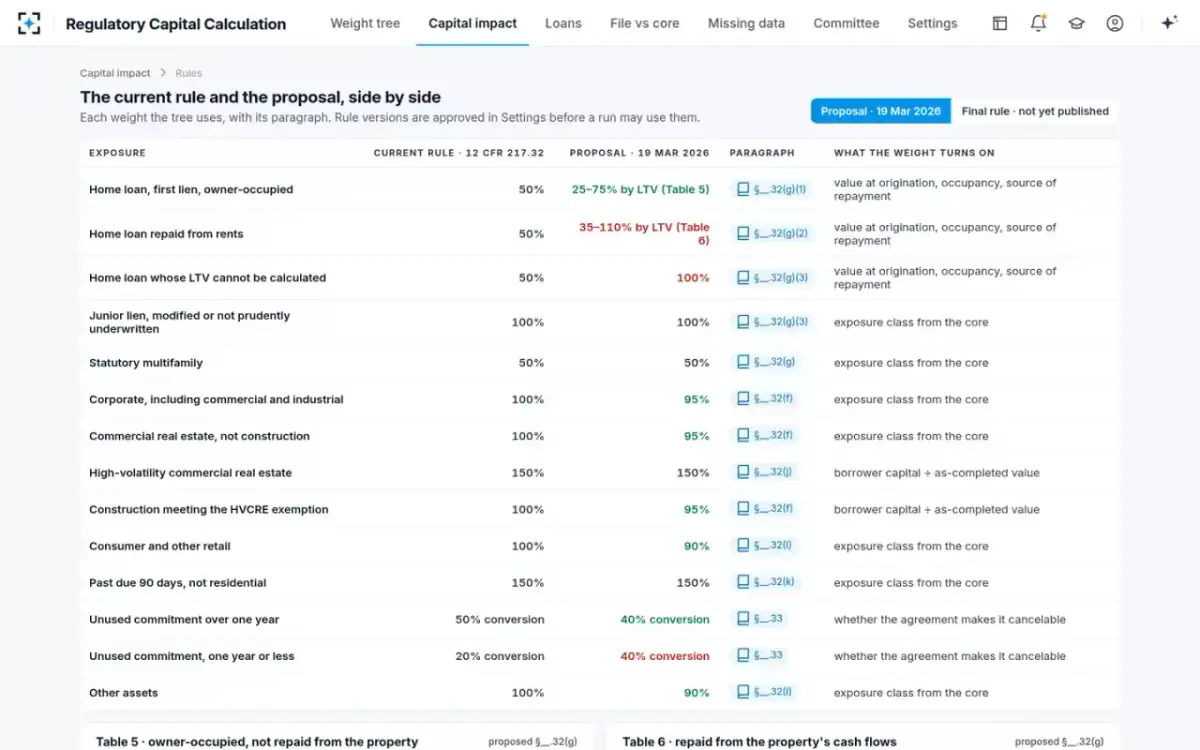
That is the sequence Regulatory Capital Calculation runs: both rules on the same loans, the document behind every answer, and a list of what is still unproved with the capital attached to each line. The construction side of it is worked through in the tests a construction loan must pass, and the residential side in loan-to-original-value.
Questions people ask
What is the difference between the standardized approach and the expanded risk-based approach?
The standardized approach assigns fixed weights by exposure category and is the framework most US banks use. The expanded risk-based approach, proposed concurrently in 2026, is a new and more granular framework covering credit risk, equity risk and operational risk, together with a revised market risk framework. It would be mandatory for Category I and II banking organizations, and the agencies propose to let banking organizations of any size elect into it in place of the standardized approach.
How much capital would the proposal free up?
The agencies estimate an 8.6 per cent fall in aggregate risk-weighted assets for covered depository institutions, which flows through to an 8.6 per cent fall in common equity tier 1 capital requirements and 7.4 per cent in tier 1 requirements. That is an industry figure computed on an explicit assumption that banking activity and risk exposures stay unchanged. What any one bank would release depends on its own mix, and on how much of its mortgage book it can place in a loan-to-value band with evidence.
Which exposures go up under the proposal?
Short commitments, principally. A commitment that is not unconditionally cancelable with an original maturity of a year or less would convert at 40 per cent rather than 20, doubling the exposure amount, which with the corporate weight at 95 per cent gives a 90 per cent increase in risk-weighted assets on that slice. Home loans repaid from the property's cash flows also take a higher table than loans that are not, and mortgage servicing assets above today's deduction threshold would stop being deducted from capital and carry a 250 per cent weight instead.
What data would a bank need that it does not have today?
Chiefly the value of each property at origination and whether repayment depends on the property's cash flows. The agencies had to estimate both from a 2023 special data collection because, in their words, regulatory reports do not carry them. Occupancy, modification history and the cancelability of each commitment matter too, and all five live in documents rather than in core system fields.
Is the 2023 Basel III endgame proposal still alive?
No. The agencies are rescinding it, and anyone who wants to comment has to comment on the 2026 proposals. Its main ideas survive in altered form — the expanded risk-based approach, now for Category I and II only and without the output floor — but its scope, its calibration and its estimated 16 per cent rise in large holding companies' requirements do not.
Does the proposal change anything for a bank in the community bank leverage ratio framework?
One thing. A bank inside the framework does not calculate risk-weighted assets, so the weight changes pass it by. But the removal of the threshold-based deduction for mortgage servicing assets, with all such assets taking a 250 per cent risk weight, is stated to apply to all banking organizations subject to the capital rule, including those in the framework. Separately, the agencies' April 2026 final rule lowered the leverage requirement to 8 per cent with effect from 1 July 2026.