Loan-to-original-value is the extension of credit divided by what the property was worth when the loan was made, and under the agencies' March 2026 proposal it is the single most consequential number on a first-lien home loan: it selects the risk weight from a table running from 25 to 75 per cent, and a loan whose ratio cannot be calculated takes 100. Unlike almost every other input to a capital calculation, it cannot be derived, refreshed or estimated — it is a fact about a day in the past, and the only thing that proves it is a document written at the time. That is why Botminds built Regulatory Capital Calculation to read imaged loan files for appraisals and evaluations rather than to assume past them: a bank's archive stops being a compliance obligation and becomes part of the denominator of its capital ratio.
The loan, the bank and the appraiser named below are fictional sample data shown in the solution. The rules and the quotations are real and linked under the figures that use them.
The same home loan, with its file and without it
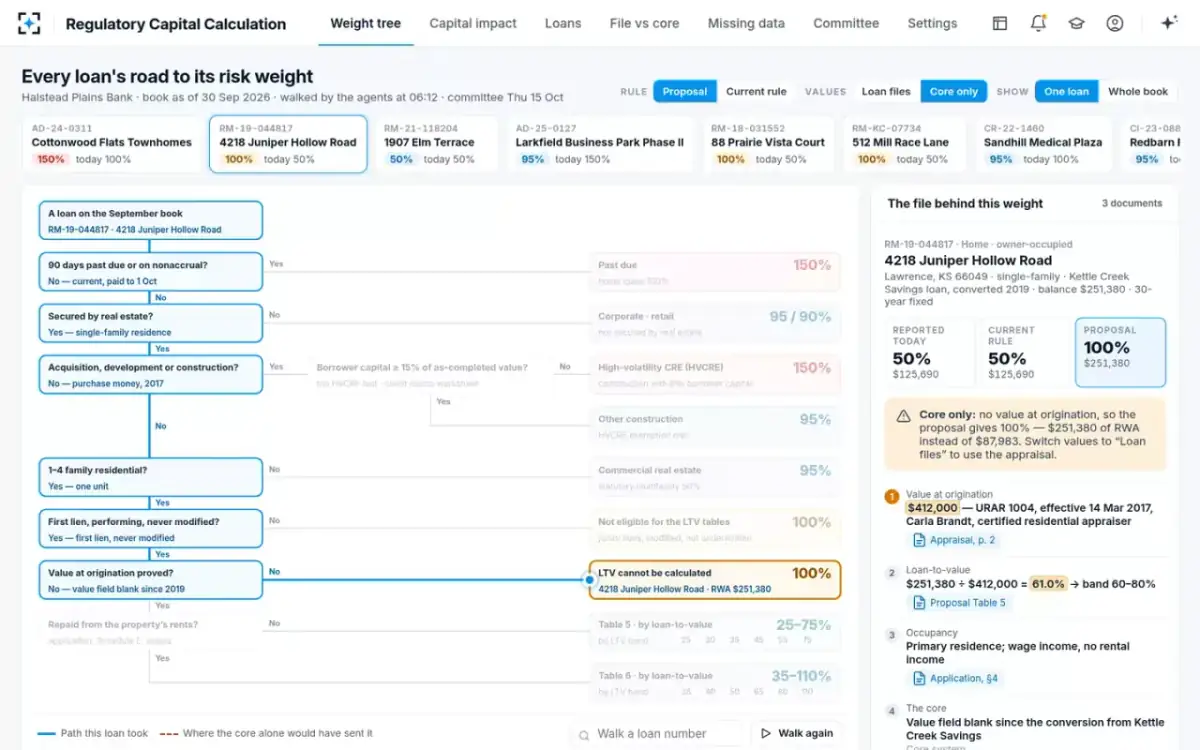
Core system only: Blank — the field was lost in a 2019 conversion.
With the appraisal found in the file: $412,000, from a URAR 1004 effective 14 March 2017 by a certified residential appraiser.
Core system only: Cannot be calculated.
With the appraisal found in the file: $251,380 ÷ $412,000 = 61.0%.
Core system only: 100% — the rule names the unmeasurable case in terms.
With the appraisal found in the file: 35%, from the band above 60 and up to 80 per cent.
Core system only: $251,380.
With the appraisal found in the file: $87,983.
Core system only: Nothing about the loan, the borrower or the house.
With the appraisal found in the file: One document was read.
What is loan-to-original-value and how is it calculated?
It is a ratio with two defined parts, and the proposal defines both. For the numerator, "a covered banking organization would calculate the LTV ratio for purposes of Table III.1 and Table III.2 below by dividing the extension of credit by the value of the property. The extension of credit means the total outstanding amount of the loan, including any undrawn committed amount" (91 FR 15332). For the denominator, "the value of the property would mean the value at the time of origination of all real estate properties securing the extension of credit, including the increased estimated value of the property if the property is being improved by an extension of credit."
Two consequences follow immediately. The numerator moves: it is the current outstanding amount, so an amortising loan's ratio falls as principal is repaid and the weight can improve over time without anything being re-appraised. The denominator does not move: it is fixed on the day of origination and stays there. A home equity line therefore has to count its undrawn committed amount in the numerator, which puts it in a higher band than its drawn balance alone would suggest.
The risk weight the proposal reads off the ratio, band by band
| Loan-to-value at origination | Not dependent on the property’s cash flows | Dependent on the property’s cash flows | The same loan today |
|---|---|---|---|
| 50% or less | 25% | 35% | 50% if it meets all four conditions of the current band |
| Above 50%, up to 60% | 30% | 40% | 50% |
| Above 60%, up to 80% | 35% | 50% | 50% |
| Above 80%, up to 90% | 45% | 65% | 50% |
| Above 90%, up to 100% | 55% | 80% | 50% |
| Above 100% | 75% | 110% | 50% |
| Cannot be calculated | 100% | 100% | 100% only where a condition of the current band fails |
Read down the first column and the proposal is generous to a well-secured book. Read the last row and it is unforgiving to an undocumented one. Both are the same rule.
Why the rule uses the value at origination and not today's value
Because a current value moves with the market and a capital requirement that moves with the market gets easier exactly when it should get harder. The agencies say so directly: "Using the value of a property at origination when calculating the LTV ratio protects against volatility risk or short-term market price inflation." A rule that let banks re-appraise into lower weights during a housing boom would release capital at the top of a cycle, which is the opposite of what a capital framework is for.
The cost of that choice falls on records rather than on economics. A value at origination for a loan made in 2004 is a fact about 2004, and the only evidence of it is a document from 2004. For a bank that has grown by acquisition, the loans with the oldest files are often the ones whose files it never received.
What counts as the value of the property at origination
The proposal's definition is broader than a single appraisal figure. It is the value at origination of all the real estate securing the extension of credit, including the increased estimated value where the credit is improving the property, and it also includes "the fair value of any readily marketable collateral and other acceptable collateral, as defined in the real estate lending guidelines, that secures the extension of credit."
What may evidence that value is set elsewhere, by the appraisal rules the capital rule points at. The current rule's 50 per cent band already says a bank "must base all estimates of a property's value on an appraisal or evaluation of the property that satisfies subpart E of 12 CFR part 208" (12 CFR 217.32(g)), so the evidence standard is not new even if the arithmetic is.
What may prove a value at origination, and what may not
| The document | Does it prove the value? | The rule that says so |
|---|---|---|
| Appraisal by a State certified or licensed appraiser | Yes. Required for a residential transaction above the threshold in force when the loan was made; for any federally related transaction of $1,000,000 or more, the appraiser must be State certified. | 12 CFR 225.63(a) and (d) |
| Evaluation | Yes, where the transaction did not require an appraiser: the institution "shall obtain an appropriate evaluation of real property collateral that is consistent with safe and sound banking practices." | 12 CFR 225.63(b) |
| Condominium or unit appraisal meeting the same standards | Yes — it is an appraisal, performed to the same minimum standards. | 12 CFR 225.63(a) |
| Broker price opinion | No. BPOs "in and of themselves, do not comply with the minimum appraisal standards … and are not consistent with the Agencies’ minimum supervisory expectations for evaluations." | Interagency Appraisal and Evaluation Guidelines, 75 FR 77450 |
| Automated valuation model output | No. The result of an AVM, "by itself or signed by an appraiser, is not an appraisal." | Interagency Appraisal and Evaluation Guidelines, 75 FR 77450 |
| A tax assessment, a purchase price or a figure typed into a system | No. None of them is an appraisal or an evaluation, and none was prepared to the appraisal standards the capital rule points at. | 12 CFR 217.32(g), which requires an appraisal or evaluation |
The three exceptions that allow a different value
The proposal allows the original value to be departed from in three cases and no others. It "would require covered banking organizations to use the value of the property at the time of origination, except under the following circumstances: (1) the covered banking organization's primary Federal supervisor requires the covered banking organization to revise the property value downward; (2) an extraordinary event occurs resulting in a permanent reduction of the property value (for example, a natural disaster); or (3) modifications are made to the property that increase its market value and are supported by an appraisal or independent evaluation using prudently conservative criteria."
Two of the three move the value down, and the third needs new evidence to move it up. There is no exception for "the market has risen," none for "the original appraisal cannot be found," and none for management judgement. A bank reading that list for a way to use a current value will not find one.
Can a broker price opinion or an automated valuation prove it?
No, and the agencies' guidance is unusually blunt about both. On broker price opinions the Interagency Appraisal and Evaluation Guidelines state the position twice over.
The Guidelines confirm that BPOs and other similar valuation methods, in and of themselves, do not comply with the minimum appraisal standards in the Agencies' appraisal regulations and are not consistent with the Agencies' minimum supervisory expectations for evaluations.
OCC, Federal Reserve Board, FDIC, OTS and NCUA, Interagency Appraisal and Evaluation Guidelines, 75 FR 77450
On automated valuations the guidelines are equally direct: "the result of an Automated Valuation Model (AVM), by itself or signed by an appraiser, is not an appraisal, because a state certified or licensed appraiser must perform an appraisal in conformance with USPAP and the Agencies' minimum appraisal standards."
This is the limit that matters most when the work is automated. In the sample bank the appraisal reader never accepts a broker price opinion or an automated valuation, never uses a current value and never estimates one; where it finds none of the permitted documents it lists the loan as missing. That is why 191 of the loans taken on from one acquisition stay at 100 per cent: their files hold a 2019 broker price opinion and nothing else. A product that filled that gap with a plausible number would make the capital ratio look better and the bank's position worse.
Appraisal, evaluation and the thresholds that decide which you needed
Which document should be in the file depends on what the transaction was. The Board's appraisal rules require that "an appraisal performed by a State certified or licensed appraiser is required for all real estate-related financial transactions except those in which: (1) The transaction is a residential real estate transaction that has a transaction value of $400,000 or less" and a list of further exceptions, including business loans of $1 million or less not dependent on the real estate for repayment (12 CFR 225.63(a)). Where no appraiser was required, an evaluation was: "the institution shall obtain an appropriate evaluation of real property collateral that is consistent with safe and sound banking practices." All federally related transactions of $1,000,000 or more require a State certified appraiser.
For a capital team this is a search strategy rather than a compliance point, and the date matters as much as the amount. The residential threshold was $250,000 until the agencies raised it to $400,000 with effect from 9 October 2019 (84 FR 53579). So a $310,000 home loan made in 2020 may legitimately have an evaluation and no appraisal, and the evaluation proves the value perfectly well; the same loan made in 2018 fell under the old $250,000 threshold, so unless another exemption applied it needed an appraisal, and a file that holds only an evaluation is a question in its own right. Looking only for appraisals on a book of small residential loans will report as missing a large number of loans whose evidence is sitting in the file under a different name. In the sample bank the split across the values found was 3,412 appraisals, 214 evaluations and 68 condominium appraisals — about one loan in seventeen proved by an evaluation rather than an appraisal.
Does private mortgage insurance lower the loan-to-value for capital?
No. The proposal is explicit: "For the LTV ratio calculation, a covered banking organization would calculate the loan amount without making any adjustments for credit loss provisions or private mortgage insurance." The agencies tie it to the capital rule's existing definition of an eligible guarantor, which does not recognise an insurer predominantly in the business of providing credit protection, and note that private mortgage insurance performed poorly during the 2007–2009 housing stress, at the same time as the loans it covered.
This surprises people, because mortgage insurance does reduce the bank's loss given default and does appear in the loan-to-value figures a lender uses commercially. For the capital calculation it does not exist. A 92 per cent loan with mortgage insurance sits in the band above 90 per cent, not in the band its insured exposure would imply.
What happens when the core has no value at origination?
Under the current rule the weight does not turn on the ratio, so a blank core field is not by itself a change of weight: the 50 per cent band asks whether the loan was prudently underwritten against a value resting on an appraisal or evaluation, and that is answered by the file. If the file holds the original appraisal, the loan qualifies whatever the core says; if neither the core nor the file can show a value, the bank cannot demonstrate condition (ii). Under the proposal the outcome is written into the rule text: 100 per cent applies to a first-lien residential mortgage exposure that does not meet the criteria "or for which the Board-regulated institution cannot calculate the LTV," and to junior-lien exposures.
The point worth making to a capital committee is that the proposal turns a records gap into a price. Today a loan with its appraisal in the file sits at 50 per cent whether or not the core carries the value. Under the proposal the same loan sits anywhere from 25 to 75 per cent if the value is read from the file, and at 100 per cent if it is not — a gap of up to 75 points of weight on a loan with plenty of equity. A bank that waits for the final rule to start the search will find out the price of its archive in the quarter it has to report it.
A 2017 appraisal Regulatory Capital Calculation found that the core system never had
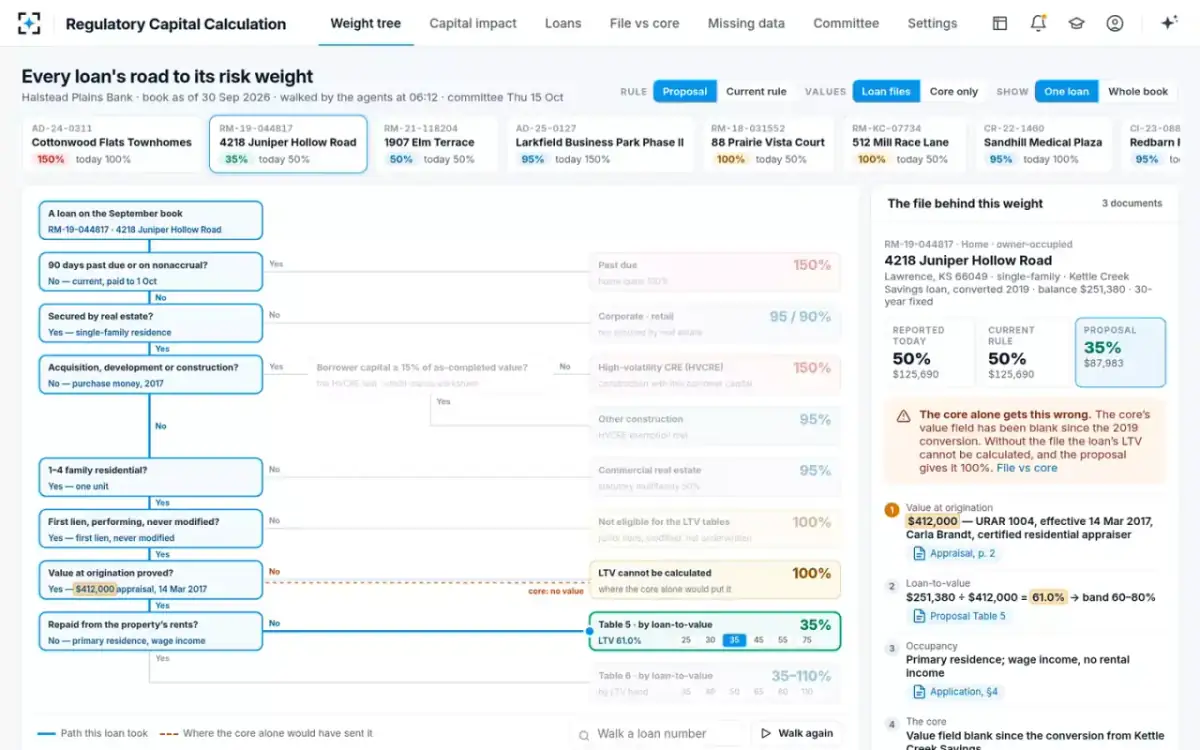
The same loan with the core's values only, and the weight that follows
Finding the number: where it actually sits in a loan file
The practical difficulty is rarely that the document is absent. It is that the file is a scanned bundle of several hundred pages with no index, the value appears in four places with three different meanings, and the one that matters is the one on the day the loan closed.
Where the value at origination hides, and which version of it the rule wants
- The appraisal report itself
Look for the effective date of the opinion of value, not the date the report was signed or delivered. The effective date is the day the value speaks to.
- The closing disclosure or settlement statement
Carries the purchase price, which is not the value and may differ from it. Useful for dating the origination, not for proving the figure.
- The underwriting worksheet or approval memo
Usually quotes the appraised value and the ratio the underwriter used. Good evidence that an appraisal existed; not a substitute for it.
- An evaluation prepared instead of an appraisal
For transactions under the threshold, this is the correct document and it proves the value. A search that only looks for appraisals will miss it.
- A later appraisal obtained for a modification or a renewal
Proves a value, but not the value at origination. It is only usable where one of the proposal’s three exceptions applies.
- A broker price opinion or an automated valuation in the servicing file
Common on acquired books, and not evidence. The honest outcome is to list the loan as missing rather than to use it.
What a found appraisal is worth, in basis points
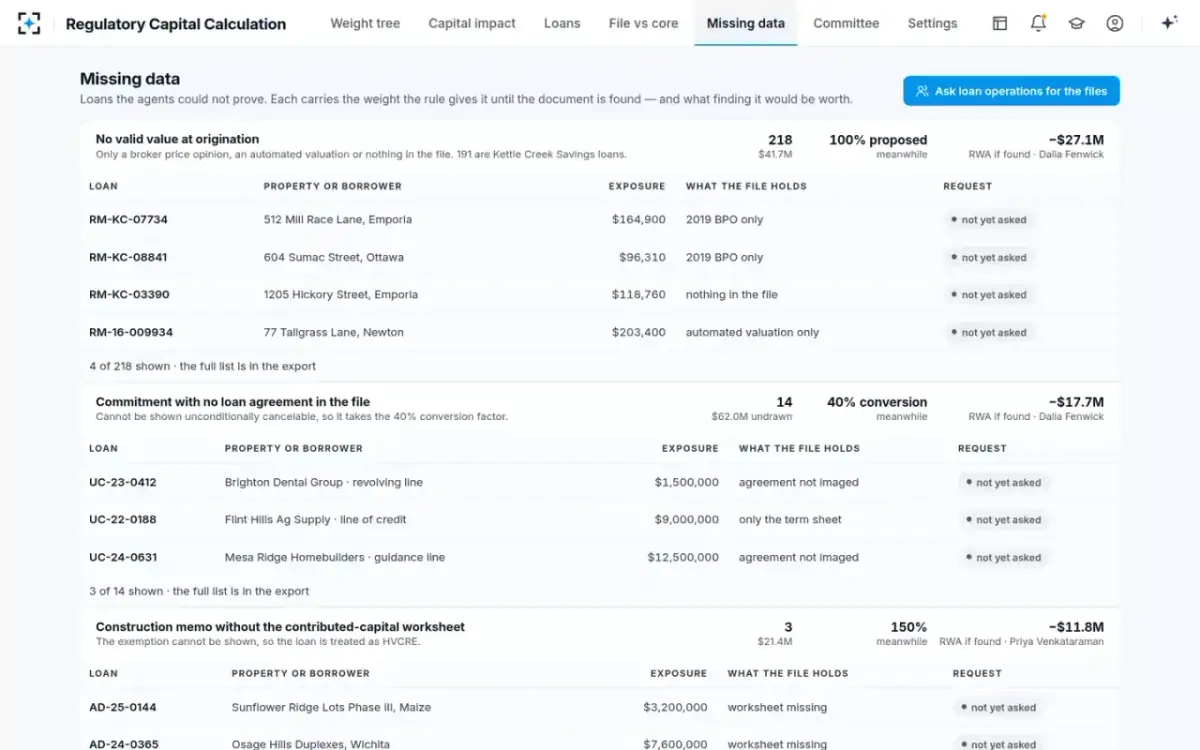
The reason to do this work is that it is measurable, loan by loan and in aggregate. On the sample book, 3,912 home loans had no value at origination in the core, most of them from a single 2019 conversion. The appraisal reader found a valid appraisal, evaluation or condominium appraisal in the imaged files for 3,694 of them. The 218 that remain are worth about $27.1 million of risk-weighted assets if their documents are ever found.
The scale of one bank's gap, and what closing it was worth
3,912loans
home loans with no value at origination in the core, most of them from one 2019 conversion
3,694
values proved from imaged files — 3,412 appraisals, 214 evaluations and 68 condominium appraisals
218loans
still unproved, $41.7M of balances, 191 of them with only a 2019 broker price opinion in the file
$27.1M
of risk-weighted assets that would come off if those last documents were found
Two things make that number useful rather than interesting. The first is that it is attached to named loans, so loan operations gets a work list ordered by what each document is worth rather than a percentage. The second is that the residue is honest: 218 loans the bank cannot prove, carrying the punitive weight, visible to the committee and to an examiner. A calculation that quietly assumed a value for those loans would show a better ratio and would be indefensible the first time anyone pulled one of them.
The loans Regulatory Capital Calculation could not prove, and what each is worth if found
The loan-to-value is one branch of a longer walk; how it sits among the other questions is set out in how to calculate risk-weighted assets, loan by loan, the weights it selects are in the exposure-by-exposure table, and the rulemaking that introduced it is covered in what the 2026 re-proposal changed. To see the search run on a real book, start from Regulatory Capital Calculation.
Questions people ask
Does the risk weight use the original value or the current value?
The original value. The proposal would require the value at the time of origination, and the agencies explain that using it "protects against volatility risk or short-term market price inflation." A current value may only be used in three narrow circumstances: where the bank's primary Federal supervisor requires the value to be revised downward, where an extraordinary event has permanently reduced it, or where improvements have raised it and an appraisal or independent evaluation on prudently conservative criteria supports the increase.
Can an old appraisal still be used?
Yes, if it was the appraisal made at origination — age is not a defect when the rule is asking what the property was worth then. For other purposes the guidelines expect an institution to test whether an existing appraisal remains valid: the agencies "allow an institution to use an existing appraisal or evaluation to support a subsequent transaction in certain circumstances," and say an institution "should establish criteria for assessing whether an existing appraisal or evaluation continues to reflect the market value of the property."
Does an automated valuation count?
No. The guidelines say the result of an automated valuation model, by itself or signed by an appraiser, is not an appraisal, because an appraisal has to be performed by a State certified or licensed appraiser in conformance with USPAP and the agencies' minimum standards. An automated valuation can be a sensible monitoring tool and can even feed into a properly prepared evaluation, but on its own it does not prove a value at origination for capital purposes.
What if the property has been improved since the loan was made?
Two different situations. Where the credit itself is improving the property, the proposal's definition of value already includes "the increased estimated value of the property if the property is being improved by an extension of credit," so the improvement is in the denominator from the start. Where improvements were made later, the third exception applies: the value may be raised only if the modifications increase market value and are supported by an appraisal or independent evaluation using prudently conservative criteria.
Does the ratio include the undrawn part of a commitment?
Yes. The proposal defines the numerator as the extension of credit, which "means the total outstanding amount of the loan, including any undrawn committed amount." For a home equity line that is the whole commitment rather than the drawn balance, which can put a modestly drawn line in a materially higher band. The outstanding amount does fall as principal is repaid, so an amortising loan's ratio — and potentially its weight — improves over time.
Is a value at origination needed under today's rule too?
Yes, though it is used differently. The current 50 per cent band requires the loan to be made in accordance with prudent underwriting standards "including relating to the loan amount as a percent of the appraised value of the property," and the same paragraph requires all estimates of value to rest on an appraisal or evaluation satisfying subpart E of 12 CFR part 208. Today the value has to exist in the file to support the 50 per cent band; under the proposal it also selects the weight, so it has to be found and read.