In a provider contract, a carve-out is an item or service that is paid outside the contract's main rate under its own term: a joint replacement case rate with the implant carved out and paid at invoice cost, an inpatient per diem with high-cost drugs carved out and paid from a drug schedule, or a stop-loss term that pays a percentage of charges above a threshold. In managed care more broadly, a carve-out also means a whole benefit, such as behavioral health, taken out of a plan's contract and run separately. Provider contract carve-outs are where a single missed term moves the most money on a single claim, because the carved-out item is usually the expensive one, and where configuration most often double-pays or misses a payment. Botminds' Provider Contract Management reads each rate term in an agreement with its page, applies the terms in force on the date of service, and compares every paid claim with the result each night, so a carve-out that is in the contract but not in the claims system shows up as a gap with its cause.
The hospital claims below are invented and their amounts illustrative. Screens from the solution show its fictional sample plan.
On two invented stays at the same hospital, how much of the allowed amount sits outside the case rate
Knee replacement, 3 days · allowed $22,332
- Case rate $16,500 · 74%
- Implant carve-out $5,832 · 26%
Same procedure, complicated 19-day stay · allowed $76,332
- Case rate $16,500 · 22%
- Implant $5,832 · 8%
- Stop-loss: 60% of charges above $120,000 · $54,000 · 70%
What is a carve out in a provider contract?
A carve-out in a provider contract is a term that removes an item, service or cost from the main payment method and pays it separately. The main method might be a case rate, a per diem, a percentage of a Medicare diagnosis-related group amount or a fee schedule; the carve-out has its own method, often invoice cost plus a percentage, a percentage of charges, or a drug pricing benchmark. The claim then pays the main rate plus each carve-out that applies.
Carve-outs exist because some costs vary too much from case to case to fit inside a fixed rate. A case rate built on an average implant price under-pays a hospital that uses an expensive device and over-pays one that uses a cheap one; carving the implant out lets the fixed rate cover the predictable part and the invoice cover the rest. The same logic applies to high-cost drugs and to very long or complicated stays.
What does carve out contract mean? The two meanings
"Carve out contract" has two meanings in health care, and searches mix them. The first is the provider contract term above. The second is a benefit carve-out: a payer, often a state Medicaid program, excludes a whole category of services from a managed care plan's contract and has them delivered and paid another way.
MACPAC, the congressional advisory commission on Medicaid, describes the second meaning: states can "carve out or exclude certain benefits to be provided through fee for service or through a limited-benefit plan," and "When services are carved out of the managed care benefit package, the health plan does not have the responsibility to provide nor does it receive payment for these services." It adds that "Behavioral health services tend to be the most commonly carved out services in Medicaid programs," with dental, pharmacy and non-emergency transportation among other common carve-outs (MACPAC, types of managed care arrangements).
Two kinds of carve-out: a payment term and a benefit design
Provider contract carve-out: An item or cost inside a claim: an implant, a drug, charges above a threshold
Benefit carve-out: A whole category of services: behavioral health, dental, pharmacy, transportation
Provider contract carve-out: The plan and the provider, in the agreement or an amendment
Benefit carve-out: The payer (often a state) and the plan, in the plan's contract
Provider contract carve-out: The claim pays the main rate plus the carved-out amount
Benefit carve-out: The plan neither provides nor is paid for the carved-out services
Provider contract carve-out: Carve-out missed, so the claim underpays; or paid twice, inside the rate and on top
Benefit carve-out: Claims for carved-out services paid by the wrong entity
What services are usually carved out?
The candidates for a carve-out are the items whose cost varies most and is easiest to document separately. Medicare's own payment systems pay several of them outside the base rate, which gives contracts a template. In hospital inpatient payment, CMS's out-of-network guide lists outliers and the new technology add-on as parts of the payment for a discharge, notes that "A separate payment is made for hemophilia clotting factors," and treats organ acquisition costs as a pass-through outside the diagnosis-related group payment (CMS, MA Payment Guide for Out of Network Payments).
Common carve-out patterns, how each is paid, and how it shows on a claim
| Carve-out | Usual payment method in the contract | How it shows on the claim | What to check |
|---|---|---|---|
| Implants and devices | Invoice cost, sometimes plus a percentage; or a percentage of charges | Device lines and codes on a surgical or inpatient claim | The invoice, any manufacturer credit, and whether the main rate already includes devices |
| High-cost drugs | A drug pricing benchmark or a percentage of charges, by drug code | Drug lines with units on an inpatient or outpatient claim | Units against the dose, the benchmark in force on the date of service |
| Stop-loss or outlier | A percentage of charges above a threshold, or a cost-based outlier like Medicare's | Billed charges above the threshold on one stay | Which charges count toward the threshold; whether carve-outs are excluded from it |
| Blood products and clotting factors | Per unit or at cost | Blood and factor lines | Units and the price per unit in force |
| Transplants and organ acquisition | A separate case rate or cost pass-through | Transplant diagnosis-related groups with acquisition charges | Which acquisition costs are included |
| Specific services inside a per diem | Paid on top of the daily rate, by code | Lines for the named services on an inpatient claim | That the per diem is not also paying for them |
How are carve-outs paid? Implants, drugs and stop-loss
Implant carve-outs are usually paid from the invoice: the hospital's cost for the device, sometimes with a handling percentage. The invoice is the evidence, and the credit is the trap. Medicare reduces its own inpatient payment when a device is replaced at no cost to the hospital, or when the hospital receives a credit of half or more of the device's cost (42 CFR 412.89). A contract that pays implants at invoice should say what happens to warranty replacements and manufacturer credits; the evidence side of that question, reconciling a bill against the invoice and its credits, is covered in the guide to the implant invoice.
Stop-loss terms pay a percentage of charges, or of cost, above a threshold, and they mirror Medicare's outlier payment. For Medicare, "Payment is 80% of the excess of the cost of an admission over the sum of the DRG payment (including IME, DSH, and new technology) and a threshold amount," and "The cost of an admission is generally determined by multiplying the hospital's cost to charge ratio by its charge." For discharges from 1 October 2026, CMS set the fixed-loss threshold at $49,346: "Under this approach, we determined a threshold of $49,346" (FY 2027 IPPS final rule). Researchers studying insurer claims describe the commercial version as hybrid "prospective payment contracts that include outlier adjustments that allow hospitals to be paid more when costs for a particular case are significantly higher than average costs" (Cooper and colleagues, 2019).
How do carve-outs affect claim payment?
A carve-out changes the claim in two ways: it adds a payment, and it changes what the main rate covers. The second is the subtle one. If the case rate is defined to exclude implants, the implant must be paid separately or the claim is short; if the case rate includes implants and the implant is also paid separately, the claim is paid twice. Both errors look like valid payments.
The order of operations matters as much as for any other term. Does a lesser-of test apply to the case rate alone or to the case rate plus carve-outs? Do carved-out charges count toward the stop-loss threshold? Does a multiple-procedure reduction touch carved-out lines? Each question has an answer in a well-drafted contract and a default in the claims system, and the two are not always the same. The lesser-of mechanics are worked in the lesser of billed charges guide.
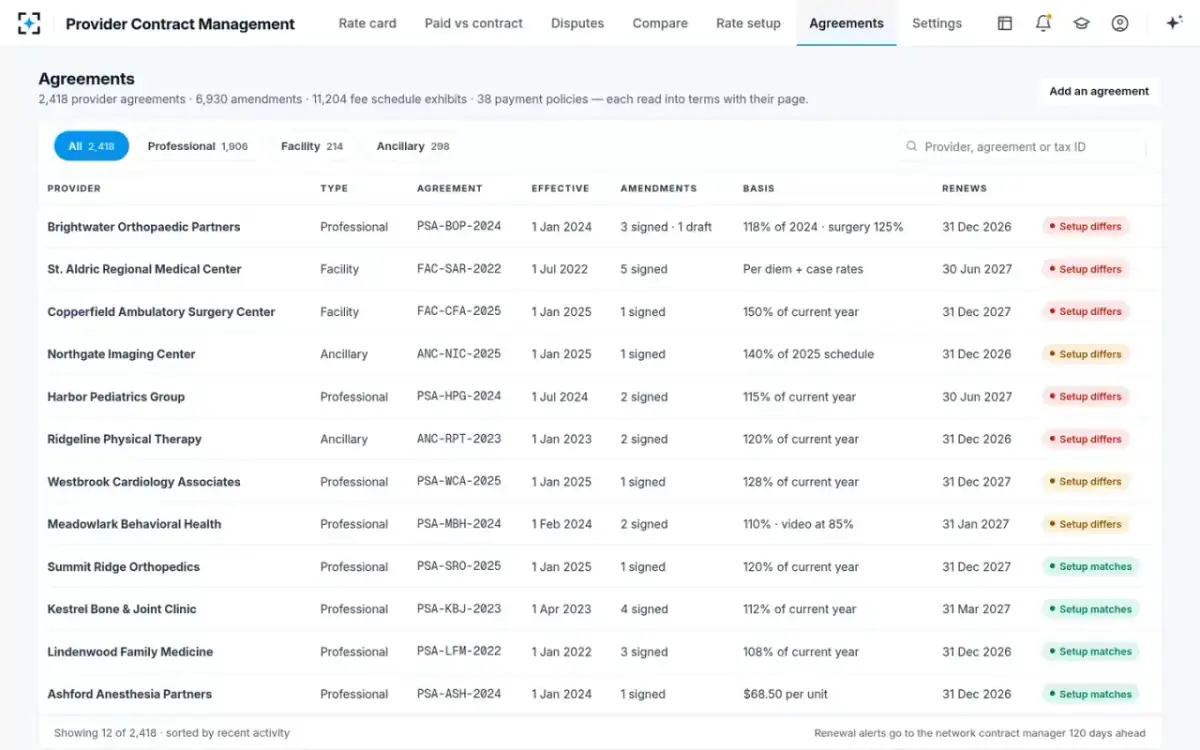
Every agreement with its rate basis: per diems, case rates and percentages of Medicare
Carve-outs, contracted rates and the qualifying payment amount
Carve-out terms also reach out-of-network pricing. Under the No Surprises Act, a plan's qualifying payment amount is built from its contracted rates, defined as "the total amount (including cost sharing) that a group health plan or health insurance issuer has contractually agreed to pay a participating provider" for the item or service (45 CFR 149.140). A rate that exists in a contract's default schedule for a service the provider never performs is a different matter: the Fifth Circuit's August 2026 ruling on such "ghost rates," and what it means for the calculation, are covered in the guide to the qualifying payment amount after TMA III.
For contract management the practical point is narrower. A plan that cannot say, for a given provider and service, which carve-out terms apply and what they pay, cannot say with confidence what its contracted rate for that service is. The same data problem shows up in the dispute, in the configuration and in the plan's public rate files.
How do you audit carve-out payments?
Carve-out payments are audited in both directions: claims where a carve-out term applied but no separate payment was made, and claims where a separate payment was made but the main rate already covered the item. The first finds underpayments the provider will dispute; the second finds overpayments the plan may only be able to recover for a limited time.
Six tests that find a missing or doubled carve-out
- List every carve-out term with its page
For each facility agreement: what is carved out, from which rate, how it is paid, from when, and what the main rate is defined to include.
- Find the claims that should trigger each term
Select paid claims for the provider with the carved-out codes, revenue lines or charge thresholds, from the term's effective date.
- Look for the separate payment
A claim with a carved-out item and no separate payment is a candidate underpayment.
- Look for the double payment
A carved-out item paid separately on a claim whose main rate includes it is a candidate overpayment.
- Check the evidence the term requires
Invoices for implants, units and dose for drugs, the charges counted toward a stop-loss threshold.
- Re-test at every amendment and renewal
Carve-outs are often renegotiated; a carve-out added, removed or re-priced by amendment is a load like any other.
How Provider Contract Management handles carve-out terms
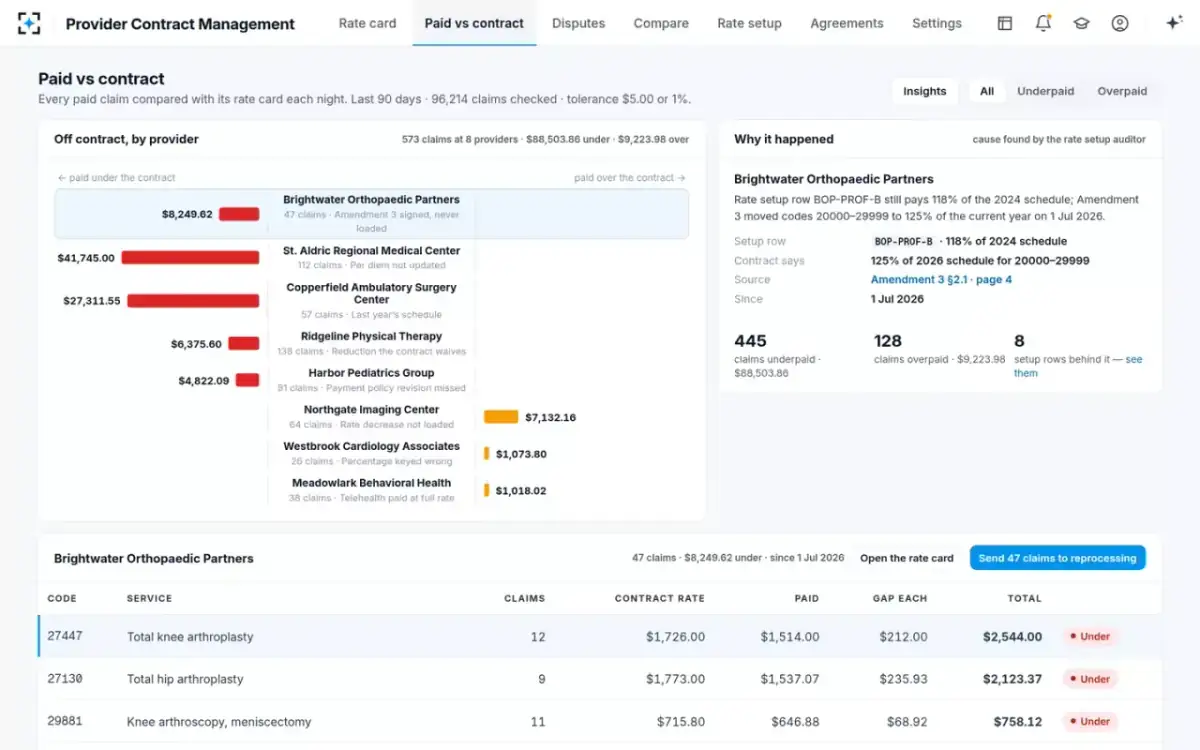
Botminds' Provider Contract Management treats a carve-out as what it is, a rate term: its contract reader reads each agreement, amendment, exhibit and payment policy into terms with their page and paragraph; its rate resolver applies the terms in force on the date of service; its paid-claims checker compares each paid claim with the result each night and looks back to the effective date for every claim with the same cause. On the solution's sample plan the rates shown are percentages of Medicare, per diems, case rates and per-unit rates, and the largest single finding was a facility whose updated per diem was never loaded: 112 claims paid $41,745.00 short.
Paid against the contract, by provider, with the cause behind each gap
The limits are the same as for every term. The agents do not hold or audit implant invoices, do not adjust or reprocess claims, and never change the claims system's setup; invoice evidence stays with the plan's bill review and payment integrity teams. A plan whose largest disputes involve invoice-based carve-outs should put those agreements and their claims in any pilot, as the provider contract management system pilot describes. To see the screens together, start from Provider Contract Management.
Questions people ask
What is an implant carve-out?
A contract term that excludes implants and devices from a case rate, per diem or percentage of a diagnosis-related group, and pays them separately, usually at the hospital's invoice cost, sometimes with a handling percentage. It should also say how manufacturer credits and no-cost replacements are treated, as Medicare's own rule does.
Is a carve-out the same as a stop-loss?
A stop-loss is one kind of carve-out: it carves the very expensive part of a stay out of the fixed rate and pays it on charges or cost above a threshold. Other carve-outs remove specific items, such as implants or drugs, whatever the size of the stay.
What is a carve-out in a Medicaid managed care contract?
It is a benefit the state excludes from the plan's contract and provides another way, through fee-for-service or a limited-benefit plan. MACPAC reports that behavioral health is the service most commonly carved out in Medicaid, and that the plan neither provides nor is paid for carved-out services.
Do carve-outs apply to Medicare Advantage claims from non-contracted hospitals?
Not as contract terms: without a contract the plan pays what Original Medicare would pay. Medicare's own separate payments, such as outliers, new technology add-on payments and the separate payment for hemophilia clotting factors, then apply as Medicare computes them.
How often should carve-out terms be reviewed?
At every amendment and renewal, and whenever the benchmark a carve-out uses changes: a drug pricing benchmark, an invoice policy, or Medicare's annual outlier threshold, which CMS set at $49,346 for fiscal year 2027.