A Medicare Advantage plan must pay a provider that has no contract with it the amount the provider could collect if the patient were in Original Medicare, and the provider must accept that as payment in full; clean claims from such providers must be paid within 30 days or carry interest, and other claims paid or denied within 60 days. CMS's "MA Payment Guide for Out of Network Payments" is the agency's outline of how to work out that Original Medicare amount for each type of provider, from hospital inpatient stays to physician services, and of the parts of Medicare's payment that a plan does and does not owe. The rule is simple to state and hard to apply, because Original Medicare's amount is the output of several payment systems, each updated on its own calendar. Botminds' Provider Contract Management is built for the other side of the line, the contracted rate in force on a date of service; this guide covers the non-contracted side so that a dispute analyst knows which rule governs before quoting a number.
Rules on this page are quoted from the Code of Federal Regulations and CMS, as read on 27 October 2026. Screens from the solution show its fictional sample plan.
Which rule prices a Medicare Advantage claim: contract, deemed contract, or Original Medicare
A person decides
Is there a signed contract with this provider?Yes: the contract's rates and its prompt payment clause govern. The plan pays on the contract's terms (42 CFR 422.520(b)).
A person decides
If not: is the member in a private fee-for-service plan, and was the provider deemed?A provider told of the enrollment and the plan's payment terms before treating a PFFS member is treated as having a contract in effect (42 CFR 422.216(f)); the plan's own terms apply.
A person decides
If not: price at the Original Medicare amountWhat the provider could collect under Original Medicare, less what the plan does not owe (for hospitals, operating IME and direct GME, which Medicare pays separately) (42 CFR 422.214).
A person decides
Apply the clock95% of clean claims within 30 days of receipt, with interest after that; other claims paid or denied within 60 calendar days (42 CFR 422.520(a)).
A person decides
Handle the dispute with the planSince 31 January 2014, non-contracted providers dispute payment amounts directly with the plan; a payment denial can be reconsidered by the plan and, if upheld, goes to CMS's independent entity.
How much does a Medicare Advantage plan pay an out-of-network provider?
A Medicare Advantage plan pays a non-contracted provider the amount the provider could have collected under Original Medicare, which means the Medicare fee schedule or prospective payment amount for that provider, service, date and location, including cost-sharing. The regulation states it from the provider's side: a provider without a contract "must accept, as payment in full, the amounts that the provider could collect if the beneficiary were enrolled in original Medicare" (42 CFR 422.214(a)(1)).
CMS states it from the plan's side. Its page on non-contracted provider disputes says Medicare Advantage organizations, cost plans and PACE organizations "are required to reimburse non-contract providers for Part A and Part B services provided to Medicare beneficiaries with an amount that is no less than the amount that would be paid under original Medicare" (CMS, Provider Payment Dispute Resolution for Non-Contracted Providers). The two statements meet at the same number: Original Medicare's amount is both the floor the plan must pay and the ceiling the provider may collect.
What is in CMS's MA Payment Guide for Out of Network Payments?
The guide is CMS's outline of how Original Medicare pays each provider type, with a "Payment information for MA plans" note under many sections. It is explicit about its limits: it "does not contain many of the payment details," and "The payment rates described in this document do not apply to a plan's network providers" (CMS, MA Payment Guide for Out of Network Payments). The version CMS links from its non-contracted provider page, last modified on 10 September 2024, is the 15 April 2015 update, so its descriptions of incentive programs that have since ended are history; its rules on what plans owe are the useful part.
Three of those rules come up in most hospital disputes. First, operating indirect medical education and direct graduate medical education payments "do not have to be paid by MA plans," because Medicare's contractors pay them on behalf of plan members, but "capital IME" does have to be paid. Second, Medicare's quality and readmission adjustments travel with the price: "The VBP adjustment is applicable to plans that are required to pay at least Medicare rates." Third, a plan may not keep a reduction Medicare would not apply: plans "are not permitted to make a payment reduction for the HIT penalties."
What the Original Medicare amount includes for a non-contracted hospital, per CMS's guide
| Component of Medicare's payment | Does the Medicare Advantage plan pay it to a non-contracted hospital? | Where it is stated |
|---|---|---|
| Base payment for the diagnosis-related group, with outliers and new technology add-on | Yes, as Original Medicare computes it | Guide: acute care hospital inpatient services |
| Operating indirect medical education (IME) and direct graduate medical education (DGME) | No: Medicare's contractors pay these on behalf of plan members | Guide; 42 CFR 422.214(b) excludes §§ 412.105(g) and 413.76 payments |
| Capital IME | Yes: part of the capital payment | Guide: payment information for MA plans |
| Organ acquisition cost pass-through | No, but the full allowed cost of an organ acquired for the plan's own member is owed | Guide: payment information for MA plans |
| Value-based purchasing and readmission adjustments | Yes: they are part of the amount the plan must pay | Guide: VBP and readmission adjustment sections |
| Electronic health record (HIT) penalties applied by Original Medicare | Not deducted by the plan | Guide: health information technology bonuses |
| Hemophilia clotting factors | Medicare makes a separate payment, so the claim carries more than the base amount | Guide: acute care hospital inpatient services |
Do non-contracted providers get paid Medicare rates?
Yes, and plans must keep those rates current. CMS's guide is direct about updates: "when original Medicare fee schedules are updated, MAOs must also update their rates of payment when reimbursing non-contracting and deemed (PFFS only) providers in order to meet their responsibility for paying at least the amount that original Medicare would have paid." A plan that loads Medicare's January schedule and misses a mid-year revision underpays every non-contracted claim the revision touched.
Medicare's own rules come with it. Professional services are "paid using the lesser of billed charges, or the Medicare Physician Fee Schedule (MPFS)," and plans paying out of network on Medicare's rules "must use rules that are not more restrictive than the CCI edits or than the OCE," Medicare's national coding edits and outpatient code editor. A plan cannot pay a non-contracted provider Medicare's rate and then apply its own stricter edits. How Medicare's lesser-of works line by line is in the lesser of billed charges guide.
Contracted and non-contracted providers in Medicare Advantage: two different rulebooks
Contracted provider: The contract's rates and methods
Non-contracted provider: What the provider could collect under Original Medicare
Contracted provider: The contract's own prompt payment provision, required by 42 CFR 422.520(b)
Non-contracted provider: 95% of clean claims within 30 days, then interest; other claims paid or denied within 60 days
Contracted provider: Only the plan's cost-sharing
Non-contracted provider: Providers of services may not; non-participating physicians only as far as Original Medicare allows, with the plan paying the excess
Contracted provider: When the contract says, often each 1 January or by amendment
Non-contracted provider: Whenever Original Medicare's fee schedules and pricers change
Contracted provider: The contract's dispute clause and state law
Non-contracted provider: Directly with the plan since 31 January 2014; reconsideration of denials, then CMS's independent entity
How fast must a Medicare Advantage plan pay an out-of-network claim?
A Medicare Advantage plan must pay 95 percent of clean claims from non-contracted providers within 30 days of receipt and pay interest, at the rate Original Medicare uses, on any clean claim paid later; every other claim from a non-contracted provider has 60 calendar days to be paid or denied (42 CFR 422.520(a)). The interest is Medicare's own, at the Treasury rate; the calculation is set out in the prompt pay interest guide.
The clocks on a non-contracted provider's Medicare Advantage claim
- Payment window30 days
- Interest at the Treasury rate if laterday 31 on
- Pay or deny60 calendar days
- Filing window after the notice60 days
- Plan decides, or sends to CMS's independent entity60 days
Can out-of-network providers balance bill Medicare Advantage members?
Hospitals, skilled nursing facilities, home health agencies and other "providers of services" cannot. CMS's guide states that they "cannot balance bill any MA plan enrollee due to §1866(a)(1)(O) of the Act." Physicians and other suppliers can balance bill only where Original Medicare allows it: a non-participating physician who does not accept assignment may charge up to Medicare's limiting charge, 115 percent of the non-participating fee schedule amount.
Even then the member is protected. When a member of a Medicare Advantage PPO sees a non-contracted physician who is permitted to balance bill and does, the guide says "it is the legal responsibility of the MA organization to pay the additional amount and to indemnify the enrollee from charges above the plan cost sharing for the service." Private fee-for-service plans are the exception, with their own balance-billing terms.
What is a deemed provider?
A deemed provider is a provider without a signed contract that is treated as contracted by a Medicare Advantage private fee-for-service plan because it treated a plan member knowing the plan's terms. The regulation says such a provider "is treated as having a contract in effect and is subject to the limitations of this section that apply to contract providers if the following conditions are met": the services are covered, and before furnishing them the provider was informed of the member's enrollment and of the plan's terms and conditions of payment (42 CFR 422.216(f)).
Deeming is specific to private fee-for-service plans and excludes emergency services in a hospital. For HMO and PPO plans there is no deeming: a provider either has a contract or is paid under the non-contract rule. A separate rule makes plans financially responsible for emergency and urgently needed services "Regardless of whether the services are obtained within or outside the MA organization" (42 CFR 422.113(b)(2)), so every plan type prices some non-contracted claims, whatever its network design.
"CMS expects all MAOs and payers to act promptly to resolve payment disputes with non-contract providers and to ensure that payments are made in accordance with the law."
CMS, Provider Payment Dispute Resolution for Non-Contracted Providers
How do non-contracted providers appeal Medicare Advantage payments?
There are two paths, and the first job is choosing the right one. A dispute about how much was paid goes to the plan: "As of January 31, 2014, providers should contact the MAO or other payer directly to dispute payments," after CMS ended its contract with an independent payment dispute contractor, and a provider that has exhausted the plan's process "may file a complaint through 1-800-Medicare." CMS adds that it "does not offer advice to providers on their potential rights in a payment dispute" (CMS guide, payment dispute resolution section).
A denial of payment is different: it is an organization determination, and a non-contracted provider can ask the plan to reconsider it as a party if it "formally agrees to waive any right to payment from the enrollee for that service" (42 CFR 422.574(b)). The request is due "within 60 calendar days after receipt of the written organization determination notice" (42 CFR 422.582(b)). If the plan upholds its denial on a payment request, it must send the case file to CMS's independent entity no later than 60 calendar days from receiving the request (42 CFR 422.590(b)).
What a dispute analyst must answer before quoting a rate
A payment dispute can turn on which rule governs before it turns on arithmetic. Before quoting any number, the analyst should be able to answer five questions in writing: did a signed contract cover this provider, location and service on the date of service; if not, was this a private fee-for-service plan and was the provider deemed; which Original Medicare payment system and which version of it applied on that date; which parts of Medicare's payment does the plan not owe; and which clock applies to the claim.
The first question is where contract management and out-of-network payment meet. A provider whose agreement expired, whose amendment added a location the plan never configured, or whose tax ID was linked to the wrong arrangement can be priced as non-contracted when it is not, or the reverse. Every in-network claim needs the contract terms in force on its date of service; every claim that falls outside them needs the Original Medicare amount. Mixing them up underpays one way and overpays the other.
Which providers have an agreement, from when, and when it renews
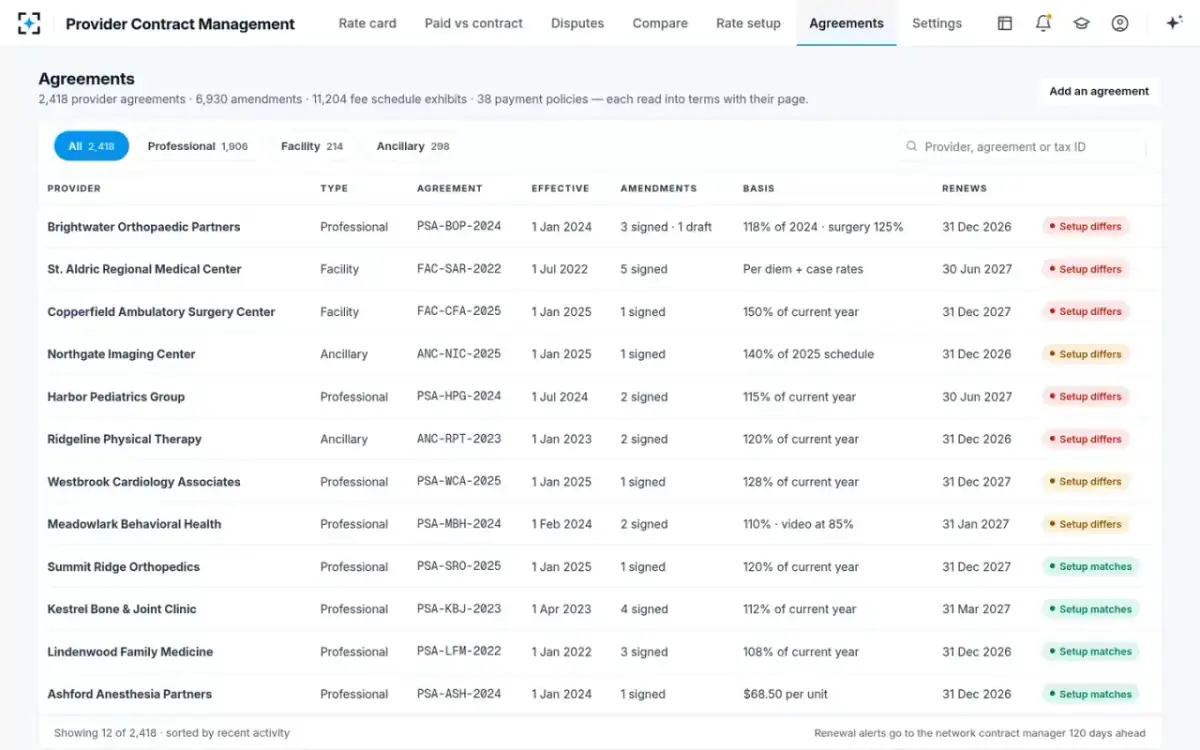
For contracted providers: every agreement and amendment by effective date, so the first question has an answer
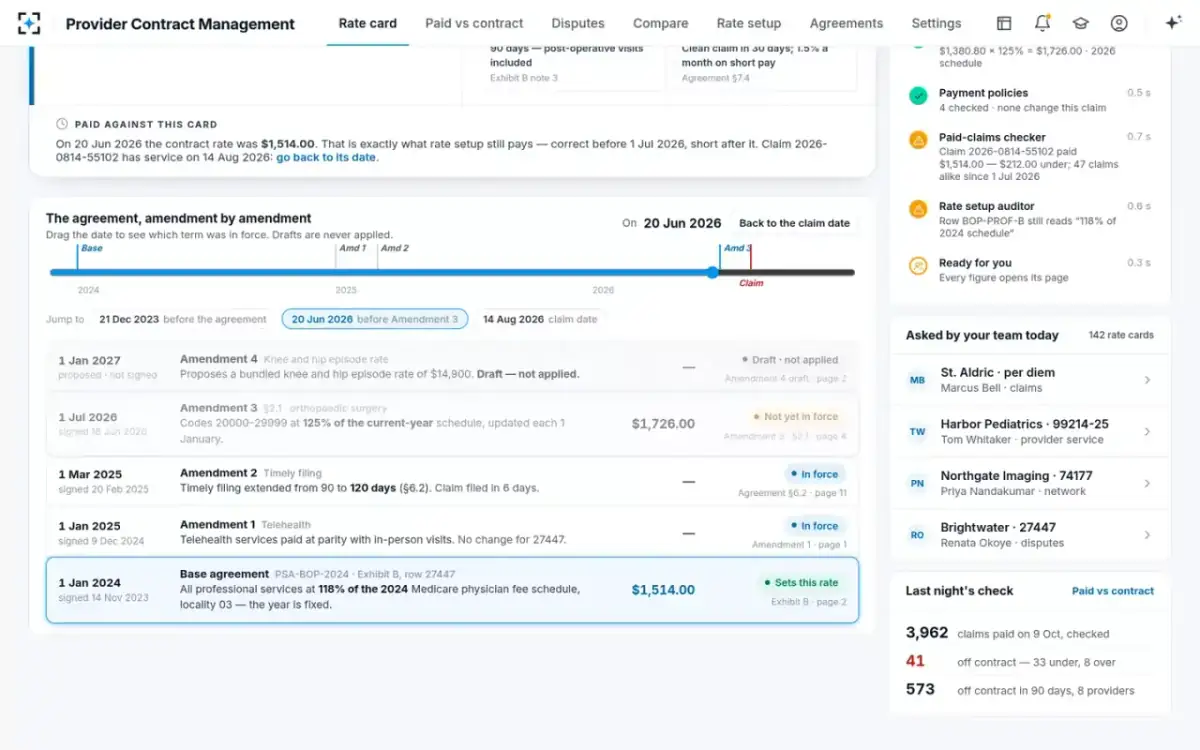
Provider Contract Management prices contracted claims, not out-of-network ones
Botminds' Provider Contract Management is built for contracted rates. Its agents read each agreement, amendment, fee schedule exhibit and payment policy into terms with their pages, answer the rate in force for a provider, code and date of service, and check every paid claim against the contract each night. It reads Medicare fee schedules by year, locality and setting because so many contracts are written as a percentage of them. It does not run Medicare's inpatient or outpatient pricers for non-contracted claims, and a plan should not treat it as an out-of-network repricer.
What it does settle is the question that comes before the out-of-network rule: whether a signed contract covered the claim on its date of service, and which term. That answer, cited to the page, is what decides whether a disputed claim belongs on this page or in claims repricing, traced. To see the contracted side end to end, start from Provider Contract Management.
Questions people ask
Does a Medicare Advantage plan have to pay an out-of-network provider at all?
For emergency and urgently needed services, yes, wherever they are obtained. For other services it depends on the plan type: a preferred provider organization must provide "for reimbursement for all covered benefits regardless of whether the benefits are provided within the network of providers" (42 CFR 422.4(a)(1)(v)), while other coordinated care plans cover out-of-network care only as their benefits allow. When the plan does pay, the non-contract amount is Original Medicare's.
Can a non-contracted provider bill more than the Medicare amount?
Hospitals and other providers of services cannot balance bill a Medicare Advantage member. Non-participating physicians may charge up to Medicare's limiting charge where Original Medicare allows it, and in a PPO the plan must pay that excess so the member owes only plan cost-sharing.
Does the 2 percent Medicare sequestration reduction apply to out-of-network Medicare Advantage claims?
CMS's out-of-network guide describes the sequester as a reduction to Medicare fee-for-service claims and notes that it does not apply to beneficiary cost-sharing; it gives no separate instruction for plans in that section. Plans should take the current answer from CMS guidance rather than from the 2015 guide.
Do plans have to reprocess non-contracted claims when Medicare changes a rate retroactively?
Not automatically, according to the guide's answer on retroactive Affordable Care Act adjustments: CMS did not require plans to reprocess all non-network claims, but said retroactive adjustments "may be appropriate if well documented and addressed in a timely manner" where large sums are involved for a provider.
Is the MA Payment Guide for Out of Network Payments still current?
CMS still links the 15 April 2015 update from its page on non-contracted provider disputes, last modified 10 September 2024. Its rules on what plans owe remain the reference, but its descriptions of individual Medicare programs date from 2015, so the amounts must come from Medicare's current payment rules.