Claims repricing is the calculation of the allowed amount for a claim from the contract or payment rule that applies to it: for an in-network claim, the provider agreement and the amendment in force on the date of service; for an out-of-network claim, whatever rule replaces the contract, such as the Original Medicare amount a Medicare Advantage plan owes a provider with no contract. Repricing is hard because the governing terms are spread across a base agreement, amendments, fee schedule exhibits and payment policies, each with its own effective date, and a claim system that applies the wrong one still produces a valid-looking price. Botminds' Provider Contract Management does the reading: its agents find the terms in force on the service date, show the arithmetic with the page that sets each number, and compare the result with what was paid, while people adjust the claim and sign anything sent to the provider.
The claim traced below is invented for this page, with illustrative schedule amounts rather than CMS figures. Screens from the solution show its fictional sample plan.
Repricing one disputed claim: 75 minutes by hand, 6 with the reading done
- Finding the agreement and the amendments in force45 min
- Working out the rate and the arithmetic30 min
- Reading6 min
What is claims repricing?
Claims repricing turns a billed claim into the amount the payer should allow, by applying the payment terms that govern it line by line. The billed charge is the provider's price; the repriced amount is the contract's price. Cost-sharing, deductibles and the plan's payment are worked out from the repriced amount afterwards.
The word covers several jobs. Inside a health plan, repricing usually means the pricing step of the claims system, or the manual pricing of a pended claim by a claims examiner. In self-funded employer plans it often means a separate service that applies a rented network's discount or a reference-based price before the claim reaches the administrator. In provider disputes it means recomputing a paid claim to show what it should have paid. The arithmetic is the same in each; what changes is who owns the terms.
What is the difference between repricing and adjudication?
Repricing answers "what is this service worth under the contract"; adjudication answers "what does the plan pay, given the member's coverage." Adjudication runs eligibility, benefits, authorizations, coding edits and cost-sharing; repricing supplies one input to it, the allowed amount. A claim can adjudicate perfectly on a wrong price, which is why the two deserve separate checks.
Repricing and adjudication answer different questions
Repricing: What is the allowed amount under the governing contract or rule?
Adjudication: Is the service covered for this member, and what does the plan pay after cost-sharing?
Repricing: Agreement, amendments, fee schedule exhibits, payment policies, the schedule year and locality
Adjudication: Eligibility, benefit plan, authorizations, coding edits, accumulators
Repricing: The date of service and the provider's identifiers
Adjudication: The member, the plan year and the claim's codes
Repricing: The right method on the wrong schedule year, or an amendment never applied
Adjudication: A denial for a missing authorization that was on file
Repricing: Recompute from the contract page and compare with the price used
Adjudication: Coding edits, audits of samples of decisions
The claim: two procedures, one date of service, a recent amendment
Take a fictional surgical group billing a fictional health plan for two procedures on the same patient on 9 September 2026: a primary procedure billed at $3,200 and a second procedure billed at $1,400, both subject to multiple-procedure rules. The group's base agreement from 2025 pays 115% of the 2025 Medicare Physician Fee Schedule, with the year fixed. Amendment 2, signed in July, pays surgical codes at 120% of the current-year schedule for dates of service on and after 1 August 2026. Every rate is subject to the lesser of billed charges, line by line, and the plan's multiple-procedure policy pays the second procedure at 50%.
Those terms sit in three documents: the base agreement's fee schedule exhibit, Amendment 2, and a payment policy. None of them states a dollar amount for either code. The dollar amount only exists once someone combines them for this date and this locality.
Claims repricing step by step, on one invented two-line claim
| Step | What it reads | Line 1 (primary) | Line 2 (second procedure) |
|---|---|---|---|
| 1. Contract in force on 9 Sep 2026 | Base agreement and amendments by effective date; drafts ignored | Amendment 2, effective 1 Aug 2026 | Amendment 2, effective 1 Aug 2026 |
| 2. Rate method and schedule year | Amendment 2: 120% of the current-year schedule | 2026 schedule amount $900.00 | 2026 schedule amount $500.00 |
| 3. Contract rate | 120% × schedule amount | $1,080.00 | $600.00 |
| 4. Payment policy | Multiple procedures ranked by schedule amount: 100% then 50% | $1,080.00 | $300.00 |
| 5. Lesser of billed charges, per line | Billed $3,200 and $1,400 | $1,080.00 | $300.00 |
| 6. Repriced allowed amount: $1,380.00 | Sum of the lines | $1,080.00 | $300.00 |
| 7. What the system paid | Setup still on the 2025 base: 115% of 2025 amounts $880.00 and $490.00, then 50% | $1,012.00 | $281.75 |
| 8. Difference: $86.25 under on the claim | Repriced minus paid | $68.00 under | $18.25 under |
Step one: which contract was in force on the date of service?
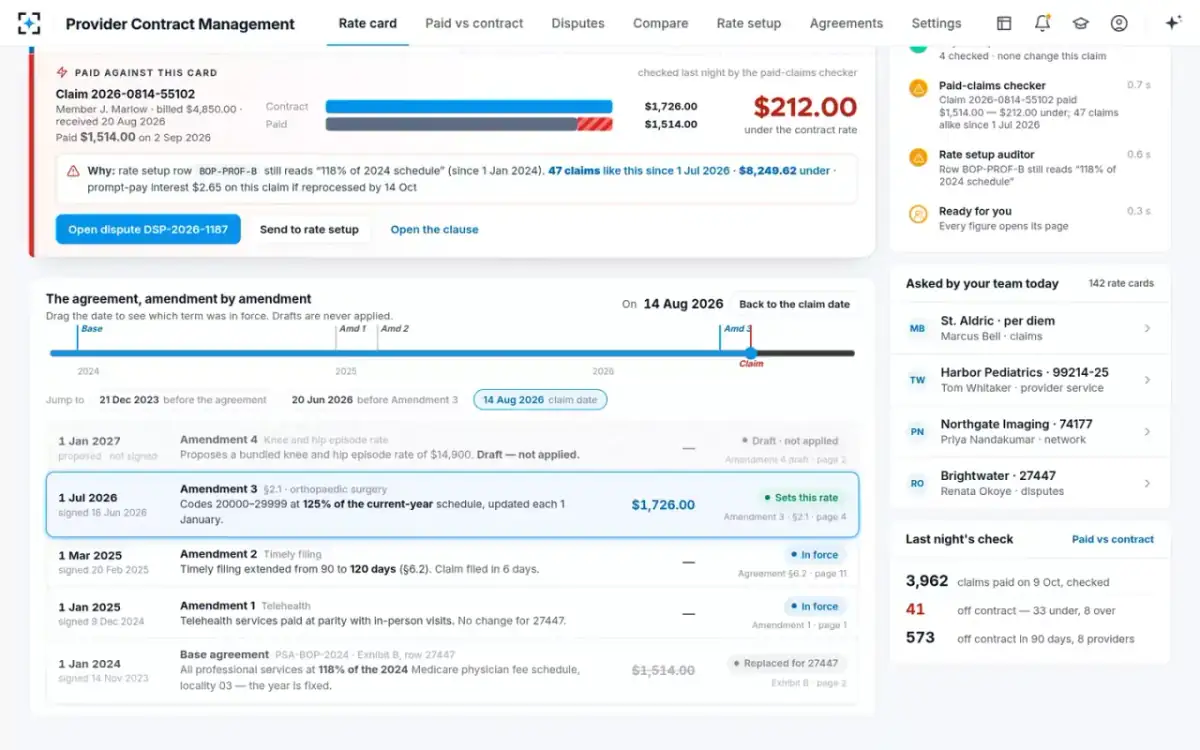
The first step is choosing the document, and it is the one most often done wrong. The rule is to take every signed term whose effective date is on or before the date of service, in effective-date order, and apply the latest one that governs the code. Unsigned drafts are not terms. Amendments signed but not yet effective on the date of service are not terms either.
Two dates trip people up. The paid date is irrelevant unless the contract says otherwise; most amendments apply by date of service, so a claim processed in October for a service in July uses July's terms. And the signature date is not the effective date: an amendment signed in July and effective 1 August does not reach a claim with service on 31 July. The amendment timeline in the solution shows this as a slider, and the fee schedule lookup guide explains why a lookup that returns today's rate gives the wrong answer to a dated question.
Every amendment stacked by effective date, with the one that sets the rate highlighted
Step two and three: the rate method and the arithmetic
Once the document is known, the method gives the formula. Percent-of-Medicare terms need the schedule amount for the right year and locality before the percentage is applied; fixed fee schedules need the exhibit row for the code; case rates and per diems need the episode or the days. In the trace, Amendment 2 points to the current-year schedule, so the 2026 amounts apply, not the 2025 ones the base agreement fixed.
Precision matters at this step. A schedule amount should be quoted, not rounded, before the percentage is applied, and the locality and setting (facility or non-facility) must match the claim. Medicare's own physician schedule had two conversion factors in 2026, so a contract that points to "the Medicare Physician Fee Schedule" without saying which leaves a question that the analyst should send back to the contract manager rather than answer alone.
Step four: payment policies change the price after the rate
Payment policies apply after the contract rate and often move more money than the rate itself. The common ones are multiple-procedure reductions, bilateral adjustments, assistant-surgeon percentages and modifier rules. Many commercial contracts borrow Medicare's: Medicare pays the second through the fifth ranked surgical procedures at 50 percent, and pays assistant-at-surgery services at 16 percent of the surgical payment amount (Medicare Claims Processing Manual, chapter 12).
A contract can also waive a policy. That is where configuration and contract most often drift apart: a reduction the plan's policy applies by default keeps applying to a provider whose agreement says it should not. In the solution's sample plan, one therapy group was paid $6,375.60 short over 138 claims for exactly that reason.
Step five: the lesser-of cap, and step six: the check against what was paid
Most contracts pay the lesser of the provider's billed charge and the contract amount. The test is usually applied per line, after the payment policy, and it bites when a provider's charge is low relative to the contract, often on inexpensive services or after a provider lowers its chargemaster. In the trace neither line is capped, because both billed charges are well above the contract amounts. How the test works under each rate method is set out in the lesser of billed charges guide.
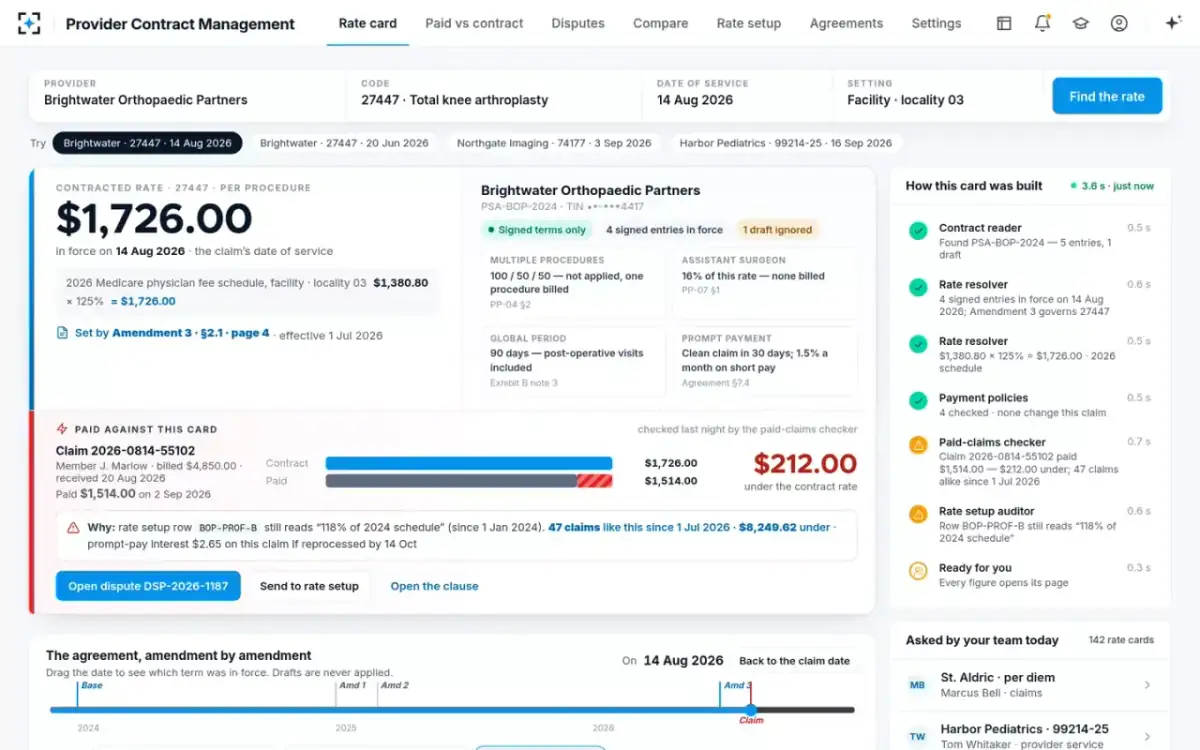
The final step is the one most repricing skips: comparing the repriced amount with what the claims system actually allowed. In the trace the system still priced from the 2025 base agreement, so the claim went out $86.25 short. That difference is the whole value of the exercise. A repricer that only produces a price, without comparing it, cannot tell a plan which claims to fix.
The cited rate, its arithmetic, and the paid claim checked against it
Who reprices out-of-network claims?
Without a contract the rule changes, and so does who does the work. In Medicare Advantage a provider with no contract must accept, as payment in full, what it could collect under Original Medicare (42 CFR 422.214), so the plan reprices with Medicare's own payment systems. For hospital inpatient claims that means Medicare's Pricer: "Software called the Pricer is used to determine much of the payment for each discharge, and these payments vary by hospital" (CMS, MA Payment Guide for Out of Network Payments). The Medicare Advantage out of network payment guide covers what that amount includes and excludes.
For commercial coverage, emergency and certain other out-of-network services fall under the No Surprises Act, where the plan's qualifying payment amount is built from its own contracted rates for the same service (45 CFR 149.140). That makes in-network repricing data an input to out-of-network pricing. How the qualifying payment amount changed after the Fifth Circuit's 2026 ruling is covered in the guide to the qualifying payment amount after TMA III.
Can AI reprice claims?
The arithmetic of repricing does not need AI; it needs the right terms. Once the governing amendment, method, schedule year and policies are known, the price is a calculation that a rules engine performs exactly and repeatably. What AI changes is the reading: turning hundreds of pages of agreements and amendments into terms with their effective dates and pages, so the calculation starts from the contract rather than from whatever was keyed into the claims system.
Provider Contract Management on one repricing question: who reads, who computes, who decides
Agent
Contract readerReads every agreement, amendment, fee schedule exhibit and payment policy into terms: codes, basis, percentage, schedule year, fixed or updating, each with its page and paragraph.
Never: infer a rate that is not written, or treat an unsigned document as signed
Agent
Rate resolverStacks the signed terms in force on the date of service, applies the schedule year, locality and payment policies, and shows the arithmetic and the governing page.
Never: apply a draft or a future amendment, or round a schedule amount before the percentage
Agent
Paid-claims checkerCompares the paid claim with the repriced amount and looks back to the term's effective date for every claim with the same cause.
Never: adjust, reprocess or recover a claim
A person decides
Claims examiner or dispute analystReads the cited arithmetic, decides the claim or the dispute, and releases reprocessing.
A person decides
Rate configuration leadApproves any change to the claims system's setup that the finding implies.
How do you check a repriced claim?
A repriced claim is checked by recomputing it from the source documents, not from the system's tables, and by testing the dates around it. Five questions catch most errors: is the governing document the latest signed term effective on or before the service date; is the schedule year the one the term names; do the locality and setting match the claim; were the payment policies the contract applies, and only those, applied; and was the lesser-of test applied at the level the contract states.
A sixth question finds the expensive errors: are there other claims with the same cause? A repricing error is almost never a single claim. If one claim paid from last year's schedule, every claim for that provider since the schedule should have moved paid the same way, and the look-back should run to the term's effective date. Why that pattern survives every claim edit is the subject of the claims system configuration guide; to see the agents' work on the sample plan, start from Provider Contract Management.
Questions people ask
What information is needed to reprice a claim?
The provider's identifiers, the codes and modifiers on each line, units, place of service, the date of service and the billed charge per line, plus the governing contract terms: the agreement and amendments in force, the rate method, the schedule year and locality, and the payment policies. For a hospital claim, the diagnosis-related group or revenue codes and the length of stay also matter.
Is claims repricing the same as a network discount?
Not quite. A network discount is one kind of repricing, in which a rented network's agreed rate replaces the billed charge. A plan's own repricing applies its direct contracts, and for Medicare Advantage claims from providers with no contract it applies Original Medicare's amount.
What is the claims repricing process in a health plan?
In most plans it runs inside the claims system: provider matching, contract and fee schedule lookup by date of service, payment policies, then the lesser-of cap, before adjudication applies benefits and cost-sharing. Claims that fail to price automatically pend for a claims examiner, who reprices them by hand from the contract.
Why does a repriced amount differ from the provider's expected payment?
The usual reasons are a different reading of which amendment was in force on the service date, a different schedule year or locality, a payment policy the provider believes its contract waives, or the lesser-of test. A response that cites the page and shows the arithmetic for each step settles most of these without a second round.
Does repricing apply to Medicare Advantage claims from non-contracted providers?
Yes. The plan must reprice to what Original Medicare would pay, using Medicare's payment systems and their updates; CMS's out-of-network payment guide notes that Medicare's internet Pricers "are generally updated quarterly." A plan that keeps an old version of a Medicare rate in its setup reprices those claims wrong in the same way a missed amendment does.