The qualifying payment amount (QPA) is the median of the rates a health plan or issuer had contracted to pay in-network providers on 31 January 2019 for the same or a similar service, by providers in the same or a similar specialty in the same geographic region and insurance market, increased each year for inflation. It sets the patient's cost sharing in surprise-billing situations where no state law applies, and it is the first factor an arbiter must consider in federal independent dispute resolution (IDR) under the No Surprises Act. On 11 August 2026 the Fifth Circuit, sitting en banc in TMA III, held that the median may not include unnegotiated "ghost rates" and may not exclude bonus and incentive payments, while upholding the exclusion of single-case agreements. The Departments said two days later that they "anticipate issuing guidance shortly"; as of 27 October 2026 their notices list none. Botminds' No Surprises Act Dispute Management attaches the plan's QPA calculation to every offer as its first exhibit.
The QPA rules before and after TMA III, issue by issue
The July 2021 rule and guidance: Each contracted rate is one data point "regardless of the number of claims paid at that contracted rate"; August 2022 FAQs dropped only $0 rates.
After the en banc ruling of 11 August 2026: Out: rates for services a provider does not provide or furnish may not count. The court: "all ghost rates must be excluded".
The July 2021 rule and guidance: Excluded: "risk sharing, bonus, penalty, or other incentive-based or retrospective payments".
After the en banc ruling of 11 August 2026: In: the "total maximum payment" includes them where they belong to the item or service.
The July 2021 rule and guidance: Excluded from contracted rates.
After the en banc ruling of 11 August 2026: Still excluded: the court agreed with the Departments on this issue.
The July 2021 rule and guidance: Not applicable.
After the en banc ruling of 11 August 2026: Pending: the court noted the Departments can let plans keep existing QPAs, through enforcement discretion, until new ones are calculated.
What is the qualifying payment amount?
In the statute's words, it is "the median of the contracted rates recognized by the plan or issuer" as "the total maximum payment (including the cost-sharing amount imposed for such item or service and the amount to be paid by the plan or issuer, respectively)" on 31 January 2019, for "the same or a similar item or service that is provided by a provider in the same or similar specialty and provided in the geographic region in which the item or service is furnished" (42 U.S.C. 300gg-111(a)(3)(E)). Those contracted rates are the ones the plan's own repricing applies every day, traced claim by claim in the guide to claims repricing. The en banc court restated the definition more plainly:
"The QPA is the median of the total maximum rates in an insurer's contract for an item or service that a provider provides and furnishes, sorted by specialty and geographic region."
U.S. Court of Appeals for the Fifth Circuit, en banc, TMA III (11 Aug 2026)
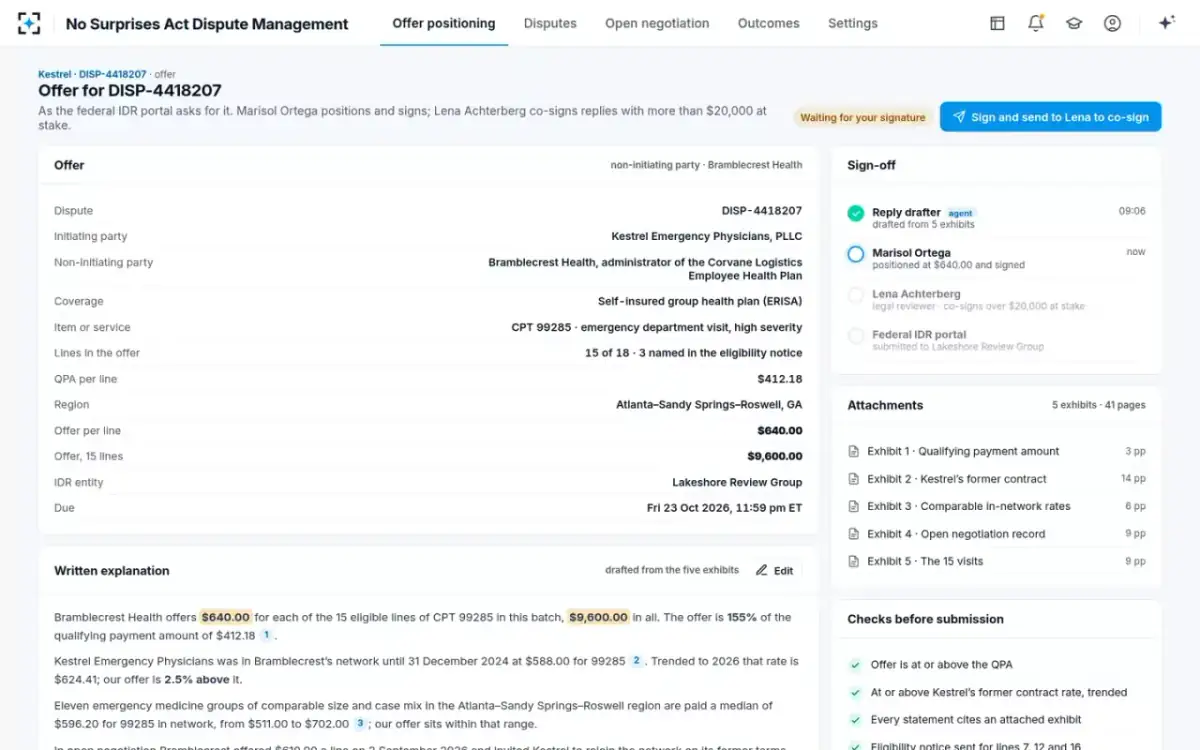
The QPA does three jobs. It is usually the recognized amount on which the member's cost sharing is based. It is disclosed to the provider with the initial payment or denial, with a certification that it was calculated in compliance with the rule (45 CFR 149.140(d)). And in federal IDR every offer must be stated "as both a dollar amount and the corresponding percentage of the qualifying payment amount", and the arbiter must consider the QPA among the statutory factors.
How is the QPA calculated?
In four moves: collect, sort, take the median, index. The regulation at 45 CFR 149.140 fills in each one.
Collect. Take the contracted rates of all the plans or coverage in the same insurance market (individual, small group, large group, or a sponsor's self-insured plans) for the same or similar service, meaning the same service code or a comparable code, with separate medians for modifier combinations such as the professional (26) and technical (TC) components. Rates are taken as of 31 January 2019. A contract with a group that applies one rate to all its providers counts once; separate contracts count separately "even if the same amount is paid to multiple providers".
Sort and take the median. Arrange the rates "from least to greatest" and select the middle one; with an even number, average the middle two. A plan needs "sufficient information": at least three contracted rates on 31 January 2019. Without them it uses an eligible database, a state all-payer claims database or an independent third-party database.
Region. One region for each metropolitan statistical area in a state and one for the rest of the state; if there are too few rates, one region for all the state's metropolitan areas and one for the rest; failing that, a Census Bureau division of several states. Air ambulance uses wider regions based on the point of pick-up.
Index. Increase the 2019 median by the combined percentage increase in the CPI-U, "as published by the Department of the Treasury and the Internal Revenue Service", each year after 2019. The CPI-U for a year is the average for the 12 months ending 31 August.
Ghost rates out: one illustrative median, recalculated
What are ghost rates in the QPA?
Ghost rates are contracted rates for services a provider does not actually provide, left on a fee schedule because nobody negotiated them. The en banc court explained how they arise: plans present "form contracts that include a default fee schedule for all covered services", providers negotiate the rates for services they plan to provide "but leave untouched the rates for services they do not provide", so that "contracts between insurers and providers often include non-negotiated 'ghost rates'", which "can be quite low (in some cases, as low as $0)" (TMA III, Part I).
The July 2021 rule told plans to count "each contracted rate" as a data point "regardless of the number of claims paid at that contracted rate". In August 2022 the Departments' FAQs told plans not to include $0 rates. The court held the rule unlawful because the statute limits the QPA to an item or service "that is provided by a provider" and "furnished", and found the $0 carve-out made the point: "If non-negotiated ghost rates must be excluded from the QPA, as the August FAQ appeared to concede, then all ghost rates must be excluded."
The court tied the issue directly to IDR. Including ghost rates made QPAs "artificially low", it wrote, and the error "has upended the NSA's dispute-resolution process", citing the volume of arbitrations, providers' success rate and arbiters choosing an amount above the QPA in "a whopping 85% of arbitrations". The newer data point the same way: the prevailing offer was above the QPA in about 87% of payment determinations in the second half of 2025 (CMS).
Do bonus payments count in the QPA?
Yes, after TMA III, where they relate to the item or service. The rule had told plans to "exclude risk sharing, bonus, penalty, or other incentive-based or retrospective payments or payment adjustments" (45 CFR 149.140(b)(2)(iv)). The court read the statute's "total maximum payment" as "the whole, entire payment and the sum of all payments from the insurer to the provider for the given item or service": "If some of the providers' payments come in the form of bonuses or incentives or other adjustments, they nonetheless must be included in the QPA for the relevant item or service."
How to include them is the open question. The Departments had argued that bonuses "are rarely tied to specific contracted rates" and are usually paid "as an annual lump sum". The court accepted that some are unconnected to any item or service but held that others are connected, and said this was "the sort of question that the agencies could have figured out in notice and comment". Until the Departments say how, a plan should at least know which of its contracts carry item-level incentives. The rule already requires plans, on request, to say whether their contracted rates include incentive payments that were excluded from the QPA (45 CFR 149.140(d)(2)(iv)).
Are single-case agreements in the QPA?
No, and TMA III left that rule in place. The regulation says a single case agreement or letter of agreement used "to supplement the network of the plan or coverage for a specific participant" in unique circumstances "does not constitute a contract" for this purpose. Air ambulance plaintiffs argued such agreements are contracted rates; the court disagreed, reasoning that a one-off price is not a "rate" in the ordinary sense and is not recognised "under" the plan, and that the QPA is meant to approximate in-network market rates.
What did the Fifth Circuit decide in TMA III, and what happens next?
It affirmed the district court's vacatur of the ghost-rate and bonus rules, reversed it on single-case agreements, and remanded: "AFFIRMED IN PART, REVERSED IN PART, and the case REMANDED for further proceedings consistent with this opinion." The court rejected the argument that vacatur would cause chaos, noting that the agencies "can exercise their enforcement discretion to allow insurers to continue using their existing QPAs until new QPAs are calculated consistent with the Act", and observing that they had been doing so while the appeal was pending.
The QPA in court and guidance, 2021 to 2026
| Date | Event | Effect on the QPA |
|---|---|---|
| 13 Jul 2021 | July 2021 interim final rules | Each contracted rate one data point; incentive payments and single-case agreements excluded. |
| Aug 2022 | Departments’ FAQs | $0 rates not to be counted. |
| 24 Aug 2023 | District court (E.D. Tex.), TMA III | Several QPA provisions vacated. |
| 6 Oct 2023 | FAQs Part 62 | Plans to use a good-faith reading of what remains; enforcement discretion for existing QPAs for items and services furnished before 1 May 2024, with any further relief not expected to extend beyond 1 November 2024. |
| 30 Oct 2024 | Fifth Circuit panel | Partly reversed the district court. |
| 30 May 2025 | Rehearing en banc granted | Panel opinion vacated; the 2023 district court decision continued to bind the Departments. |
| 11 Aug 2026 | Fifth Circuit en banc | Ghost rates out, bonus and incentive payments in, single-case agreements still out. |
| 13 Aug 2026 | Departments’ statement | Reviewing the opinion; "anticipate issuing guidance shortly"; the IDR process remains operational. |
What the guidance will say is not known, and nothing here predicts it. Two points are safe. First, the QPA a plan discloses must still come with the statement that it "was determined in compliance with" the rule, so the plan needs a defensible position on ghost rates and incentives whether or not guidance has arrived. Second, the arbiter must still consider the QPA, but it is one factor among several, and an offer that rests on the QPA alone has mostly lost.
How is the QPA used in an IDR dispute?
As the reference point, not the answer. The arbiter "shall consider" the QPA and then information on the additional circumstances the statute lists, among them contracted rates between the parties "during the previous 4 plan years" (42 U.S.C. 300gg-111(c)(5)(C)). Plans have leaned on the QPA: their offers were at or below it in about 47% of 2024 disputes, the CRS found. For emergency department disputes in 2023 data, a peer-reviewed study found decisions averaging 2.7 times the QPA, and QPAs averaging 2.4 times Medicare, though it cautioned that disputes were "dominated by a small group of health plans and providers" (Health Affairs Scholar, 2024).
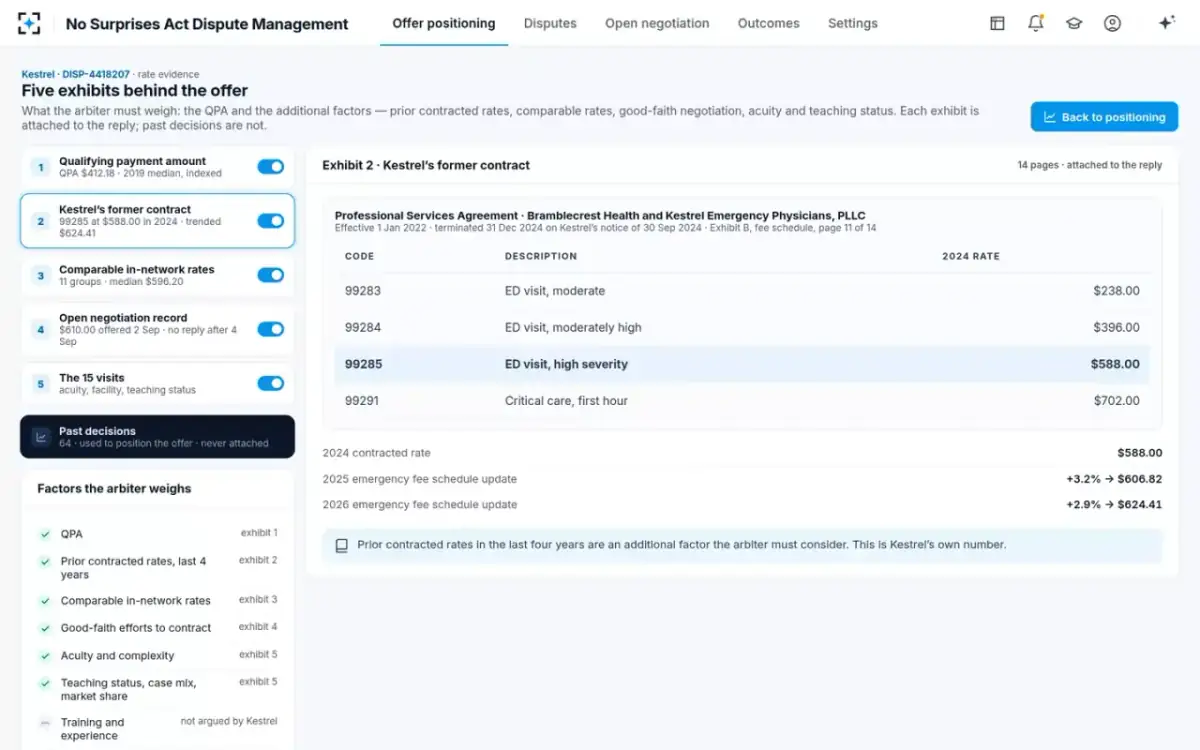
Exhibit 1 is the QPA; the provider's own former contract is exhibit 2
What should a plan do about its QPAs now?
Prepare, without guessing at the guidance. The checklist below is work a plan can do on its own data while the Departments decide how recalculation will work.
QPA housekeeping after TMA III, while guidance is pending
- Find the ghost rates
For each code, specialty and region, flag 31 January 2019 contracted rates for providers who billed no claims for that code; keep the method and the claims evidence.
- Find item-level incentives
List contracts whose bonus or incentive payments attach to specific services, as opposed to annual lump sums.
- Keep single-case agreements out
The en banc court upheld their exclusion; check that none crept into the median.
- Re-check the disclosure
Each disclosure certifies compliance; since 3 August 2026 it must also carry the plan’s legal business name and, once required, its federal IDR registration number.
- Know which QPA each dispute used
An IDR offer is stated as a percentage of the QPA; the plan must be able to show the calculation behind the one it disclosed.
- Watch the notices page
The Departments said on 13 August 2026 that they anticipate issuing guidance shortly.
In the solution, the rate evidence builder attaches the plan's QPA calculation and, where one exists, the provider's own contract from the previous four plan years, trended, and the reply drafter states every offer both in dollars and as a percentage of the QPA, as the rule requires. Its offer floor is the QPA: the agents never draft an offer below it. For how offers are positioned above it, see the open negotiation notice; for the dispute steps that follow, see the No Surprises Act IDR process.
Every offer stated in dollars and as a percentage of the QPA
Questions people ask
Is the QPA the same as the in-network rate?
No. It is the median of a plan's in-network contracted rates in a market on 31 January 2019, indexed forward; a particular provider's current contracted rate can sit well above or below it.
How is the QPA indexed for inflation?
By the CPI-U. The 2019 median is increased by the combined percentage increase published by the Treasury and the IRS, and each year's CPI-U is the average of the 12 months ending 31 August, rounded to 10 decimal places.
Must plans disclose how the QPA was calculated?
Plans must disclose the QPA for each item with the initial payment or denial, certify it was calculated in compliance with the rule, and explain any downcoding. On request they must also say whether non-fee-for-service rates, an eligible database or a related code were used, and whether incentive payments were excluded.
Does TMA III apply outside the Fifth Circuit?
The ruling affirmed a district court's vacatur of the provisions themselves, and the Departments wrote in June 2026 that the 2023 district court decision "continues to bind the Departments" pending the en banc decision. One concurring judge noted that the government had asked the court to revisit whether universal vacatur is lawful. How the Departments apply the ruling is for the guidance they said they anticipate issuing.
What happens if the QPA is wrong?
The provider can dispute the payment, and in IDR it can argue that the QPA understates the value. A plan's disclosure also certifies compliance, so an error is a compliance issue as well as a weaker offer.