The federal IDR operations rule is the final rule "Federal Independent Dispute Resolution Operations", published on 4 June 2026 at 91 FR 33900 by the Departments of Health and Human Services, Labor and the Treasury and the Office of Personnel Management. It rewrites much of the No Surprises Act's federal independent dispute resolution (IDR) process: what plans disclose with each initial payment, how open negotiation and initiation work, how arbiters review eligibility, how claims may be batched, how fees are paid, and a new requirement that plans and issuers register in the federal IDR portal. It took effect on 3 August 2026, but it does not all bind at once. The $15 administrative fee applied from 11 June 2026 and the QPA disclosure changes from 3 August; most process changes apply only to disputes whose open negotiation begins 90 days after the Departments announce the portal features for them. For a health plan the job is to know which rule governs each dispute. Botminds' No Surprises Act Dispute Management applies the rule that governs each line by its open negotiation date.
A federal IDR dispute under the old rules and under the 2026 operations rule
Rules for disputes now under way: The notice goes to the other party; no response is required.
The 2026 rule, once its features apply: The notice goes to the other party and the Departments through the portal; the other party must respond by the 15th business day, with documents.
Rules for disputes now under way: Notice of IDR initiation; the plan objects to the arbiter within 3 business days.
The 2026 rule, once its features apply: A new notice of IDR initiation response from the non-initiating party within 3 business days, naming any alternative arbiter.
Rules for disputes now under way: The arbiter reviews eligibility; no deadline for the review.
The 2026 rule, once its features apply: Final eligibility decision within 5 business days of final selection; requests for information answered within 5 business days.
Rules for disputes now under way: Statute’s similar-condition test; no line cap; 90-calendar-day cooling-off.
The 2026 rule, once its features apply: Up to 50 lines; defined similar-condition tests; 30-business-day cooling-off after a batched decision.
Rules for disputes now under way: 10 business days after selection.
The 2026 rule, once its features apply: 10 business days after final selection, or after the eligibility decision where extenuating circumstances apply.
Rules for disputes now under way: None.
The 2026 rule, once its features apply: Plans and issuers register in the federal IDR registry; the registration number goes on QPA disclosures.
What is the federal IDR operations final rule?
It is the Departments' finalisation of rules first proposed in November 2023, after more than two years in which the Congressional Research Service noted that the proposal "had not been finalized" (CRS R48738). In its own summary, the rule finalises "new requirements relating to the disclosure of information" that plans must include with the initial payment or denial, requires plans to use "claim adjustment reason codes (CARCs) and remittance advice remark codes (RARCs)" when sending remittance advice to providers they have no contract with, amends open negotiation, initiation, eligibility review, fees and batching, and adds "provisions that require plans and issuers to register in the Federal IDR portal" (91 FR 33900). A correction on 28 August 2026 fixed typographical errors and omissions (91 FR 55462).
The Departments gave their reasons plainly: volumes far beyond expectations, plans and providers each alleging that the other side does not negotiate in earnest, repeated court-ordered shutdowns, and "a large number of ineligible disputes". By 31 January 2026, they wrote, parties had submitted "over 5.1 million disputes".
When is the IDR operations rule effective?
The rule was effective on 3 August 2026, but effective is not the same as applicable. Each provision has its own applicability date, and for most of the process changes that date depends on the Departments' portal.
When each part of the 2026 operations rule reaches a health plan
- $15 fee11 Jun
- Rule effective3 Aug
- Batching1 Nov
- Announced one by one; apply 90 days after each announcementrolling, up to 24 months
Three things applied without any further announcement. The administrative fee of $15 per party applies to disputes initiated on or after 11 June 2026; the Departments waived the usual delay because a higher fee "would constrain access" to the process. The changes to what plans disclose about the QPA apply "to disclosures required to be provided on or after the effective date". The definition of a bundled payment arrangement, which codifies existing guidance, applied on 3 August. And the provisions on continuing to negotiate after initiation, parts of the withdrawal rules and extensions for extenuating circumstances apply 90 days after the effective date, which is 1 November 2026.
What changes for health plans under the IDR operations rule?
Six things, sorted below by when each binds and where it stands on 27 October 2026. The status column is the one to check before relying on any of them: until each provision applies, the old rule still governs.
Each change in the 2026 operations rule, when it applies and its status on 27 October 2026
| Change | When it applies | Status on 27 Oct 2026 |
|---|---|---|
| Administrative fee $15 per party (was $115) | Disputes initiated on or after 11 Jun 2026 | In force |
| QPA disclosures: legal business name, registration number, open negotiation instructions | Disclosures due on or after 3 Aug 2026; registration number once registration applies | In force, except the registration number and the instruction to notify the Departments, which wait for the registry and the portal |
| Bundled payment arrangement defined | 3 Aug 2026 | In force |
| Batching: 50-line cap, similar-condition tests, 30-business-day cooling-off for batches | Open negotiation starting on or after 1 Nov 2026 | Announced 3 Aug 2026; starts 1 Nov 2026 |
| Continuing to negotiate after initiation; some withdrawals; extensions | 90 days after 3 Aug 2026 | Starts 1 Nov 2026 |
| Open negotiation through the portal; 15th-business-day response | 90 days after functionality is announced | Not announced |
| Initiation response, entity selection, 5-day eligibility review | 90 days after functionality is announced | Not announced |
| Offer deadline amendments; other cooling-off amendments | 90 days after functionality is announced | Not announced |
| Federal IDR registry for plans and issuers | 90 business days after functionality is announced | Not announced |
| CARCs and RARCs on remittance advice to non-contracted providers | A date set in guidance | Guidance not issued |
Until a provision applies, the rule is explicit about what governs. This is the sentence a compliance team should keep in front of it:
"Until the relevant applicability date for the requirements of the Federal IDR process ... plans, issuers, providers, and certified IDR entities are required to continue to comply with the corresponding section ... currently in effect."
Federal IDR Operations final rules, 91 FR 33900, section II.H
That has a practical trap. The electronic Code of Federal Regulations already shows the amended text of 45 CFR 149.510 as current, because the rule is effective. A desk that reads the current eCFR and applies the 15th-business-day response duty or the 5-business-day eligibility review to today's disputes is applying rules that do not yet govern them; the text in force before 3 August, still available as a point-in-time version, is the one that does for most steps (eCFR, 1 July 2026).
What changed about batching in 2026?
Batching is the first portal-dependent change to be switched on. CMS announced on 3 August 2026: "All batching provisions in the final rules will be applicable for disputes with open negotiation periods beginning on and after November 1, 2026" (CMS notice). From that date a batch may hold up to 50 lines, which must share a billing NPI or TIN and a payer and relate to a similar condition under one of three tests, and a batched determination triggers a 30-business-day cooling-off period instead of 90 calendar days.
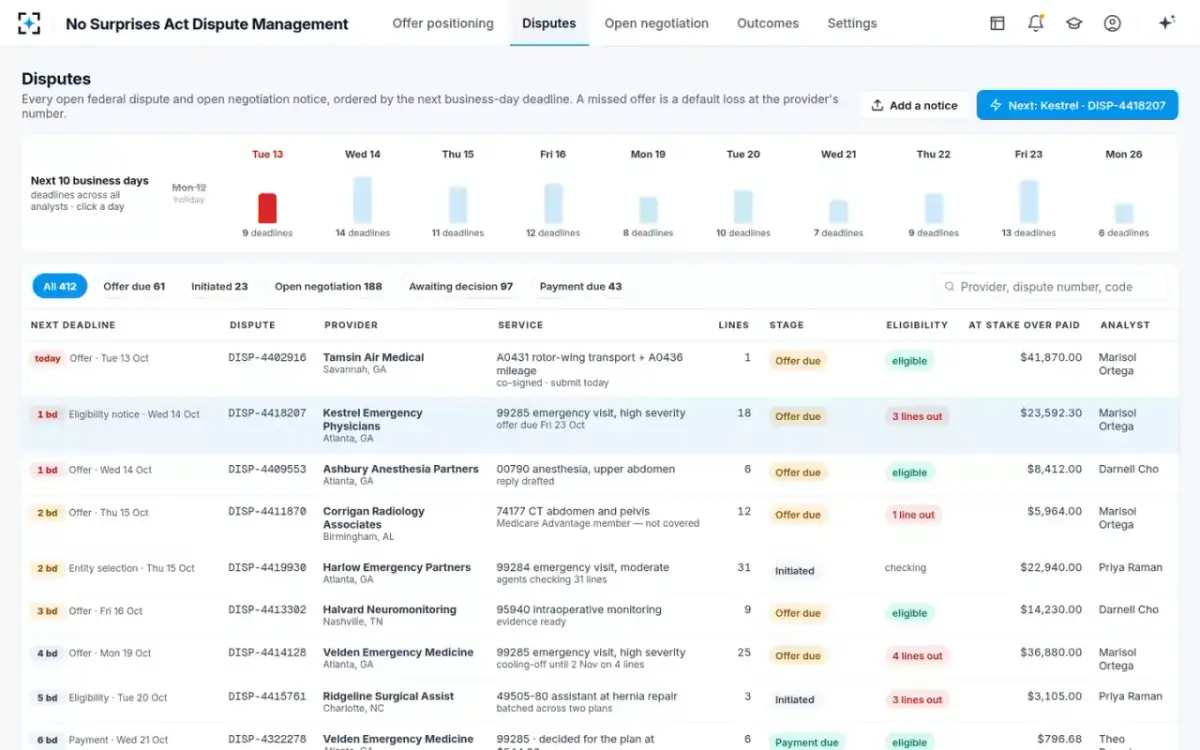
The change runs by open negotiation date, not by initiation date, so desks will hold both regimes at once for months. CMS's notice of 2 October 2026 spells it out: batched disputes whose open negotiation started before 1 November keep the 90-calendar-day cooling-off, and single and bundled disputes keep it regardless of date. The full line test is in IDR batching rules.
Two cooling-off regimes in one queue
Must plans register in the federal IDR portal?
Yes, once the registry applies, and not before. Self-insured group health plans, FEHB carriers and issuers subject to the federal process must register "before the later of the date that is 90 business days after the date the registry becomes available" or the date they begin offering coverage subject to it, and the rule says failure to register by then "will be a violation" (91 FR 33900). Self-insured plans that opted into a specified state law will have to list the states.
The registry is not the same thing as the IDR Gateway. The Gateway is CMS's new platform for submitting and tracking disputes: account creation opened on 15 September 2026, web forms for initiation, response, entity selection and offers arrive on 13 November 2026, and web forms outside the Gateway end on 15 January 2027, except the resubmission form (CMS, 14 October 2026). A plan, or the organisation that processes its disputes, needs a Gateway account now; registration in the registry waits for its own announcement.
What are CARCs and RARCs for the No Surprises Act?
Claim adjustment reason codes and remittance advice remark codes are the standard codes on remittance advice that explain why a claim was paid as it was. The rule requires plans to use specified CARCs and RARCs when they send paper or electronic remittance advice "to an entity that does not have a contractual relationship with the plan or issuer", so a provider can see from the remittance that a claim is a No Surprises Act claim and what the plan disclosed. The codes will be named in guidance. The Departments said they intend to issue it within six months of publication and to give plans no less than four months to comply, and the rule is clear that until then: "Plans and issuers will not be required to use CARCs and RARCs under these final rules until the applicability date specified in guidance."
What did the rule not change?
Three things a plan might expect did not happen. The Departments did not finalise the proposed reduced administrative fee for low-dollar and ineligible disputes, nor the proposed changes to when and how the administrative fee is collected. The certified IDR entity fee ranges set in December 2023 stay as they were. And the rule restates that the Act's surprise billing provisions "do not apply to emergency or non-emergency ground ambulance services". Nor does the rule address the qualifying payment amount after the Fifth Circuit's en banc ruling of 11 August 2026, which came later; the Departments said on 13 August that they anticipate issuing guidance on it.
How should a plan get ready?
By running two rulebooks side by side and switching each line over on the right date. Most of the readiness work is data: knowing each dispute's open negotiation start date, each plan's funding type and opt-in elections, and the plan's legal business name as it will appear on disclosures and, later, in the registry.
Readiness for the 2026 federal IDR operations rule, in date order
- Charge and budget $15 administrative fees
For disputes initiated on or after 11 June 2026; $115 for earlier disputes still open.
- Update QPA disclosures
Legal business name of the plan or issuer and, for self-insured plans, of the sponsor, from 3 August 2026; the registration number once the registry applies.
- Apply the new batching tests by open negotiation date
50 lines, similar-condition tests and the 30-business-day cooling-off for batches whose open negotiation starts on or after 1 November 2026.
- Sign up for the IDR Gateway
Accounts opened 15 September 2026; Gateway web forms from 13 November; outside forms end 15 January 2027.
- Prepare a 15th-business-day open negotiation response
It binds 90 days after the Departments announce the feature; build the documents now.
- Plan for a 5-business-day eligibility review
Objections and supporting documents will need to be complete at the response stage.
- Watch for CARC and RARC guidance
Expected within six months of 4 June 2026; at least four months to comply.
The 5-business-day eligibility review is the change with the most practical bite. Eligibility has been "the primary cause of dispute processing delays", CMS wrote in July 2026 (CMS), and the new rule moves the weight of proof earlier: the non-initiating party's response must carry its eligibility position and documents within three business days of initiation, and the arbiter decides within five business days of final selection. A plan whose objections are assembled by hand on day four will not keep up.
How No Surprises Act Dispute Management handles the two rulebooks
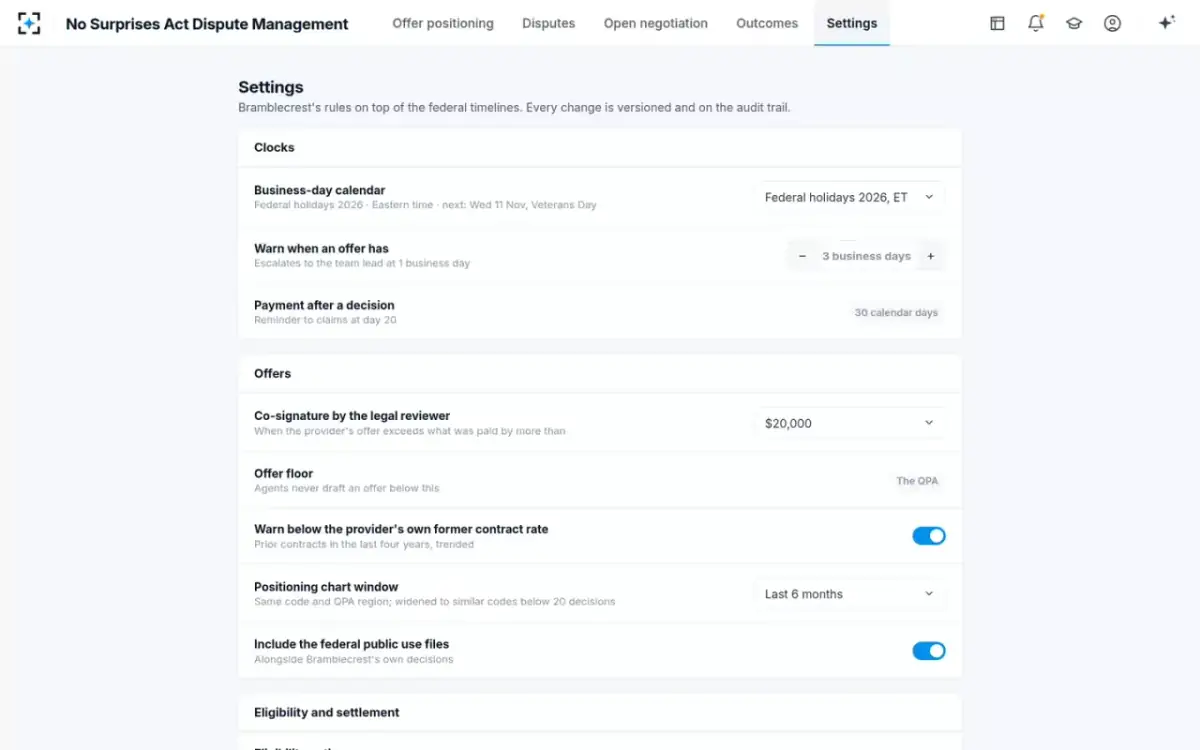
By date, line by line. The eligibility checker reads each line's open negotiation start date from the notice and applies the batching and cooling-off rule that governs it; the deadline queue counts every clock in business days, federal holidays excluded, under the rule in force for that dispute; and the plan's settings are versioned, so each change carries a date and an owner. When the Departments announce the next feature, the change is a dated rule switch rather than a retraining of the desk. What the rule changes in the process step by step is in the No Surprises Act IDR process, day by day, and what it means for an outsourcing decision in IDR management services or agents.
Rule changes become dated, versioned settings
Questions people ask
Is the 2026 rule the same as the 2023 proposed rule?
It finalises the November 2023 proposal with changes. Among them, the administrative fee is $15, not the proposed $150; the reduced fee for low-dollar disputes was not finalised; and most process changes were tied to portal functionality rather than to a fixed date.
Does the new rule change how arbiters decide?
The factors an arbiter must consider come from the statute and were not changed. The rule changes procedure around the decision: eligibility review, information requests, offer timing and batching.
When will open negotiation go through the portal?
When the Departments announce the functionality; the requirement then applies to open negotiation periods beginning 90 days later. As of 27 October 2026 CMS's notices had not announced it.
Why was the administrative fee cut to $15?
By statute the fee must cover the Departments' estimated cost of running the process. Dividing an estimated $119.4 million a year by an estimated 6.9 million fees gave $15; the Departments had collected about 5.3 million fees in the year to April 2026.
Is a plan out of compliance if it follows the amended text early?
For steps that have not yet applied, the rule tells parties to keep complying with the provisions currently in effect. A plan can prepare for the new steps, but its deadlines and objections should follow the rule that governs each dispute.