The IDR batching rules decide when several out-of-network claims may be decided together in one federal independent dispute resolution (IDR) payment determination under the No Surprises Act. Today a batch must come from one provider or facility, identified by the same NPI or TIN, be payable by the same group health plan or issuer, concern items "related to the treatment of a similar condition", and fall within one 30-business-day period. For batched disputes whose open negotiation begins on or after 1 November 2026 the rules tighten: no more than 50 lines, three defined ways to show a similar condition, and a 30-business-day cooling-off period after the decision. Each line that fails the test can be objected to and taken out of the batch. Botminds' No Surprises Act Dispute Management runs the batch test line by line, under the rule that governs each dispute's open negotiation date.
About a third of federal IDR payment determinations are batches
Jul–Dec 2025 · 1,145,039 determinations
- Batched 31% · 31%
- Single and bundled 69% · 69%
What are the IDR batching rules today?
For disputes whose open negotiation began before 1 November 2026, the test is the statute plus what survives of the 2021 regulation. The statute lets items be "considered jointly as part of a single determination" only if they "are furnished by the same provider or facility", payment "is required to be made by the same group health plan or health insurance issuer", they "are related to the treatment of a similar condition", and they were furnished in a 30-day period following the first item (42 U.S.C. 300gg-111(c)(3)).
The regulation added that the items must carry the same National Provider Identifier or Taxpayer Identification Number, be paid by the same plan or issuer, and fall "within the same 30-business-day period, or the same 90-calendar-day period" for items whose open negotiation ended during a cooling-off period (45 CFR 149.510(c)(3)). Its fourth test, that batched items be billed under the same service code, was vacated by a federal court in August 2023. The Departments' answer since then:
"That statutory text provides that items and services may be considered jointly as part of a single determination only if they are 'related to the treatment of a similar condition.'"
FAQs about ACA and CAA Implementation Part 63, Q2 (28 Nov 2023)
Until new rules applied, the FAQs said, disputes should be submitted "in a manner that is consistent with the statutes and regulations that remain in effect", and "certified IDR entities have the sole responsibility" for deciding whether a batch meets them. In practice that left the similar-condition test to each arbiter's judgement for more than three years, which is one reason batching has been a frequent eligibility fight.
What changed about batching in November 2026?
The 2026 operations rule rewrote the test, and CMS switched it on for batched disputes "with an open negotiation start date on or after November 1, 2026" (CMS, 3 August 2026). An arbiter "may consider up to 50 qualified IDR items and services jointly as part of a single payment determination" if all four conditions hold (45 CFR 149.510(c)(4)(i), as amended).
IDR batching rules before and after 1 November 2026
Open negotiation before 1 Nov 2026: No cap in the rule; the arbiter’s fee rises by tier after 25 lines.
Open negotiation on or after 1 Nov 2026: Up to 50 lines.
Open negotiation before 1 Nov 2026: Same NPI or TIN.
Open negotiation on or after 1 Nov 2026: Same NPI or TIN.
Open negotiation before 1 Nov 2026: Same group health plan or issuer.
Open negotiation on or after 1 Nov 2026: Same issuer, even across different group plans or individual policies; for self-insured plans, the same plan, and never several plans sharing one administrator.
Open negotiation before 1 Nov 2026: The statute’s test, applied by each arbiter.
Open negotiation on or after 1 Nov 2026: One of three: one patient encounter on one claim form; the same service code across patients; or, for anesthesiology, radiology, pathology and laboratory, codes in the same Category I CPT range.
Open negotiation before 1 Nov 2026: Within one 30-business-day period.
Open negotiation on or after 1 Nov 2026: Within 30 business days of the first item, and open negotiation ended within 4 business days of initiation.
Open negotiation before 1 Nov 2026: 90 calendar days.
Open negotiation on or after 1 Nov 2026: 30 business days, then a 4-business-day window to file items whose negotiation ended meanwhile.
Three of the changes matter most to a plan's desk. The 50-line cap limits the size of a batch for the first time. The same-payer test is now explicit that a third-party administrator does not make several self-insured plans one payer, so a batch across two employers' plans fails even if the same administrator pays both. And the timing test now has two parts, so every line's open negotiation end date has to be checked against the initiation date, not just the first line's.
What is the difference between batching and bundling?
Batching joins separate claims or items into one dispute; bundling is one payment for several items billed together. The Congressional Research Service puts it simply: batched claims are "multiple qualified services" considered "jointly as part of one IDR determination", while bundled claims are those where "a provider or facility bills for multiple items or services under a single service code" (CRS R48738).
The fees differ. A bundled payment arrangement carries the single-dispute arbiter fee, $200 to $840, under both the old and the amended rule; a batch carries the batched fee, $268 to $1,173, plus $75 to $250 for every further 25 lines from the 26th (88 FR 88494). The 2026 rule also codified the definition of a bundled payment arrangement, applicable from 3 August 2026.
How many claims can be in one batch?
Up to 50 for batched disputes whose open negotiation starts on or after 1 November 2026; the rule set no cap before. CMS's portal enforces the cap on the notice of IDR initiation form, which from that date limits such batches to 50 dispute lines (CMS, 2 October 2026).
Size has a cost in time as well as fees. In the fourth quarter of 2024, batched emergency and non-emergency disputes took a median of 98 business days to resolve, against 46 for single disputes and 39 for bundled ones, the CRS calculated from CMS's public use files.
Batches took twice as long to decide as single disputes
Can a plan object to a batched dispute?
Yes, line by line, as an eligibility objection. If an arbiter finds a batch includes items that are improperly batched, CMS's FAQs let it "continue with payment determinations for the items and services that are appropriately batched and direct the initiating party to resubmit the items and services that were improperly batched" (CMS batching FAQs, A3). The standard window to resubmit is four business days, through the portal's resubmission web form. Under the amended rule, items that are not eligible or do not meet the batching test are simply dropped from the batch while the rest continues.
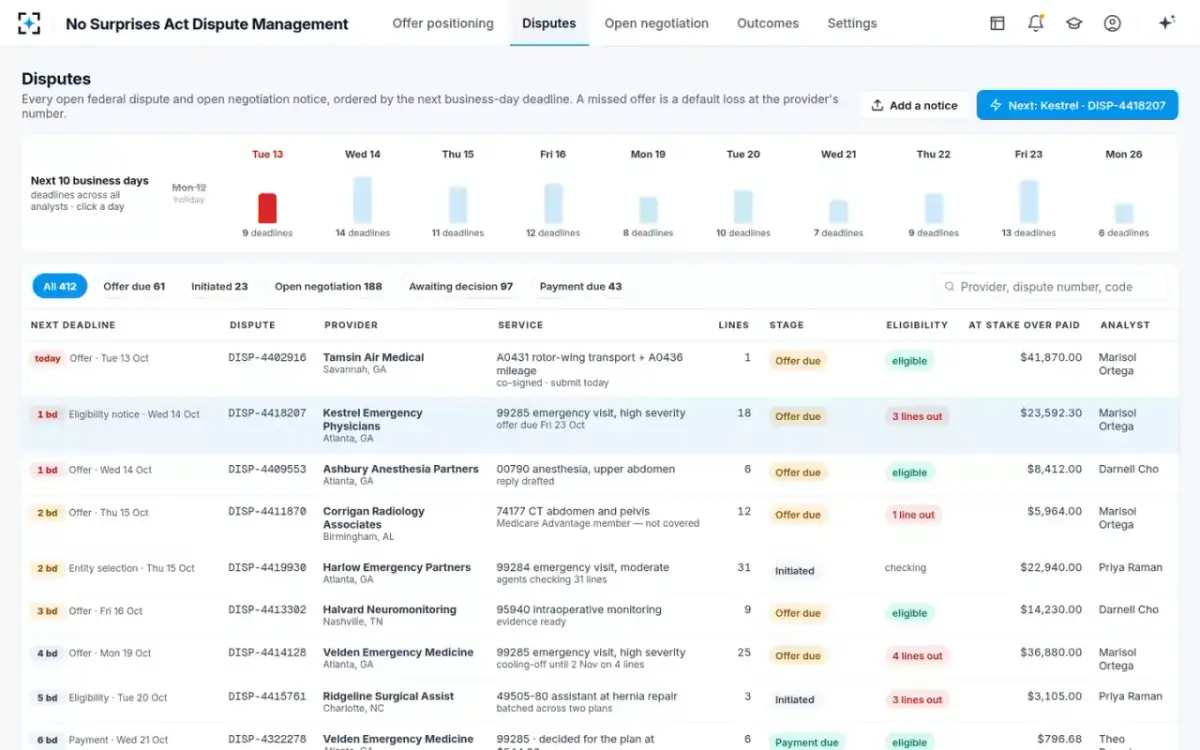
The plan's objection is strongest when it names the failing test and the document behind it for each line: two different payers, dates of service more than 30 business days apart, different provider identifiers, or, under the new rule, more than 50 lines or a code outside the range. The sample queue in the solution shows the pattern, a surgical-assist batch flagged because it was "batched across two plans".
Batch problems surface in the queue before the offer is due
The batch test a plan should run on every line
A plan can run the same test the arbiter will, before the objection deadline. The checklist below uses the rule that governs each dispute; the only input it needs that the notice may not give is the open negotiation start date.
A line-by-line batch test for the plan's side of federal IDR
- Which rule governs?
Open negotiation on or after 1 November 2026: the amended rule. Before it: the statute plus the surviving 2021 tests.
- One provider
The same billing NPI or TIN on every line.
- One payer
The same issuer, or the same self-insured plan; never two employers’ plans, even through one administrator.
- A similar condition
Under the new rule, one encounter on one claim form, the same code (with modifiers), or for anesthesiology, radiology, pathology and laboratory the same Category I CPT range.
- One window
Dates of service within 30 business days of the first line.
- Negotiation ended on time
New rule: each line’s open negotiation ended within 4 business days of initiation.
- No more than 50 lines
For batches whose open negotiation starts on or after 1 November 2026.
- Cooling-off
No decision on the same items between the same parties within 30 business days (batched, new rule) or 90 calendar days (all others).
A worked batch: six lines through the November 2026 test
Take an illustrative batch, not drawn from any plan's data: an emergency group files six lines under one TIN, with open negotiation for all six ending on the same day in November 2026 and initiation inside the four-business-day window. The first visit was on Tuesday 1 September 2026, so the 30-business-day window, counted past Labor Day and Columbus Day, closes on Thursday 15 October.
Six illustrative lines in one batch, tested line by line
| Line | Code and payer | Date of service | Result |
|---|---|---|---|
| 1 | 99285 · employer A’s self-insured plan | Tue 1 Sep 2026 | Passes; it sets the window |
| 2 | 99285 · employer A’s plan | Mon 21 Sep 2026 | Passes |
| 3 | 99285 · employer B’s self-insured plan, same administrator | Wed 23 Sep 2026 | Out: a different payer |
| 4 | 99284 · employer A’s plan, another patient | Tue 29 Sep 2026 | Out: a different code and not one encounter |
| 5 | 99285 · employer A’s plan | Wed 14 Oct 2026 | Passes |
| 6 | 99285 · employer A’s plan | Tue 20 Oct 2026 | Out: after the window closed on 15 Oct |
Three lines continue and three are out, each for a different reason, and each reason needs a different document: the plan's own enrolment data for line 3, the claim's code and patient for line 4, and the date of service for line 6. Under the rules for earlier disputes, line 4 might have survived, because the arbiter would apply the statute's similar-condition test on its own judgement; under the new rule it has a fixed answer. That is the practical gain for a plan: the batching objection becomes a matter of matching documents to tests rather than arguing about what "similar" means.
How are batched disputes decided?
The arbiter can reach a different answer for each line. CMS's guidance says that in batched determinations the arbiter "may make different payment determinations for each qualified IDR item or service under dispute", and the party with the fewest determinations in its favour pays the arbiter's fee; if each side wins the same number, the fee is split. The amended rule codifies that split. Offers are still stated in dollars and as a percentage of the QPA.
For a plan, that makes a batch a set of separate bets that share a fee and a deadline. Positioning one number for 15 identical high-severity emergency visits, as the analyst does in the solution's sample case, is reasonable when the lines are genuinely alike; when they are not, the evidence for each line has to stand on its own. How the offer per line is placed is covered in the open negotiation notice and the steps around it in IDR eligibility.
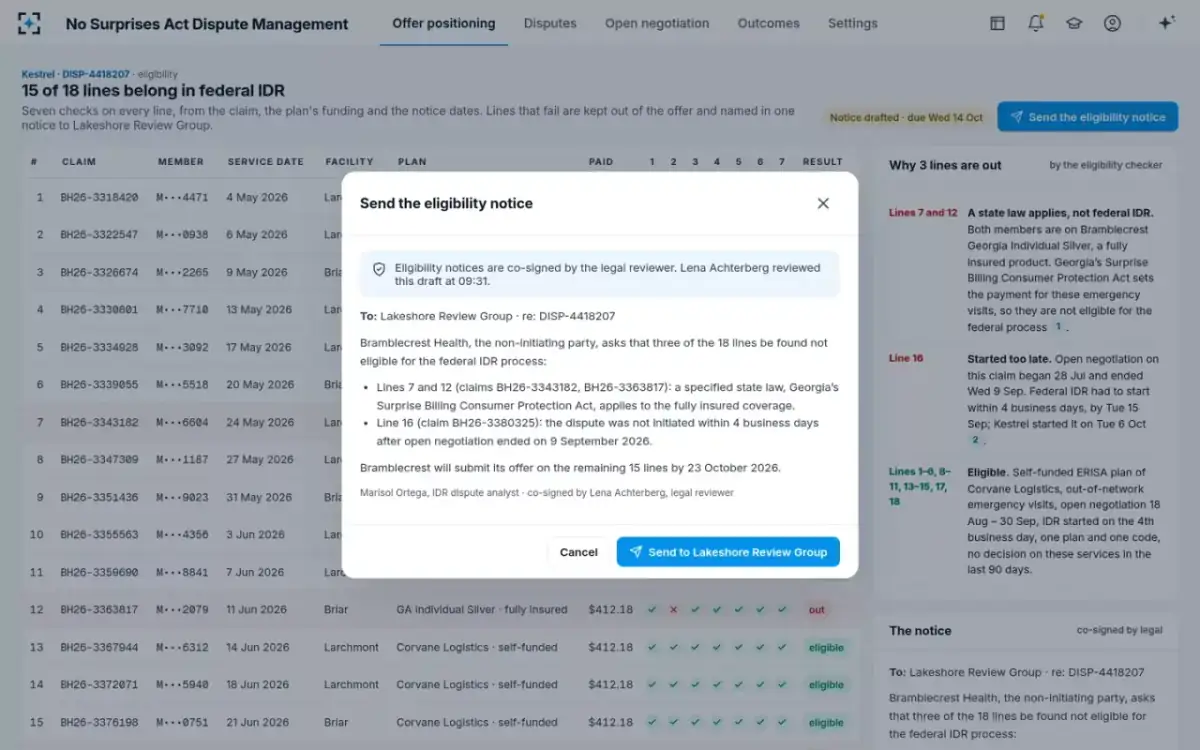
An objection that takes three lines out of an 18-line batch
Questions people ask
What claims can be batched in federal IDR?
Claims from the same provider (same NPI or TIN), payable by the same plan or issuer, for items related to the treatment of a similar condition, furnished within one 30-business-day period. For disputes whose open negotiation starts on or after 1 November 2026, the similar-condition test has three defined forms and the batch is capped at 50 lines.
Does batching save the provider fees?
Usually. Each party pays one $15 administrative fee per dispute, and one arbiter fee covers the batch, $268 to $1,173 plus tiered amounts beyond 25 lines, instead of $200 to $840 for each single dispute.
Can air ambulance base and mileage codes be batched?
Yes. After a 2023 court ruling, CMS's FAQs allow a single air ambulance transport's base rate code and mileage code to be submitted as a batch, so long as the other batching rules are met; they may also be filed separately.
Do batched disputes have a different cooling-off period?
From 1 November 2026, yes: a batched determination on a dispute whose open negotiation started on or after that date triggers a 30-business-day cooling-off period. Single and bundled disputes, and batches with earlier open negotiation, keep 90 calendar days.
Who decides whether a batch is valid?
The certified IDR entity. CMS's FAQs say entities have "the sole responsibility" for deciding whether batched items meet the statutory and regulatory standards; the portal's validations screen out some errors, such as dates of service more than 30 business days apart.