An IDR analyst is the person at a health plan or third-party administrator who works the plan's side of federal independent dispute resolution (IDR) under the No Surprises Act. When an out-of-network provider disputes a payment, the analyst confirms which lines are eligible for the federal process, objects to the ones that are not, assembles the evidence behind the plan's rate and submits an offer, as a dollar amount and a percentage of the qualifying payment amount (QPA), within ten business days of the arbiter's selection. The work is hard because every step runs on a business-day clock and a missed step can lose the dispute outright. Botminds' No Surprises Act Dispute Management exists to take the reading, matching and drafting off that clock, so the analyst's hours go to the offer and the signature.
The analyst does not work alone. A dispute touches the claims examiner who paid the claim, the legal reviewer who signs eligibility objections, the reimbursement manager who owned open negotiation and the team lead who watches the deadlines. The flow below is the desk as most plans would draw it.
One federal dispute, seat by seat, on a No Surprises Act dispute desk
A person decides
Reimbursement manager negotiatesAnswers the open negotiation notice during its 30 business days and settles where the price is within authority.
Agent
Notices are read and claims matchedThe initiation notice is read, each line tied to its claim, remittance and QPA disclosure, and the plan funding type confirmed.
Never: re-adjudicate a claim or change a date
Agent
Eligibility checked line by lineEach line is tested against coverage, state law, timing, open negotiation, batching and cooling-off, with the reason written down.
Never: send an objection
A person decides
Legal reviewer co-signs objectionsReads the reasons and the documents behind them and co-signs what goes to the arbiter.
A person decides
IDR analyst sets and submits the offerChooses the number, reads the drafted explanation, signs and submits before the tenth business day.
A person decides
Claims examiner paysPays the award, less what was already paid, within 30 calendar days of the determination.
What does an IDR analyst do?
An IDR analyst turns a provider's initiation notice into a defensible offer before the deadline. In practice that is five jobs: find the original claim behind every disputed line, decide whether each line belongs in federal IDR, object in time to the lines that do not, build the rate evidence, and submit an offer the arbiter can choose. Each job has a clock set by 45 CFR 149.510.
The offer is the job's centre of gravity because federal IDR is final-offer arbitration. The certified IDR entity must select one of the two offers, the one it "determines best represents the value" of the service, and the plan cannot split the difference afterwards. Each party must submit its offer as a dollar amount and as a percentage of the qualifying payment amount no later than 10 business days after the entity is selected (how that amount is calculated after the Fifth Circuit's 2026 ruling is the subject of the qualifying payment amount after TMA III), and the plan must also state its coverage area, the QPA's geographic region and whether the coverage is fully insured or self-insured.
The analyst also has to know what the arbiter may not hear. By statute the entity cannot consider usual and customary charges, the provider's billed charges, or what Medicare, Medicaid, TRICARE or other public payers pay (42 U.S.C. 300gg-111(c)(5)(D)). An explanation built on a Medicare comparison is wasted paper. What the entity must weigh is the QPA and the "additional circumstances" the statute lists, including the provider's training and outcomes, market share, patient acuity, a facility's teaching status and case mix, and good-faith efforts to contract, with contracted rates "during the previous 4 plan years".
How many IDR disputes does a health plan receive?
Far more than any plan budgeted for in 2022: 390,602 federal disputes were initiated in September 2026 alone, and 2,895,872 in the first nine months of 2026, according to CMS's bi-monthly report. The Departments said in the 2026 operations rule that the first year brought 489,000 disputes, 14 times what they had expected for a whole year. Nearly all are brought against plans, not by them: providers and facilities initiated more than 99% of disputes in 2024, the Congressional Research Service found.
The volume an IDR desk now answers
390,602
federal disputes initiated in September 2026
9% more than August
2.9M
initiated January to September 2026
2,895,872
42%
of disputes had their eligibility challenged, Jul–Dec 2025
17
certified IDR entities, as of 11 Sep 2026
The volume is concentrated on both sides. In the second half of 2025 the top ten initiating parties brought about 66% of all disputes and the top three, HaloMD, Team Health and SCP Health, about 38%, CMS reported. Emergency department services made up 52% of the payment determinations in that half-year and radiology 15%. A plan's desk therefore sees the same few counterparties and the same few codes again and again, which is why knowing how past disputes on a code and region were decided is worth the effort.
How many of those land on any one plan depends on its out-of-network exposure in the states where disputes cluster. The CRS found that Texas alone accounted for 36% of out-of-network emergency and non-emergency disputes in 2024 (507,020). No public figure gives disputes per plan, so a desk has to size itself from its own initiation notices, counted by week, code and counterparty.
Who handles No Surprises Act disputes at a health plan? The desk, seat by seat
At most plans federal IDR sits with payment integrity or provider reimbursement, and the work passes through four or five people. The analyst is the only one whose whole week is disputes; the others each own one moment where a mistake is expensive.
Four seats on the IDR desk, before and after the reading and drafting move to agents
Today
Opens each initiation notice cold: finds the claims, checks every line, builds the exhibits, picks a number and writes the explanation, all inside ten business days.
With agents
Opens a case with the lines matched, the eligibility reasons drafted and the exhibits attached; spends the time on the number and the signature.
Still theirs: Sets, signs and submits every offer.
Today
Pulls claims, remittances and QPA disclosures on request, then pays awards against a 30-calendar-day clock.
With agents
Sees each line already matched to its claim and remittance; releases payment with the determination attached.
Still theirs: Releases every payment.
Today
Reads eligibility objections and high-value offers late, often the day they are due.
With agents
Co-signs objections and large offers in which every statement points to an attached document.
Still theirs: The legal judgement on state law and plan coverage.
Today
Answers open negotiation notices from a spreadsheet and learns of a dispute when the initiation notice arrives.
With agents
Sees each open negotiation notice on its clock with a counter-offer band from past decisions.
Still theirs: Settlement authority and the network relationship.
The team lead or manager is the fifth seat, and the least visible. Their job is the calendar: most federal IDR clocks count business days, which exclude weekends and federal holidays, so a Columbus Day or a Veterans Day moves every deadline behind it. A lead who learns of a missed offer from the entity's decision letter has already lost it.
What is the difference between an IDR analyst and a claims examiner?
A claims examiner decides and pays claims; an IDR analyst defends the payment after a provider disputes it. The examiner's work ends at the initial payment or denial, which the plan must send no later than 30 calendar days after the provider transmits the bill (42 U.S.C. 300gg-111(a)(1)(C)(iv)). The analyst's work starts when the provider answers that payment with an open negotiation notice and, if that fails, an initiation notice.
The two seats meet twice. At the start, the analyst needs the examiner's claim, remittance and QPA disclosure for every disputed line, matched by claim number, member, date of service and code. At the end, the examiner pays the award: the selected offer, less the initial payment and the member's cost sharing, "not later than 30 calendar days after the determination" under 45 CFR 149.510(c)(4)(ix).
Claims examiners are a counted occupation; IDR analysts are not. The BLS counts about 376,100 jobs in 2025 for claims adjusters, examiners and investigators together, 7% of them at direct health and medical insurance carriers, and projects the group to shrink 6% from 2025 to 2035 (BLS Occupational Outlook Handbook). No federal series counts IDR analysts, so salary and staffing benchmarks for the seat have no public source.
Do health plans need lawyers for IDR?
No rule requires counsel, but some IDR questions are legal ones, and most plans put a lawyer's signature on them. Whether a specified state law governs the claim, whether a self-insured plan opted into one, or whether a plan type is outside the No Surprises Act at all (Medicare Advantage, Medicaid, short-term coverage, excepted benefits) decides eligibility, and the objection has to be right the first time.
The award is also hard to undo. A determination is binding "in the absence of fraud or evidence of intentional misrepresentation of material facts" and "is not subject to judicial review" except on the narrow grounds of the Federal Arbitration Act (45 CFR 149.510(c)(4)(vii)). Collecting an award is a matter for the agencies more than the courts: the Fifth Circuit's 2025 Guardian Flight decision found no private right to sue on it, so in that circuit an unpaid provider complains to CMS (CRS), and the analyst's job is to pay on time so that no complaint arises.
The sample plan in the solution sets its line at money and law: its legal reviewer co-signs every eligibility objection and every offer where the provider's number exceeds what was paid by more than $20,000. That threshold is a setting the plan chooses, not a rule.
What skills does an IDR analyst need?
The seat sits between claims, coding, contracting and procedure, and the best analysts are fluent in all four. The checklist below is what the rules themselves demand of the person signing an offer.
What an IDR analyst has to know to sign a federal offer
- Business-day arithmetic
Thirty business days of open negotiation, four to initiate, three to select an entity, ten to submit, thirty for the decision; federal holidays excluded.
- The plan types the Act does not cover
Medicare, Medicaid, Medicare Advantage, TRICARE, short-term coverage and excepted benefits are outside it; CMS’s web forms list them.
- Specified state laws and self-insured opt-ins
A state law that sets the payment governs instead of federal IDR; a self-insured ERISA plan can opt into one, and the web forms now ask whether it did.
- How the QPA was calculated
The plan’s 2019 median contracted rate for the code, specialty and region, indexed for inflation, and how the August 2026 Fifth Circuit ruling changes it.
- Coding and modifiers
Batching and duplicate checks turn on service codes and, since late 2025, modifiers; a downcoded claim needs its explanation on file.
- The factors an arbiter may and may not weigh
Prior contracted rates in the last four plan years count; Medicare rates and billed charges do not.
- Where its own past decisions landed
Which offers, for which codes and counterparties, the entities chose; CMS publishes every determination in its public use files.
How is an IDR team organized around the clocks?
Around deadlines, not around providers. A queue sorted by the next business-day deadline makes the expensive failure visible: a missed offer or unpaid fee hands the dispute to the other side. Under CMS's guidance, when one side misses its offer or its fees and the other side does not, the entity must choose the side that submitted and paid (CMS).
Defaults are not rare. Default decisions made up 17% of payment determinations in the second half of 2025, down from 22% in the first half, and 90% of them went to providers, facilities and air ambulance providers. Each of those was a side that missed an offer or a fee, and in nine cases out of ten it was the plan's side that lost.
The desk's queue: every open dispute, ordered by its next deadline
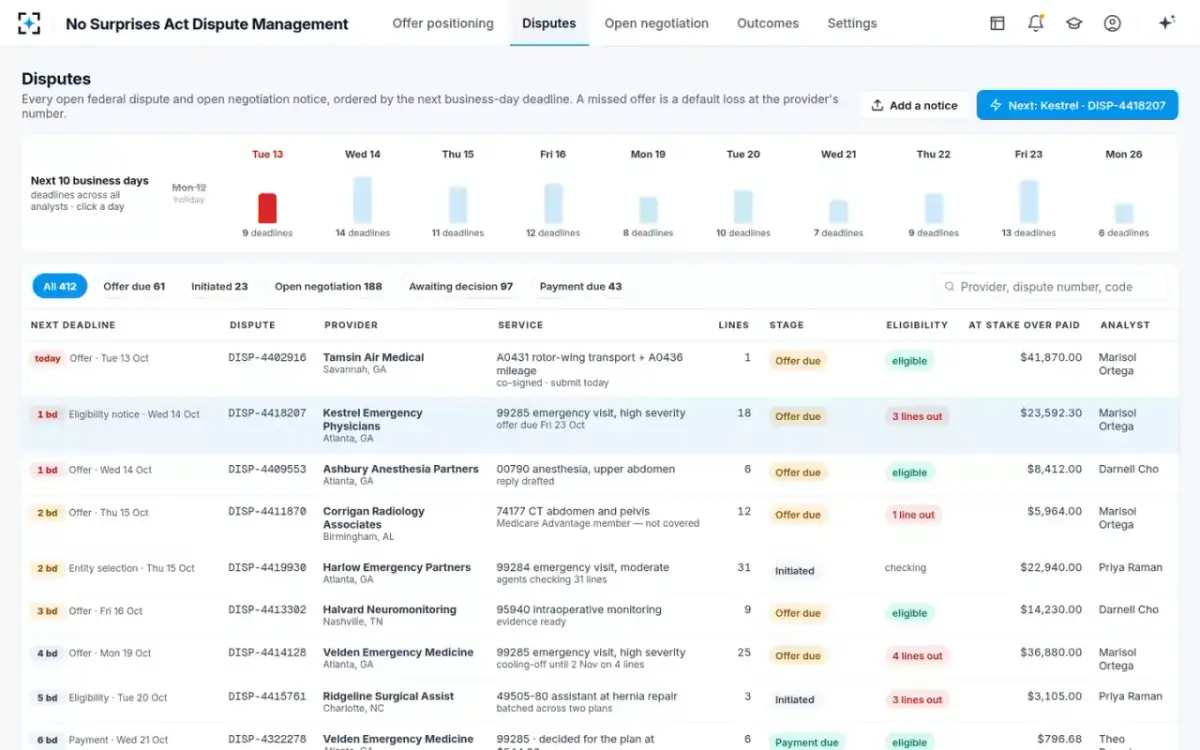
A deadline-first queue also shows a manager where to put people. In the sample above, 61 offers fall due in the next ten business days and 43 awards are waiting to be paid. The first number is the analysts' week; the second is the claims examiner's, and it has its own 30-calendar-day clock.
Where the IDR analyst's hours go on one batched dispute
Most of an analyst's time on a dispute goes to finding and assembling, not deciding. Botminds' estimate for a typical batched dispute worked by hand is about ten hours: two to read the notice and find every claim and remittance, an hour and a half to check eligibility line by line, three to build the rate evidence, one to choose the offer, two to write the explanation and half an hour to sign off and submit.
An analyst's ten hours on one batched dispute, by hand and with agents
By hand · 10 h
- Finding claims and eligibility · 35%
- Rate evidence · 30%
- Choosing the offer · 10%
- Explanation · 20%
- Sign-off · 5%
With agents · 2.5 h
- Finding claims and eligibility · 20%
- Rate evidence · 20%
- Choosing the offer · 20%
- Explanation · 20%
- Sign-off · 20%
The shift that matters is in the second row's shares. With the agents doing the reading, matching and first drafts, choosing the offer and signing it become 40% of a much shorter job. Those are the two steps that decide the outcome, and the only two the solution leaves entirely to people.
The rate evidence is the biggest block by hand for a reason. Plans have mostly argued from the QPA, and the federal data show it: insurers' offers were at or below the QPA in about 47% of 2024 disputes, the CRS found, while the prevailing offer was above the QPA in about 87% of determinations in the second half of 2025. An analyst who wants to win at a number above the QPA needs evidence the arbiter must weigh, such as the provider's own former contract, and that takes time to find.
How No Surprises Act Dispute Management splits the desk's work
The solution gives six agents the mechanical steps and keeps every decision with a named person. A notice reader extracts the dispute number, parties, lines, dates and offer. A claim and payment matcher finds each line's claim, remittance, QPA disclosure and funding type, read-only. An eligibility checker runs the line-by-line tests and drafts the objection. A rate evidence builder assembles the exhibits. An outcome analyst places the case among past determinations for the same code and region and recommends a number. A reply drafter writes the explanation, citing an attached exhibit for every statement.
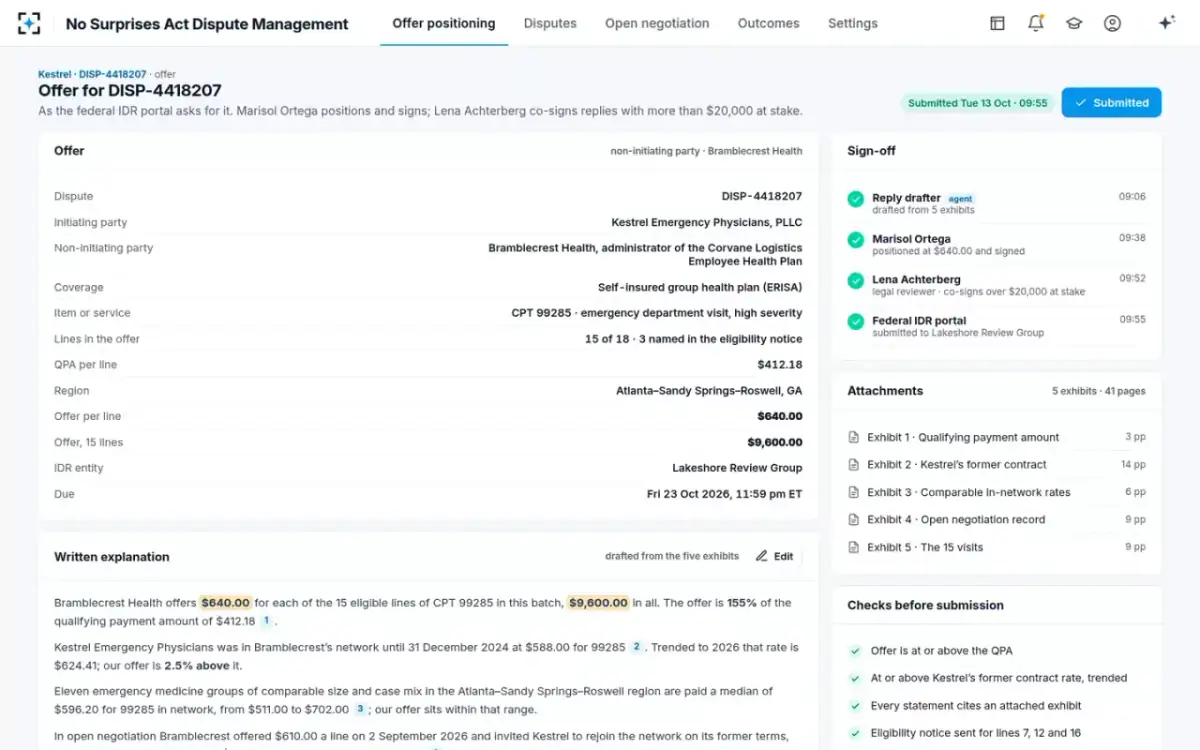
Take a sample case as it runs through the solution: Bramblecrest Health, a fictional plan, answering an 18-line batch of high-severity emergency visits (CPT 99285) from Kestrel Emergency Physicians, a fictional group that left its network at the end of 2024. The agents finished their run in 7 minutes 40 seconds; the analyst, Marisol Ortega, positioned the offer at $640.00 a line, signed at 09:38, the legal reviewer co-signed at 09:52 and the offer went in at 09:55, eight business days before it was due.
Signed, co-signed and submitted: the last step is always a person
"I have ten business days and one shot. I want to know where this arbiter has landed before I pick a number."
Marisol Ortega, the sample plan's IDR dispute analyst (fictional)
What the solution does not do matters as much. It never submits to the federal portal, never sends an objection, never sets the offer and never drafts one below the QPA. The design target is zero offers lost by default for a missed deadline; it is a target, not a result. For the steps and deadlines in full, see the No Surprises Act IDR process, day by day; for the line tests the eligibility checker runs, see IDR eligibility and the evidence behind an objection.
Questions people ask
Is an IDR analyst the same as an arbitrator?
No. The arbitrator is the certified IDR entity, one of 17 organisations certified by the Departments as of September 2026. The IDR analyst works for one side, usually the plan, and prepares its offer and evidence for the entity to judge.
Who pays the IDR fees when a plan loses?
Both parties pay the entity's fee with their offers, and the entity refunds the winner within 30 business days, so the losing party bears it. Both parties also pay a non-refundable administrative fee, $15 per party for disputes initiated on or after 11 June 2026, down from $115.
Can a health plan start an IDR dispute itself?
Yes: either party may initiate after open negotiation fails. In practice plans rarely do; providers and facilities initiated more than 99% of disputes in 2024, according to the Congressional Research Service.
What happens if the plan misses the offer deadline?
The entity selects the other party's offer. CMS's guidance says that if one party has not submitted an offer by the deadline, the entity "will select the other party's offer as the final payment amount", and an offer counts as received only once the fees are paid.
Do IDR analysts need medical coding knowledge?
Enough to read service codes and modifiers. The QPA is calculated per code, specialty and region, batching tests compare codes, and the federal web forms have checked duplicates by claim number, date of service, code and modifier since late 2025.
How fast do arbiters decide?
Faster than before. In the second half of 2025, 62% of payment determinations came within 30 business days, up from 37% in the first half, CMS reported; in 2024 most did not, with a median of 54 business days for emergency and non-emergency disputes in the fourth quarter.