The No Surprises Act IDR process is the federal arbitration that sets the out-of-network rate when a health plan and an out-of-network provider cannot agree on payment for a surprise-billing service. It runs in fixed steps. The plan sends an initial payment or denial within 30 calendar days of the bill; either side may then open a 30-business-day open negotiation; if that fails, either side may start federal independent dispute resolution (IDR) in a four-business-day window; the parties pick a certified IDR entity within three business days; each submits one offer within ten business days of the selection; and the entity picks one of the two offers within thirty. The plan pays within 30 calendar days. Botminds' No Surprises Act Dispute Management computes every one of those dates from the rule, so a desk sees each deadline before it arrives.
The federal IDR process in business days, from the open negotiation notice to the award
- Open negotiation30 days
- Start IDR4 days
- Arbiter3 days
- Offers and fees10 days
- Decisionto day 30 after selection
How does the No Surprises Act IDR process work?
It is final-offer, or "baseball-style", arbitration with fixed clocks. Each side submits one number, and the certified IDR entity must select the offer that it "determines best represents the value of the qualified IDR item or service as the out-of-network rate" (45 CFR 149.510(c)(4)(ii)). The arbiter cannot pick a figure in between. The process covers out-of-network emergency services, non-emergency services by an out-of-network provider at an in-network facility, and air ambulance services, under group and individual commercial coverage, unless a specified state law or All-Payer Model sets the payment.
It is used heavily. Providers and facilities initiated more than 99% of disputes in 2024, the Congressional Research Service found, and 390,602 disputes were initiated in September 2026 alone. So for a health plan the process is almost always something that happens to it, on a timetable the provider starts.
When does open negotiation start?
When either side sends an open negotiation notice, which it may do within 30 business days of the day the provider receives the plan's initial payment or notice of denial. That payment or denial itself must go out "not later than 30 calendar days after the bill for such services is transmitted" (42 U.S.C. 300gg-111(a)(1)(C)(iv)). The 30 business days of negotiation begin on the day the notice is first sent, and the notice must use the Departments' standard form, identify the items, dates, service codes and initial payment, and make an offer.
CMS's guidance counts the days precisely. Weekends and federal holidays never count, and IDR may be started "within 4 business days after the close of the open negotiation period (in other words, 4 business days beginning on the 31st business day after the start of the open negotiation period)" (CMS guidance, section 4.1). The open negotiation notice and the plan's response are the subject of a guide of their own.
What are the steps of the federal IDR process?
Seven steps follow a failed negotiation, and the plan has a duty in five of them. The flow shows who acts at each step, as a plan's desk would divide them.
The steps of the federal IDR process, and who acts at each on the plan's side
A person decides
1 · InitiationThe provider (usually) files the notice of IDR initiation with the other side and the Departments in the 4-business-day window; the initiation date is the day the Departments receive it.
Agent
2 · Read and matchThe plan’s side reads the notice and ties each line to its claim, remittance, QPA disclosure and plan type.
Never: change a date the notice states
A person decides
3 · Arbiter selectionThe plan agrees or objects to the proposed entity within 3 business days; without agreement the Departments pick at random within 6.
A person decides
4 · Eligibility objectionThe plan files any inapplicability information with the notice of selection, 1 business day after the 3-day period, and pays the administrative fee.
A person decides
5 · Offer and feeWithin 10 business days of selection the plan submits its offer, in dollars and as a percentage of the QPA, with the arbiter’s fee.
A person decides
6 · DecisionWithin 30 business days of selection the arbiter picks one offer and explains why in writing.
A person decides
7 · PaymentThe plan pays the award, less what it already paid, within 30 calendar days of the decision.
One dispute, dated: the plan's deadline at each step
Dates are where desks go wrong, so here is one illustrative dispute counted day by day with the 2026–27 federal holidays (5 U.S.C. 6103). A provider receives a plan's initial payment on Monday 5 October 2026 and sends its open negotiation notice on Monday 2 November. Nothing settles, and the provider initiates IDR on the first permitted day.
An illustrative federal IDR dispute, every deadline dated
| Step | Rule | Date | Note |
|---|---|---|---|
| Initial payment received | Sets the open negotiation window | Mon 5 Oct 2026 | Columbus Day, 12 Oct, is not a business day. |
| Last day to send the open negotiation notice | 30 business days from receipt | Tue 17 Nov 2026 | Veterans Day, 11 Nov, excluded. |
| Open negotiation notice sent | Day 1 of 30 | Mon 2 Nov 2026 | |
| Open negotiation ends | Day 30 | Tue 15 Dec 2026 | Thanksgiving, 26 Nov, excluded. |
| IDR initiation window | Days 31 to 34 | Wed 16 Dec – Mon 21 Dec 2026 | Initiated Wed 16 Dec in this example. |
| Arbiter selected | 3 business days after initiation | Mon 21 Dec 2026 | Random selection, if needed, by Thu 24 Dec. |
| Plan’s eligibility objection and admin fee | With the notice of selection, 1 business day later | Tue 22 Dec 2026 | |
| Offers and arbiter’s fee due | 10 business days after selection | Wed 6 Jan 2027 | Christmas and New Year’s Day excluded. |
| Decision due | 30 business days after selection | Thu 4 Feb 2027 | Martin Luther King Jr. Day, 18 Jan, excluded. |
| Award paid | 30 calendar days after the decision | By Sat 6 Mar 2027 | Calendar days: weekends count. |
| Cooling-off ends | 90 calendar days after the decision | Wed 5 May 2027 | For single and bundled disputes. |
Two details in the table catch desks out. First, the offer window over Christmas runs to 6 January, not 4 January, because two federal holidays fall inside it. Second, payment switches from business days to calendar days, so a decision on a Thursday makes the award due on a Saturday, and claims has to pay by the Friday.
What does each side submit with its offer?
An offer "expressed as both a dollar amount and the corresponding percentage of the qualifying payment amount", any information the arbiter asks for, and some details about itself. Providers state the size of their practice or facility and their specialty; plans state "the coverage area of the plan or issuer, the relevant geographic region for purposes of the qualifying payment amount, whether the coverage is fully-insured or partially or fully self-insured", and the QPA (45 CFR 149.510(c)(4)(i)).
The arbiter "shall consider" the QPA and information on five additional circumstances: the provider's training, experience and quality and outcome measures; the market share of either side; the patient's acuity or the service's complexity; a facility's teaching status, case mix and scope of services; and good-faith efforts to contract, with contracted rates between the parties "during the previous 4 plan years" (42 U.S.C. 300gg-111(c)(5)(C)). It may not consider usual and customary charges, the provider's billed charges, or public-payer rates such as Medicare's. Since a 2023 court ruling, the regulation's ordering of those factors, with the QPA weighed first, no longer applies (FAQs Part 63).
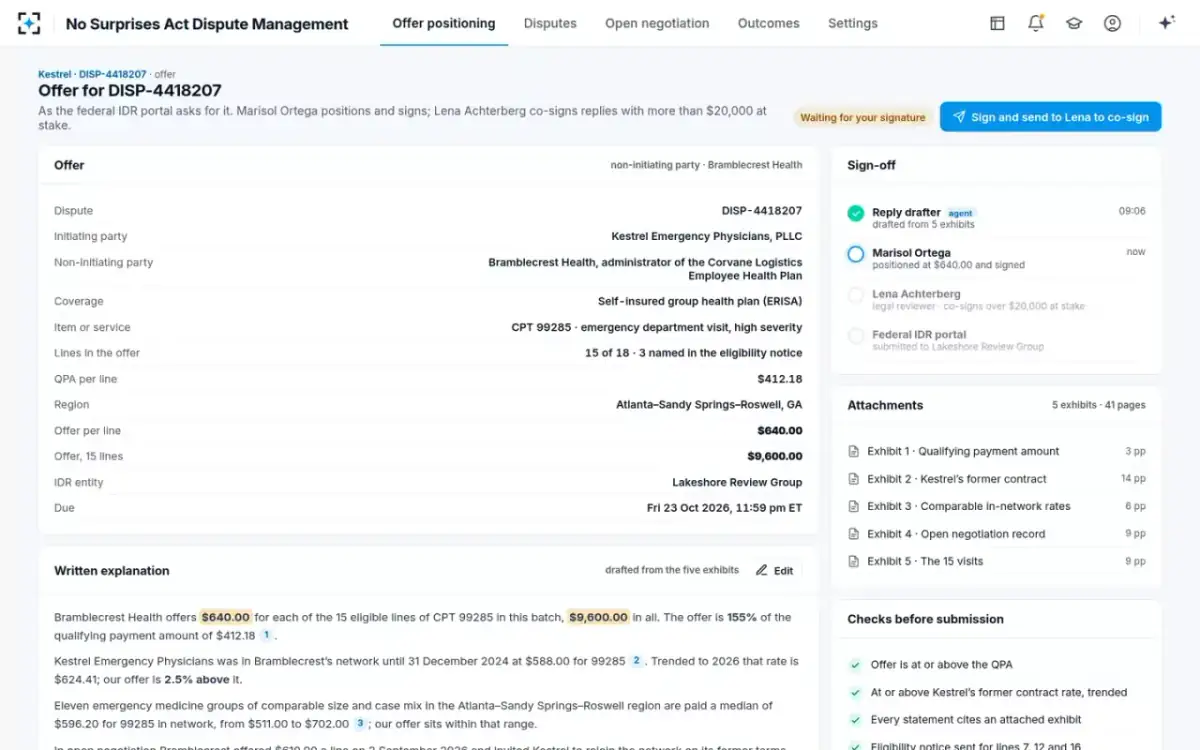
An offer laid out as the federal portal asks for it
Who pays the IDR fees?
Both sides pay up front; the loser ends up paying the arbiter. Each party pays a non-refundable administrative fee when the arbiter is selected: $15 per party for disputes initiated on or after 11 June 2026, down from $115 (91 FR 33900). Each also pays the arbiter's fee with its offer, and the arbiter refunds the winner within 30 business days of its decision. The fee ranges are $200 to $840 for a single dispute and $268 to $1,173 for a batch.
Fees and offers are linked: under CMS's guidance an offer "will not be considered received by the certified IDR entity until the certified IDR entity fee and the administrative fee have been paid", and if one side's offer is not received, the entity selects the other side's (CMS guidance, section 6.2). A plan that submits on time but pays late has defaulted.
"In Q4 of 2024, 26% of disputes were resolved through a default and approximately 90% of default disputes were decided in favor of providers and facilities."
Congressional Research Service, R48738 (26 Nov 2025)
When must a plan pay an IDR award?
Within 30 calendar days of the decision. The rule says the amount of the offer selected, "less the sum of the initial payment and any cost sharing paid or owed", must be paid directly to the provider "not later than 30 calendar days after the determination" (45 CFR 149.510(c)(4)(ix)). If the selected offer is below what the plan already paid plus cost sharing, the provider owes the difference back on the same clock. If the parties settle after initiation, payment is due within 30 business days of the agreement.
Enforcement runs mainly through the Departments. In 2025 the Fifth Circuit held in Guardian Flight that the Act gives a winning provider no private right to sue for the award, leaving a complaint to CMS as the main recourse in that circuit, while other courts have not adopted that reading, the CRS noted. A plan should not read that as licence to pay late: the determination binds it either way.
How long does the IDR process take in practice?
Longer than the rule's 30 business days for many disputes, though the gap is closing. In 2024 most determinations came outside the window; the median for emergency and non-emergency disputes was 54 business days in the fourth quarter, and batched disputes took a median of 98 business days against 46 for single disputes (CRS). In the second half of 2025, 62% of payment determinations came within 30 business days, up from 37% in the first half (CMS).
Delay does not move the plan's own deadlines. CMS's guidance tells parties to keep meeting deadlines while the arbiter reviews eligibility, so a slow arbiter never excuses a late offer. Extensions exist for extenuating circumstances such as natural disasters, but they are granted case by case or announced by the Departments, not assumed.
Where No Surprises Act Dispute Management sits in the process
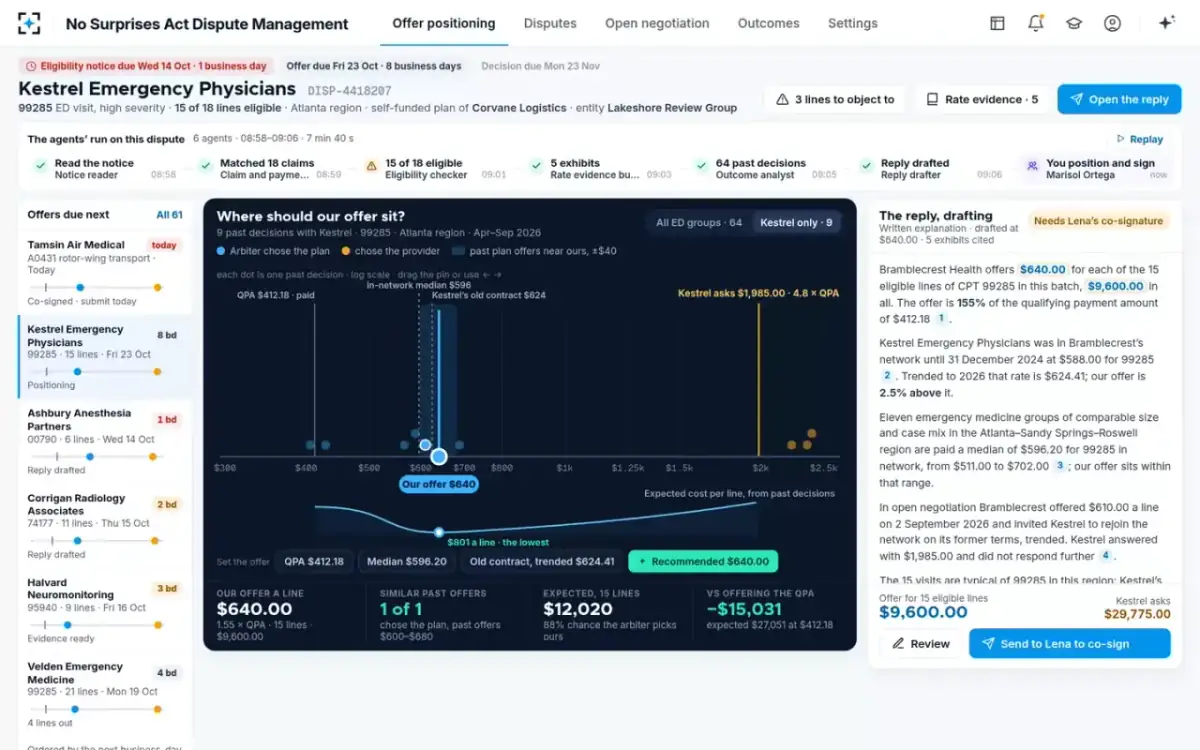
Across steps 2 to 5, with people at every signature. A notice reader takes the dispute number, parties, lines, dates and the provider's offer from each notice and flags any conflict with the portal without changing a date. The eligibility checker counts every clock in business days, federal holidays excluded, and drafts the objection. The rate evidence builder and reply drafter prepare the offer package. The queue orders every open dispute by its next deadline and, in the sample plan's settings, warns when an offer has three business days left and escalates at one.
Take the sample case in the solution: Bramblecrest Health, a fictional plan, answering 15 eligible lines of CPT 99285 from Kestrel Emergency Physicians, a fictional group. The case page carries its clocks across the top: the offer due Friday 23 October and the decision due Monday 23 November 2026, the second counted past Veterans Day. The offer went in on 13 October, eight business days early. What the 2026 operations rule changes in this process, and when, is set out in the federal IDR operations rule.
Nine past decisions with one provider, on the same price line
Questions people ask
What is a certified IDR entity?
An organisation certified jointly by the Departments of Health and Human Services, Labor and the Treasury to decide federal IDR disputes; there were 17 as of 11 September 2026. It must be free of conflicts with either party and is certified for five years.
Can the parties settle after IDR has started?
Yes, at any point before the decision. The agreed amount becomes the out-of-network rate, the initiating party notifies the Departments within 3 business days, half of each side's arbiter fee is returned and the administrative fee is not.
Is air ambulance handled the same way?
Largely, under a parallel section of the rule, 45 CFR 149.520, with additional factors such as the vehicle type and the population density of the pick-up location. Air ambulance disputes were about 3% of 2024 initiations, according to the CRS.
Does the arbiter have to follow past decisions?
No. Each determination stands on the offers and information in that dispute. Past determinations are public in CMS's files, which is why plans use them to position offers, but they are not precedent.
Will the 2026 operations rule change these deadlines?
Some of them, once the Departments announce the portal features for each change; disputes whose open negotiation begins 90 days after that announcement follow the new steps. The batching changes apply to disputes whose open negotiation starts on or after 1 November 2026.