An open negotiation notice is the written notice, on the Departments' standard form, that starts the 30-business-day open negotiation period for an out-of-network claim under the No Surprises Act. Either the provider or the health plan may send it within 30 business days of the day the provider receives the plan's initial payment or denial, and it must identify the items, dates, service codes and initial payment and make an offer. Open negotiation must be completed before either side can start federal independent dispute resolution (IDR), and it is the plan's best chance to settle: once IDR starts, the arbiter must pick one side's number whole, and providers prevailed in about 85% of payment determinations in the second half of 2025 (CMS). Botminds' No Surprises Act Dispute Management puts every open negotiation notice on its clock with a counter-offer band drawn from past decisions for the same code and region.
Anatomy of an open negotiation notice, and what the plan should check on each part
The items and services
Dates furnished and service codes for each claim.
Plan checkMatch every line to its claim and remittance today, not at initiation.
The initial payment
What the plan paid, or that it denied payment.
Plan checkConfirm it against the remittance; the date the provider received it opened the 30-business-day window.
An offer
The provider’s proposed out-of-network rate.
Plan checkExpress it as a multiple of the QPA and place it beside past decisions for the code and region.
Contact information
Who sent it and how to reach them.
Plan checkLog who received it and when; CMS warns a notice not properly provided may not start the clock.
The standard form
The Departments’ open negotiation notice.
Plan checkCheck the plan type and funding now: a line outside federal IDR is better settled or answered than disputed.
What is an open negotiation notice?
It is the opening move of every federal surprise-billing dispute. The rule in force for disputes now under way requires that the notice "include information sufficient to identify the item(s) and service(s) (including the date(s) the item(s) or service(s) were furnished, the service code, and initial payment amount, if applicable), an offer of an out-of-network rate, and contact information for the party sending the open negotiation notice", using "the standard form developed by the Secretary" (45 CFR 149.510(b)(1)(ii)). It may be sent by email if the sender believes in good faith that the recipient can read it and a paper copy is available free on request.
Plans make sending one easy on purpose. With every initial payment or denial, a plan must give the provider the qualifying payment amount (QPA) and "contact information, including a telephone number and email address, for the appropriate person or office to initiate open negotiations" (45 CFR 149.140(d)(1)). A plan that publishes an address nobody watches has not escaped the clock; it has only stopped seeing it.
How long is the open negotiation period?
Thirty business days, starting on the day the notice is first sent; IDR may then be started in the four business days beginning on the 31st. The window to send the notice is itself 30 business days from the provider's receipt of the initial payment or denial. Business days exclude weekends and federal holidays, so a Thanksgiving or Christmas inside the period pushes its end back.
Thirty business days of open negotiation: a plan's own milestones
- Log, match, checkdays 1–5
- Evidence and counterdays 6–15
- Settle or decide not todays 16–30
- IDR may startdays 31–34
One warning from CMS changes how a plan should log notices. The guidance says that "if the open negotiation notice is not properly provided to the non-initiating party (and no reasonable measures have been taken to ensure actual notice has been provided), the Departments may determine that the 30-business-day open negotiation period has not begun", and any later determination "may be unenforceable" (CMS guidance, section 3.2.2). For a plan that received a notice, the date it arrived and where is evidence; for a plan that never saw one, the absence is the basis of an objection that open negotiation was not completed.
Does a health plan have to respond to open negotiation?
Not under the rules in force for disputes now under way, but it will have to, and it usually should already. The current text requires the notice and the 30 business days; it does not require a response. The 2026 operations rule changes that: the party receiving the notice must respond to the other party and the Departments "as soon as practicable, but no later than the 15th business day of the 30-business-day open negotiation period", with supporting documentation, and the notices go through the federal IDR portal (45 CFR 149.510(b)(1)(i), as amended).
That requirement applies only to disputes whose open negotiation begins 90 days after the Departments announce that the portal supports it, and as of 27 October 2026 they had not (CMS notices). The reason for it is in the rule's preamble: plans and providers have each alleged that the other "regularly fails to engage in meaningful open negotiation", leaving "relatively few disputes being settled outside of the Federal IDR process" (91 FR 33900).
Why open negotiation is where a plan has the most control
Because in open negotiation the plan can accept a price between the two positions, and in IDR it cannot. The arbiter must choose one of two offers. In the second half of 2025, providers, facilities and air ambulance providers prevailed in about 85% of payment determinations and plans in about 14%; even leaving defaults aside, providers won 84% (CMS).
Defaults made the results worse than the arguments did. The Congressional Research Service traced much of providers' improvement in 2024 to determinations in which the insurer defaulted by not submitting an offer or paying its fees, and found that in both 2023 and 2024 providers won about 85% of the disputes that were not decided by default (CRS R48738). Defaults have since fallen, but they remain a large share of determinations.
Default decisions have fallen, but one determination in six is still a default
A settled claim also costs less to process. Settling before initiation avoids the $15 administrative fee each side pays and the arbiter's fee the loser bears, $200 to $840 for a single dispute and more for a batch, as well as the analyst's hours. Those costs are small beside the award, which is why the offer, not the fee, should drive the decision.
What should a plan offer in open negotiation?
A number the plan could defend in IDR, made early enough to become evidence if negotiation fails. Two pieces of evidence matter most. The first is where arbiters have landed for the same code and region, which CMS's public use files show for every determination. The second is the provider's own contracted rate with the plan in the previous four plan years, which the arbiter must consider as part of "demonstrations of good faith efforts (or lack of good faith efforts)" to contract (42 U.S.C. 300gg-111(c)(5)(C)).
Take a sample case as it runs through the solution. Kestrel Emergency Physicians, a fictional emergency group, left the network of Bramblecrest Health, a fictional plan, at the end of 2024, when its contract paid $588.00 for a high-severity emergency visit (CPT 99285). In open negotiation on 2 September 2026 the plan offered $610.00 a line and invited the group back on its former terms. The group answered with $1,985.00, 4.8 times the QPA of $412.18, and did not respond further. When the dispute reached IDR, that exchange became the plan's fourth exhibit: evidence of a good-faith effort, and a fixed point from which the plan's eventual offer of $640.00 rose.
One provider's past decisions, on the same price line as the open negotiation offer
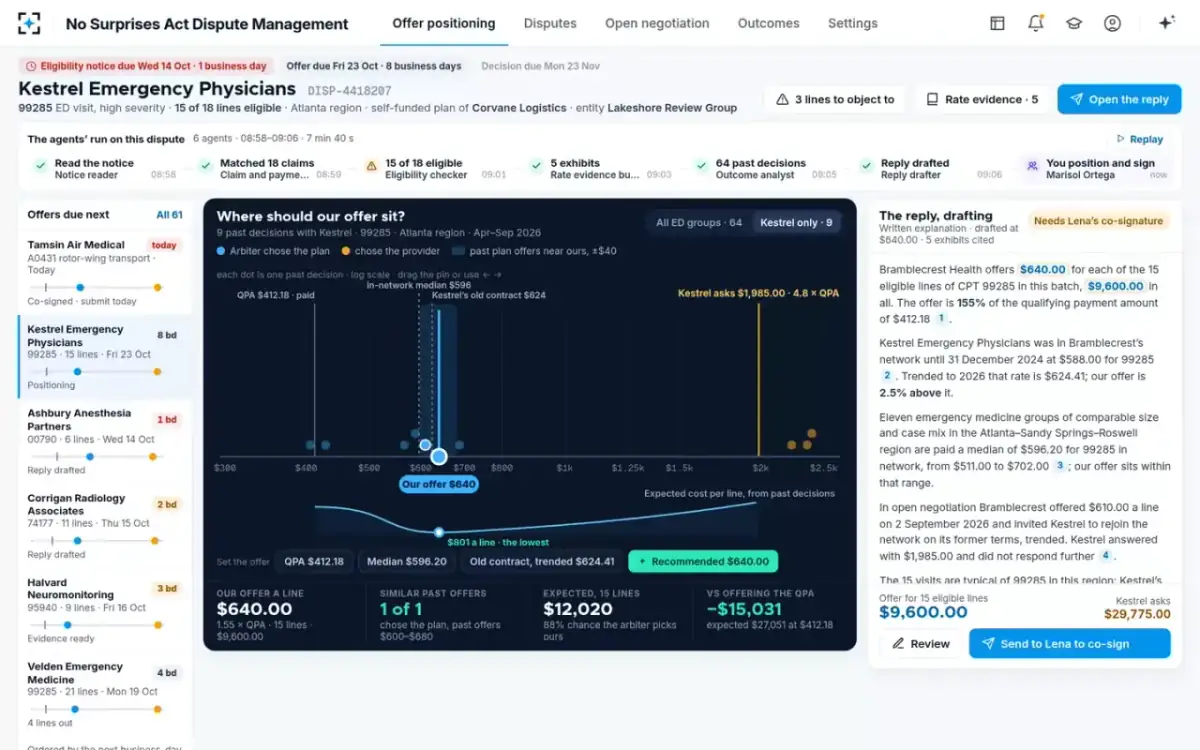
How to read the provider's opening number
Convert it to a multiple of the QPA and compare it with where arbiters have landed for that kind of service. The multiples differ enormously by specialty. In 2024 the median prevailing offer in emergency department disputes ran from roughly 2.5 to 3 times the QPA each quarter, while for radiology it was about five times by the fourth quarter, for surgery nearly 13 times and for neurology and neuromuscular procedures almost 17 times, the CRS found from CMS's data (CRS R48738).
Dollar size distorts those multiples. CMS notes that "low-dollar items and services had higher prevailing offers expressed as a percentage of the QPA, partly because a small dollar difference translates into a large percentage difference" (CMS). The CRS found that among 2024 non-default neurology determinations where the prevailing offer exceeded 30 times the QPA, the median QPA was $76. A plan deciding whether to settle should therefore look at the dollars at stake across the lines, not the multiple alone: a fourfold ask on a $76 code and a fourfold ask on a high-dollar air ambulance transport are different decisions.
The provider's number also tells the plan what the provider is likely to put to the arbiter. CMS observed that providers "often benchmarked their offers to past OON payment amounts with the disputing plan or issuers and past in-network rates", so a plan that has paid the same provider more in the past, or contracted with it at a higher rate, should expect to see those figures again in IDR and should weigh them now.
Who works open negotiation at a health plan?
Usually the provider reimbursement or network team, because a settlement is a price and often a step back toward a contract. The plan's IDR analysts, legal reviewer and claims examiners each need what happens in negotiation, and in most desks they see it too late.
Four seats in open negotiation, before and after the notices are on one clock
Today
Finds the notice in a shared inbox in week three and answers from a spreadsheet.
With agents
Sees every notice on its 30-business-day clock with a counter-offer band from past decisions and the settlement authority marked.
Still theirs: Settles within authority; escalates above it.
Today
Meets the claim for the first time when the initiation notice arrives.
With agents
Inherits a case with the open negotiation history, the offer made and the reply received already attached as evidence.
Still theirs: The offer if negotiation fails.
Today
Learns of a state-law or plan-type problem at the objection deadline.
With agents
Sees eligibility problems flagged during negotiation, while settling or explaining is still possible.
Still theirs: The legal position.
Today
Pays an award months later on a claim nobody negotiated.
With agents
Pays a settlement within 30 business days with the signed agreement attached.
Still theirs: Every payment.
What happens if open negotiation fails?
Either party may start federal IDR during the four business days beginning on the 31st business day. The plan then has three business days to agree or object to the arbiter proposed, files any eligibility objection with the notice of selection one business day later, and submits its offer and fees within ten business days of the selection. Each step is set out in the No Surprises Act IDR process, day by day.
Not every failed negotiation becomes a dispute, and not every dispute is eligible. If the provider initiates after the four-day window, or before the 30 business days ran, the line can be objected to; the grounds and the evidence are in IDR eligibility. And if the line was never eligible, because a specified state law governs it or the plan type is outside the Act, the negotiation was the time to say so.
Can a plan settle after IDR is initiated?
Yes, at any point before the arbiter decides. The agreed amount "will be treated as the out-of-network rate", payment of any amount above the initial payment is due "not later than 30 business days after the agreement is reached", the initiating party must notify the Departments within three business days with both parties' signatures, and the arbiter returns half of each side's fee; the administrative fee is not refunded (45 CFR 149.510(c)(2)). The 2026 rule restates the authority to keep negotiating, applicable from 1 November 2026, and adds withdrawal rules that apply in stages.
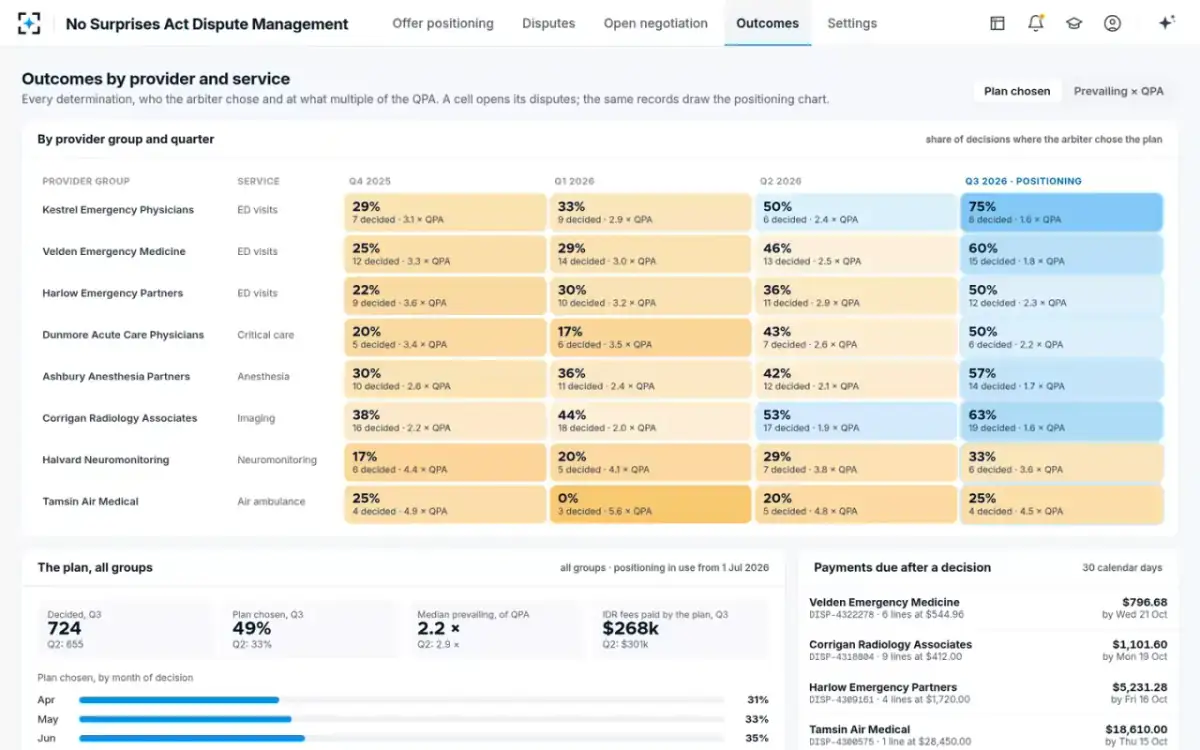
Where the plan's offers have been chosen, by provider and quarter
Questions people ask
Where is the open negotiation notice sent?
Today, to the other party, in writing, by email where the sender believes in good faith the recipient can read it, with paper free on request. Once the 2026 rule's portal features apply, the notice and the response also go to the Departments through the federal IDR portal.
Can a plan send an open negotiation notice?
Yes. Either the provider or the plan may start open negotiation within 30 business days of the provider's receipt of the initial payment or denial, though in practice providers start almost all of it, as they start more than 99% of IDR disputes.
Is there a standard open negotiation notice form?
Yes. The rule requires the standard form developed by the Departments, and CMS's guidance points to it on the Department of Labor's No Surprises Act page. The 2026 rule expands its contents once the portal supports the new notice.
What if the provider never sent an open negotiation notice?
Then open negotiation was not completed and the dispute is open to an eligibility objection. CMS's guidance says the Departments may find that the period never began if the notice was not properly provided.
Does a settlement in open negotiation need anything filed?
Not before initiation, under the rules in force now; the parties simply agree and the plan pays. A settlement after IDR has been initiated must be reported to the Departments within three business days, signed by both parties.