IDR eligibility is the question of whether a disputed claim may be decided in the federal independent dispute resolution (IDR) process under the No Surprises Act at all. A line is eligible only if it is a "qualified IDR item or service": an out-of-network emergency service, a non-emergency service by an out-of-network provider at an in-network facility, or an air ambulance service, under coverage the Act reaches, where no specified state law or All-Payer Model sets the payment, after a completed open negotiation, started on time, outside a cooling-off period and, if batched, batched correctly. The plan's chance to say a line fails is short: its objection goes through the federal portal with the notice of arbiter selection. Botminds' No Surprises Act Dispute Management runs those tests on every line and drafts the reasons with the documents behind them, for the plan's legal reviewer to sign.
Seven tests every disputed line must pass to be eligible for federal IDR
- Covered by the Act
Group or individual commercial coverage or an FEHB plan; not Medicare, Medicaid, Medicare Advantage, TRICARE, short-term or excepted-benefit coverage.
- No specified state law or All-Payer Model sets the payment
If one does, the state process governs; a self-insured ERISA plan is in only if it opted in.
- A qualifying service, without valid notice and consent
Emergency services, non-emergency services by an out-of-network provider at an in-network facility, or air ambulance; ground ambulance is outside the Act.
- Open negotiation started and completed
Started within 30 business days of the initial payment or denial, and ran its 30 business days.
- Started on time
Initiated in the 4 business days beginning on the 31st business day after open negotiation began.
- Batched correctly, if batched
Same provider identifier, same plan or issuer, related to a similar condition, within one 30-business-day window.
- Not during a cooling-off period
No determination between the same parties on the same or similar service in the past 90 calendar days, unless the late-window rule applies.
What makes a dispute eligible for federal IDR?
Every line must clear every test above; one failure takes that line out. The entity reviews eligibility before anything else: "For all disputes, the certified IDR entity must confirm dispute eligibility before the dispute can proceed," CMS wrote in its report on the second half of 2025, and it named eligibility as "the primary cause of dispute processing delays".
The tests come from three places. The statute defines what the Act protects and lets a specified state law or All-Payer Model take precedence. The regulation at 45 CFR 149.510 sets the clocks and the batching and cooling-off rules. And court rulings since 2023 have changed some of those rules, most visibly batching: a federal court vacated the "same service code" requirement in August 2023, leaving the statute's test that batched items be "related to the treatment of a similar condition" (FAQs Part 63, November 2023).
What are common reasons IDR disputes are ineligible?
Since late 2024 the two most frequent reasons have been an unfinished 90-calendar-day cooling-off period and a specified state law or All-Payer Model that governs instead, CMS reported. The Congressional Research Service lists the broader set: a state law or all-payer agreement applies, the initiating party missed the timelines, the parties "did not complete the open negotiation period", or the claims were not correctly batched or bundled (CRS R48738).
The share of disputes found ineligible has fallen, but not to zero
A falling share is not a small number. Of the 7,304,875 disputes closed from the portal's opening in April 2022 to 30 September 2026, 1,262,335 were found ineligible. Each of those still used an arbiter's time, and some cost the parties fees, which is why the Departments have added screens to the initiation form: since July 2025 it checks service dates against the open negotiation start date and against each other in a batch, and since September 2026 it blocks initiations more than 30 business days after a 90-day cooling-off period ends (CMS notices).
The evidence each ineligibility objection needs
An objection wins on documents the entity can check, not on the plan's assertion. The table pairs each ground with the evidence that proves it and where that evidence usually sits at a health plan.
Grounds for an IDR eligibility objection, and the evidence behind each
| Ground | What proves it | Where it sits at a plan |
|---|---|---|
| Plan type not covered | Member’s enrolment on the date of service and the product it belongs to (Medicare Advantage, Medicaid managed care, short-term, excepted benefits). | Eligibility files |
| Specified state law governs | Funding type (fully insured) or a self-insured plan’s opt-in, the state where the service was furnished, and the state statute that sets payment. | Eligibility files, plan documents, legal’s state-law matrix |
| Notice and consent given | The signed consent form for a non-emergency service where the rules allow consent. | Provider’s submission, prior authorisation file |
| Open negotiation not started in time | Date the initial payment or denial reached the provider and the date the open negotiation notice was sent. | Remittance history, notice inbox |
| Open negotiation not completed | The notice’s date and the initiation date, under 30 business days apart. | Notice inbox, initiation notice |
| Initiated late | The last day of open negotiation and the initiation date, more than 4 business days apart. | Initiation notice, holiday calendar |
| Cooling-off period | The earlier determination: dispute number, date, parties and service. | The plan’s own determination letters |
| Incorrectly batched | Billing NPI or TIN, payer, service codes and conditions, and dates of service for every line. | Claims system |
| Duplicate | An earlier dispute with the same claim number, date of service, code and modifiers. | The plan’s own dispute history |
Two grounds deserve extra care because they are the most frequent. For a state-law objection, the decisive point is usually the funding type, not the state. The 2026 operations rule describes self-insured group health plans "not otherwise subject to State law" that may opt in to a specified state law where the state allows it (91 FR 33900), so the same state's law can govern one member's claim and not the next. The same rule notes that "many States do not maintain publicly available lists" of self-insured plans that have opted in, which is why the plan's own election documents are the evidence. Since July 2025 the federal web forms make a self-insured plan say whether it opted in, and make a non-initiating plan attest to the plan type the provider entered, choosing from a list that includes "Other" types the Act does not cover (CMS, 1 July 2025).
For a cooling-off objection, the evidence is the plan's own earlier determination. The initiating party "may not submit a subsequent notification involving the same other party with respect to a claim for the same or similar item or service" for 90 calendar days after a determination, but may file for items whose open negotiation ended during that period within the 30 business days after it (45 CFR 149.510(c)(4)(vii)). A plan that cannot find its own determination by provider, code and date cannot make this objection.
How do you object to IDR eligibility?
Through the federal IDR portal, by the date the notice of arbiter selection is due. Under the rules in force for disputes now under way, a non-initiating party that believes the process does not apply "must also provide information regarding the Federal IDR process's inapplicability through the Federal IDR portal by the same date that the notice of certified IDR entity selection must be submitted" (45 CFR 149.510(c)(1)(iii)). CMS's guidance puts that date at "not later than 1-business-day after the end of the 3-business-day period for certified IDR entity selection".
The objection runs alongside the offer clock, not instead of it
- Arbiter selectiondays 1–3
- Objectionday 4
- Arbiter reviewsas it can
- Arbiter selectiondays 1–3
- Offer and fee10 business days
The objection does not stop the clock. That is the single most expensive misunderstanding on an IDR desk, and CMS's guidance addresses it directly:
"While the matter is under review by the certified IDR entity, the timelines of the Federal IDR Process continue to apply, so the parties should continue to meet deadlines to the extent possible."
CMS, Federal IDR Process Guidance for Disputing Parties, section 5.5
So a plan objects and submits an offer, with fees, by the tenth business day after selection. If the arbiter later finds the line ineligible, the offer is moot. If it finds the line eligible and the plan held back its offer, the arbiter selects the provider's number by default, and the plan has lost twice.
Does a state surprise billing law make a dispute ineligible?
Only if it is a "specified state law" for that claim: one that provides a method for determining the total amount payable for the item or service, applied to coverage the state can regulate. CMS's guidance says that where an All-Payer Model Agreement or specified state law provides that method, "the state law will govern, rather than the Federal IDR Process" (CMS guidance, section 1.4). The usual dividing line is funding: a specified state law reaches the coverage the state regulates, and a self-insured plan not otherwise subject to it is in federal IDR unless it opted in.
Take a sample batch as it runs through the solution: Kestrel Emergency Physicians, a fictional emergency group, has filed 18 lines against Bramblecrest Health, a fictional plan. Most lines are for members of a self-funded ERISA plan that Bramblecrest administers; two, lines 7 and 12, are for members of its fully insured individual product in Georgia. The plan's legal reviewer concluded that Georgia's surprise billing law governs those two, and the eligibility checker drafted the objection on that ground. A batch that mixes a self-funded employer plan with an issuer's insured product is also open to a second objection: batched items must be paid by "the same plan or issuer", and here two different payers are responsible.
The objection, drafted with its reasons and co-signed by legal
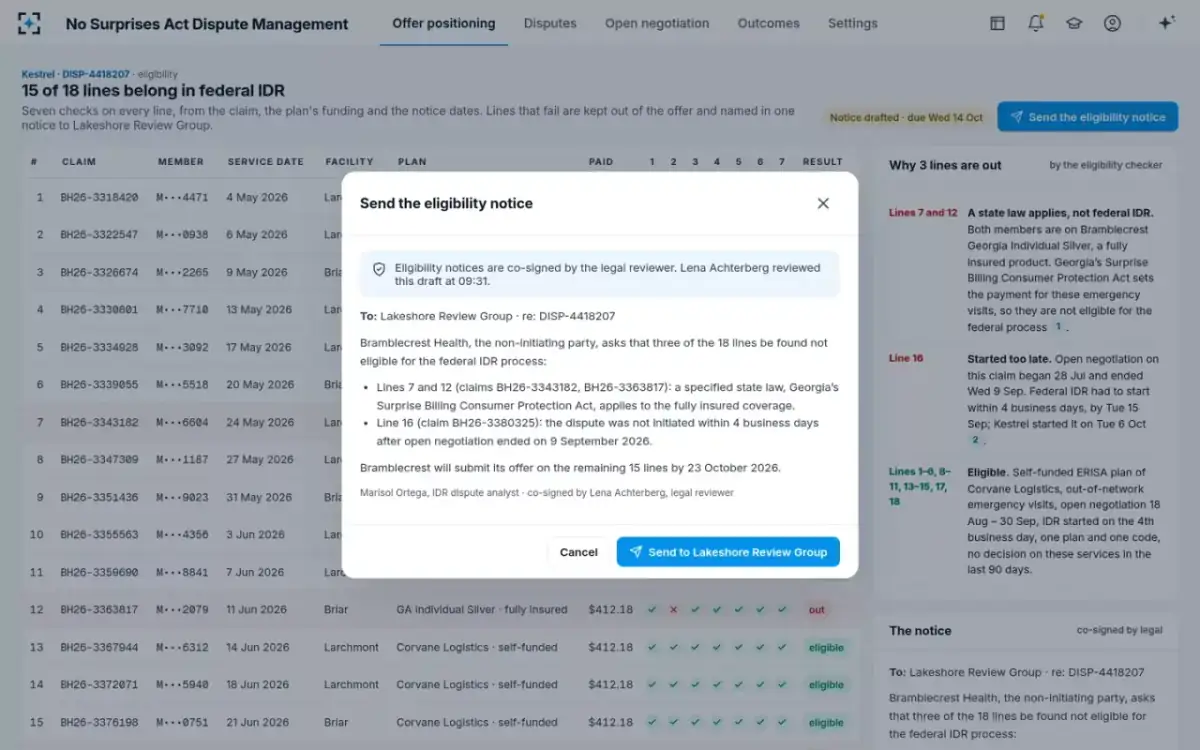
Line 16 of the same batch failed on timing. Its open negotiation ended on Wednesday 9 September 2026, so the four-business-day window to initiate ran from Thursday 10 to Tuesday 15 September. Kestrel initiated on Tuesday 6 October. That objection needs only two dates and a calendar, but it is lost if nobody looks at the dates of line 16 separately from the other seventeen.
How long does an IDR eligibility review take?
There is no fixed deadline yet. Under the rules in force for disputes now under way, the arbiter must "review the information submitted in the notice of IDR initiation to determine whether the Federal IDR process applies" and, if it does not, notify the Secretary and the parties "within 3 business days of making that determination" (45 CFR 149.510(c)(1)(v)), but the regulation sets no deadline for the review itself.
That will change. The 2026 operations rule requires the arbiter to make an eligibility determination "no later than 5 business days after the date of final selection" and lets it ask either party for more information, due within 5 business days (45 CFR 149.510(c)(2), as amended). Those provisions apply only to disputes whose open negotiation begins 90 days after the Departments announce that the portal supports them. The Departments have announced the batching functionality (from 1 November 2026) but, as of 27 October 2026, not the eligibility review; what changes when is set out in the federal IDR operations rule, provision by provision.
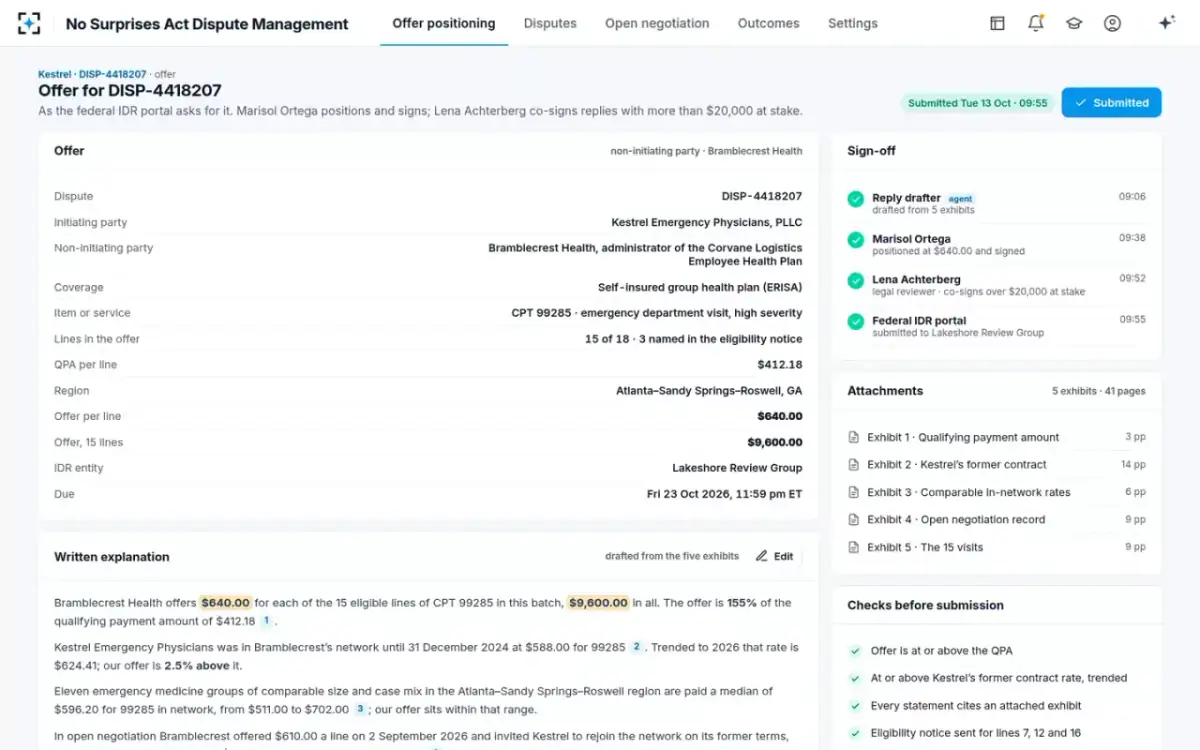
The offer goes in on the remaining lines, with the objection already sent
What happens if a dispute is found ineligible?
The dispute closes for the ineligible lines and the arbiter takes no further action on them. In a batch, the rest can continue: CMS's batching FAQs let the arbiter proceed with the items that are properly batched and direct the initiating party to resubmit the rest, and the standard window to resubmit improperly batched items is four business days (CMS FAQs, November 2023). The portal has a separate resubmission web form for exactly this, and it is the one form CMS is keeping outside the new IDR Gateway after 15 January 2027.
What happens to the money depends on the ground. If a specified state law governs, the state's process sets the payment and the federal determination never comes. If the line failed on timing or open negotiation, the federal process produces no determination for it. Either way the administrative fee is not refunded.
How No Surprises Act Dispute Management prepares an eligibility file
The eligibility checker runs the tests on every line using the claim, the plan's funding type and the notice dates, counts every clock in business days with federal holidays removed, and writes the reason for each line that fails, citing the document behind it. It drafts the objection; it never sends one. In the sample plan's settings every objection is co-signed by the legal reviewer before a person sends it, and the objection always goes with a commitment to submit an offer on the lines that remain.
For batches, the checker's line test is the subject of its own guide, IDR batching rules, including the 50-line cap and the 30-business-day cooling-off period that apply to batched disputes whose open negotiation starts on or after 1 November 2026.
Questions people ask
What is the 90-day cooling-off period?
After an arbiter decides a dispute, the party that started it may not file another against the same party for the same or similar service for 90 calendar days. Items whose open negotiation ended during that period can be filed in the 30 business days after it; for a batched determination on a dispute whose open negotiation starts on or after 1 November 2026, the cooling-off period itself shortens from 90 calendar days to 30 business days.
Can the plan raise eligibility after it submits an offer?
The rule asks for the plan's inapplicability information with the notice of arbiter selection, and the arbiter can ask either party for more at any time. Raising it late risks the arbiter having already decided eligibility, so the safe course is to object on time and submit the offer anyway.
Are Medicare Advantage claims eligible for federal IDR?
No. The No Surprises Act's federal IDR process covers group and individual commercial coverage and FEHB plans; the federal web forms list Medicare, Medicaid, Medicare Advantage, TRICARE, short-term coverage and excepted benefits among the plan types to which it does not apply. A Medicare Advantage plan instead pays a non-contracted provider what Original Medicare would, as set out in the Medicare Advantage out-of-network payment guide.
How many disputes do plans challenge?
In the second half of 2025, non-initiating parties challenged the eligibility of 42% of initiated disputes, 574,128 of 1,372,563, up from 40% in the first half, according to CMS.
Does ground ambulance go to federal IDR?
No. The Departments restated in the 2026 operations rule that the Act's surprise billing provisions do not apply to emergency or non-emergency ground ambulance services; Congress instead set up an advisory committee on ground ambulance billing.