IDR software for payers is the system a health plan or third-party administrator uses to answer federal independent dispute resolution (IDR) cases under the No Surprises Act: it takes in open negotiation and initiation notices, counts every business-day deadline, checks each disputed line for eligibility, assembles the rate evidence, drafts the offer and its explanation, and tracks the award to payment. Good IDR software leaves the decisions with people, and a plan can put it live in about ten weeks if it starts with notice intake and deadlines, where disputes are lost without being argued, and adds eligibility, evidence and offers afterwards. Botminds' No Surprises Act Dispute Management is software of this kind: six agents for the reading and drafting, and a named analyst for every offer.
A ten-week go-live for IDR software, against the federal calendar
- Notices and deadlineswk 1–2
- Claims matchedwk 3–4
- Eligibilitywk 5–6
- Evidence and draftswk 7–8
- Offers, signedwk 9–10
- 1 Nov batching rules1 Nov
- 13 Nov IDR Gateway forms13 Nov → 15 Jan
What is IDR software, and what should IDR software do for payers?
It is case management built around the federal rules rather than a generic workflow tool: every screen, clock and check comes from 45 CFR 149.510 and the plan's own policy. The requirements follow from how disputes are lost. Default decisions were 17% of payment determinations in the second half of 2025, and 90% of them went to providers (CMS); eligibility was "the primary cause of dispute processing delays"; and the prevailing offer was above the qualifying payment amount (QPA) in about 87% of determinations, while plans "often benchmarked their offers to the QPA". Software that fixes only the last of those has started at the wrong end.
What IDR software must do for a payer, in the order disputes are lost
- Catch every notice
Open negotiation notices by email or mail today, initiation notices from the federal portal, and the arbiter’s requests; nothing lives only in one inbox.
- Count every clock in business days
Monday to Friday without federal holidays, for open negotiation, initiation, selection, the objection, the offer and the decision; and calendar days for payment.
- Test every line
Coverage, state law and opt-ins, timing, open negotiation, batching under the rules for its open negotiation date, cooling-off and duplicates.
- Find the plan’s best evidence
The QPA and its disclosure, the provider’s contracts in the last four plan years, comparable in-network rates.
- Show where offers have landed
The plan’s own determinations and the federal public use files, by code, region, provider and arbiter.
- Draft, never send
Explanations whose every statement points to an attached document; a named person signs and submits.
- Pay and reconcile
Awards within 30 calendar days of the determination; the winner’s entity fee back within 30 business days.
- Keep up with the federal system
The IDR Gateway from 13 November 2026 and each 2026-rule feature as the Departments announce it.
How does IDR software track deadlines?
By counting business days the way the Departments do, and showing the next one first. CMS's guidance defines them as "Monday through Friday, not including Federal holidays" (CMS guidance, section 3.2.1). That sounds trivial until a holiday lands inside a window. Columbus Day fell on Monday 12 October 2026, Veterans Day on Wednesday 11 November, Thanksgiving on Thursday 26 November and Christmas on Friday 25 December (5 U.S.C. 6103); a ten-business-day offer window that spans Christmas and New Year's Day ends two business days later than a calendar would suggest.
The clocks also hand off to each other. The four-business-day initiation window opens on the 31st business day after open negotiation began; arbiter selection has three business days from the initiation date; the plan's eligibility objection is due with the notice of selection, one business day later; the offer is due ten business days after selection, and the decision thirty. Payment then switches to calendar days: "not later than 30 calendar days after the determination". A day counted wrong at the start moves every date behind it, which is why the software should compute each date from the rule, not from the date the last step was done.
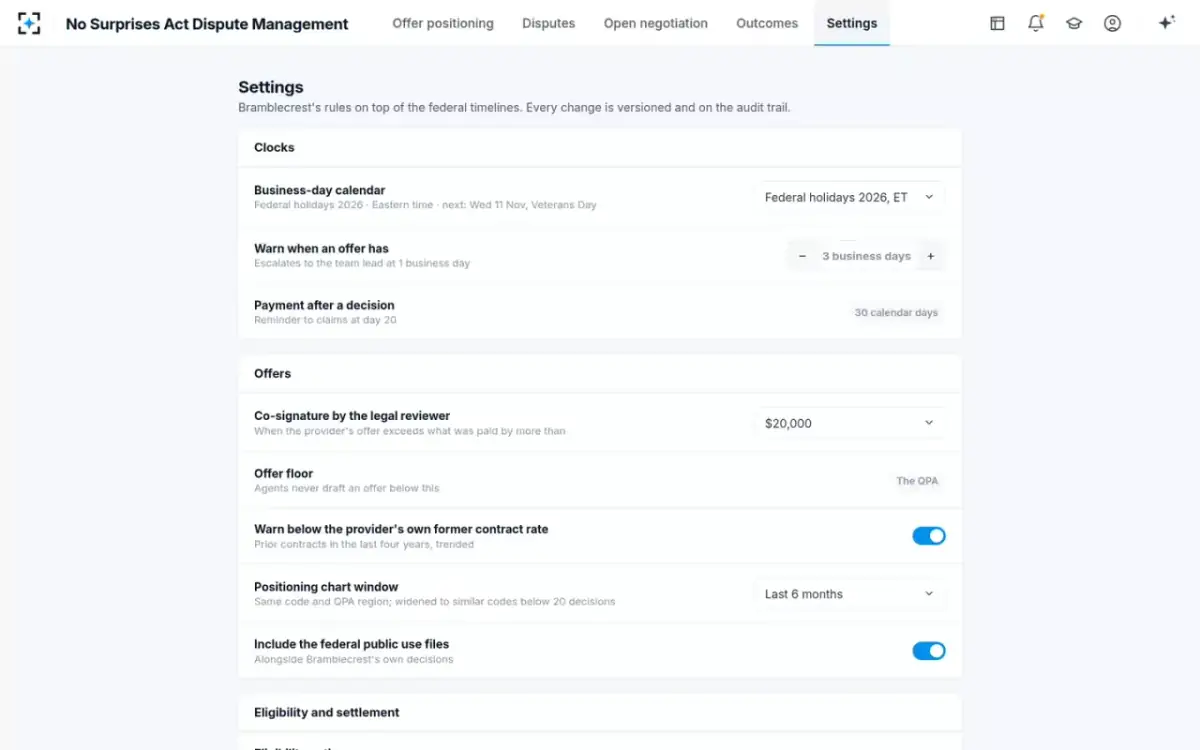
The plan's rules, set once on top of the federal timelines
What data does IDR software need?
Seven feeds, most of them read-only, and all of them things a plan already holds. The software should read claims, never re-adjudicate them, and take the plan's funding type and opt-in elections from the plan's own files rather than from the provider's notice, because the notice may be wrong and the federal web forms now ask the non-initiating plan to confirm or correct the plan type.
The data IDR software needs from a health plan, and why each matters
| Feed | What it supplies | Why the dispute needs it |
|---|---|---|
| Federal IDR notices | Initiation notices, arbiter selection, requests, determinations | Every clock starts here; the Gateway replaces single-use web forms from 13 November 2026. |
| Open negotiation notices | The provider’s offer and the date sent | The 30 business days run from the day the notice is first sent. |
| Claims and remittances | Claim number, member, date of service, code, modifiers, payment | Matching every disputed line, and proving dates for timing objections. |
| QPA calculations and disclosures | The QPA for each line and what the plan disclosed with the payment | The offer must be stated as a percentage of the QPA; the disclosure is evidence. |
| Eligibility and plan files | Funding type, product, ERISA status, state-law opt-ins | State-law and plan-type objections; self-insured plans must say whether they opted in. |
| Contracts and fee schedules | Prior contracts with the provider, comparable in-network rates | Contracted rates in the previous 4 plan years are a factor the arbiter must consider. |
| Determinations | The plan’s own decisions and CMS’s public use files | Where arbiters have landed by code, region, provider and, since the 2025 Q3–Q4 files, entity. |
How long does it take to implement IDR software?
About ten weeks is a realistic plan for a first production release, if the plan stages it so that each stage pays for itself before the next begins. The ten weeks are not a vendor promise; they are what the work requires once feeds are open, and a plan that cannot get read access to claims and contracts in the first fortnight will take longer.
Weeks one and two put every notice and every deadline in one queue, working on live disputes, with analysts still doing everything else by hand. That stage alone attacks defaults, the largest avoidable loss. Weeks three and four match each disputed line to its claim and remittance and confirm the funding type. Weeks five and six turn on the eligibility tests, with the legal reviewer reading every drafted reason. Weeks seven and eight add the rate evidence and the drafted explanations. Weeks nine and ten bring offer positioning against past determinations, with analysts setting and signing every number.
Who does what during an IDR software go-live, and after it
Today
Sponsors the project, sets the co-signature threshold and settlement authority, and picks the first measures.
With agents
Reads defaults, early submissions, objections filed and award multiples by provider every week.
Still theirs: The plan’s rules and their changes.
Today
Works live notices beside the software for four weeks, correcting every match and every reason it drafts.
With agents
Opens cases already matched, checked and drafted; sets and signs the offer.
Still theirs: The number and the signature.
Today
Writes down the plan’s state-law positions and opt-in elections the checker will apply.
With agents
Co-signs objections and large offers, each statement pointing to its document.
Still theirs: Every legal judgement.
Today
Opens read-only feeds of claims, remittances, QPA disclosures, eligibility and contracts.
With agents
Releases award payments with the determination attached; maintains the feeds.
Still theirs: The claims and contract systems, and every payment.
Does IDR software connect to the federal IDR portal?
Ask precisely what "connect" means, because the federal side is changing. CMS's notices describe web forms, dashboards and reports inside the new IDR Gateway: from 13 November 2026, organisations with Gateway accounts can submit the notice of IDR initiation, the initiation response, the notice of arbiter selection and the notice of offer there, and view reports on their disputes (CMS, 14 October 2026). The notices do not describe a system-to-system interface. Organisations that process disputes for a party must sign up for the Gateway, and the old web forms end on 15 January 2027, except the resubmission form.
So for most plans in late 2026, software prepares the offer and its attachments and a person enters or uploads them in the Gateway. That is also where a named person should be in any case: No Surprises Act Dispute Management never submits to the portal, by design.
What is the first thing to automate in IDR?
Notice intake and the deadline queue. They are the cheapest stage, they need only the notices and a holiday calendar, and they attack the only loss that needs no argument. In the sample plan in the solution, the queue held 412 open disputes and open negotiation notices, with 61 offers due in the next ten business days; a strip across the top counts deadlines per day, with the federal holiday struck out.
After deadlines, automate the line tests. Eligibility challenges are routine, 42% of initiated disputes in the second half of 2025, and the batching rules change for disputes whose open negotiation begins on or after 1 November 2026: a 50-line cap and a 30-business-day cooling-off period after a batched determination (CMS, 3 August 2026). The IDR batching rules set out the new tests in full.
Which measures show IDR software is working?
Four, each with a national baseline a plan can compare against. Missed offers and fees should fall to none, which is the solution's design target rather than a result. Defaults are the national comparison: 17% of determinations in late 2025. Objections should be filed on time and upheld at a known rate. And the award multiple, the selected offer as a multiple of the QPA by code and provider, shows whether positioning is working.
The first measures to watch after go-live
0
offers or fees missed
design target, not a result
17%
of determinations were defaults, Jul–Dec 2025
the national baseline
42%
of disputes had eligibility challenged, Jul–Dec 2025
87%
of prevailing offers were above the QPA, Jul–Dec 2025
How to judge IDR software in a demonstration
Bring a real batch and three questions. First, ask the software to show the business-day arithmetic for one line, with the holiday calendar it used. Second, ask it to explain why one line is out, and open the document behind the reason. Third, move the offer and watch what changes: the drafted explanation should change with it, and every statement should still point to an attached exhibit.
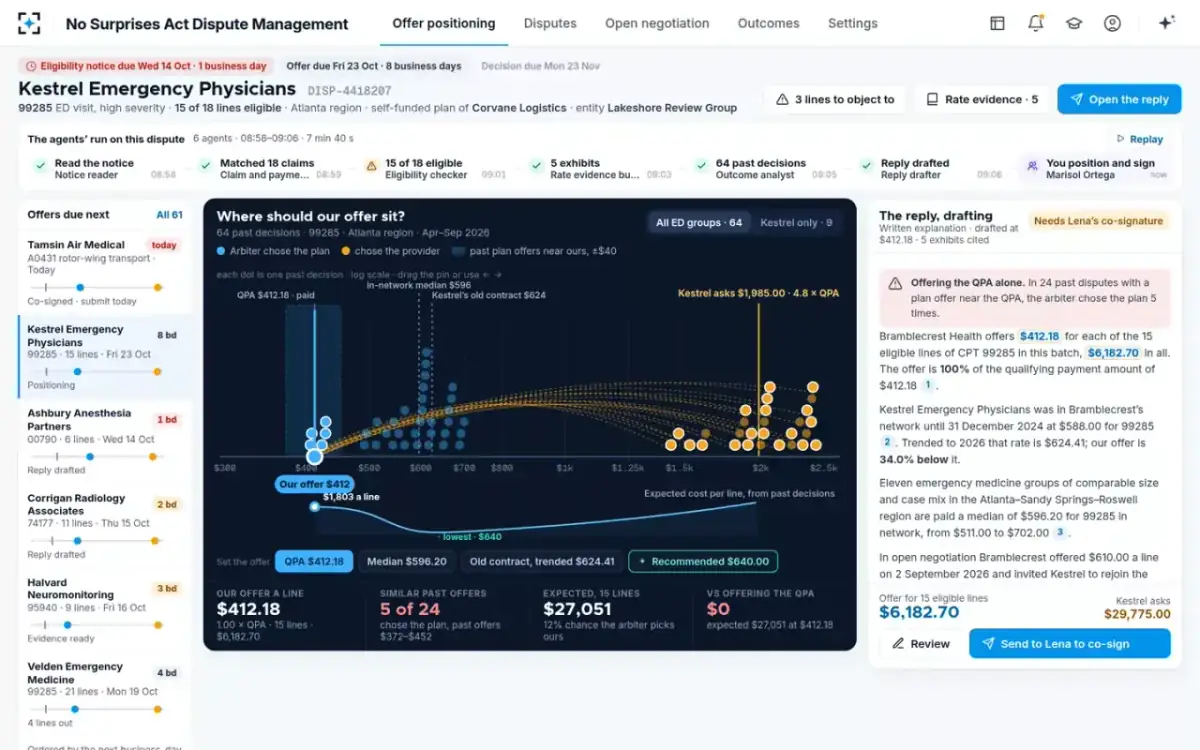
In the sample case in the solution, an analyst at Bramblecrest Health, a fictional plan, tried the reflex first: an offer at the QPA of $412.18 a line on 15 lines of high-severity emergency visits. The chart placed that offer beside past determinations for the same code and region, where the plan had been chosen in 5 of 24 similar disputes, and the drafted reply warned that it was offering the QPA alone.
An offer at the QPA, placed beside every similar past decision
Where the solution does not fit matters too. It is not a claims system and does not re-adjudicate claims; it does not replace the plan's lawyers; and it does not send anything to an arbiter or the federal portal on its own. The first job of a pilot is connecting it to the plan's own claims, remittance, contract and eligibility data. For the rule changes a buyer should test against, see the federal IDR operations rule, change by change.
Questions people ask
Is IDR software only for large plans?
No, but the case for it grows with volume. Disputes initiated each month rose from 248,452 in January 2026 to 390,602 in September, CMS reports; a plan that sees a handful a month may manage with a disciplined calendar, while one that sees hundreds a week cannot.
Can IDR software submit offers automatically?
It should not. The offer binds the plan and the determination is not open to judicial review except on narrow grounds, so a named person should set, sign and submit it; No Surprises Act Dispute Management drafts and never submits.
Does IDR software need the federal public use files?
It should use them. CMS publishes every payment determination quarterly, including offers and, from the 2025 third- and fourth-quarter files released on 22 July 2026, the entity that decided each line, which lets a plan see how offers for a code and region have fared beyond its own disputes.
What changes for IDR software on 1 November 2026?
Batched disputes whose open negotiation starts on or after that date are capped at 50 lines and trigger a 30-business-day cooling-off period after a determination, instead of 90 calendar days. Single and bundled disputes keep the 90-day period, so software has to apply the right rule by dispute type and open negotiation date.
What is the IDR Gateway?
CMS's new platform for the federal process, replacing single-use web forms: accounts opened on 15 September 2026, web forms for initiation, response, entity selection and offers arrive on 13 November 2026, and web forms outside the Gateway end on 15 January 2027, except the resubmission form.